Tank Baffle Engineering for Sloshing and Wave Damping in Transport Applications: Free-Surface Resonance Math, Baffle Geometry Selection, the 80 Percent Fill Rule, and DOT Stability Compliance for Polyethylene Mobile Service Tanks
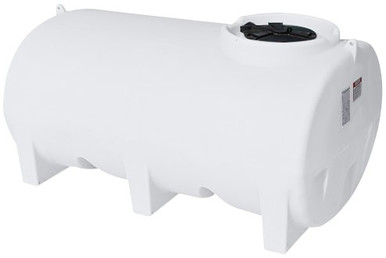
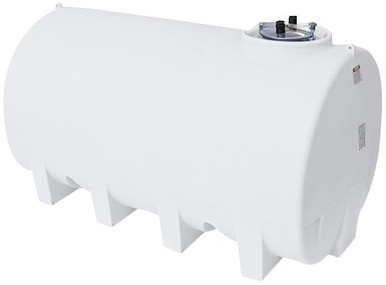
A 1,025-gallon horizontal leg tank on a pickup-bed mounting platform travels down a county road carrying 800 gallons of liquid fertilizer. The truck takes a moderate curve at 45 mph and the driver feels the steering pull harder than the truck's suspension would predict. What the driver felt is the liquid load shifting inside the tank — a slosh wave traveling forward and to the outside of the curve, momentarily concentrating the load away from the truck's center of gravity. On a curve closer to the limit, that same slosh wave can roll the truck. Tank baffles — internal partitions that interrupt liquid motion — are the engineering solution. This article walks the slosh dynamics that baffles address, the baffle geometry options that interrupt different slosh modes, the 80-percent-fill operational rule that limits slosh in unbaffled tanks, and the DOT regulatory framework that distinguishes baffled from unbaffled cargo tanks.
The references cited are 49 CFR 178 Subparts L and N (specifications for cargo tank motor vehicles), 49 CFR 173.5 (agricultural exceptions for shipping), DOT and FMCSA guidance on cargo tank stability, ASME Section VIII Division 1 (where applicable to pressure-rated cargo tanks), and the manufacturer's installation instructions for tanks intended for transport service. The intent is the field-operations decision for non-pressurized polyethylene transport tanks, not the full DOT 406/407 cargo-tank-truck specification treatment.
1. The Slosh Dynamics That Baffles Address
Liquid in a partially filled tank has a free surface that responds to acceleration. When the vehicle accelerates, brakes, or turns, the liquid wave propagates across the tank in the direction opposite the acceleration vector. The wave dynamics:
- Slosh frequency. The natural slosh frequency depends on tank geometry and fill level. For a horizontal cylindrical tank of length L and fill depth h, the lowest sloshing mode has a frequency of roughly 0.5/sqrt(L) Hz at typical highway-vehicle dimensions. A 12-foot-long tank has lowest slosh frequency around 0.14 Hz, period of about 7 seconds — close to the natural frequency of vehicle steering inputs and load shifts.
- Wave amplitude vs acceleration. A 0.2-g lateral acceleration (a moderate freeway curve) generates a slosh wave with amplitude of roughly 8-15 percent of the tank's transverse dimension. In a 5-foot-wide horizontal tank, this is a 5-9 inch peak-to-peak surface wave traveling across the tank.
- Resonance amplification. When the vehicle's input frequency matches the tank's natural slosh frequency, wave amplitude builds dramatically. A series of moderate sway inputs can build a slosh wave several times larger than a single input would produce.
- Center-of-gravity shift. The slosh wave moves liquid mass laterally, shifting the cargo center of gravity. For a 1,000-gallon tank carrying 800 gallons (6,800 pounds of liquid), a 12-percent slosh amplitude shifts roughly 800 pounds of cargo by 1.5 feet — a 1,200 foot-pound moment that the vehicle's chassis must accommodate.
- Phase relative to vehicle motion. The slosh wave is delayed relative to the vehicle input by 90 degrees of phase. The peak liquid offset occurs as the vehicle is recovering from the input, just when the chassis is most vulnerable to additional moment.
The combination — significant lateral mass shift, occurring out of phase with vehicle dynamics, potentially amplified by resonance — is the engineering reason transport tanks need baffles for any service that involves road operation at highway speed.
2. Baffle Geometry Options
Baffles are internal partitions that subdivide the tank's free surface area, interrupting wave propagation. The standard geometric options:
- Full transverse bulkhead. A solid wall extending floor to ceiling, dividing the tank into separate compartments. Full bulkheads completely interrupt slosh between compartments at the cost of complicating fill, drain, and venting. Used in DOT 406/407 cargo tanks and in some specialty service tanks.
- Partial transverse baffle. A vertical plate that extends partway across the tank cross-section, leaving a gap at the bottom (for liquid flow) and at the top (for vapor and pressure equalization). The standard configuration in non-pressurized transport tanks.
- Perforated transverse baffle. A vertical plate with through-holes that allow liquid passage but resist wave propagation. The hole pattern is engineered to maximize wave damping while permitting fluid flow during fill and drain.
- Longitudinal baffle. A vertical plate running along the tank's long axis, dividing the tank laterally rather than longitudinally. Reduces lateral slosh effectively but does not address fore-and-aft slosh.
- Surge plates. Floating or suspended plates that ride at the liquid surface, increasing the effective viscous damping of slosh waves. Used in specialty applications.
For polyethylene transport tanks, partial transverse baffles and perforated transverse baffles are the standard. Full transverse bulkheads are used in larger DOT-spec cargo tanks but are mechanically complex to incorporate into a rotomolded tank shell. Perforated baffles are popular because they damp slosh while allowing complete drainage from a single bottom outlet.
3. Baffle Spacing Per the DOT Cargo Tank Specifications
49 CFR 178.345-7 (specifications for DOT 406, 407, and 412 cargo tanks) sets baffle spacing requirements. While polyethylene transport tanks are typically not built to DOT 406/407 specs (those are for hazardous-material highway tankers built to ASME pressure-vessel codes in steel or aluminum), the spacing principle is widely applied:
- Maximum compartment length: 60 inches (5 feet) for hazardous-material service in DOT-spec cargo tanks. Polyethylene tanks for non-hazmat service may use longer spacing but the 5-foot rule is a defensible engineering baseline.
- Minimum baffle area: 80 percent of the tank cross-section. The remaining 20 percent allows liquid passage and pressure equalization.
- Symmetric placement. Baffles equally spaced along the tank length, with no compartment significantly larger than another.
For a 12-foot-long horizontal leg tank, the DOT-spec baffle layout would be at least two baffles, dividing the tank into three roughly 4-foot compartments. For a 6-foot tank, one center baffle is sufficient. The number of baffles increases with tank length; a 24-foot tank may have 4 or 5 baffles.
4. The 80-Percent Fill Rule for Unbaffled or Lightly Baffled Tanks
For tanks without engineered baffles, an alternative slosh-management strategy is the 80-percent-fill rule:
- Above 80 percent fill: liquid free surface is small relative to tank cross-section, slosh wave amplitude is geometrically constrained, and the dynamic effects are minimized. Operating at 80-100 percent fill is operationally safer for unbaffled tanks at the cost of reducing usable capacity.
- Below 20 percent fill: liquid mass is small, total slosh moment is correspondingly small even with large wave amplitude. Below 20 percent is also acceptable.
- Between 20 and 80 percent fill: the worst slosh dynamics regime. Liquid mass is significant and free surface is large, allowing high-amplitude slosh waves with large total mass shift. Unbaffled tanks operating in this range are operationally risky on highway service.
The 80-percent rule is the operational compensation for an unbaffled tank. It is widely practiced in agricultural service where mobile fertilizer applicators may be filled to 90+ percent at the supply yard for highway transit, then drawn down only after reaching the field where speeds and turn radii are lower. It is an operational discipline, not a regulatory requirement, but it is the basis for the practical use of unbaffled poly tanks in transport service.
5. Baffle Material and Construction in Polyethylene Tanks
Baffles in polyethylene transport tanks are typically rotomolded as part of the tank shell rather than added as separate components. The construction details:
- Integral rotomolded baffle. The baffle is part of the tank's mold and is created during the rotational molding process. The baffle is the same polyethylene material as the tank shell, with full bonding at the perimeter where the baffle meets the shell. No mechanical fastening, no leak paths.
- Baffle thickness. Typical 0.5-1.0 inch wall thickness, similar to the tank shell at the same location. Thicker than necessary for slosh-load resistance but matched to the rotomolding process capabilities.
- Baffle perforation pattern. If perforated, the holes are designed into the mold and created during the rotational process. Hole diameter typically 4-8 inches; pattern designed for damping efficiency.
- Drain integration. Baffle bottom geometry must allow complete drainage of all compartments to the tank's single outlet. Either the baffle terminates 2-4 inches above the tank floor (allowing liquid passage under the baffle) or the baffle extends to the floor with through-flow openings.
Aftermarket field-installed baffles in rotomolded polyethylene tanks are not standard practice. The integral molded baffle is the design baseline, and installations that need baffling must specify a baffled tank from the manufacturer rather than retrofit one.
6. Tank Selection for Transport Service
The 5-brand polyethylene catalog includes tanks specifically rated for transport service, with manufacturer-published baffle specifications:
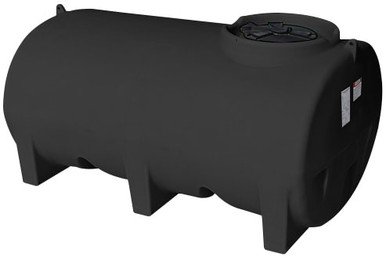
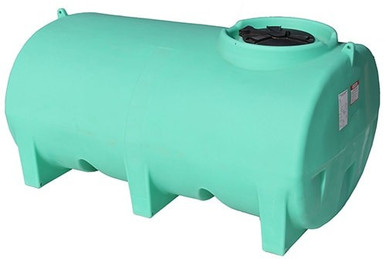
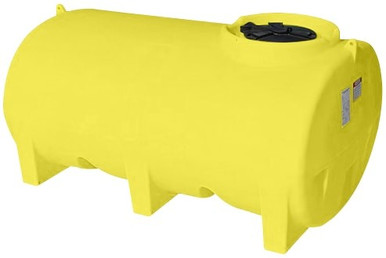
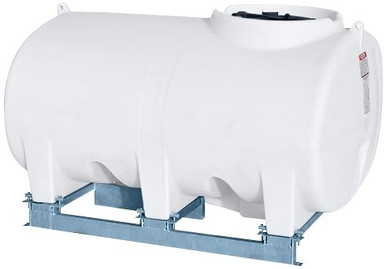
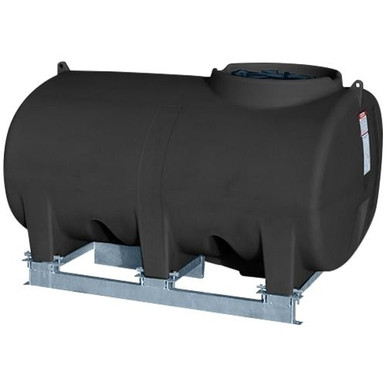
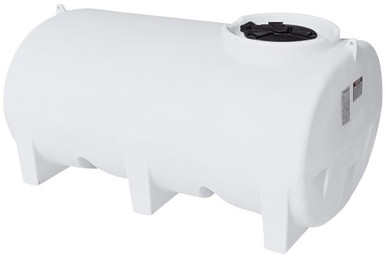
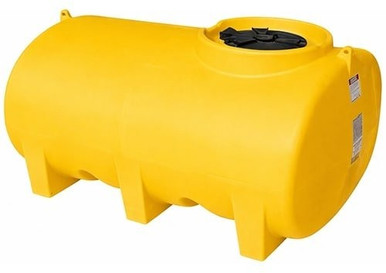
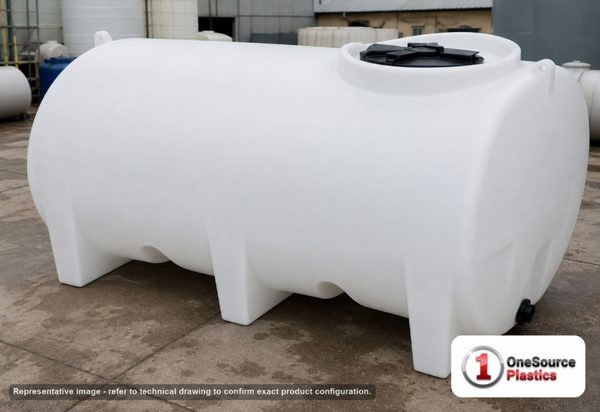
- Norwesco horizontal leg tank, agricultural applicator service: the standard configuration for chassis-mounted or trailer-mounted fertilizer and crop-input applicators. Reference N-40090 1,025 gallon horizontal leg tank; the manufacturer's leg-tank product line includes both baffled and unbaffled variants — buyer specifies based on planned road service. The 49 CFR 173.5 agricultural exception allows on-road transport for ag-input service with simplified DOT compliance.
- Norwesco doorway and small mobile tanks: the smaller transport tanks where the 80-percent fill rule makes baffling less critical. Reference N-44800 100 gallon doorway tank; at this size the slosh moment is small and unbaffled service is operationally acceptable.
- Norwesco vertical bulk for stationary-site service: when the tank stays at a fixed location and road transport is only the delivery event. Reference N-40164 5,000 gallon and N-43128 10,000 gallon; these tanks are not for transport service after installation, and the delivery truck's professional driver manages the slosh dynamics during the one-time delivery.
- Snyder Captor double-wall: stationary service with secondary containment. Reference SII-5990102N42 1,000 gallon; not transport-service rated, but the install delivery requires the same lift planning as other large tanks.
The transport service distinction is important. A tank rated for stationary service is not necessarily structurally capable of repeated road use; cyclic vibration, varying acceleration loads, and slosh dynamics put loads on the tank shell that stationary service does not. Manufacturer guidance on transport-service rating is the first specification check before configuring a tank for mobile use.
7. DOT Agricultural Exception (49 CFR 173.5)
The 49 CFR 173.5 agricultural exception permits on-road transport of certain agricultural materials in non-DOT-spec containers under defined conditions:
- Eligible commodities: liquid fertilizers, agricultural chemicals, irrigation water, and some other agricultural inputs. Hazardous materials in regulated quantity must still meet DOT cargo-tank specifications.
- Operating distance limit: typically within 150 air miles of the farm or originating point, though specific exceptions apply.
- Operator qualification: the driver may be a farm employee or contractor; CDL requirements apply per usual FMCSA rules.
- Container requirements: the tank need not be DOT 406/407 spec but must be in good condition and properly secured to the vehicle. Baffling is recommended but not always required by the exception.
- Marking and placarding: dependent on the specific commodity and quantity. Some commodities require marking even under the agricultural exception.
The agricultural exception is the regulatory framework that supports mobile fertilizer applicators, NRT (non-roadable trailer) leg tanks for short-haul ag service, and similar polyethylene transport tank configurations. Buyers operating outside the exception (commercial chemical hauling, hazmat service, longer-distance transport) need a different tank specification — typically a DOT 406 or 407 spec cargo tank in steel or aluminum.
8. Stability Calculation for Mobile Tank Service
Beyond slosh, the transport-tank installation must consider overall vehicle stability with the tank loaded. The math:
- Center-of-gravity height. The tank's vertical center of gravity (vehicle frame plus tank plus liquid load) must be calculated. A 1,000-gallon tank centered at 5 feet above ground level shifts a 4,000-pound vehicle's center of gravity upward significantly.
- Static stability factor. The ratio of vehicle track width to twice the center-of-gravity height. SSF below 1.0 is rollover-vulnerable; SSF above 1.5 is stable. A vehicle with 6-foot track width and tank-loaded center of gravity at 4 feet has SSF of 0.75 — rollover risk in maneuvers.
- Dynamic stability with slosh. The slosh-induced lateral mass shift adds to the static stability calculation. A vehicle with marginal SSF and significant slosh amplitude can roll over in maneuvers that a tank-truck with full-bulkhead baffles would handle.
- Vehicle gross weight rating. The full-loaded tank weight plus vehicle plus driver must not exceed the vehicle's GVWR. A 1,025-gallon tank at full water capacity (8,540 pounds) plus tank weight (300-500 pounds) is over 9,000 pounds — many pickup trucks cannot legally carry this load.
The stability calculation is the responsibility of the vehicle operator, not the tank manufacturer. The tank specification feeds into the calculation but does not determine its outcome.
9. Field Operations Discipline for Transport Tanks
The transport-tank operational discipline includes:
- Fill-level management. Operators trained on the 80-percent rule for unbaffled tanks, the safe fill ranges for partially baffled tanks, and the slosh-amplitude expectations for the specific tank-and-vehicle combination.
- Speed reduction in turns. Slosh wave amplitude is roughly proportional to lateral acceleration squared. Reducing turn-entry speed by 25 percent cuts slosh amplitude by nearly half. Standard practice for tank-truck operators is to enter turns 10-15 mph below posted limits.
- Smooth steering inputs. Abrupt steering corrections excite the slosh modes; smooth, gradual inputs minimize wave amplitude. Driver training emphasizes this.
- Pre-trip inspection. Tank fill level, mounting hardware, vent integrity, fittings sealed. The pre-trip catches conditions that might worsen slosh effects (an air leak that allows surge, a loose fitting that drips).
- Route planning. Hilly or curvy routes require additional caution; unbaffled tanks may require route variants that minimize lateral acceleration events.
The combination of tank specification (baffled vs unbaffled), operational rule (80-percent fill), and driver discipline (smooth inputs, reduced speed) is the engineering system that makes polyethylene transport tanks safe in highway service. No single element is sufficient; all three operate together.
10. The Specification Decision
The specification decision for a transport-service tank:
- Short-haul, low-speed, ag-exception service: unbaffled or single-baffle polyethylene tank with 80-percent fill rule. Cost-effective and operationally proven for typical farm-to-field movement.
- Highway-speed mobile service, multiple tanks per route: multi-baffle polyethylene tank with manufacturer-specified slosh damping. Higher tank cost but lower operational risk.
- Hazardous-material commercial service: DOT 406/407 spec cargo tank, not polyethylene. The polyethylene specification does not meet DOT pressure-vessel and crash-resistance requirements for regulated hazmat.
- Stationary-site bulk service with delivery only: standard vertical or horizontal polyethylene tank, slosh management handled by the delivery driver during the one-time transport event.
OneSource Plastics ships polyethylene transport and stationary tanks across all 5 brands with manufacturer-published baffle specifications and transport-service ratings. Our engineering team supports tank selection for mobile applications including 49 CFR 173.5 agricultural exception qualification, vehicle stability factor analysis, and baffle-configuration selection for the route and service profile. List pricing by SKU is published on each product page; LTL freight to your ZIP is quoted separately via the freight estimator or by phone at 866-418-1777. For related transport content see applicator and leg tanks DOT NRT scope and portable utility tanks 49 CFR 173.5 ag exemption.
Recommended Tanks for This Guide
Live pricing, updated automatically · estimate freight to your ZIP.