Tank Chemical Service Conversion: HDPE-to-XLPE Migration Decision Guide
The fastest way to bleed money in industrial chemistry storage is to keep replacing HDPE tanks every 2-4 years on aggressive service that XLPE would handle for 8-15 years. The fastest way to overspend is to upgrade to XLPE on benign service that HDPE would handle for 20+ years. Most operators do one or the other; few make the migration decision on actual numbers. This guide turns the HDPE-to-XLPE conversion question into a numbers-driven calculation backed by ASTM D1998 design hoop stress, ASTM D1693 environmental stress crack resistance (ESCR), specific-gravity rating envelopes, and 20-year total cost of ownership across both materials.
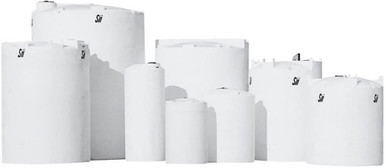
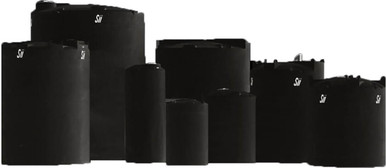
OneSource carries both HDPE and XLPE rotomolded tanks across all five major North American manufacturers — Norwesco, Snyder Industries, Chem-Tainer, Enduraplas, and Bushman. Both are useful. Both have a place. The conversion question is when to pay the 30-60% premium for XLPE because the chemistry, specific gravity, or temperature envelope says HDPE will not last. The numbers below are the ones we use internally to make the call.
The Material Difference (Quick Recap)
HDPE (high-density polyethylene) is rotomolded from linear high-density polyethylene resin pellets. The polymer chains are linear and not chemically bonded to each other; they slide past each other under stress, which is why HDPE is repairable by hot-plate fusion and recyclable through PE2 streams. ASTM D1998 Section 6.4.1 sets the design hoop stress at 600 psi at 73F. Maximum specific gravity rating is typically 1.5 (1.7 SG on heavy-wall variants). Maximum continuous service temperature 100-120F.
XLPE (cross-linked polyethylene) is rotomolded with a peroxide-initiated or thermal cross-linking agent that chemically bonds the polymer chains in a three-dimensional network during the cure cycle. The cross-link prevents chains from sliding past each other, which is why XLPE handles higher SG (1.9 standard, some 2.0), higher temperatures (140F continuous), and effectively unlimited ESCR per ASTM D1693 standard test conditions. The trade-off: cross-linked material cannot be re-melted, so XLPE is not recyclable through PE2 streams and is repairable only by mechanical fasteners or epoxy patch.
The Six Migration Triggers
Migrate from HDPE to XLPE when any of the following apply. The triggers are independent; one is enough.
Trigger 1: Stored medium specific gravity exceeds 1.5
HDPE design envelope per ASTM D1998 caps at 1.5 SG (1.7 SG on heavy-wall variants). Above 1.5 SG, the hoop-stress math at 600 psi at 73F starts pushing past the resin's allowable creep envelope. The tank may not fail in week one, but the fatigue accumulation over years cuts service life dramatically.
Common stored media above 1.5 SG:
- Concentrated sulfuric acid 93% — SG 1.84.
- Ferric chloride 38-42% — SG 1.40-1.44 (close to limit).
- Aluminum sulfate (alum) 49% — SG 1.32.
- Calcium chloride brine 38% — SG 1.39.
- Sodium hydroxide 50% — SG 1.53 (just over).
- Potassium hydroxide 45% — SG 1.46.
- Phosphoric acid 75% — SG 1.58.
For media with SG between 1.4 and 1.5, HDPE heavy-wall (1.7 SG rated) is acceptable. For media with SG above 1.5, XLPE is the correct answer.
Trigger 2: Continuous operating temperature exceeds 100F
HDPE design hoop stress derates with temperature. At 100F the allowable hoop stress is roughly 530 psi (88% of 73F baseline). At 120F it falls to 425 psi (71%). At 140F HDPE is effectively done; tank shell creep accelerates and most manufacturers void warranty.
XLPE retains useful hoop stress to 140F continuous and 160F intermittent. For applications with summer ambient excursions to 110-130F, outdoor solar gain on dark tanks reaching surface temperatures of 130-150F, or process heating to 110-140F, XLPE is the correct answer.
Trigger 3: Aggressive oxidizer or chloride service driving HDPE ESCR failure
Environmental stress crack resistance (ESCR) per ASTM D1693 measures how long a stressed polyethylene specimen survives in a wetting agent under load. HDPE has finite ESCR (typically 100-1,000 hours under standard test conditions). XLPE is effectively unlimited under the same test (specimens routinely run 10,000+ hours without crack initiation).
The chemistries that drive ESCR failure on HDPE:
- Sodium hypochlorite 12.5% — typical HDPE service life 2-4 years; XLPE 8-15 years.
- Calcium hypochlorite saturated solutions — similar profile.
- Hydrogen peroxide 30-50% — HDPE acceptable but life 50-70% of XLPE.
- Sulfuric acid (low concentration where HDPE chemistry-rated) — life 60-70% of XLPE.
- Ferric chloride — HDPE 3-5 years; XLPE 8-12 years.
- Polyaluminum chloride (PAC) — similar to ferric profile.
- Long-chain alcohols, surfactants, detergents at elevated temperature — ESCR-driven on HDPE.
If your predecessor HDPE tank failed in under 5 years on any of the above, you have direct evidence the application is ESCR-limited. Migrate to XLPE.
Trigger 4: Replacement disruption cost exceeds tank cost
HDPE saves capital but costs replacement cycles. If the tank is in a production-critical location where replacement requires shutdown, crane access, repiping, or process restart, the replacement event cost may exceed the tank itself. XLPE that lasts 3x as long pays back even if the per-tank cost is 60% higher.
Worked example for a 1,500-gallon sodium hypochlorite feed tank, 20-year horizon:
- HDPE option: $1,200 capital × 5-7 replacements over 20 years (life 3-4 years) = $6,000-8,400 capital. Crane and rigging $500 per replacement = $2,500-3,500. Production downtime 4-8 hours per replacement at $400-1,200 per hour = $8,000-67,000+. Total: $16,500-79,000.
- XLPE option: $1,800 capital × 2-3 replacements over 20 years (life 7-10 years) = $3,600-5,400 capital. Rigging $1,000-1,500. Downtime $1,600-9,600. Total: $6,200-16,500.
- Migration savings: $10,000-60,000 over 20 years.
Trigger 5: Process spec stability requires constant chemistry strength
HDPE on aggressive chemistry develops surface degradation; the inner-wall biofilm or chemistry interaction creates "patches" that change discharge chemistry temporarily after agitation, sediment disturbance, or thermal cycling. For processes that require constant feed-stream concentration (water-treatment chlorination, semiconductor process chemistry, food-grade oxidizers), HDPE may pass the SG and ESCR tests but still be inappropriate because process control suffers.
XLPE's tighter chemical resistance reduces inner-wall interaction and gives more consistent feed-stream chemistry over years.
Trigger 6: Manufacturer specifies XLPE for the chemistry
Most major manufacturers publish chemical compatibility tables that explicitly call out XLPE-only for certain chemistries. Snyder Industries, Norwesco, and Chem-Tainer all maintain compatibility documentation. When the manufacturer says XLPE, the warranty depends on it. Do not save 30% on capital and lose the warranty.
Examples from manufacturer published guidance: Snyder MPN 5000000N48 (1,000 gallon XLPE heavy-duty cone bottom) and MPN 5280200N46 (6,000 gallon XLPE cone bottom) are specifically rated for the SG-1.9 / aggressive-chemistry envelope. Snyder MPN 1810000N30 (850 gallon HDPE vertical with sulfuric resin #880046) is the modified-polyolefin specialty case where neither standard HDPE nor XLPE is the answer — see our resin decision tree.
The Migration Decision Matrix
| Stored Medium | Concentration | SG | HDPE Life | XLPE Life | Migration? |
|---|---|---|---|---|---|
| Potable / domestic water | N/A | 1.0 | 20-25 yr | 20-25 yr | No |
| UAN-32 fertilizer | 32% | 1.32 | 15-20 yr | 15-25 yr | No (HDPE OK) |
| Calcium chloride brine | 38% | 1.39 | 10-15 yr | 15-25 yr | Borderline |
| Aluminum sulfate (alum) | 49% | 1.32 | 8-12 yr | 15-20 yr | Yes (long-life) |
| Sodium hypochlorite 12.5% | 12.5% | 1.18 | 2-4 yr | 8-15 yr | Yes (high-value) |
| Sodium hydroxide | 50% | 1.53 | 5-8 yr (heavy-wall) | 15-20 yr | Yes (SG-driven) |
| Ferric chloride | 40% | 1.42 | 3-5 yr | 8-12 yr | Yes |
| Sulfuric acid 93% | 93% | 1.84 | N/A (specialty resin only) | 10-20 yr (XLPE 1.9 SG) | Yes (HDPE excluded) |
| Hydrogen peroxide 35% | 35% | 1.13 | 5-8 yr | 10-15 yr | Yes |
| Phosphoric acid 75% | 75% | 1.58 | N/A (SG over 1.5) | 10-15 yr | Yes (HDPE excluded) |
| Diesel fuel (ground tank) | N/A | 0.85 | 15-25 yr | 15-25 yr | No |
| DEF (urea 32.5%) | 32.5% | 1.09 | 15-20 yr | 15-20 yr | No (HDPE OK) |
| Polyaluminum chloride (PAC) | 10-12% Al2O3 | 1.30-1.40 | 3-5 yr | 8-12 yr | Yes |
Worked TCO Examples
Example 1: 1,500-Gallon Sodium Hypochlorite Day Tank, 20-Year Horizon
- Application: water-treatment plant chlorination feed.
- HDPE option: $1,200 capital × 5 replacements (life 4 years) = $6,000. Replacement labor + rigging $500 each = $2,500. Process downtime 6 hours per replacement at $600/hr = $15,000. Disposal of degraded chemistry at each replacement $200 each = $1,000. Total: $24,500.
- XLPE option: $1,800 capital × 2 replacements (life 10 years) = $3,600. Rigging $1,500. Downtime $3,600. Disposal $300. Total: $9,000.
- Migration savings: $15,500 over 20 years on a single tank.
Example 2: 850-Gallon Sulfuric Acid Storage
- Snyder MPN 1810000N30 (850 gal HDPE w/ sulfuric resin #880046): $3,200 list, life 8-10 years.
- XLPE alternative (specify SG-1.9 rated): comparable life on dilute sulfuric, 5-8 years on concentrated.
- For concentrated 93%+ sulfuric, neither standard HDPE nor XLPE is the right answer — manufacturer modified-polyolefin specialty resin (Snyder 880046 spec) is engineered for the specific SG and surface chemistry. Migration: stay with the modified-polyolefin specialty SKU.
Example 3: 6,000-Gallon Cone-Bottom Process Tank, Snyder MPN 7000000C37 vs MPN 5280200N46
- Snyder MPN 7000000C37 (6,000 gal HDPE vertical, $8,008 list): water and benign service.
- Snyder MPN 5280200N46 (6,000 gal XLPE cone bottom, $17,600 list): aggressive chemistry SG up to 1.9.
- For 50% sodium hydroxide (SG 1.53) at 90F process: HDPE option is excluded by SG. XLPE is the engineered answer at $17,600 vs an HDPE option that costs $1,000s less but fails warranty.
- For potable water storage at the same 6,000 gallon: HDPE at $8,008 is the right answer. XLPE wastes $9,600 of capital with no service benefit.
What Conversion Looks Like Operationally
The conversion is more than swapping the tank. It involves:
- Site survey and removal: the existing HDPE tank must be drained, decontaminated, and removed. Hazardous-chemistry residue may require RCRA-compliant disposal.
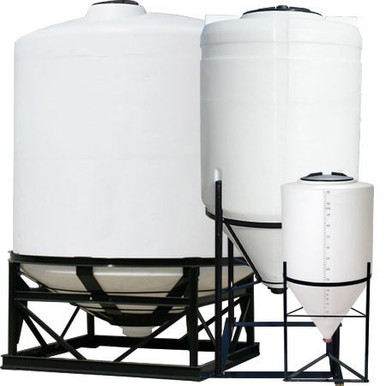
- Foundation review: if the new XLPE tank has different geometry (XLPE often comes in cone-bottom for chemistry service vs flat-bottom HDPE), foundation pad redesign may be required. Cone-bottom tanks need stands per ASTM D1998 Section 7 sand-pad-then-stand sequence.
- Piping refit: XLPE chemistry service typically uses Viton, FKM, or specialty-elastomer gaskets vs EPDM on HDPE water service. Bulkhead fittings may upgrade from standard duty (e.g., Norwesco MPN 63481) to heavy-duty (e.g., Norwesco MPN 63683 2-inch heavy-duty) or from PE/PVC to PP polypropylene (e.g., Norwesco MPN 34100053 4-inch PP threaded with EPDM, swap to Viton: e.g., MPN 34701346 3-inch PE with Viton or TF300V 3-inch poly with Viton).
- Documentation: if the predecessor was warranty-replaced for ESCR failure, retain failure documentation for the chemistry's ESCR archive. Communicate to the new manufacturer so the warranty terms accurately reflect the duty cycle.
- Commissioning: XLPE tanks need different cleaning and conditioning before first chemistry charge. Most manufacturers recommend a 24-72 hour fresh-water soak with discharge to confirm no manufacturing residue, then drain, then chemistry charge.
- Operator training: XLPE cannot be hot-plate fusion repaired in the field. Operators trained on HDPE repair must understand the difference; mechanical and epoxy patch are the only field-repair options on XLPE.
When NOT to Migrate
The HDPE-to-XLPE migration is wrong when:
- The application is water, DEF, fertilizer at SG below 1.4, or mild chemistry where HDPE life is already 15-25 years. Premium pays nothing back.
- The tank is replaced on a calendar (e.g., 5-year refresh program for compliance reasons) regardless of material. XLPE life advantage is nullified by the schedule.
- The site has hot-plate fusion repair as the primary maintenance method. XLPE cannot be repaired this way; switching forces a maintenance procedure change.
- The chemistry is on the polyethylene-incompatible list entirely (concentrated oxidizers above polyethylene's chemistry envelope, aromatic solvents, hot caustic above 140F). The migration target is FRP or stainless, not XLPE.
How OneSource Specs the Migration
For a chemistry-storage replacement procurement, we ask:
- What chemistry, concentration, and temperature?
- What was the predecessor material and how long did it last?
- What was the failure mode? Hoop stress / creep, ESCR cracking, surface chemistry attack, or fitting failure?
- What is the production-critical replacement disruption cost?
- What does the manufacturer chemistry compatibility table say for the candidate medium?
Answers to the five questions resolve into a stay-with-HDPE, migrate-to-XLPE, or specialty-resin recommendation in 90% of cases. The 10% edge cases route to Specialty & Metal Fabrication for FRP or stainless engineering.
Catalog reference SKUs cited above include Snyder MPN 1810000N30, 5000000N48, 5280200N46, 7000000C37; Norwesco MPN 63481, 63683, 62299, 34100053, 34700239, 34701346; and the bulkhead and gasket cross-references in our bulkhead style guide. Listed at BC catalog price; LTL freight quoted separately per ZIP via the Freight Estimator or 866-418-1777.
Internal Resources
- Polyethylene Resin Decision Tree
- Cross-Material Selection Guide
- Drain-Time Engineering
- Foundation Pad Engineering
- Bulkhead Fitting Style Guide
- Chemical Compatibility Database (309 chemicals)
- Specialty & Metal Fabrication
- Freight Cost Estimator
Source Citations
- ASTM D1998 — Standard Specification for Polyethylene Upright Storage Tanks (Section 6.4.1 design hoop stress; Section 7 foundation; Section 8 venting).
- ASTM D1693 — Standard Test Method for Environmental Stress-Cracking of Ethylene Plastics.
- ASTM D543 — Standard Practices for Evaluating the Resistance of Plastics to Chemical Reagents.
- ASTM D618 — Standard Practice for Conditioning Plastics for Testing.
- NSF/ANSI 61 — Drinking Water System Components: Health Effects.
- FDA 21 CFR 177.1520 — Olefin polymers (food-contact polyolefin).
- 40 CFR Part 261 — Identification and Listing of Hazardous Waste (RCRA Subtitle C).
- AWWA B300-22 — Hypochlorites.
- AWWA B403-21 — Aluminum Sulfate (Alum).
- AWWA B407-22 — Liquid Ferric Chloride.
- AWWA B501-21 — Sodium Hydroxide.
- OSHA 29 CFR 1910.146 — Permit-Required Confined Spaces.
- OneSource Plastics master catalog data, 2026-03-26 snapshot (9,419 products).
Recommended Tanks for This Guide
Live pricing, updated automatically · estimate freight to your ZIP.