Fifty-five hundred gallons of natural white, rated for dense product
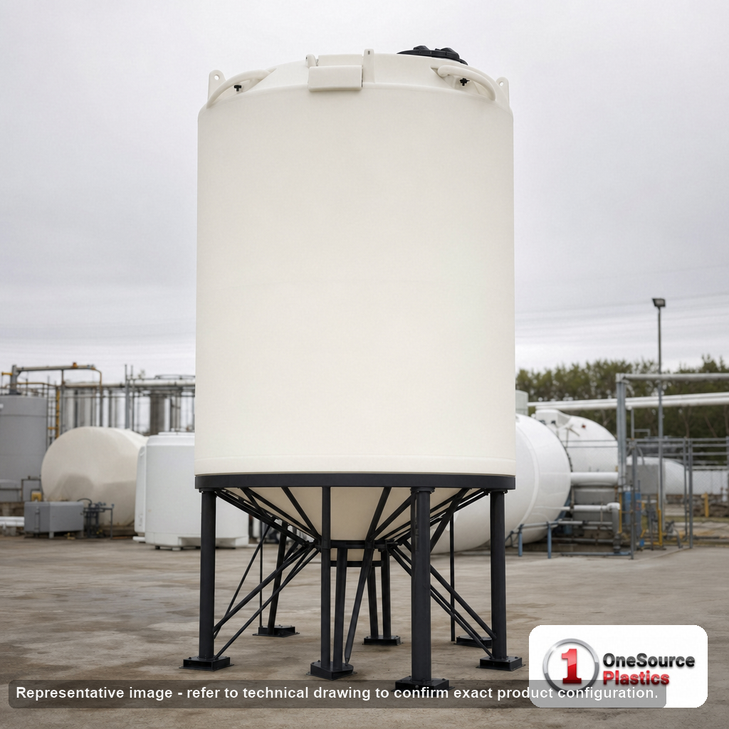
Twenty feet one inch of natural white shell over a cone is the shape of the Snyder 7040000N42. The sheet lists it at 5,500 gallons, 90 inches long, 90 inches wide and 241 inches tall, at 2,000 pounds empty and 2,000 pounds shipping, with the material field reading Crosslinked Linear Polyethylene and the colour given as Natural White. Heavy duty is the maker's own name word for this listing, and the sheet puts figures behind it rather than adjectives: the wall is rated at a specific gravity of 1.9 and the max contents figure is 87,153 pounds, against 45,870 pounds of water at 8.34 pounds per gallon. The opening on top is an 18 inch threaded vented manway, and the outlet field reads 1 Manway / Lid, which names an opening rather than a discharge. The service limit is 100 F / 37 C and the freight class reads 300. This sheet publishes no cone angle field, no structural lug or flange detail, no inlet, no separate lid size, no stand and no warranty term, and none of them is claimed here.
Engineer on the job? Request a written quote with the spec attached, or get freight to your ZIP and add to cart above; 866-418-1777 answers the technical questions.
The heavy duty white listing of the fifty-five hundred family
Three part numbers share this shell and all three are listed on this sheet. 7040000N40 and 7040000N46 are both 1,500 pounds empty. 7040000N48 is 2,000 pounds, the same weight as this tank. All of them hold 5,500 gallons on a 90 inch circle at 241 inches, so nothing about the footprint, the height or the pad changes when you move between them. What changes is the rating and the colour, and that is the whole of the decision. This listing is rated at a specific gravity of 1.9 with 87,153 pounds of max contents, which is the pair of figures for a product denser than water: concentrated solutions, heavy blends, liquids carrying solids in suspension. The two 1,500 pound listings carry their own lower rating and their own lower max contents figure on their own sheets, and if your product sits at or below water weight, one of those is the honest buy and the lighter shipment is a real saving on the freight ticket. The colour field is what separates this listing from 7040000N48, which is the same 2,000 pounds in black. Natural white is specified when the tank stands indoors and somebody wants to read the liquid line through the wall; black is the outdoor shell. The sheets give the two colours and explain nothing further, and no wall thickness, layer count or construction difference is printed behind the heavy duty name on any of them, so none is stated on this page. What no sheet in the family carries is a stand: no legs, no skirt, no support ring, no bolt pattern. A cone bottom tank has no flat floor and cannot stand on its own bottom, so the structure is a separate item with its own drawing and lead time, and no stand height, rated load or stand material appears here. Settle it with the cone bottom tank stand compatibility matrix and confirm the fit with us against this part number. Then the arithmetic: stand, plus 241 inches of shell, plus clearance above the manway, with separate room under the cone for whatever the discharge feeds, all measured down from the lowest fixed thing over the spot. Size the volume first with the tank sizing calculator and take the freeboard from the tank sizing guide.
Three of one shell, a shorter tank and a wider one
| Part | Gallons | Length x width x height | Empty weight |
|---|---|---|---|
| 7040000N42 (this tank, natural white, rated 1.9) | 5500 | 90 x 90 x 241 in | 2,000 lb |
| 7040000N48 (same weight, black) | 5500 | 90 x 90 x 241 in | 2,000 lb |
| 7040000N40 (lighter listing, natural white) | 5500 | 90 x 90 x 241 in | 1,500 lb |
| 7040000N46 (lighter listing, black) | 5500 | 90 x 90 x 241 in | 1,500 lb |
| 8050200C75501 (shorter, wider circle) | 5000 | 102 x 102 x 166 in | 1,300 lb |
| 5280200N40 (widest and squattest) | 6000 | 142 x 142 x 136 in | 1,100 lb |
The top four rows are one shell under four names and the bottom two rows are a ladder of shapes at roughly the same duty. Read them by height and the choice becomes obvious. This tank puts 5,500 gallons on a 90 inch circle, seven and a half feet of floor, by standing 241 inches tall. 8050200C75501 puts 5,000 gallons on a 102 inch circle at 166 inches and 1,300 pounds. 5280200N40 puts 6,000 gallons on a 142 inch circle at 136 inches and 1,100 pounds. Same broad capacity, three completely different buildings. If the ceiling is the constraint, work up that list from the bottom; if the floor is the constraint, work down it from the top. What you buy with the narrow column is a small circle to pave, to bund and to keep clear, which in a congested yard is often the only thing that matters. What it costs is height, and height has consequences that are easy to underrate: a working-at-height plan for every routine task on the roof, a more carefully drawn foundation because the load lands concentrated in a small circle, real wind exposure on an empty shell, and a greater tendency to stratify if the product will let it. Plan the draw point and the mixing arrangement together on a vessel this slender rather than one after the other. If the resin question is still open on your side, the honest comparison is here: crosslinked polyethylene against high density polyethylene for chemistry duty. And for the longer read on this capacity and shape, the complete buyer's guide at this capacity covers what a spec sheet cannot.
Height or floor the limit? The table has both shapes; freight to your ZIP is quoted on each row, or call 866-418-1777 with the site.
The manway and the vent on a twenty foot column
- The vent: it arrives with the access on this sheet, as part of an 18 inch threaded vented manway rather than as a separate item, and on a vessel this tall it is the fitting that protects the wall. A pump drawing from the bottom of twenty feet of full column pulls hard; if air cannot come in through the vent, the wall takes the load instead. Keep it clear, check it every time the tank is opened, and never blank or tape it.
- The manway: 18 inches, threaded, at 241 inches plus the stand. That is a working-at-height job in any building, so a platform or fixed ladder with a fall protection plan belongs in the same drawing as the structure, and the fill should land at a coupling at working level rather than at the top of the shell.
- The outlet field: it reads 1 Manway / Lid. That names an opening and not a discharge, and we print it exactly as it reads rather than turning it into a pipe size. No outlet dimension, no thread, no bulkhead and no valve is published or claimed. Give us the line size, the valve type and the product and we will confirm what this part number carries before it is ordered.
- The cone angle: this sheet publishes no cone angle field and the product name carries none, so none is stated here. We are not going to read an angle off a photograph or borrow one from a neighbouring listing. If drainage behaviour is what decides your purchase, ask and we will confirm the geometry against the part number.
- Structural detail: this sheet publishes none. No lug counts, no ladder lugs and no flange lines appear on it, so nothing of the kind is claimed here; agree the lifting arrangement with us rather than assuming a fitting exists.
- Blanks and ratings: no inlet, no separate lid size, no warranty term and no NMFC number are published. The ratings given are a specific gravity of 1.9, 45,870 pounds of water at 5,500 gallons, 87,153 pounds of max contents and a limit of 100 F / 37 C.
Where a vessel of this height stands over ground, a floor or a drain that would have to be recovered after a release, the containment question is separate from the tank question and deserves its own answer: the Captor containment comparison sets the contained polyethylene route against the alternatives before a bund is designed around the wrong footprint.
Concentrated product that has to leave through the low point
A 1.9 rated cone at 5,500 gallons on a small footprint goes to operations with a heavy product and no floor to spare. Concentrated mineral and salt solutions in a process building, spent acid and pickling liquor at a metals plant, heavy liquid fertiliser and crop input blends at an agricultural retailer, thickened sludge and dewatering feed at a treatment works, mineral and wash plant slurry, and batch make-up in chemical manufacturing where the vessel changes product and cannot afford to leave a heel behind. That last case is the reason people pay for a cone at all. On a flat bottomed tank every changeover leaves a layer, and at 45,870 pounds of water a layer is a real volume with a real disposal cost and a real contamination risk in the next batch. This vessel drains toward its low point instead, and what happens at that point is worth designing properly rather than bolting together on the day. The natural white shell earns its place indoors, where seeing the liquid line through the wall settles arguments an instrument can start, and the 87,153 pound max contents figure is what tells you whether your product belongs in this listing or in one of the lighter ones. Check the liquid in our chemical compatibility reference before the fittings are specified, because the chemistry chooses the gasket and the valve.
Which liquids, at what concentration, with which fitting
Each entry pairs a rated liquid with its concentration limit and the fitting and gasket to order alongside the tank. The full rating sits on the linked page and in the chemical compatibility database before ordering.
- Acetic Acid (60%) - PP/PVC fittings, EPDM gaskets
- Aluminum Sulfate (50%) - PVC fittings, EPDM gaskets
- Calcium Chloride (40%) - PVC fittings, EPDM gaskets
- DEF (32.5%) - 316SS fittings, EPDM gaskets
- Ethylene Glycol (100%) - PVC fittings, EPDM gaskets
- Ferric Chloride (50%) - PVC fittings, EPDM gaskets
- Ferric Sulfate (60%) - PVC fittings, EPDM gaskets
- Ferrous Sulfate (20%) - PVC fittings, EPDM gaskets
- Hydrofluosilicic Acid (26%) - PP/PVC fittings, Viton gaskets
- Magnesium Chloride (30%) - PVC fittings, EPDM gaskets
- Polyaluminum Chloride - PVC fittings, EPDM gaskets
- Potassium Carbonate (50%) - PVC fittings, EPDM gaskets
- Potassium Hydroxide (saturated) - PVC fittings, EPDM gaskets
- Propylene Glycol - PP/316SS fittings, EPDM gaskets
- Sodium Carbonate (30%) - PVC fittings, EPDM gaskets
- Sodium Thiosulfate (40%) - PVC fittings, EPDM gaskets
- Urea Solution (50%) - PP/PVC fittings, EPDM gaskets
Two thousand pounds, twenty feet on the trailer
Moulded at Lincoln, Nebraska, with Nebraska given as the origin state on the sheet, so the central lanes are short and both coasts are long hauls. The freight class reads 300, a numeric class rather than a mode, and the sheet publishes no NMFC number. The shipping size measures 90 inches by 90 inches by 241 inches at 2,000 pounds, so it is the length rather than the weight that governs the booking: twenty feet one inch of package riding on a trailer at a weight a forklift would laugh at. Price your own ZIP with the freight cost estimator; the listed price is before freight. It travels lying down and is stood up at your end, and standing twenty feet of tank is the single operation on this project most likely to go wrong, so give it a nominated machine, a nominated person and a clear circle of ground rather than a decision taken in the yard while the driver waits. The sheet publishes no crane, no rigging, no permit and no escort detail, and none is stated here; agree the offload arrangement and the window with us before the truck is booked. Have the stand set, levelled and anchored first, because a cone bottom tank with nowhere to stand is a tank lying in your yard occupying the space you needed. This sheet lists no lifting lugs, so lift under the body with slings and never by the manway, and keep the tank restrained from the moment it is upright, because an empty shell this tall takes wind well before anyone expects it to. Then prove the installation with clean water rather than product: hold the 45,870 pound load, read the manway seal, the cone joint, the stand feet and the pad edge in daylight, and leave it standing full overnight. Check the anchor bolts and the strap tension again a week later; ground settles under a new load, and the fixing that was tight on day one is the one that is loose on day eight. The vent screen is the cheapest part on the tank and the one that saves it; look at it every time the manway opens.
Freight and documents
Ships from: Lincoln, NE. LTL freight is quoted to your ZIP with the freight cost estimator or by phone at 866-418-1777. The listed price is before freight.
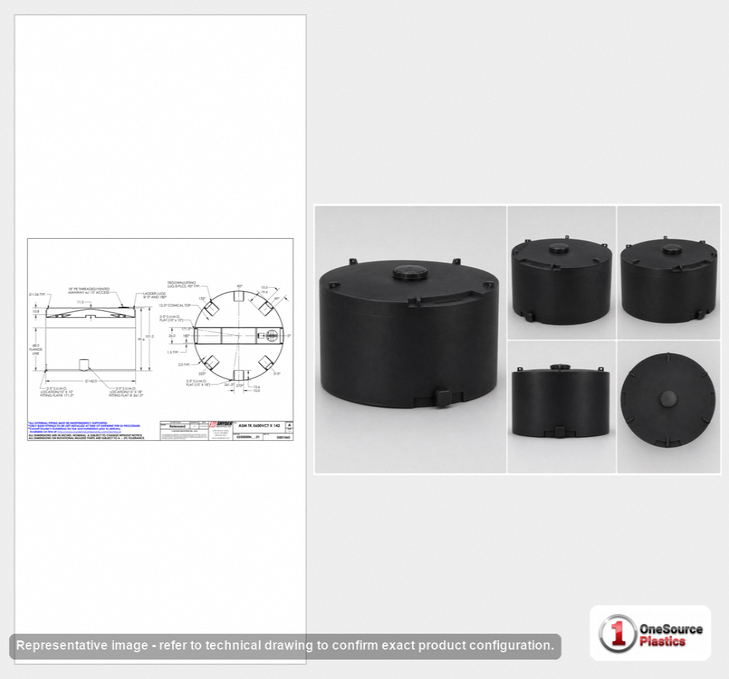
Technical drawing (PDF) for Snyder Industries 7040000N42.
See this tank
Interactive 3D model with live fill. This tank has an interactive 3D model built to its manufacturer dimensions. Rotate it, and set a fill level to see how much liquid it holds at any height. Open the 3D view on the product photo above. Download the 3D model (GLB).
Ready to order?
Add it to your cart at the top of this page, get LTL freight to your ZIP, request a written quote, or call 866-418-1777. The listed price is before freight.