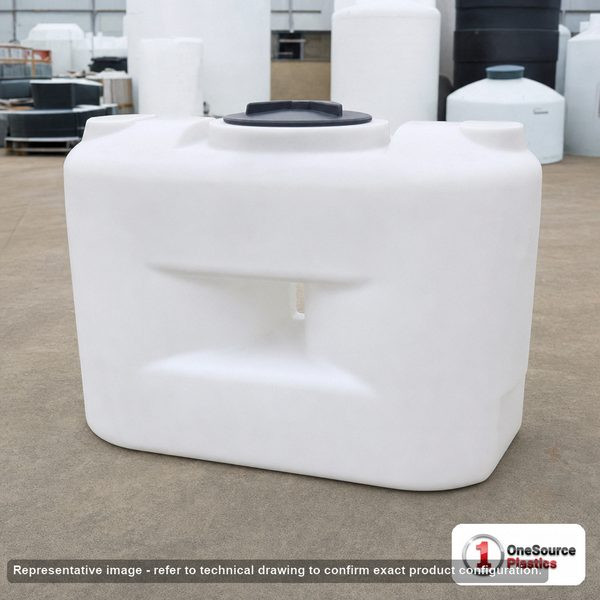
Tank Concentrator + Evaporator Operations: Tank Material Selection for High-TDS Brine
Concentrator and evaporator operations — whether for produced-water reduction, RO concentrate disposal, cooling-tower blowdown, mining tailings, road-deicing brine reuse, or food-industry liquor concentration — produce a process stream with extreme total dissolved solids (TDS), often above 200,000 mg/L. The tanks that hold feed, intermediate, and concentrate streams must withstand chloride pitting, scale precipitation on every wall, sulfide and bromide attack, and operating temperatures that drift 30°F daily. Pick the wrong tank material and a 5,000-gallon poly tank looks great for six months, then fails on a Tuesday at 3 AM. This pillar walks tank-material selection for high-TDS brine service across feed, evaporator-circuit, and concentrate storage on Norwesco, Snyder, Chem-Tainer, Enduraplas, and Bushman platforms, with the precipitation chemistry, corrosion physics, and disposal regulations every operator must internalize before specifying.
Reference standards in this guide: ASTM D1998 Section 7 (polyethylene service-temperature limits and chemistry compatibility), NACE MR0175 / ISO 15156 (sulfide stress-cracking-resistant materials for oil and gas service that overlap with concentrate brine), API Specification 12P (specification for fiberglass-reinforced plastic tanks used in oilfield service), API RP 12R1 (recommended practice for setting, maintenance, inspection, operation, and repair of tanks in production service), ASME B31.3 (process piping that ties brine systems together), NSF/ANSI 61 (potable contact for upstream feed water), EPA Underground Injection Control (UIC) Class I and II for brine disposal wells under SDWA 40 CFR 144–148, and ASME PTC 23 (atmospheric water cooling equipment, applicable to evaporative concentrator design). Real OneSource catalog SKUs cited include Norwesco MPN 43852 (1,000-gallon 45-degree cone-bottom), MPN 43854 (1,500-gallon 45-degree cone-bottom), MPN 41484 (300-gallon cone-bottom), Snyder MPN 32101 (150-gallon mixing cone-bottom), MPN 32419 (60-gallon mixing cone-bottom), MPN 5580000N52 (2,500-gallon double-wall), and the open-top mixing platforms MPN 1520000N51 and 1850000N51 used as feed-prep vessels.
What “High-TDS Brine” Actually Means
Standard fresh water has TDS under 500 mg/L. Brackish water sits at 1,000–10,000 mg/L. Seawater is approximately 35,000 mg/L. Concentrate streams from RO membrane systems run 60,000–100,000 mg/L. Evaporator concentrate from zero-liquid-discharge (ZLD) plants reaches 200,000–350,000 mg/L — nearly the saturation limit for sodium chloride at process temperature. Mining brines and produced water from oil and gas separation plants commonly exceed 250,000 mg/L. Each step up in TDS multiplies the corrosion and scaling risk on the storage tank shell.
| Stream Class | Typical TDS (mg/L) | Dominant Ions | Tank Material Notes |
|---|---|---|---|
| Brackish feed | 3,000–10,000 | Na, Ca, SO4, HCO3 | HDPE, XLPE OK |
| Seawater | 35,000 | Na, Cl, SO4, Mg | XLPE, FRP, lined steel |
| RO concentrate | 60,000–100,000 | Na, Cl, SO4, scale formers | XLPE, FRP, lined steel |
| Evaporator intermediate | 100,000–200,000 | Na, Cl, scale, biocides | FRP, duplex stainless, lined |
| ZLD concentrate | 200,000–350,000 | Saturated NaCl, residual | FRP, NACE-spec stainless |
| Produced-water brine | 100,000–300,000 | Na, Cl, Br, H2S, BTEX | API 12P FRP, NACE MR0175 |
Polyethylene (HDPE / XLPE) Performance on High-TDS Brine
HDPE and XLPE polyethylene are the dominant low-cost tank materials for brackish to seawater-class TDS service. Both polymers are chemically inert to chlorides, sulfates, and most dissolved-solids matrices. The failure modes are physical, not chemical:
- Stress cracking under load: ASTM D1998 explicitly addresses environmental stress crack resistance (ESCR). HDPE rotomolded tanks have lower ESCR than XLPE on aggressive surfactant or detergent service. For brine without surfactant content, both polymers perform indefinitely at room temperature.
- Service temperature ceiling: HDPE rated 100°F continuous, 140°F intermittent; XLPE rated 120°F continuous, 150°F intermittent. Evaporator service can exceed both. Specify XLPE for thermally-loaded brine.
- Scale precipitation on the wall: CaCO3, CaSO4, BaSO4 scale forms on every wall in brine service. Polyethylene is harder to mechanically descale than steel; cleaning cycle is longer. Plan a hot-water or acid wash protocol.
- UV degradation outdoors: ASTM D1998 polyethylene is UV-stabilized but not unlimited. Plan 15–25 year design life on exterior tanks; plan periodic inspection per API RP 12R1.
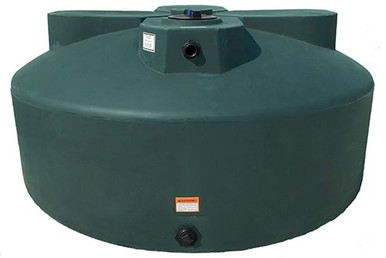
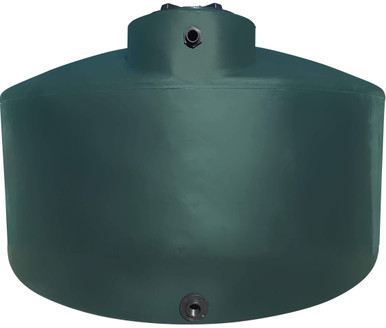
For brackish to RO concentrate (under 100,000 mg/L) at ambient temperatures, Norwesco MPN 43852 (1,000-gallon 45-degree cone-bottom), MPN 43854 (1,500-gallon 45-degree), and MPN 41484 (300-gallon) are field-proven platforms. Snyder MPN 32101 (150-gallon mixing cone-bottom) is widely deployed as the chemical pre-treatment dosing tank that conditions brine before concentrate handling. Open-top Snyder mixing tanks MPN 1520000N51 (15-gallon) and MPN 1850000N51 (17-gallon) work as feed-prep vessels for batch evaporator operations.
FRP / Fiberglass Performance on High-TDS Brine
Fiberglass-reinforced plastic (FRP) tanks per API Specification 12P are the workhorse for produced-water brine, intermediate evaporator service, and concentrate above the polyethylene service-temperature ceiling. The chemistry-resistance comes from the resin selection (vinyl ester or epoxy for brine service); the structural properties come from the glass-fiber reinforcement schedule. Service temperatures up to 180–200°F are common. See FRP & Fiberglass Tanks for the engineered-fab path.
- Resin selection: vinyl ester for chloride and sulfate brine; bisphenol-A epoxy for higher-temperature service; novolac epoxy for mixed acid / brine.
- Inner liner: a corrosion-barrier liner (typically 100–125 mil thick, with C-veil or synthetic-veil reinforcement) takes the chemistry directly. The structural FRP wraps the liner.
- Inspection: API RP 12R1 covers in-service inspection.
- Repair: hand-laid resin patch is field-feasible; major scale-blasting damage is reparable in-place.
Lined Carbon Steel and Duplex Stainless on Brine
Lined carbon steel
- Carbon-steel pressure vessel with a polyolefin or rubber lining.
- Cost-effective for very large-volume concentrate storage (tens of thousands of gallons).
- Chemistry-resistance is the liner; the steel is structural.
- Standard for ZLD evaporator feed and concentrate at large industrial sites.
Duplex and super-duplex stainless steel
- Duplex 2205 (UNS S32205) and super-duplex 2507 (UNS S32750) resist chloride pitting and stress corrosion cracking far better than 304 / 316 grades.
- Required for high-temperature concentrate above 180°F where polyethylene and most FRP fail.
- NACE MR0175 / ISO 15156 governs material qualification for any service with H2S exposure (produced-water brine).
- Capital cost is highest; lifecycle cost is competitive on long-life service.
The 304/316 stainless trap
Operators frequently default to 316 stainless on aggressive brine service because it works for most chemistry. On high-chloride service above approximately 50°C, 316 is below its critical pitting temperature. The fluid is at the failure threshold. Pitting corrosion initiates and the tank leaks within months to a few years. NACE MR0175 explicitly steers operators to duplex or higher grades for the demanding chloride service ranges.
Evaporator-Circuit Tank Functional Roles
- Feed tank: upstream of the evaporator; holds incoming wastewater, RO reject, or process bleed before concentration. TDS is moderate; chemistry is well-characterized. Polyethylene or FRP standard.
- Pre-treatment / chemical conditioning tank: doses pH adjustment, anti-scalant, or biocide before the evaporator. Polyethylene cone-bottom mixing tanks (Snyder MPN 32101, 32419) are the standard platform.
- Concentrate intermediate tank: downstream of the first concentration stage; receives 2–5× concentrated brine. Materials selection depends on operating temperature.
- Final concentrate / disposal tank: holds the maximum-concentration stream awaiting truck-haul to disposal well or solidification. Highest material-selection bar; FRP or duplex stainless typical.
- Distillate / condensate storage: holds the recovered fresh-water product. Low TDS, but elevated temperature (above 120°F at the condenser exit). XLPE or FRP.
Scale Chemistry: What Actually Precipitates
As brine concentrates, dissolved solids approach saturation and precipitate as scale. The order matters because some scales are easy to remove (bicarbonate / carbonate scale) and some are nearly impossible without acid attack on the tank wall (sulfate scales).
| Scale | Solubility (mg/L) | Removal Method |
|---|---|---|
| CaCO3 calcium carbonate | approximately 14 | Dilute acid, mechanical brush |
| CaSO4 calcium sulfate (gypsum) | approximately 2,000 | Mechanical / hot water + EDTA |
| BaSO4 barium sulfate | approximately 2.5 | EDTA + heat; rarely removable |
| SrSO4 strontium sulfate | approximately 110 | Acid + chelant |
| SiO2 amorphous silica | approximately 120 | Hot caustic; aggressive on most tanks |
| FeS iron sulfide | approximately 0.005 | Acid (release H2S, ventilate) |
Scale removal protocols on polyethylene: dilute citric or phosphoric acid is safe; muriatic acid is acceptable in dilution but never concentrated. Hot caustic for silica scale is borderline-acceptable on XLPE (verify against ASTM D1998 and the Snyder / Norwesco / Chem-Tainer manufacturer data). FRP with vinyl ester resin handles dilute acid descaling without compromise.
Brine Disposal Regulatory Path
Concentrate brine ultimately goes to one of four disposal paths:
- Surface discharge under NPDES: permitted only if the receiving water can absorb the chloride load. Increasingly restricted.
- Class II UIC injection well: the dominant path for oilfield produced-water brine. EPA SDWA Part 144–148 governs.
- Class I UIC injection well: for industrial / RO concentrate brine; permits issued by EPA or state primacy agency.
- Solidification / landfill: evaporate to solids (crystallizer end-state), package, and landfill. Required where injection wells are unavailable.
Tank operators handling brine awaiting disposal must comply with 40 CFR 264 (RCRA hazardous-waste storage) where the brine carries a listed hazardous constituent (BTEX from produced water, certain industrial process residuals). State-by-state regulations layer on top; verify with the state environmental agency before any new install. Tank materials selection drives whether the tank itself is a permitted storage vessel.
Pricing Doctrine
OneSource Plastics provides the polyethylene tank platforms field-deployed in brine feed, pre-treatment, and intermediate-concentrate service: Norwesco MPN 43852 (1,000 gal), MPN 43854 (1,500 gal), MPN 41484 (300 gal); Snyder MPN 32101 (150 gal mix), MPN 32419 (60 gal mix), MPN 1520000N51 (15 gal open-top), MPN 1850000N51 (17 gal open-top), MPN 5580000N52 (2,500 gal double-wall). High-TDS evaporator concentrate tanks above the polyethylene service-temperature ceiling typically require FRP, lined steel, or duplex stainless — refer to FRP & Fiberglass Tanks and Certified Steel Tanks for the engineered-fab path. Tanks listed at platform list price before freight; freight quoted separately per ZIP via the Freight Cost Estimator or by phone.
Common Selection Errors on Brine Service
Error 1: HDPE in elevated-temperature evaporator service
Above 100°F continuous the polymer creeps and fails. Specify XLPE for >100°F or FRP for >120°F.
Error 2: 316 stainless on hot chloride concentrate
Pitting corrosion onset above approximately 50°C in chloride-rich service. Specify duplex 2205 / 2507 per NACE MR0175.
Error 3: No anti-scalant pre-treatment
Scale precipitates on every wall and degrades heat-transfer / volume / inspection access. Specify pre-treatment dosing tank ahead of the concentrator.
Error 4: Skipping inspection cadence
API RP 12R1 sets inspection intervals; brine service rarely fails gracefully. Annual visual + 3–5 year detailed inspection minimum.
Error 5: Field-installed bulkhead with wrong gasket
EPDM in produced-water brine with hydrocarbon traces swells and fails. Viton (FKM) or PTFE for petroleum-contaminated brine. See Tank Plumbing System Design.
Error 6: Open-top vessel for H2S brine
Hydrogen sulfide release is a Class A confined-space and respiratory hazard. Closed vessel with vapor recovery, NACE-MR0175 materials, and OSHA 1910.146 compliance.
Error 7: Disposal-stream tank with no secondary containment
40 CFR 264 and SPCC 40 CFR 112.7(c) require containment dike for any fluid above the regulatory thresholds. Brine awaiting injection well disposal often qualifies.
Error 8: Cooling-tower blowdown reuse without scale modeling
Recycled blowdown to a polymer feed tank exceeds saturation on the second pass. Use the langelier saturation index or Stiff & Davis index to predict.
Internal Resources
- Tank Plumbing System Design
- Tank Foundation Pad Engineering
- Cold-Climate Insulation
- Sodium Chloride Storage
- Calcium Chloride Storage
- Magnesium Chloride Storage
- FRP & Fiberglass Tanks
- Certified Steel Tanks
- Freight Cost Estimator
Source Citations
- ASTM D1998 Section 7 — Polyethylene Upright Storage Tanks: Service-Temperature and Chemistry-Compatibility Limits
- NACE MR0175 / ISO 15156 — Petroleum and Natural Gas: Materials for Use in H2S-containing Environments
- API Specification 12P — Specification for Fiberglass-Reinforced Plastic Tanks
- API Recommended Practice 12R1 — Recommended Practice for Setting, Maintenance, Inspection, Operation, and Repair of Tanks in Production Service
- ASME B31.3 — Process Piping
- ASME PTC 23 — Atmospheric Water Cooling Equipment
- NSF/ANSI 61 — Drinking Water System Components: Health Effects (potable feed water)
- EPA Underground Injection Control (UIC) 40 CFR 144–148 — Class I and II Disposal Wells
- 40 CFR 264 — RCRA Standards for Hazardous Waste Treatment, Storage, and Disposal
- 40 CFR 112.7(c) — Spill Prevention, Control, and Countermeasure: Secondary Containment
- OSHA 29 CFR 1910.146 — Permit-Required Confined Spaces
- OneSource Plastics master catalog data, dated 2026-03-26 snapshot (9,419 products)
Recommended Tanks for This Guide
Live pricing, updated automatically · estimate freight to your ZIP.