Pesticide Container Disposal Under 40 CFR Part 165: Triple-Rinse + Recycle vs Refillable Return-and-Refill
Pesticide Container Disposal Under 40 CFR Part 165: Triple-Rinse + Recycle vs Refillable Return-and-Refill
Filed under: ag retailer compliance, ag chemical handling, EPA pesticide regulation. Companion read: Chemical Storage Tank Category and Glyphosate Compatibility Pillar.
The 1985 problem and the 2011 solution
Through the 1980s and 1990s, ag retail dealers and end-user farms generated a stream of empty pesticide containers — primarily 2.5-gallon HDPE jugs and 30-gallon and 55-gallon steel drums — that ended up in farm dumps, on burn piles, or in municipal landfills. EPA estimated tens of millions of containers per year, often with measurable pesticide residue, leaching into soil and groundwater. The Federal Insecticide, Fungicide, and Rodenticide Act (FIFRA) gave EPA authority to regulate the containers themselves, and after a long rulemaking process the agency published the Pesticide Container Standards rule on August 16, 2006 (71 FR 47330), with major compliance dates phased in through August 2011.
The rule, codified at 40 CFR Part 165, establishes design and residue-removal standards for pesticide containers and for containment at refilling sites. It also formalized the framework that gave rise to the Ag Container Recycling Council (ACRC) and the modern ag-retail mini-bulk refillable container system. This article walks through the rule, the two main container-management paths it authorizes, the economics of each, and where the OneSource bulk-tank catalog fits into the refillable model.
The two container categories under Part 165
Part 165 distinguishes nonrefillable containers (Subpart B, sections 165.20-165.28) from refillable containers (Subpart C, sections 165.40-165.47). The two categories are defined functionally:
- Nonrefillable container. A container that is not designed and not constructed to be filled with pesticide more than once. Includes the 2.5-gallon HDPE jugs, the 30-gallon steel drums, and the small consumer-pack containers familiar in any ag retail outlet.
- Refillable container. A container that is intended to be filled with pesticide more than once, including bulk-handling containers (typically 100-gallon to 1,200-gallon mini-bulk shuttles) and the larger 2,500-gallon and 6,000-gallon stationary tanks at dealer plants.
The two categories carry different regulatory obligations because they create different residue-management challenges.
Nonrefillable container standards (40 CFR 165.25)
The headline residue-removal standard at 40 CFR 165.25 applies to rigid nonrefillable containers with capacity less than or equal to 5 gallons (liquid) or 50 pounds (solid) when the pesticide product's labeling allows or requires the product to be diluted before application. For these containers, each container/formulation combination must be capable of attaining at least 99.99 percent removal of each active ingredient when tested under the EPA test procedure "Rinsing Procedures for Dilutable Pesticide Products in Rigid Containers."
The 99.99% removal target is achievable through the well-established triple-rinse procedure:
- Drain the container into the spray tank or mix tank, holding the container in the inverted position for at least 30 seconds after the steady stream becomes drips.
- Refill the container to approximately 10 percent of capacity with water (or the diluent specified on the label).
- Replace the closure tightly and shake or rotate the container to wash all interior surfaces.
- Drain the rinse water into the spray tank, again holding the inverted position for 30 seconds after drips begin.
- Repeat steps 2-4 two more times for a total of three rinses.
Pressure-rinse using a manifold-mounted pressure-rinse nozzle (PRN) is the modern equivalent and is faster: a single 35-second rinse at 40 PSI achieves equivalent residue removal to a manual triple-rinse and is the preferred method at any volume operation.
Per 40 CFR 165.27, a properly rinsed nonrefillable container is considered "empty" for purposes of disposal. The container can then be:
- Recycled through the Ag Container Recycling Council (ACRC) program, which accepts triple-rinsed HDPE jugs at over 200 collection sites nationwide.
- Disposed in a permitted municipal solid-waste landfill if the state allows.
- In some states, burned in an open pile if state regulations permit (uncommon in the modern era).
Cap-and-cone is a closely related concept: after triple-rinse, the cap is replaced on the container in the inverted "cone" position to indicate to inspectors and to downstream handlers that the container has been emptied per the rinse procedure. Some state lead agencies require cap-and-cone marking; some ACRC collection sites require it for acceptance.
Refillable container standards (40 CFR 165.40-165.47)
Refillable containers carry a different set of obligations because they re-enter the pesticide-handling chain after each empty cycle. The rule requires:
- One-way valve or tamper-evident seal (165.45) on each refillable container to ensure cross-contamination cannot occur between products.
- Cleaning before refill with a different product (165.45(c)) — the refiller must clean the container per a defined procedure if the container previously held a different pesticide product, with the cleaning procedure documented in the refiller's records.
- Marking and labeling (165.45(b)) — the refillable container must carry an EPA-registered product label and a serial number traceable to the original product registration.
- Periodic inspection (165.45(e)) — the refiller must inspect the container before each refilling for damage, residue, and label integrity.
Refillable container repackaging at the dealer plant is also subject to the containment-pad and contained-area standards at 40 CFR 165.80 onward (Subpart E). A dealer plant that refills mini-bulks or stationary bulk tanks must have an engineered containment pad sized to capture the largest container being filled plus rainfall, and the containment pad and dispensing area must meet specific design and operational criteria.
The economics — why refillable is winning at scale
For an end-user farm spraying 100,000 acres of soybeans annually with glyphosate at 22 ounces per acre, the math drives toward refillables almost immediately.
Nonrefillable jug economics:
- 2.5 gallon HDPE jug, $15 per empty container included in the wholesale glyphosate price (typical list-builder math).
- 100,000 acres x 22 oz/acre = 2,200,000 oz = 17,188 gallons of finished glyphosate (assuming a typical 4 lb/gal formulation).
- 17,188 gallons / 2.5 gallons per jug = 6,875 jugs.
- Empty container cost embedded: 6,875 x $15 = $103,125.
- Triple-rinse labor: 6,875 jugs x 1 minute average = 115 hours of operator time at $25/hr loaded = $2,875.
- ACRC drop-off: typically free at the collection site, but requires a transport trip.
- Total nonrefillable container handling cost: approximately $106,000.
Refillable mini-bulk economics:
- One-time cost of a 1,000-gallon stationary refillable bulk tank at the farm equipment shed (or a 250-gallon mini-bulk shuttle): typically embedded in a multi-year supply agreement with the ag retailer.
- Per-gallon glyphosate cost typically $0.50-$1.00 lower than the equivalent jug-pack price because the dealer is not buying and disposing of containers.
- 17,188 gallons x $0.75/gal savings = $12,891 annually.
- Operator labor for mini-bulk fill: minimal compared to jug-by-jug handling.
- Annual savings vs jug-pack: approximately $13,000-$25,000 depending on chemistry and volume.
The economics get even better when you factor in the elimination of ACRC drop-off transport, the elimination of jug storage space, and the reduction in operator exposure during chemical handling. For any farm spraying more than 1,000 acres of corn-soy or wheat-canola rotation chemistry annually, refillable bulk is the financially obvious choice.
Where the OneSource catalog fits into the refillable model
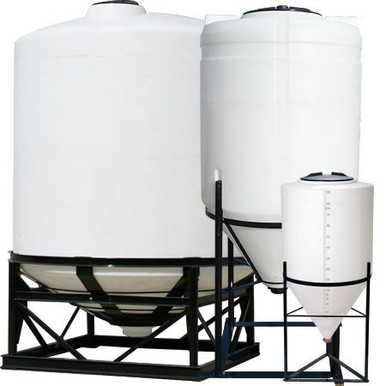
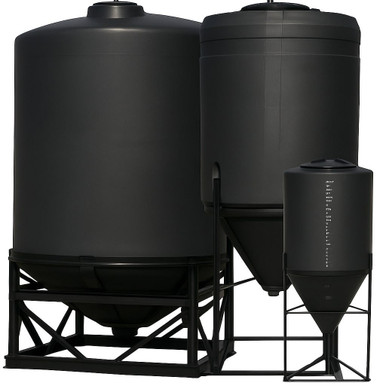
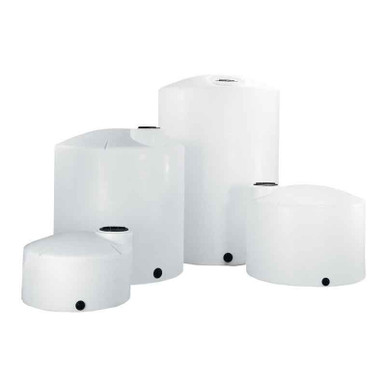
OneSource sells the polyethylene tanks that serve as the on-farm or on-dealer-plant refillable infrastructure. Two categories matter:
Stationary on-farm bulk holding tanks
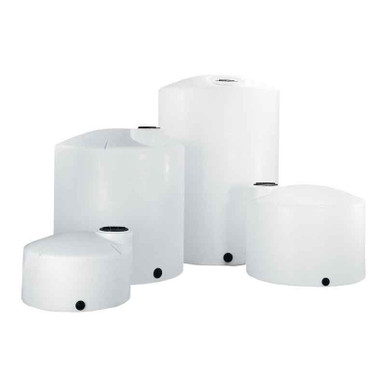
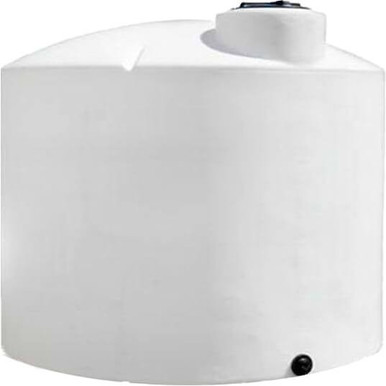
The 1,000-3,000 gallon polyethylene vertical that lives at the farm equipment shed and accepts deliveries from the ag retailer's tender truck. The tank is "refillable" in the 40 CFR 165 sense because the dealer's tender truck refills it on a defined schedule with a defined product. Dealer compliance documentation handles the labeling and serial-number tracking; the tank itself is OneSource-supplied polyethylene.
Real OneSource SKUs for this role:
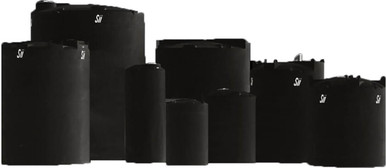
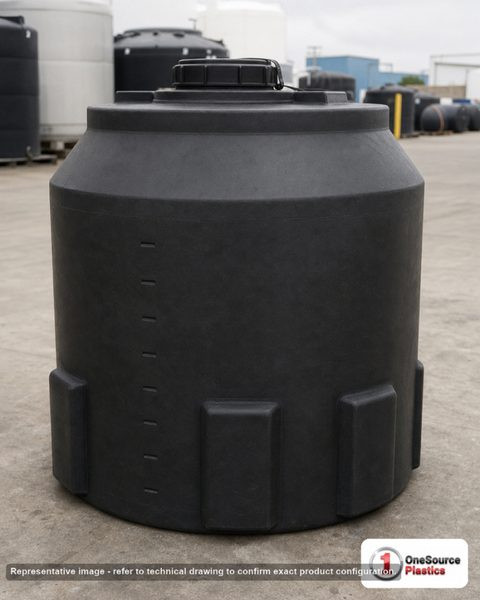
- Norwesco MPN 41500 — 1000 Gallon Vertical Water Storage Tank in Black, listed at $1,699.00. Often spec'd into glyphosate or 2,4-D bulk holding service. Black resin protects herbicide active ingredients from photodegradation.
- Norwesco MPN 43808 — 1525 Gallon Vertical Water Storage Tank in Black, listed at $1,799.00. Larger holding capacity for bigger operations.
- Enduraplas MPN THV02500 — 2500 Gallon Plastic Vertical Liquid Storage Tank in Faint Green, listed at $2,769.85. Sized for multi-product or higher-volume operations.
- Enduraplas MPN TLV02100 — 2100 Gallon Plastic Vertical Water Storage Tank in Black, listed at $2,188.40.
- Chem-Tainer MPN TC8674IA — 1700 Gallon HDPE Vertical Liquid Storage Tank, listed at $3,059.71. The HDPE chemical body is appropriate for most ag chemistry refillable bulk service.
Mini-bulk shuttles and tender-truck tanks
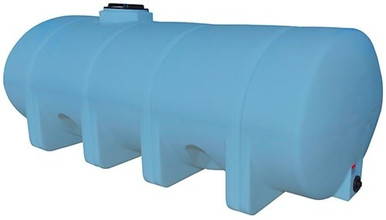
The 100-500 gallon polyethylene horizontal that rides on the farm equipment trailer or in the back of the spray tender truck for delivery to the field. These are the day-to-day workhorses of refillable handling.
Real OneSource horizontal SKUs commonly specified:
- Norwesco MPN 40327 — 300 Gallon Horizontal Elliptical Cradle Tank in White, listed at $898.27.
- Norwesco MPN 40328 — 500 Gallon Horizontal Elliptical Cradle Tank in White, listed at $1,298.99.
- Norwesco MPN 45746 — 300 Gallon Horizontal Elliptical Cradle Tank Offset, listed at $926.06.
- Norwesco MPN 41468 — 150 Gallon Plastic Horizontal Leg Tank, listed at $528.99.
- Norwesco MPN 40298 — 125 Gallon Horizontal Leg Tank in White, listed at $529.00.
- Norwesco MPN 44804 — 135 Gallon Horizontal Elliptical Leg Tank in White, listed at $509.52.
Containment pad requirements (40 CFR 165 Subpart E)
Sites that refill containers — the dealer plant filling the tender truck, or the farm filling its own mini-bulks from an on-site stationary tank — must have an engineered containment pad meeting Subpart E criteria. The pad must:
- Be constructed of materials of sufficient thickness, density, and composition to contain any pesticide spilled or released until cleanup is completed.
- Have a capacity equal to either (a) at least 100 percent of the volume of the largest stationary container plus the volume displaced by other tanks and equipment within the pad, OR (b) at least 110 percent of the volume of the largest portable container being filled.
- Be sloped to a sump or low point to allow recovery of spilled material.
- Be constructed without expansion joints, cracks, or other openings that could allow leaks.
- Be maintained — annual visual inspection plus cleanup of any visible residue or staining.
OneSource does not sell the containment pad — that is poured concrete with chemical-resistant coating, designed and stamped by a structural engineer for the specific site. We do supply the polyethylene tanks that sit on the pad and benefit from the containment.
Closed transfer systems and the modern dispensing chain
The state of the art at large dealer plants and progressive farms is the closed transfer system: a permanently-installed dispensing connection where the operator never sees liquid product. The mini-bulk shuttle or jug screws onto a coupler, a metering pump dispenses a measured volume into the spray tank, and the empty container is detached without operator exposure. Closed transfer systems significantly reduce the residue-handling problem because no rinse step is needed at the field — the system meters the product and any residual rinse goes back to the dealer plant via the empty mini-bulk.
Closed transfer systems are particularly valuable for high-toxicity chemistry (paraquat, certain organophosphates) and for sites where operator exposure documentation is a recurring compliance issue.
State variations in container management
Federal Part 165 sets the floor; states layer additional requirements. A few examples:
- California Department of Pesticide Regulation requires container management documentation that exceeds federal requirements, with specific record-keeping for both nonrefillable and refillable containers.
- Minnesota Department of Agriculture operates one of the most active ACRC partner programs in the country, with collection events through the growing season at dealer locations statewide.
- Washington State Department of Agriculture has specific requirements for closed transfer systems on certain Restricted Use Pesticides.
- Texas Department of Agriculture regulates container management through its Pesticide Use Rules with state-specific recordkeeping requirements.
Verify with the state lead agency — typically the Department of Agriculture or environmental agency depending on the state — for the current state-specific requirements layered on the 40 CFR Part 165 federal floor.
Common compliance findings on container-handling inspections
- Triple-rinse procedure not documented in the spray records. The rinse happened, but the operator did not log it. Inspectors look for written procedure compliance.
- Refillable container missing the EPA-registered label. The mini-bulk has a faded label that is no longer legible. Refillers are required to relabel the container at refill if the existing label is damaged.
- Refillable container without one-way valve or tamper-evident seal. Older mini-bulks predating the 2011 compliance deadline that have not been upgraded.
- Containment pad cracked or undersized for the largest container. Site has a containment pad but it does not meet the 100% / 110% volume criteria when the calculation is run.
- Mixed cross-contamination on a refillable container. Container previously held one product, was refilled with a different product without the documented cleaning procedure.
- Triple-rinsed nonrefillable containers stored on-site without disposal. Empty containers piling up because the operator has not made the ACRC drop-off trip.
Bottom line
Pesticide container management under 40 CFR Part 165 has matured into a clean two-path framework: triple-rinse plus ACRC recycling for nonrefillable containers, and bulk refillable systems for high-volume operations. The economics drive toward refillable bulk for any operation above the small-acreage threshold, and the polyethylene tank infrastructure that supports the refillable model is OneSource territory. Specify the on-farm bulk holding tank in the 1,000-3,000 gallon range, the mini-bulk shuttle in the 100-500 gallon range, and pair both with an engineered containment pad that meets Subpart E criteria. Get the recordkeeping right and the inspector finds nothing to cite.
Browse the Horizontal Leg and Elliptical Tank Category for mini-bulk and tender-truck tanks, and the Chemical Storage Tank Category for stationary on-farm bulk holding. Freight on any tank is quoted to ZIP through the Freight Cost Estimator or by phone at 866-418-1777.
Recommended Tanks for This Guide
Live pricing, updated automatically · estimate freight to your ZIP.