1020 Gallon 15 Degree Cone Bottom Tank: Complete Buyer's Guide
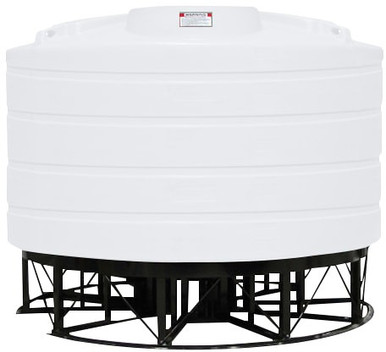
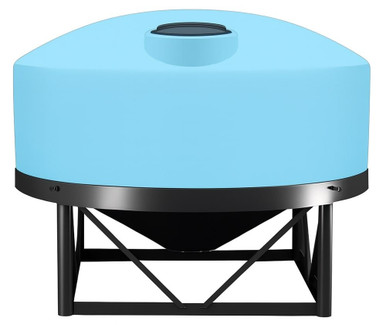
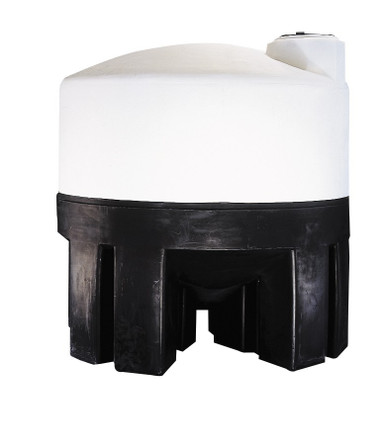
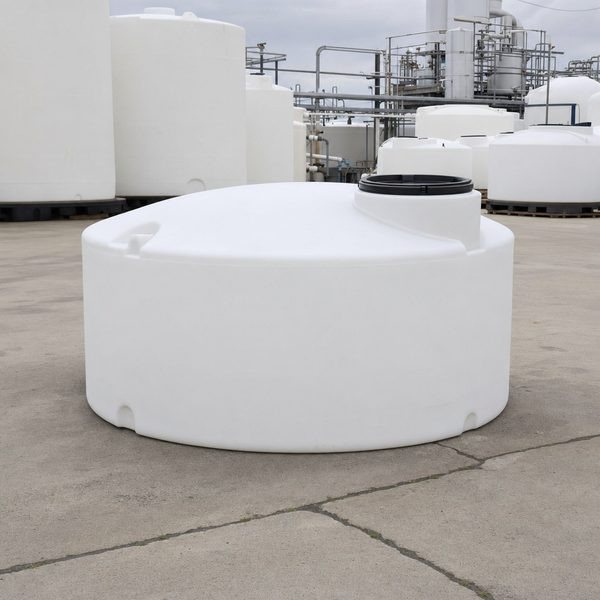
The 1,020-gallon 15-degree cone bottom tank is a compact full-drain process vessel — 91 inches across and just 53 inches tall, a low-profile cone tank that empties completely through its apex outlet. Rated to a 1.5 specific gravity, it suits mixing and batch processing in spaces where a taller cone tank won't fit.
Specifications at a Glance
Every figure below is pulled straight from the live product record for this exact tank — the same data on the product page, so what you read here and what you buy never disagree.
Standards & Materials
- ASTM D1998 — Standard Specification for Polyethylene Upright Storage Tanks. Governs wall-thickness and hydrostatic design for vertical rotomolded poly tanks of this class.
- FDA 21 CFR 177.1520 — Olefin polymers. The food-contact regulation the FDA-grade resin in this tank is compounded to meet.
- Specific gravity rating 1.5 — the tank is engineered for liquids up to 1.5× the density of water (water is about 8.34 lb/gal). Confirm your fluid’s SG before storage.
Product Overview
The 1,020-gallon shares the 91-inch diameter of its larger 15-degree siblings but in a notably shorter body — just 53 inches tall. That low profile is its calling card: it delivers true cone-bottom complete drainage in the lowest height the geometry allows, which matters when the tank plus its stand has to clear a low ceiling, fit under existing equipment, or leave room for a mixer above. For a process line with limited overhead, this is the cone tank that fits.
Like all cone tanks, its purpose is total drainage. The 15-degree sloped floor funnels the entire batch — liquid and any settled solids — to the bottom outlet, leaving no residual pool. Norwesco rotomolds it as a single seamless piece of virgin linear polyethylene rated to a 1.5 specific gravity, handling process liquids up to 12.5 pounds per gallon. The seamless wall resists abrasion under agitation and traps no product between batches, and the wide 91-inch surface accommodates a top-entry mixer.
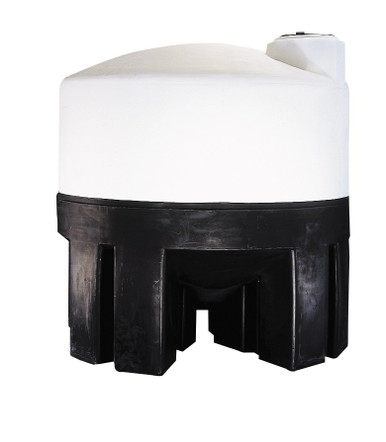
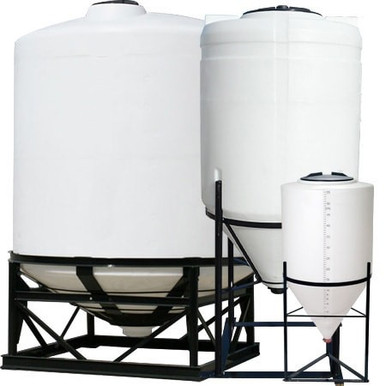
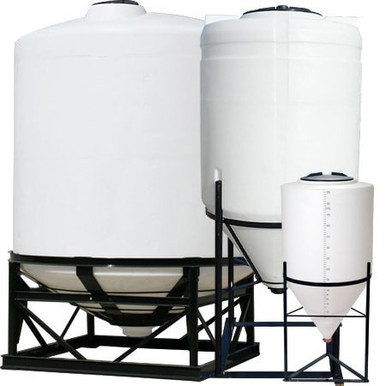
The non-negotiable rule applies in full: with no flat base, the tank must be supported in a stand rated for the full loaded weight, cradled around its sidewall with the load carried through the stand's legs — never resting on the cone apex or the outlet. Empty, the tank weighs 204 pounds; filled with a 1.5-SG product it carries roughly 12,964 pounds, all of which a properly rated stand must bear.
The bottom outlet is a 2-inch NPT fitting at the apex, factory-installed and leak-tested for complete gravity drainage. The 16-inch lid serves filling, venting, mixer mounting, and inspection, and the translucent natural-white wall lets you watch the level and mixing action. Maximum service temperature is 120°F. Norwesco's 3-year warranty applies, and the tank ships LTL freight — allow a couple of weeks, with liftgate available.
Technical Drawing
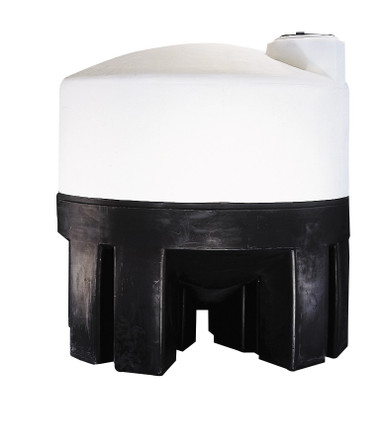
Official Norwesco technical drawing — 1020 Gallon 15 Degree Cone Bottom Tank
Key Features and Specifications
- 1,020-gallon capacity — sized for full-drain mixing and batch processing
- Constructed from virgin linear polyethylene (HDPE) with 1.5 specific gravity rating — handles liquids up to 12.5 lbs/gal
- 53" tall x 91" diameter — compact vertical footprint
- 204 lbs empty, approximately 12,964 lbs when full at rated specific gravity
- 2" NPT outlet fitting — factory installed and leak-tested
- 16" lid opening for fill, venting, and interior access
- FDA approved for potable water and food-grade liquid contact
- 3 Year Warranty from Norwesco against manufacturing defects
- Translucent white walls allow visual level monitoring without opening the tank and reflect sunlight to keep contents cooler
- Rated for continuous service up to 120 F / 48 C
- Seamless one-piece rotational molding — no seams, no welds, no leak points
- Manufactured by Norwesco — a leading name in rotomolded polyethylene tanks
- Must be installed on the manufacturer-supplied or compatible stand rated for the full loaded weight. Never rest a cone bottom tank directly on its apex
- Ships via LTL freight — allow 2-3 weeks for delivery. Lift gate and residential delivery available at additional cost
Installation and Setup Guide
As with every cone tank, the install hinges on the stand — but the 1,020-gallon's low profile makes overhead clearance the other thing to plan carefully, since the whole point of choosing this size is fitting into a tight vertical space.
Stand and Foundation
Support the tank in a stand rated for the full loaded weight — roughly 12,964 pounds at 1.5 SG — that cradles the sidewall and carries the load through its legs to a level, load-bearing surface, ideally concrete. Use the manufacturer's matching stand or an engineered compatible structure; never improvise or rest the tank on its apex. Because this is the low-profile size, choose a stand height that gives you just enough clearance under the apex for a valve and discharge line while staying within your overhead limit — that balance is the whole reason to pick the 1,020.
Placement and Connections
Plumb the 2-inch apex outlet with a full-port valve right at the cone to preserve complete drainage. With a low tank on a modest stand, valve and discharge clearance below is tighter than on a tall cone tank, so lay out the bottom plumbing before you set the tank. Use flexible connections to absorb flex and any mixer vibration, and match all wetted materials to the process chemical.
Venting and Mixing
Fit a vent in the 16-inch lid sized to your fastest fill or draw to prevent vacuum during a quick bottom-drain. If you mount a mixer, the short 53-inch tank height plus the 15-degree cone profile defines your impeller geometry — verify the agitator reaches into and sweeps the shallow cone without striking it, and support the mixer on the stand or a bridge rather than the lid. Use a chemical-rated pressure/vacuum vent for off-gassing products.
Maintenance and Long-Term Care
Maintaining the low-profile 1,020 is the same cone-tank discipline as any other — stand integrity, drain path, clean changeovers — with the added ease that its low height makes the lid and cone genuinely reachable for inspection and cleaning. This is chemical-service equipment.
Quarterly Inspection Checklist
- Stand: Inspect for corrosion, cracked welds, loose fasteners, or a settled leg. The stand bears the entire load, so any weakness is the most serious finding. Confirm it stays level for even cone drainage.
- Cone and apex: Check the cone wall and apex area for stress or distortion, and verify the tank is cradled correctly with no weight on the apex.
- Outlet valve: Inspect the 2-inch apex fitting and valve for weeping or buildup that would impede the full drain — easy to reach on this low tank.
- Vent and mixer: Confirm the vent is clear and the mixer mount secure.
Cleaning and Changeover
Use the cone's complete drainage to your advantage: open the apex valve and the whole batch, including settled solids, runs out cleanly. Between products, drain fully, then flush per the outgoing chemical's procedure — the low height makes it easy to confirm through the 16-inch lid that the cone and outlet are clear. Verify polyethylene compatibility with the incoming chemistry before refilling, and handle rinsate per the label.
UV and Heat
Many low-profile cone tanks live indoors in process areas; if yours is outside, inspect the wall yearly for chalking. Indoors, prioritize ventilation for off-gassing chemistry. Stay within the 120°F service limit, especially if mixing or reaction adds heat to the batch.
Alternatives and Comparisons
The 1,020's niche is height, so compare on that axis:
This versus a taller 15-degree cone of similar diameter: the 1,020 is the low-profile choice — same 91-inch diameter, much shorter body — for tight overhead. A taller cone tank of the same diameter holds more volume but needs more height for the tank and its stand. If your ceiling or existing equipment limits height, the 1,020 wins; if you have headroom and want more capacity, step up.
Cone versus flat-bottom: the cone earns its stand and complexity only if complete drainage and clean changeovers matter to your process. For static single-product storage, a low flat-bottom vertical is simpler, self-supporting, and cheaper.
Frequently Asked Questions
How long will the 1020 Gallon 15 Degree Cone Bottom Tank last?
Fifteen to twenty years is realistic with a properly rated, level stand and use within the 1.5-SG and 120°F limits. The stand is as critical as the tank — an inadequate or unlevel stand is the main risk — while the seamless wall reaches the upper range when supported correctly and run with compatible chemistry.
What chemicals can I store in this tank?
Rated to a 1.5 specific gravity, it handles process chemicals, blends, and treatment solutions up to 12.5 pounds per gallon. Not for fuels, solvents, or flammables. Because it cycles and often mixes product, verify polyethylene compatibility for each chemical against a chart — poly resists most acids and bases but is attacked by certain hydrocarbons and strong oxidizers.
What kind of foundation does a 1020-gallon tank need?
It needs a stand rated for the full loaded weight (roughly 12,964 pounds here) that cradles the tank and carries the load through its legs — never resting on the cone apex. The stand's legs sit on a level, load-bearing surface, ideally concrete. On this low-profile size, choose stand height to balance valve clearance below against your overhead limit.
Does this tank come with a warranty?
Yes — Norwesco's 3-year warranty covers factory material and workmanship defects. It excludes over-spec products, improper support (apex resting or an inadequate stand), incompatible-chemical attack, and impact damage. Document your rated stand and level setup for any claim.
Can I install this tank underground?
No — this is an above-ground process vessel that drains through a bottom cone while supported in a stand; it cannot be buried. For below-grade storage, use a purpose-built underground cistern engineered for soil load.
Buying Considerations
Choose the stand first — rated for the full loaded weight and matched to this tank — because the tank can't function or stand safely without it. Then confirm the low-profile math actually works for you: measure your overhead limit against the 53-inch tank height plus your chosen stand height plus any mixer, leaving clearance for the bottom valve. Verify your process liquid is at or under 1.5 SG. It ships LTL on a pallet — allow a couple of weeks and request a liftgate if you lack a dock or forklift.
Related Products You May Need
Questions? Call (866) 418-1777 — our team knows these products inside and out and can help you select the right tank for your application.
Recommended Tanks for This Guide
Live pricing, updated automatically · estimate freight to your ZIP.