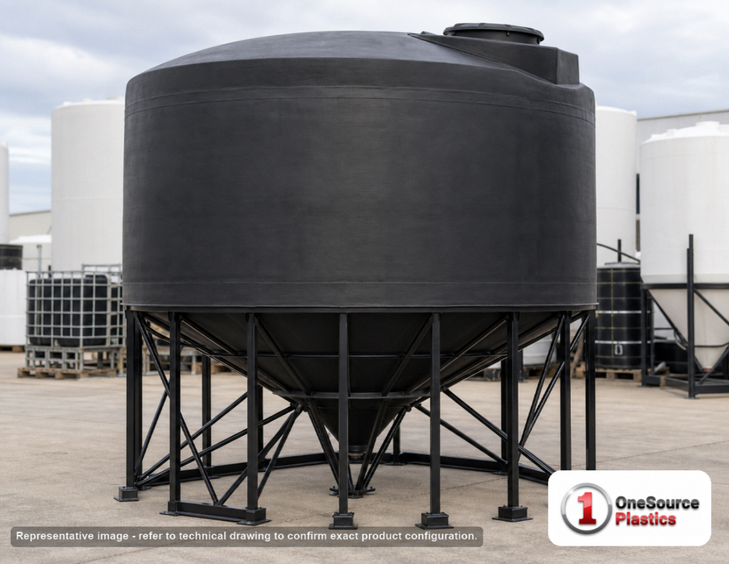
A thousand gallons in a narrow, tall shell
The Snyder 5000000N51 is a 1,000 gallon heavy duty cone bottom tank, listed 64 inches long, 64 inches wide and 103 inches tall, at 210 pounds empty and 210 pounds shipping, with the colour given as black and the material field reading High Density Linear Polyethylene. Heavy duty is the maker's own name word and the sheet backs it with figures rather than adjectives: the wall is rated at a specific gravity of 1.9, and the max contents figure is 15,846 pounds against 8,340 pounds of water at 8.34 pounds per gallon. The cone angle is published as 45 degrees. The opening on top is an 18 inch threaded vented manway. The outlet field reads 1 Manway / Lid, which names an opening rather than a discharge, and no discharge size is published. The service limit is 100 F / 37 C and the freight class reads 400. There is no inlet, no stand and no warranty term on this sheet.
Replacing a tank that failed? Call 866-418-1777 with what it held and how long it lasted; or check freight to your ZIP and put the 1000 gallon tank in your cart above.
Two thousand gallon tanks, two very different footprints
The most useful thing on this sheet is that it lists a second 1,000 gallon tank beside this one, and the two are nothing alike. 1890000N42 holds 1,000 gallons on an 86 inch circle at 66 inches tall and 210 pounds. This one holds the same 1,000 gallons on a 64 inch circle at 103 inches tall and the same 210 pounds. Identical capacity, identical weight, and a completely different installation: one is a low wide drum that goes under a roof, the other is a slim column that fits into a corner. So the question is never which tank holds more, it is which shape your site actually has room for. Five feet four inches of circle is less ground than a lot of pallet positions, which is why this shell turns up in plant rooms, in bunded bays and on skids where the wide vessel would have to go outside. What it asks for is height: 103 inches of shell, then the stand under all of it, then clearance above the manway for a person to work. Do that addition against the lowest fixed obstruction in the room, not the ridge, because a duct run, a crane rail or a sprinkler main is what decides it. The second thing this sheet gives you and the wide 1,000 gallon listing does not is a published cone angle: 45 degrees. That is a steep cone, and it is the reason this shape is bought for product that settles or thickens rather than for plain water. It is also why the shell is tall for its volume, since a steeper cone puts more of the height into the drain. Third, the rating: 1.9, with 15,846 pounds of max contents, which is what lets you fill it with something heavier than water. If your product is not, a lower rated shell is the more honest buy. Under all of it, a cone bottom vessel has no flat floor and cannot stand on its own bottom, and this sheet publishes no stand, no legs, no skirt, no ring and no bolt pattern, so the support is a separate item and no stand height, rated load or stand material is stated here. A narrow circle concentrates the load more than a wide one does, so the 210 pounds of empty tank, 8,340 pounds of water and 15,846 pounds at the rating all arrive through a handful of feet inside five feet four inches. That is engineered ground. Work the structure out with the cone bottom tank stand compatibility matrix, read the complete buyer's guide at this capacity and angle, size the volume with the tank sizing calculator, and take the freeboard from the tank sizing guide.
The sixty-four inch thousand against the eighty-six inch thousand
| Part | Gallons | Length x width x height | Empty weight |
|---|---|---|---|
| 5000000N51 (this tank, tall and narrow) | 1000 | 64 x 64 x 103 in | 210 lb |
| 1890000N51 (low wide shell, black) | 1000 | 86 x 86 x 66 in | 210 lb |
| 1890000N42 (XLPE heavy duty listing) | 1000 | 86 x 86 x 66 in | 210 lb |
| 1890000N48 (XLPE heavy duty listing) | 1000 | 86 x 86 x 66 in | 210 lb |
| 6190000N42 (step down, same narrow circle) | 500 | 64 x 64 x 63 in | 120 lb |
| 8310000N42 (step up, much wider) | 1250 | 95 x 95 x 70 in | 300 lb |
Read the top four rows as two pairs rather than four options. This listing and the three 1890000 listings all hold 1,000 gallons at 210 pounds; the difference is entirely shape, 64 by 103 inches against 86 by 66 inches. The sheet states both and explains neither, and neither will this page. What it means on the ground is simple enough to settle with a tape measure: if you are short of floor, take this one; if you are short of ceiling, take one of the wide ones. Inside the 1890000 group the sheet separates the three only by name and code, so pick on colour and on whatever an existing installation already uses. The bottom two rows show what the family does either side. 6190000N42 keeps this same 64 inch circle and comes down to 500 gallons at 63 inches and 120 pounds, which is the honest buy when the real batch is half of this one and you would rather not fill a tall tank a quarter of the way up. 8310000N42 goes to 1,250 gallons but takes a 95 inch circle to do it, at 70 inches tall and 300 pounds, so it is the wide answer again rather than a straight step up. Set the three circles side by side and the family becomes easy to read: 64 inches buys floor space and spends height, 86 and 95 inches do the opposite, and the capacity is almost incidental to that choice.
Want the certified one or the plain one? Call 866-418-1777 and say what the inspector asks for; or request a quote on the row you need.
The vented lid, the cone angle and the blank outlet field
- The vented lid: an 18 inch threaded vented manway, with the vent part of the top fitting on this sheet rather than a separate line. On a column being pumped from the bottom that air path is the wall's protection and not a convenience, so keep it clear, check it whenever the tank is opened, and never blank, tape or paint over it.
- Where it sits: 103 inches plus the stand puts the lid well above head height. Plan a fixed ladder or a platform and a fall protection routine with the structure, and land the fill line at a coupling at working level so nobody climbs with a hose.
- The cone: published at 45 degrees. A steep cone is what you want for product that settles or thickens, because a shallower geometry lets material sit at the wall where nothing reaches it. It is also the reason this shell is tall for a thousand gallons.
- The outlet field: it reads 1 Manway / Lid, which names an opening rather than a discharge. Printed exactly as it reads, with no outlet size, no thread, no bulkhead and no valve claimed anywhere on this page. Tell us the line size, the valve type and the product, and we will confirm what this part number carries before anything is ordered.
- What hangs underneath: the valve, any reducer and the first run of pipe are carried on steelwork off the stand, never on the tank, with a flexible connector at the first joint so pump vibration stays out of the wall. There are 15,846 pounds of rated contents above that joint at full load.
- Inlet, warranty and NMFC: none published on this sheet and none claimed. Ratings are a specific gravity of 1.9, 8,340 pounds of water at 1,000 gallons, 15,846 pounds of max contents, and 100 F / 37 C.
Decide how the level will be read before the tank is standing, because retrofitting an instrument to the top of a tall shell costs more than choosing the right one did: the level gauge selection guide for chemical service works through the technologies honestly. And settle the chemistry before the gaskets: three of the products this tank is most often asked about have their own pages, namely sulfuric acid, sodium hypochlorite and diesel exhaust fluid, and each one changes the fitting and gasket answer rather than the tank.
Chemical day tanks that have to empty completely
A steep cone at a thousand gallons in a narrow footprint is a day-tank and batch-vessel shape, and that is where it goes. Polymer and coagulant preparation at a water or wastewater works, acid and caustic day tanks feeding a dosing skid, plating and pickling solution holding in a metals shop, blending and make-up in chemical manufacturing where the vessel changes product between runs, liquid fertiliser and crop input dosing at an agricultural retailer with a tight yard, and settled solids handling where a flat floor would simply hold the material. The 45 degree cone is the reason the vessel empties rather than mostly empties, and the 1.9 rating is what lets it hold something denser than water. One caution belongs to the shape rather than the tank: a tall slender column stratifies more readily than a low wide one, so if your product separates, where you draw from and how you mix matter more here than they would in the 86 inch shell listed beside it. Plan the draw point and the agitation together. Check any product in our chemical compatibility reference before the fittings are specified.
Two hundred and ten pounds from Nebraska
This tank is moulded at Lincoln, Nebraska, so the plains and the Midwest are the short lanes and either coast is the long one. The freight class reads 400, a numeric class rather than a mode, and the sheet publishes no NMFC number. It shipments at 64 inches by 64 inches by 103 inches at 210 pounds, which is a compact and light shipment by the standards of this family, and the narrow footprint means it is easier to place on a mixed trailer than the wide shells are. Price the lane to your ZIP with the freight cost estimator; the listed price is before freight. No crane, rigging, permit or escort detail appears on this sheet and none is stated here; agree the offload arrangement with us before the truck is booked. Have the stand set, levelled and anchored first, because a cone bottom tank cannot be stood on the ground while somebody finishes the structure. Sling under the body, never by the manway, and keep it restrained the moment it is upright, since an empty shell of this height moves in wind before anybody expects it to. Prove the installation with clean water rather than with product, holding the 8,340 pound load, and read the manway seal, the cone joint and the stand feet in daylight. Then check the anchor bolts again a week later; new ground settles a little under a concentrated load, and the fixing that was tight on day one is the one that is loose on day eight. Keep one spare gasket for the outlet fitting on the shelf; it is the part that fails on a holiday.
Freight and documents
Ships from: Lincoln, NE. LTL freight is quoted to your ZIP with the freight cost estimator or by phone at 866-418-1777. The listed price is before freight.
Technical drawing (PDF) for Snyder Industries 5000000N51.
See this tank
Interactive 3D model with live fill. This tank has an interactive 3D model built to its manufacturer dimensions. Rotate it, and set a fill level to see how much liquid it holds at any height. Open the 3D view on the product photo above. Download the 3D model (GLB).
Ready to order?
Add it to your cart at the top of this page, get LTL freight to your ZIP, request a written quote, or call 866-418-1777. The listed price is before freight.