500 Gallon 30 Degree Cone Bottom Tank: Complete Buyer's Guide
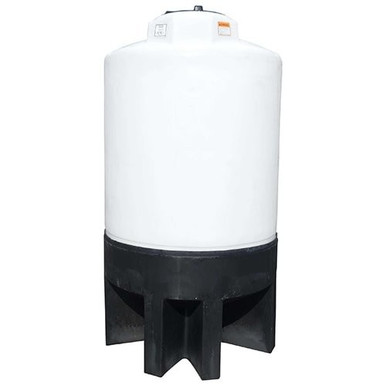
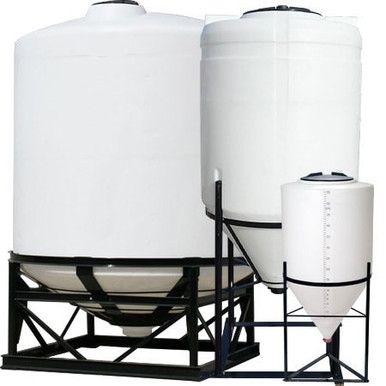
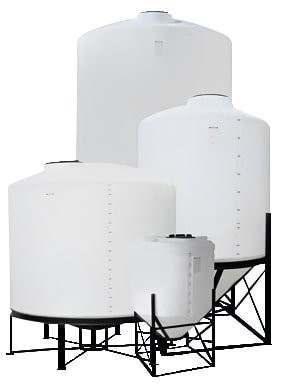
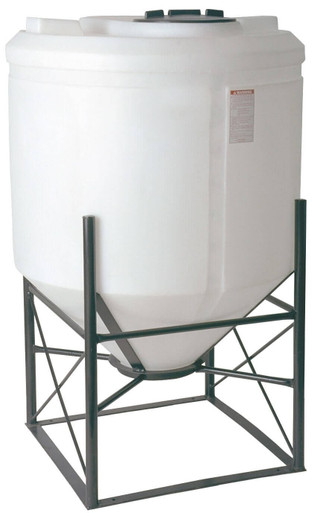
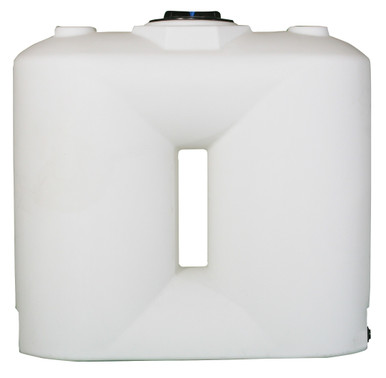
500 Gallon 30 Degree Cone Bottom Tank from Norwesco.
Technical Drawing
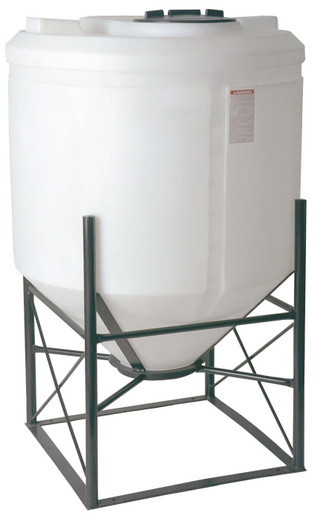
Official Norwesco technical drawing — 500 Gallon 30 Degree Cone Bottom Tank
Specifications at a Glance
Every figure below is pulled straight from the live product record for this exact tank — the same data on the product page, so what you read here and what you buy never disagree.
Standards & Materials
- ASTM D1998 — Standard Specification for Polyethylene Upright Storage Tanks. Governs wall-thickness and hydrostatic design for vertical rotomolded poly tanks of this class.
- FDA 21 CFR 177.1520 — Olefin polymers. The food-contact regulation the FDA-grade resin in this tank is compounded to meet.
- Specific gravity rating 1.5 — the tank is engineered for liquids up to 1.5× the density of water (water is about 8.34 lb/gal). Confirm your fluid’s SG before storage.
Installation and Setup Guide
The 30-degree cone strikes a deliberate middle path: steeper than a 15-degree slope so it drains a wider range of liquids cleanly, but shallower than a 45-degree cone so it does not force you to build a tall stand. On a 500-gallon vessel that balance matters, because at this volume the difference of a few cone degrees translates into real stand height and real working-platform decisions. As with every cone tank, the structure beneath it is what you are actually installing.
The Stand Comes First
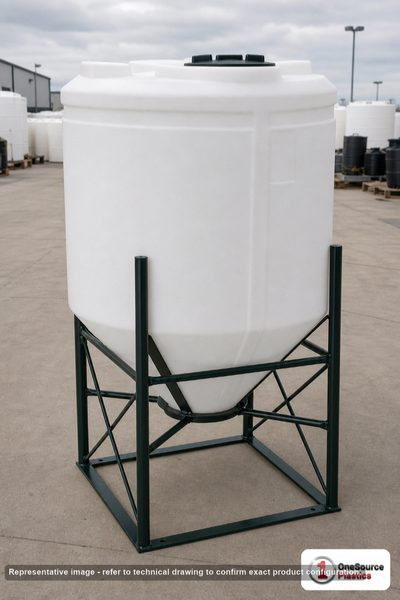
A cone-bottom tank has no flat base; it must hang in a stand sized for both its diameter and its full loaded weight. Source or build that stand before the tank arrives, confirm its conical seat matches this 500-gallon body, and rate it generously above the wet weight of 500 gallons of your specific liquid. Set it on a hard, level, non-settling surface and bring the legs into true plane before the cone goes in.
Seating the Cone
Lower the tank so the cone beds evenly all the way around the seat. Continuous contact is the goal; any gap leaves an unsupported span that becomes a stress riser under load. The apex is strictly a drain point — never let it bear weight against a hard surface.
Outlet and Venting
Plumb the bottom outlet with schedule 80 PVC or stainless, support the line independently in the first foot, and add a full-port valve for batch control. Vent the lid to suit your chemistry so the tank can breathe on fast fills and draws without dimpling the upper wall or pressurizing. Because a cone empties briskly once the valve opens, size the vent for your real draw rate, not a token breather.
Maintenance and Long-Term Care
A 30-degree cone in chemical-batch duty wants the same disciplined attention as any cone tank: watch the structure under load and watch the chemical path, with the cone tip getting the closest look.
Routine Inspection
- Stand and seat: Quarterly, check the legs, joints, and footings for corrosion, cracking, or settlement, and confirm the cone still nests fully in its seat.
- Bottom outlet: The lowest point of the cone collects sediment and the strongest concentration. Inspect the fitting and valve for weeping and hand-snug any joint that has crept.
- Cone shoulder: Look at the transition from sidewall to cone for stress whitening, the earliest visible sign that the load path needs correcting.
Cleaning Between Products
Drain fully through the cone, then rinse from the top. The sloped bottom clears the vessel far more completely than a flat floor, which is the entire reason to choose a cone. When you switch chemistries, follow the incoming product's decontamination steps and verify polyethylene compatibility before refilling. This is process equipment for chemical service, not a potable-water tank, so cleaning targets cross-contamination rather than drinking-water sanitation.
Outdoor Service
If the tank lives outdoors, give the sun-facing side an annual check for chalking and add shade in extreme-UV regions; the molded-in UV package protects the resin but does not last forever. Indoors near a process line, UV is not a concern.
Alternatives and Comparisons
At 500 gallons the 30-degree cone is a versatile general-purpose batch tank, and its drain angle is the headline specification to weigh.
Why 30 degrees: A 30-degree slope drains most free-flowing and lightly settling liquids cleanly while keeping the stand height moderate, which is easier to fit under a normal ceiling than a 45- or 60-degree cone of the same volume. If you batch heavy slurries that need an aggressive evacuation, step up to a steeper cone and accept the added height. If you only handle thin, non-settling liquid, a shallower cone or a flat-bottom 500-gallon tank costs less and stands lower.
Other -Gallon Options
Frequently Asked Questions
How long will the 500 Gallon 30 Degree Cone Bottom Tank last?
With a properly rated stand and use within standard polyethylene temperature and density limits, a cone tank like this typically delivers 15 to 20 years. Complete self-drainage helps it last, since nothing sits stagnant attacking the cone between batches. A weak stand, thermal abuse, or incompatible chemistry are what cut that short.
What chemicals can I store in this tank?
It handles a broad range of agricultural and industrial liquids within polyethylene's compatibility range. Always confirm a specific product against a compatibility chart before storing it, and never use it for fuels, solvents, or flammables. As a cone-bottom batch vessel it is built for chemical service, not for drinking water.
Does this tank come with a warranty?
Norwesco backs the tank against manufacturing defects in materials and workmanship under normal use. That covers molded-in faults but not stand failures, overloading, incompatible-chemical attack, or impact damage. Keep your receipt and a photo of the seated installation for any claim.
Can I install this tank underground?
No. This is an above-ground cone tank with no ability to resist soil pressure; burying it would collapse the cone and void the warranty. For below-grade needs, our underground cistern and septic products are built and reinforced for that load.
Buying Considerations
Before ordering this 500-gallon, 30-degree cone, line up three things. First, a stand sized to the tank's diameter and rated for the full wet weight of your liquid — it is the load-bearing component and should be ordered with the tank if you do not already have one. Second, the installed height, since the cone plus stand needs vertical room and serviceable access to the lid and the bottom valve. Third, your chemistry, confirmed against a polyethylene compatibility chart. Listed at $1,149.39 before freight, with delivery quoted to your ZIP.
Related Products You May Need
Questions? Call (866) 418-1777 — our team knows these products inside and out and can help you select the right tank for your application.
Recommended Tanks for This Guide
Live pricing, updated automatically · estimate freight to your ZIP.