Calcium Hardness Scaling in High-Mineral Feedwater Storage Tanks: Langelier Saturation Index Math, Scale-Layer Buildup Rate, and the Cleaning Cadence That Keeps Bulkhead Fittings From Locking
High-hardness feedwater is the silent killer of well-water and rural-utility storage tank systems. The water leaves the source clear, the tank fills, the tank delivers - and over months to years a calcium carbonate scale layer builds on the wetted surface, on the bulkhead fitting threads, on the level-sensor probe, and on the outlet valve seat. By the time the operator notices reduced flow or a stuck valve, the scale is millimeters thick and represents a multi-day cleaning project plus replacement of any threaded fittings whose threads are now permanently displaced by mineral buildup. This is one of the most predictable maintenance failure patterns in tank operation, and it is also one of the most preventable if the procurement specification accounts for hardness chemistry from day one.
This guide walks the chemistry that governs calcium scaling, the Langelier Saturation Index (LSI) calculation methodology that predicts scaling tendency in any specific water sample, the scale-layer buildup rates documented in AWWA and EPRI feedwater research, the polyethylene tank wall behavior under scale conditions, the bulkhead fitting selection that minimizes thread-locking, and the cleaning cadence that keeps a hard-water tank serviceable across a 20-year life. Reference standards include AWWA C652 for tank disinfection, ASTM D511 for calcium hardness measurement, USGS Water-Resources Investigation Report 79-10 on natural water hardness mapping, and EPRI Technical Brief on industrial water scaling.
1. The Hardness Chemistry: Why Calcium Carbonate Wants to Precipitate
Calcium and magnesium dissolved in water exist as the bicarbonate form Ca(HCO3)2 and Mg(HCO3)2 when the water is in equilibrium with atmospheric carbon dioxide. The bicarbonate equilibrium is sensitive to pH, temperature, and dissolved CO2 concentration. When the water enters a storage tank and equilibrates with the lower partial pressure of CO2 in the tank headspace (the headspace is typically at atmospheric CO2 around 400 ppm, while groundwater may be at 2000-5000 ppm CO2 in the source aquifer), CO2 outgasses from the water. The reaction Ca(HCO3)2 to CaCO3 + CO2 + H2O proceeds to the right as CO2 leaves, depositing solid calcium carbonate on the wetted surface.
The driving force for this reaction is the Langelier Saturation Index, defined as LSI = pH actual - pH saturation, where pH saturation is the equilibrium pH at which the water is exactly saturated with respect to calcium carbonate. Positive LSI means the water is supersaturated and will deposit scale; negative LSI means the water is undersaturated and will dissolve any existing scale (and if no scale exists, will dissolve cement-bound aggregates in concrete and copper from copper plumbing). LSI of 0 is the chemical neutral point.
The simplified LSI calculation uses pH, total dissolved solids (TDS), calcium hardness (as CaCO3), total alkalinity (as CaCO3), and water temperature:
- pHs (saturation pH) = (9.3 + A + B) - (C + D)
- A = (log10(TDS) - 1) / 10
- B = -13.12 * log10(temp_C + 273) + 34.55
- C = log10(calcium_hardness_as_CaCO3) - 0.4
- D = log10(total_alkalinity_as_CaCO3)
Worked example for typical Texas Edwards Aquifer well water at 20 deg C: TDS 350 mg/L, calcium hardness 280 mg/L as CaCO3, total alkalinity 250 mg/L as CaCO3, pH 7.4. A = 0.154, B = 2.10, C = 2.05, D = 2.40. pHs = (9.3 + 0.154 + 2.10) - (2.05 + 2.40) = 7.10. LSI = 7.4 - 7.10 = +0.3, which is mildly scale-forming. Same chemistry warmed to 30 deg C raises LSI to +0.5 (scaling accelerates significantly with temperature).
2. Scale-Layer Buildup Rate Documentation
The EPRI water-treatment research and the AWWA Manual M55 on plastic pipe both reference field measurements of calcium carbonate scale buildup at 0.5 to 5 millimeters per year on cold-water surfaces at LSI between +0.3 and +1.0. The dependencies:
- Higher LSI - higher rate. LSI of +1.5 produces scale 3-5x faster than LSI of +0.3.
- Higher temperature - higher rate. 30 deg C scaling rate is approximately 2x the 20 deg C rate at the same LSI.
- Lower flow turbulence - higher rate. Stagnant zones (tank bottom, dead-leg fittings) scale faster than well-mixed zones.
- Surface roughness - higher rate. Rough surfaces nucleate calcium carbonate crystals more readily than smooth surfaces.
- Bulkhead fitting threads - dramatically higher rate. The interrupted geometry creates flow recirculation zones that concentrate scale at the thread roots.
For a typical agricultural well-water tank in central Texas (LSI +0.3, ambient 20-30 deg C), expect 1-2 mm scale on the tank wall after 10 years of service, 3-5 mm at the tank bottom where sediment and stagnant water concentrate, and 5-15 mm at threaded fittings where the geometry concentrates scaling. The fitting scale is the operational problem - it locks threaded connections, restricts flow, and eventually requires fitting replacement that can no longer be done by simple unthreading.
3. Polyethylene Tank Wall Behavior Under Scale
The good news for polyethylene tanks: the smooth, low-energy surface of HDPE and XLPE resists calcium carbonate adhesion at LSI below +1.0. Scale that does form is usually loose, friable, and removable by mechanical scraping or pressure-washing. This is a significant advantage over concrete tanks (where calcium carbonate scale chemically bonds to the cement matrix) and over carbon steel tanks (where scale forms preferentially over corrosion sites and removes only with acid).
The not-so-good news: scale buildup on the inner tank wall reduces effective tank volume by a percentage proportional to the wall scale thickness. A 2,500 gallon tank with 2 mm uniform wall scale loses approximately 30 gallons of effective capacity (1.2% volume reduction at 2 mm scale on a typical vertical tank surface area). At 5 mm wall scale, capacity loss is 75 gallons (3%) and the level-sensor calibration drifts because the wall position has moved inward. Tank-level reporting becomes unreliable until the scale is removed and the sensor is recalibrated.
The polyethylene wall itself does not degrade under calcium carbonate exposure - the chemistry is fully compatible across the LSI range that occurs in natural waters. Where polyethylene starts to have problems is when an acid descaling chemistry is used: hydrochloric acid at industrial concentrations can plasticize HDPE over extended exposure, and citric acid at warm temperatures can swell XLPE. Cleaning chemistry choice matters; we will return to this in Section 7.
4. Bulkhead Fitting Selection for Hard-Water Service
Bulkhead fittings are the primary scaling failure point in hard-water tank service. The thread geometry creates flow recirculation, concentrates scale at the thread roots, and eventually locks the fitting permanently. The fitting selection guidelines for hard-water service:
- Smooth-bore bulkheads preferred over threaded NPT. Smooth-bore polyethylene welded bulkheads (Banjo, Hayward, Norwesco-spec) reduce scale concentration at the wetted bore.
- Stainless steel 316 fittings preferred over plastic threaded fittings. Stainless smoother surface finish, lower scale adherence, and more aggressive descaling chemistry tolerance than plastic threads.
- Cam-and-groove (Camlock) preferred over screwed connections at tank outlet. Cam-and-groove disconnects easily even with scale buildup; screwed connections seize.
- Schedule the outlet at 6 inches above tank bottom. Sediment and concentrated scaling water settle to the bottom 4 inches; outlet above that draws cleaner water.
- Install a bottom drain and use it. Quarterly bottom drainage of 50 gallons removes the most heavily scale-loaded water before it can deposit on the lower wall.
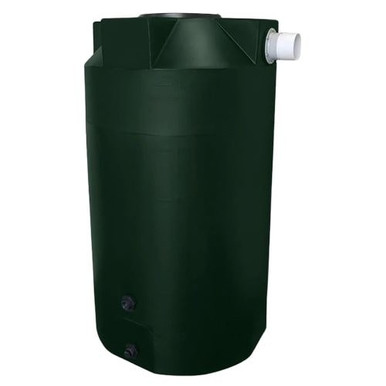
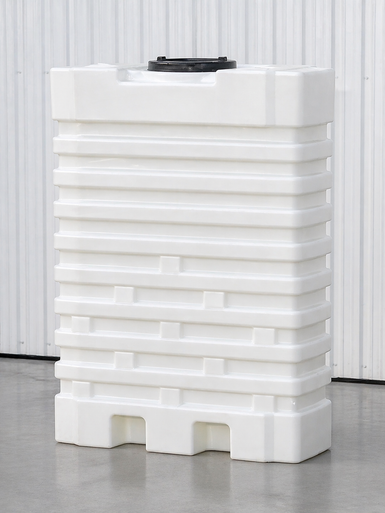
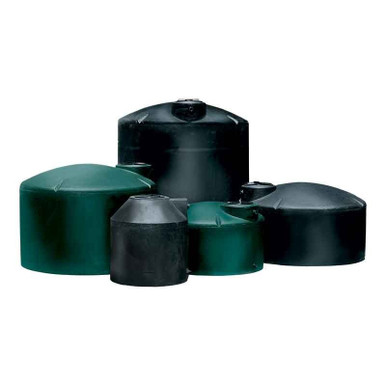
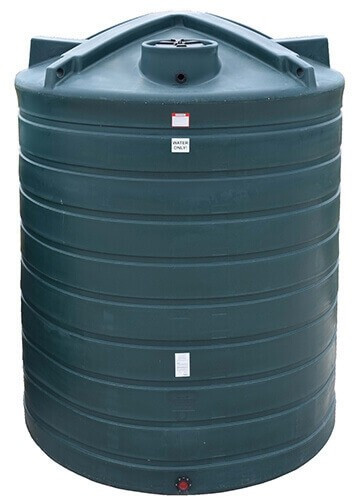
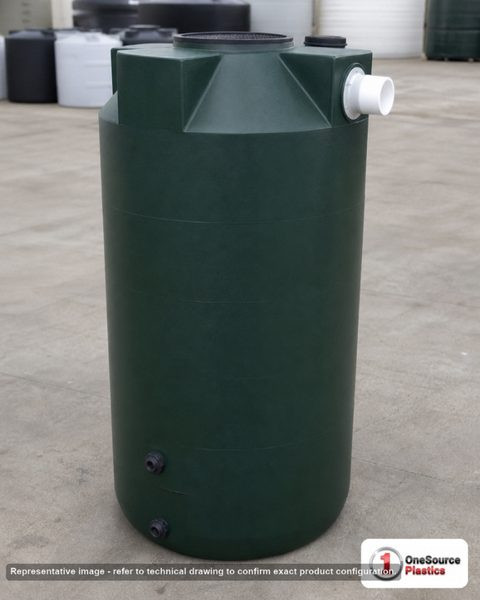
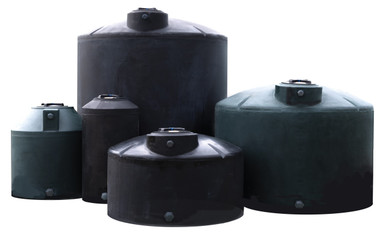
For tank selection, our catalog options that pair well with hard-water service include the Norwesco N-40146 1,500 gallon vertical (factory bulkhead options, schedule 80 PVC fittings preferred) and the Norwesco N-43675 925 gallon horizontal leg tank (compact form factor for skid-mount with cam-and-groove outlet). The smaller Norwesco N-44800 100 gallon doorway tank is appropriate for point-of-use hard-water service where the tank can be physically removed for cleaning every 12-24 months.
5. Cleaning Cadence and Method
The cleaning cadence depends on LSI severity:
- LSI -0.5 to +0.0 (slightly aggressive to neutral): No scale forms. Inspect tank annually for biofilm rather than scale. Clean per AWWA C652 disinfection protocol every 2 years.
- LSI +0.0 to +0.3 (mildly scale-forming): Bottom drainage quarterly, full inspection annually, mechanical cleaning every 5-7 years.
- LSI +0.3 to +1.0 (moderately scale-forming, most rural well water): Bottom drainage quarterly, fitting inspection semi-annually, mechanical cleaning every 3-5 years, descaling acid wash if mechanical cleaning is insufficient.
- LSI +1.0 to +2.0 (aggressively scale-forming, hard groundwater regions): Bottom drainage monthly, full inspection quarterly, mechanical cleaning every 1-2 years, dedicated water-softening pre-treatment is the better long-term answer.
Mechanical cleaning protocol: drain the tank to the bottom port, enter with confined-space permit and atmospheric monitoring, remove loose scale with plastic scrapers (NOT steel - steel scratches the polyethylene wall and creates nucleation sites for future scale), pressure-wash with cold water at 1500-2500 psi (avoid hot water above 50 deg C with HDPE; XLPE tolerates hot water to 80 deg C), inspect the wall for damage, refill, and disinfect per AWWA C652.
Acid descaling protocol when mechanical alone is insufficient: use 10% citric acid solution at ambient temperature, fill the tank to operating level, circulate for 4-6 hours with a small recirculation pump drawing from the tank outlet and returning through a top fill port, monitor pH (rises from 2.0 to 3-4 as scale dissolves and consumes acid), replenish acid as pH rises, drain and rinse 3x with fresh water, then disinfect. Citric acid is preferred over hydrochloric or sulfuric for polyethylene compatibility and operator safety.
6. Pre-Treatment Options That Eliminate The Problem
For sites with chronic high-LSI water, pre-treatment is more cost-effective than perpetual descaling:
- Ion-exchange softening - sodium-based exchange replaces Ca and Mg with Na, eliminates scaling, increases sodium content (issue for sodium-restricted users and for some agricultural irrigation applications).
- Reverse osmosis - removes 95-99% of dissolved solids including hardness. Capital cost higher than ion exchange; operational cost dominated by replacement membranes and concentrate disposal.
- Acid injection - sulfuric or hydrochloric acid injected upstream of the tank to reduce alkalinity and shift LSI negative. Requires careful pH control to avoid corrosion downstream of the tank.
- Chelation (polyphosphate) - food-grade polyphosphate at 2-5 mg/L sequesters calcium and prevents scaling without removing it. Inexpensive, simple, no waste stream. Limited to drinking water applications because polyphosphate in agricultural feedwater can interfere with some pesticide chemistries.
- Magnetic and electromagnetic conditioners - marketed but not validated by independent peer-reviewed research. Skip unless backed by reliable testimonial from site with comparable water chemistry.
7. Decision Matrix: When Hard-Water Tank Selection Differs From Standard
The selection differences for hard-water service vs standard service:
- Tank material: XLPE preferred over HDPE for hard-water service because XLPE tolerates the warmer cleaning water (50-70 deg C) needed to fully remove scale. HDPE limits cleaning to ambient or warm rinse only.
- Tank color: White or natural preferred over dark colors. Lower solar gain reduces in-tank water temperature, reduces LSI, reduces scaling rate. Black tank in southern latitudes runs 5-10 deg C warmer than white at same site, doubling scaling rate.
- Fittings: Cam-and-groove or smooth-bore bulkhead. Avoid threaded NPT in the wetted path where possible.
- Bottom drainage: Mandatory. Specify a 1-1/4 inch or 2-inch bottom drain port at tank bottom for quarterly sediment flushing.
- Top access: 18-inch or 24-inch manway for confined-space cleaning entry. 8-inch fill port is too small for personnel access if cleaning becomes necessary.
- Level instrumentation: Non-contact (radar or ultrasonic) preferred over hydrostatic or float for hard-water service. Submerged sensors scale and drift in 1-2 years. Non-contact reads above the water surface and stays accurate.
8. Action Checklist for Hard-Water Storage Procurement
- Pull a recent water analysis from the source. State drinking-water laboratory results, USDA NRCS soil-and-water lab analysis, or equivalent. Need pH, calcium hardness as CaCO3, total alkalinity as CaCO3, TDS, and water temperature.
- Calculate LSI using the simplified formula in Section 1, or use one of the public calculators (USGS, AWWA, or APSP for swimming pool variants).
- If LSI is above +0.3, document the projected scale-forming rate and the cleaning cadence in the procurement specification. The site operator will need this for budgeting.
- Specify XLPE if cleaning cadence is more aggressive than every 5 years, or if cleaning will involve warm-water rinse. HDPE if scaling is mild and cleaning is mechanical only.
- Specify white or natural color unless aesthetic considerations override. Document the solar-gain trade-off in writing.
- Specify smooth-bore bulkhead or stainless steel fittings in the wetted path. Avoid threaded plastic.
- Specify bottom drainage port and 18-inch or 24-inch top manway.
- Specify non-contact level instrumentation (radar or ultrasonic) for any installation that will run more than 5 years between cleanings.
- Pre-purchase descaling chemistry inventory: 10% citric acid concentrate, plastic scrapers, pressure washer rated for cold water, AWWA C652 disinfection chemistry. Avoid surprise downtime when the first descaling is needed.
- Schedule the first inspection at month 18 and the first descaling cleaning at month 36 as default cadence; adjust based on observed scale buildup rate.
OneSource Plastics carries the polyethylene tanks suitable for hard-water service across the Norwesco, Snyder, and Enduraplas product lines. For LSI calculation, hard-water-service tank specification, and bulkhead fitting selection, call us at 866-418-1777 with your most recent water analysis on hand. Reference pricing for representative SKUs: Norwesco N-40146 1,500 gallon vertical at $2,837.16 list; Norwesco N-44800 100 gallon doorway tank at $408.99 list; Norwesco N-43675 925 gallon horizontal leg tank at $2,427.90 list. LTL freight to your ZIP is quoted via the freight estimator.
For complementary reading on water-quality management and tank service-life topics, see our tank cleaning maintenance schedule and the chemical compatibility hub. For the related topic of polyethylene service-life prediction in outdoor water service, see our UV degradation guide.
Recommended Tanks for This Guide
Live pricing, updated automatically · estimate freight to your ZIP.