Norwesco Doorway, Vertical, Horizontal, and Cone Tanks: Geometry Selection by Use Case
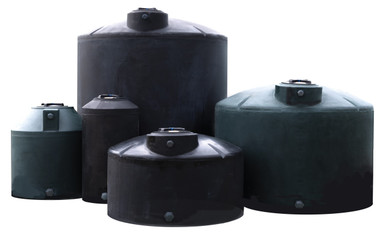
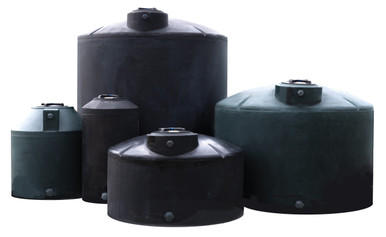
Norwesco produces polyethylene tanks across five primary geometries: vertical, horizontal cradle, horizontal leg, doorway (slimline), and cone-bottom. Each geometry exists for a specific reason. Picking the wrong one for your application leaves you with a tank that holds the right gallons but doesn't drain, doesn't fit, doesn't transport, or doesn't survive the chemistry. This guide is the geometry selection framework.
Real Norwesco SKU references are pulled from the OneSource Plastics catalog 2026-03-26 snapshot. Norwesco produces 1,200+ SKUs across these geometries; we cite representative examples. The decision framework applies whether you're sourcing a 35-gallon leg tank for a sprayer rig or a 10,500-gallon vertical for industrial process water.
The Five Norwesco Geometries
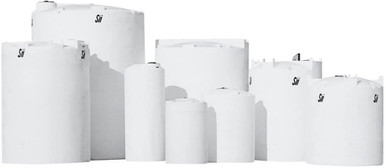
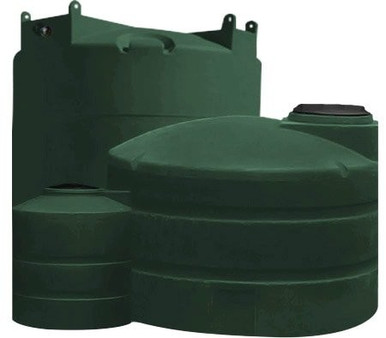
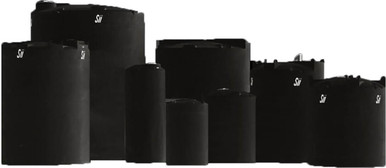
- Vertical — cylindrical tank standing on its flat bottom. The default for stationary above-ground storage.
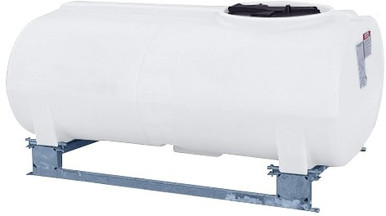
- Horizontal Cradle — horizontal cylindrical tank designed to rest in a separately-purchased steel or polyethylene cradle stand. Common for stationary horizontal installs in low-headroom locations.
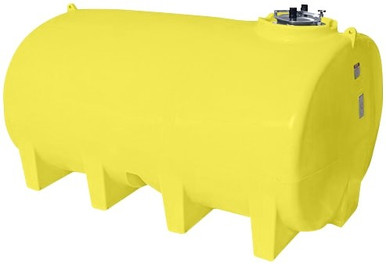
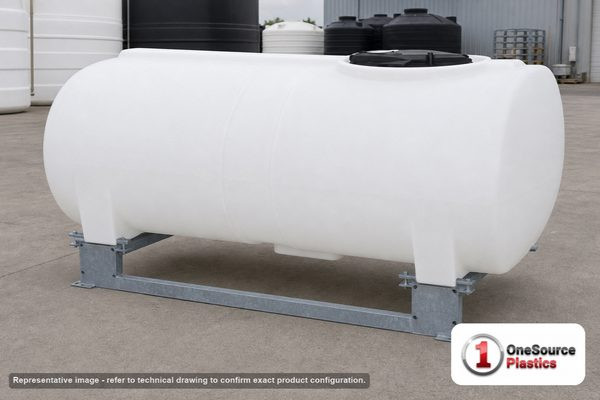
- Horizontal Leg — horizontal cylindrical tank with integrally-molded support legs. No separate stand required. Common for transportable applications and mobile sprayer rigs.
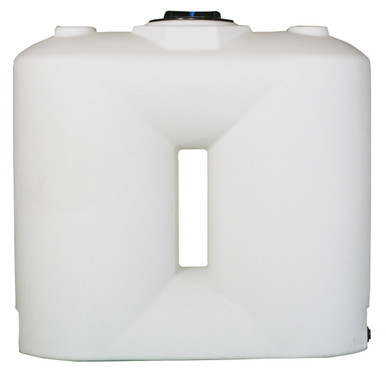
- Doorway (slimline) — rectangular-with-rounded-ends tank with a narrow dimension that fits through standard doorways. For installations behind doors that can't accept standard verticals.
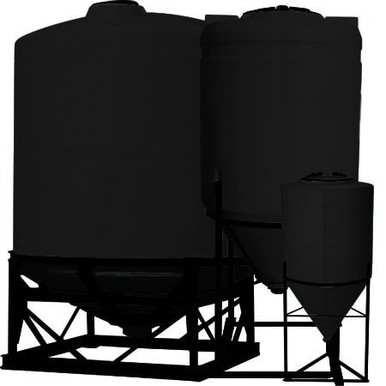
- Cone-Bottom — vertical tank with sloped (typically 15-degree, 30-degree, or 45-degree) bottom for full drain-down. Requires elevation on a separately-purchased stand.
Each is engineered for a specific service envelope. The first decision in any tank selection is which geometry, before you even look at gallons or material.
Geometry 1: Vertical Tanks — The Default
Vertical Norwesco tanks span the capacity range from small under-sink units to 10,500 gallons. Common configurations:
| SKU | Capacity | Color | SG | List Price |
|---|---|---|---|---|
| N-44844 | 10 gal | White | 1.5 | $99.99 |
| N-43808 | 1525 gal | Black | 1.0 (water) | $1,459.99 |
| N-40627 | 1550 gal | Black | 1.0 (water) | $1,365.29 |
| N-44129-C | 2000 gal | Black | 1.0 (water) | $1,960.50 |
| N-47888 | 2000 gal | Black | 1.5 | $3,289.99 |
| N-40941 | 5000 gal | White | 1.5 | $4,799.99 |
| N-44119 | 6600 gal | Green | 1.1 (water) | $6,889.44 |
| N-44395 | 8400 gal | White | 1.5 | $10,866.40 |
| N-47638 | 10,500 gal | White | 1.5 | $15,999.99 |
Use vertical tanks for:
- Stationary above-ground water or chemistry storage
- Site has floor area for the tank's full diameter footprint
- Ceiling clearance accommodates tank height
- Application doesn't require full drain-down (use cone-bottom if full drain is critical)
- Visual fluid level monitoring matters (vertical tanks naturally show level on their cylindrical sidewall)
Don't use vertical tanks when:
- Floor footprint is constrained to a narrow corridor or alcove (use doorway)
- Headroom is below 60 inches (use horizontal cradle)
- Application needs total fluid drain-down for cleaning or batch chemistry (use cone-bottom)
- Tank must transport between sites (use horizontal leg)
Geometry 2: Horizontal Cradle Tanks
Horizontal cradle tanks are cylindrical tanks oriented on their long axis, supported by a separately-purchased steel or polyethylene cradle stand. They earn their place where headroom is constrained or where the tank length is acceptable but tank height is not.
Common Norwesco horizontal cradle SKUs:
- SKU N-40327 (300 Gallon Horizontal Elliptical Cradle in White, $829.99 list) — small footprint application, basement or low-ceiling install.
- SKU N-45746 (300 Gallon Horizontal Elliptical Cradle Offset, $856.00 list) — offset fitting orientation for installations against walls.
- SKU N-40328 (500 Gallon Horizontal Elliptical Cradle in White, $1,159.99 list) — mid-range stationary horizontal.
The cradle stand is a separate purchase. Norwesco specifies the cradle dimensions and load rating; using a non-matching stand voids warranty. Always order the matching cradle from your supplier; we ship cradles with the tank when you call OneSource at 866-418-1777.
Use horizontal cradle when:
- Headroom is below the height of an equivalent-capacity vertical tank
- Floor space is available in a corridor or against a wall
- Application is stationary (not transported between sites)
- Drain-down is acceptable from a sidewall outlet (the tank doesn't fully drain through a sidewall outlet; expect 1-3% residual)
Geometry 3: Horizontal Leg Tanks
Horizontal leg tanks have integrally-molded support legs. No separate stand required. Common for transportable applications: agricultural sprayer trailers, water hauling, mobile chemical service.
Common Norwesco horizontal leg SKUs:
- SKU N-45223 (35 Gallon Horizontal Leg in White, $138.74 list) — small ATV or pickup-bed sprayer.
- SKU N-45191 (65 Gallon Horizontal Leg in White, $279.99 list) — mid-range pickup or trailer.
- SKU N-45209 (925 Gallon Horizontal Leg in White, $1,781.76 list) — commercial sprayer trailer or mobile water hauling.
- SKU N-43675 (925 Gallon Horizontal Leg Black with Fitting Installed, $2,063.29 list) — same capacity, factory fitting install.
- SKU N-40775 (2035 Gallon HDPE Horizontal Elliptical Leg in Black, $4,638.43 list) — large mobile or stationary outdoor service.
- SKU N-41294 (2635 Gallon HDPE Horizontal Elliptical Leg in Black, $7,151.00 list) — largest commonly-stocked horizontal leg.
- SKU N-40283 (2635 Gallon HDPE Horizontal Elliptical Leg in Blue, $6,589.80 list) — same capacity blue 1.9 SG variant.
The integrally-molded legs distinguish horizontal leg from horizontal cradle. The legs are part of the rotomold; you can't remove them or substitute a different stand. The advantage is single-piece construction and transportability. The disadvantage is the legs occupy floor footprint that an equivalent-capacity vertical wouldn't, so for stationary installs in space-constrained areas the cradle version is often a better choice.
Use horizontal leg when:
- Tank must transport (sprayer trailer, water-haul truck, mobile service)
- Site has open ground area for leg footprint
- Tank may be moved or relocated within the facility
- Outdoor application where the mounted legs are protected from frost heave (horizontal legs assume firm bedding; soft soil settling tilts the tank)
Geometry 4: Doorway (Slimline) Tanks
Doorway tanks are rectangular-with-rounded-ends, dimensioned so the narrow face fits through a standard 30-36 inch interior doorway. The full doorway selection guide is at Norwesco Doorway Tank Sizing Guide; this section covers when to choose doorway vs the alternatives.
Use doorway when:
- Tank install location is behind a door that the tank must pass through
- Door width is between 24 and 40 inches (matching tank narrow dimension)
- Capacity needed is 100 to 1,000 gallons (the doorway range)
- Vertical or horizontal alternatives don't fit through the access
Don't use doorway when:
- Tank installation has unrestricted access (use vertical — cheaper per gallon, easier inspection)
- Capacity above 1,000 gallons is needed (no doorway product at scale)
- Application needs full drain-down (doorway has flat bottom, not cone)
- Application is mobile or transported (use horizontal leg)
Geometry 5: Cone-Bottom Tanks
Cone-bottom tanks have a sloped bottom that funnels fluid to a centered drain outlet. They earn their place where complete fluid drain-down is operationally critical: batch chemistry, slurry holding, food-grade processing, sludge accumulation. The cone requires elevation on a separately-purchased steel stand.
Norwesco's cone-bottom line includes 15-degree cones (gentle slope, less stand height required) and 30-degree or 45-degree cones (steeper slope, faster drain, more stand height needed). Specific SKUs are in the cone-bottom catalog category.
Use cone-bottom when:
- Application needs total drain-down with minimal residue
- Process is batch-style (fill, react, drain, refill)
- Slurry contains settled solids that need full evacuation
- Cleaning between batches requires zero cross-contamination
Don't use cone-bottom when:
- Application is steady-state continuous flow (vertical with sidewall outlet is cheaper and equivalent)
- Site can't accommodate the elevation height needed for the stand + cone
- Fluid is fully soluble water with no settling concerns
- Capacity above 2,500 gallons is needed (cone-bottom max is typically that range; above that, look at vertical with sloped insert or specialty fabrication)
For full guidance on cone-bottom stand selection, see our Cone-Bottom Stand Compatibility companion post.
Geometry Decision Tree
Walk through these questions in order:
- Does the tank need to transport between sites? Yes → horizontal leg. No → continue.
- Does the application need total drain-down? Yes → cone-bottom. No → continue.
- Is the install behind a doorway or in a constrained alcove? Yes (and capacity is 100-1000 gal) → doorway. No → continue.
- Is the headroom below the height of an equivalent vertical tank? Yes → horizontal cradle. No → vertical.
This four-question decision tree gets you to the right geometry in 90% of cases. The remaining 10% require trade-off analysis between two geometries (typically vertical vs cone-bottom for chemistry batching, or doorway vs horizontal cradle for tight basements).
Use Case Pairings
| Use Case | Recommended Geometry | Example Norwesco SKU |
|---|---|---|
| Residential well water storage | Vertical white | N-41527 (300 gal) |
| Outdoor agricultural water | Vertical black | N-43808 (1525 gal) |
| Industrial process water | Vertical white 1.5 SG | N-40941 (5000 gal) |
| Basement pump-house water | Doorway white | N-44960 (300 gal) |
| Brewery rinse water | Doorway white | N-44549 (400 gal) |
| Greenhouse fertigation concentrate | Doorway white | N-42337 (250 gal) |
| Pickup-bed sprayer | Horizontal leg | N-45191 (65 gal) |
| Pull-behind sprayer | Horizontal leg | N-45209 (925 gal) |
| Field-service water hauling | Horizontal leg | N-41294 (2635 gal) |
| Low-headroom basement chemistry | Horizontal cradle | N-40328 (500 gal) |
| Batch chemistry mixing | Cone-bottom | Cone-bottom catalog |
| Pretreatment sludge holding | Cone-bottom | Cone-bottom catalog |
| Large-scale industrial storage | Vertical 1.5 SG | N-47638 (10,500 gal) |
Geometry-Specific Mistakes
Vertical mistake: ordering an oversized tank for a constrained pad
Verticals scale fast in diameter as capacity increases. A 5,000-gallon vertical is roughly 95 inches diameter; a 6,500-gallon is 102 inches; a 10,500-gallon is 142 inches. Verify pad dimensions before ordering, especially in retrofit installations where the original pad was sized for a different tank.
Horizontal cradle mistake: forgetting the cradle stand
The cradle is a separate purchase. Norwesco horizontal cradle tanks ship without the stand. Confirm the stand is on the same order; otherwise you'll receive a 500-gallon tank with no place to set it.
Horizontal leg mistake: installing on soft or uneven ground
The integrally-molded legs distribute weight to four points. If the ground settles unevenly under one leg, the tank tilts, fluid level reads incorrectly, and the wall stress redistributes non-uniformly. Specify a level pad or compacted bedding for any horizontal-leg install above 500 gallons.
Doorway mistake: not measuring the actual clear opening
Casing-to-casing measurement is wider than clear opening. Always measure with the door open to 90 degrees, frame to frame. Subtract 1 inch for safety. The doorway tank's narrow dimension must be at or below this measurement. See the Doorway Sizing Guide for the full pre-order checklist.
Cone-bottom mistake: skimping on the stand height
The cone-bottom needs sufficient stand elevation to put a 5-gallon bucket or larger drain container under the discharge valve. A 30-degree cone on a 1,500-gallon tank typically needs 36+ inches of stand height. Specify the stand height to match your drain workflow.
Mixing Geometries in a Single System
Most facilities run multiple geometries in series:
- Vertical bulk storage for primary fluid
- Doorway day-tank in mechanical room for metering pump suction
- Cone-bottom for batch chemistry and sludge
- Horizontal cradle in low-headroom space
- Horizontal leg for transport between facilities
Don't force a single geometry where the application calls for two. The right answer is often a smaller doorway day-tank fed from a larger vertical bulk storage, with a small cone-bottom for batch reactions, all integrated by piping. Total system cost may be slightly higher than a single tank, but operational efficiency and replacement-ease are dramatically better.
Material Considerations Across Geometries
All five geometries are produced in HDPE 1.5 SG (general industrial), HDPE 1.9 SG (heavy chemistry), XLPE 1.9 SG (cross-linked for aggressive chemistry), and HDPE 1.0 / 1.1 SG (water-only). Color options vary by geometry:
- Vertical: white (NSF/FDA standard), black (UV-protected outdoor), green (agricultural), blue (signaling 1.9 SG), natural translucent (sight-glass).
- Horizontal cradle and leg: white, black, blue, green.
- Doorway: white, black, green, natural-white. (No blue 1.9 SG in doorway profile typically.)
- Cone-bottom: white, black.
The blue 1.9 SG color is industry-standard signaling for heavy chemistry tanks. If you see a blue Norwesco tank, it's a 1.9 SG construction regardless of size. White is the default for general service.
Internal Resources
- Water Storage Tanks — full vertical and horizontal water catalog
- Chemical Storage Tanks — XLPE 1.9 SG and chemistry-rated geometries
- Cone-Bottom Tanks — full drain-down catalog
- Doorway Tanks — slimline catalog
- Horizontal Leg Tanks — mobile and transportable
- Doorway Sizing Guide — companion post
- Cone-Bottom Stand Compatibility — companion post
- Tank Spec Sheet Decoded — engineering fundamentals
- Freight Cost Estimator — LTL quote to your ZIP
Source Citations
- Norwesco product specification sheets, current production catalog
- OneSource Plastics master catalog data, dated 2026-03-26 snapshot
- ASTM D1998 — Standard Specification for Polyethylene Upright Storage Tanks
- NSF/ANSI 61 — Drinking Water System Components: Health Effects
- FDA 21 CFR 177.1520 — Olefin polymers (food-contact polyethylene)
Recommended Tanks for This Guide
Live pricing, updated automatically · estimate freight to your ZIP.