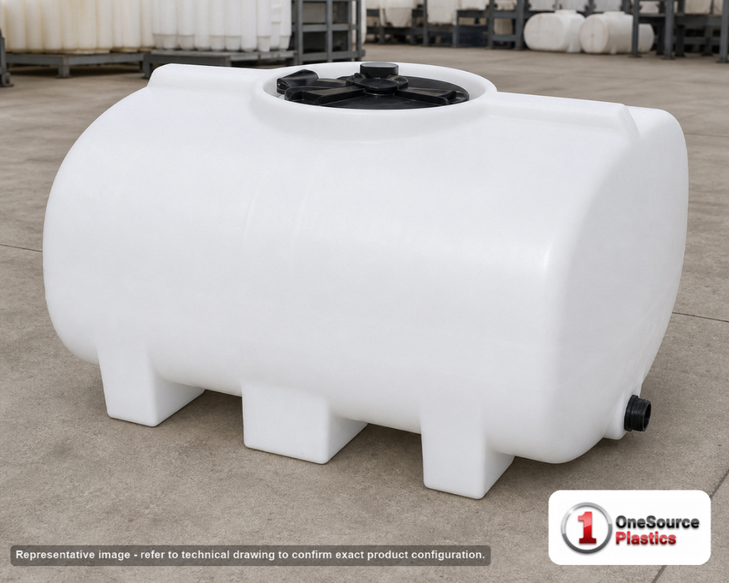
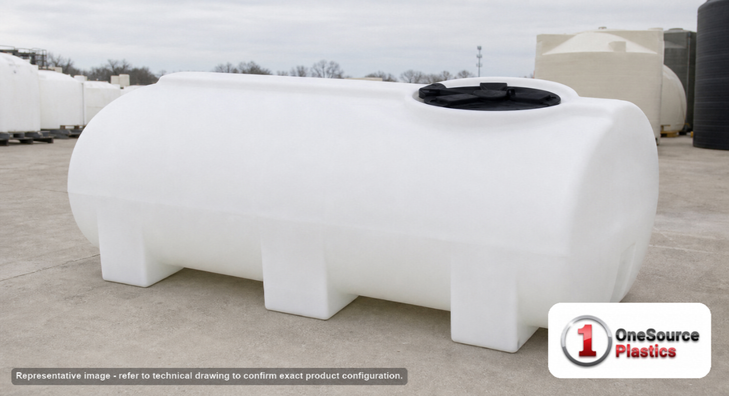
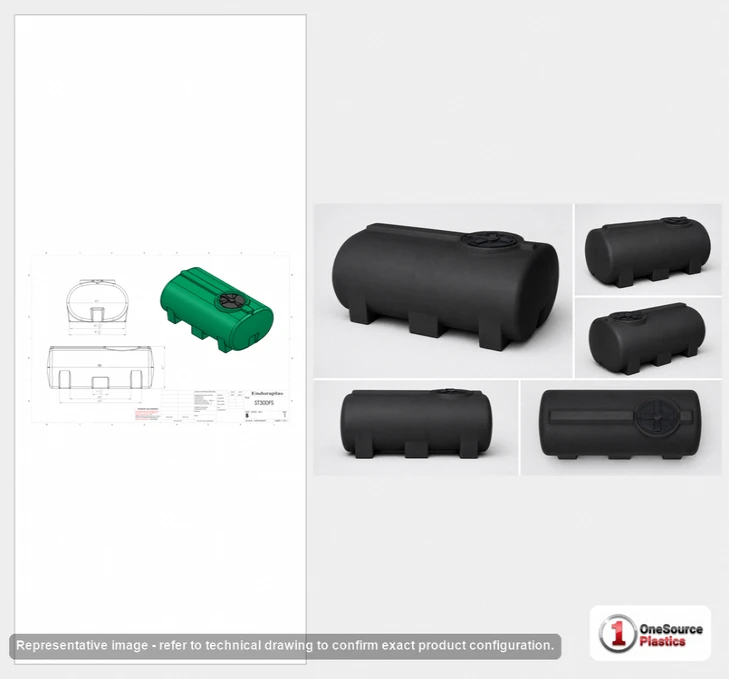
The Enduraplas 300 Gallon White Horizontal Sump Bottom Leg Tank is a transport-and-treat tank built for hauling and applying liquids that a plain water tank cannot handle. The molded polyethylene body holds 300 gallons in a 74 in. long by 46 in. wide footprint, stands 36 in. tall on its integrated frame, and carries a 1.9 specific gravity rating, which is why this enduraplas horizontal leg tank turns up on so many fertilizer, applicator, and chemical-haul rigs. The sump bottom drains the tank fully, and the low leg-tank profile sits stable on a trailer or skid.
Will it work for your load?
Start with weight, because that is what trips up a 300 gallon tank buyer. Filled with water this tank carries 2,502 lb of contents; because it is rated to 1.9 specific gravity, the maximum rated contents weight climbs to 4,754 lb. Run the Tank Sizing Calculator with your own product's specific gravity before you spec the trailer, the mount, and the tie-downs, and use the Tank Sizing Guide if you are sizing a fleet. The 46.0 x 74.0 in. footprint is the number to match against your deck. One thing a 300 gallon horizontal hauler does that an upright tank does not: dense product at 1.9 SG sloshes hard during transport, so account for surge load in your mounting and driving, not just the static weight. Confirm fitting size and locations against the technical drawing on this page, or by phone at 866-418-1777, before you finalize plumbing.
Chemical compatibility
This is a polyethylene tank with a 1.9 specific gravity rating, which is what makes it a chemical-service tank rather than a plain water hauler. Our resin designation for this tank is not fully confirmed, so confirm HDLPE vs XLPE (and its temperature rating) for your specific chemical before you commit it to service. Compatibility is concentration- and temperature-specific; always verify against the OEM chemical-resistance chart for your exact product and strength. The following chemicals have published compatibility at the noted concentrations, with the recommended fitting and gasket materials:
- Acetic Acid (60%) - PP/PVC fittings, EPDM gaskets
- Aluminum Sulfate (50%) - PVC fittings, EPDM gaskets
- Calcium Chloride (40%) - PVC fittings, EPDM gaskets
- DEF (32.5%) - 316SS fittings, EPDM gaskets
- Ethylene Glycol (100%) - PVC fittings, EPDM gaskets
- Ferric Chloride (50%) - PVC fittings, EPDM gaskets
- Ferric Sulfate (60%) - PVC fittings, EPDM gaskets
- Ferrous Sulfate (20%) - PVC fittings, EPDM gaskets
- Hydrochloric Acid (37%) - PVC fittings, Viton gaskets
- Hydrofluoric Acid (48%) - PP/PVC fittings, Viton gaskets
- Hydrofluosilicic Acid (26%) - PP/PVC fittings, Viton gaskets
- Hydrogen Peroxide (50%) - PVC fittings, Viton gaskets
- Magnesium Chloride (30%) - PVC fittings, EPDM gaskets
- Peracetic Acid (30%) - 316SS fittings, Aflas gaskets
- Phosphoric Acid (85%) - PVC fittings, Viton gaskets
- Polyaluminum Chloride - PVC fittings, EPDM gaskets
- Potassium Carbonate (50%) - PVC fittings, EPDM gaskets
- Potassium Hydroxide (saturated) - PVC fittings, EPDM gaskets
- Propylene Glycol - PP/316SS fittings, EPDM gaskets
- Sodium Bisulfate - PVC/PP fittings, EPDM gaskets
- Sodium Bisulfite - PVC/PP fittings, EPDM gaskets
- Sodium Carbonate (30%) - PVC fittings, EPDM gaskets
- Sodium Hypochlorite (<16.5%) - PVC fittings, Viton gaskets
- Sodium Thiosulfate (40%) - PVC fittings, EPDM gaskets
- Sulfuric Acid (98%) - CPVC fittings, Viton gaskets
- Urea Solution (50%) - PP/PVC fittings, EPDM gaskets
- Zinc Orthophosphate - PP/316SS fittings, EPDM gaskets
- Ozonated Water (up to 10 PPM) - PVC fittings, EPDM gaskets
For the full matrix and to confirm your chemical, see our chemical compatibility resource. Two pairings on this list deserve attention: Sodium Hypochlorite calls for Viton, not EPDM, and benefits from venting because it off-gasses, and DEF demands 316 stainless fittings - a detail the fertilizer applicator and leg tank guide covers alongside DOT scope for non-roadable trailers.
The mistake to avoid
Do not assume the 1.9 specific gravity rating means any chemical at any strength is safe. That rating governs the structural load the tank wall can carry, not chemical attack - two separate checks. A dense brine can sit inside the weight rating while a strong oxidizer at high concentration still degrades the resin or the wrong gasket. Verify the specific gravity against the weight math and the chemical against the resistance chart, and match your fitting and gasket materials to the list above. If you are blending fertilizer, the tank stratification guide explains why density-driven layering can throw your spreader off-spec.
This tank ships LTL freight from the Enduraplas plant in Neche, ND, quoted live to your delivery ZIP - get your number in seconds with the Freight Cost Estimator or call 866-418-1777. Listed before freight; LTL is quoted separately to your ZIP.
Freight and documents
Ships from: Neche, ND. LTL freight is quoted to your ZIP with the freight cost estimator or by phone at 866-418-1777. The listed price is before freight.
See this tank
Interactive 3D model with live fill. This tank has an interactive 3D model built to its manufacturer dimensions. Rotate it, and set a fill level to see how much liquid it holds at any height. Open the 3D view on the product photo above. Download the 3D model (GLB).
Product video. Watch the Enduraplas 300 Gallon White Horizontal Sump Bottom Leg Tank w/ Frame video (62 seconds) with dimensions, fittings and shipping notes.
Ready to order?
Add it to your cart at the top of this page, get LTL freight to your ZIP, request a written quote, or call 866-418-1777. The listed price is before freight.