Sodium Hypochlorite 12.5% Trade Strength: Outgassing Chemistry, Degradation Kinetics, and Chiller-Cooled Storage Architecture for Long-Hold Municipal Disinfection Inventory
Sodium hypochlorite at 12.5 percent trade strength (commonly written 12.5% NaOCl, sometimes referred to as 12.5 percent available chlorine) is the standard form delivered to municipal water-treatment plants, large industrial cooling-water programs, and high-volume sanitation operations. It arrives at the receiving tank fresh, holds reasonably well for the first few weeks, and then begins a self-decomposition cascade that produces oxygen gas, sodium chlorate, and progressively lower available-chlorine concentration. The kinetics of that decomposition are temperature-dependent, transition-metal-catalyzed, and pH-sensitive, and the operational consequence at warm storage temperatures is significant: a 12.5 percent solution can lose 30-50 percent of its available chlorine in 30 days at a tank temperature of 95 degrees F, while the same solution at 50 degrees F loses only 5-10 percent over the same period.
This article walks the chemistry and the engineering response. The chemistry: outgassing mechanisms, decomposition pathway, the half-life table, and the catalytic-impurity sensitivity. The engineering: chiller-cooled storage architecture, vent geometry for the oxygen offgas, headspace inerting considerations, tank material selection for long-hold service, sample-and-monitor protocols, and the operational economics of cold storage versus the avoided overdose-then-rebuy cost cycle. References cited: AWWA B300 standard for hypochlorites, AWWA M20 manual for water disinfection chemicals, NIST chemistry data for thermodynamic properties, EPA SDS for sodium hypochlorite (CAS 7681-52-9), and manufacturer technical bulletins published by the major NaOCl producers (Olin, Westlake, Hill Brothers).
1. The Decomposition Pathway and the Three Reaction Routes
Sodium hypochlorite in aqueous solution decomposes through three competing pathways. Each pathway is well-characterized and the kinetics are documented in AWWA M20 and the open literature.
Pathway 1: oxygen-evolution decomposition (transition-metal catalyzed). 2 NaOCl → 2 NaCl + O2(g). This is the primary route in the presence of trace transition metals (iron, copper, nickel, manganese), which catalyze hypochlorite ion to chloride plus oxygen. Field implication: any iron or copper contamination in the storage tank, transfer piping, or carrier truck dramatically accelerates this pathway. A storage tank with even minor iron contamination from a steel inlet fitting can outgas oxygen at 5-10 times the rate of a fully PVC-fittinged tank.
Pathway 2: chlorate disproportionation. 3 NaOCl → 2 NaCl + NaClO3. This pathway converts available-chlorine hypochlorite into sodium chlorate, which is non-disinfecting and a regulated water-treatment byproduct. Chlorate accumulation is the slow background decomposition that runs whether or not transition metals are present. Rate is temperature-dependent and accelerates strongly above 80 degrees F.
Pathway 3: light-driven decomposition. Hypochlorite ion absorbs UV at 290 nm and visible at 350 nm. Photolysis produces both O2 evolution and chlorate formation. Field implication: storage in sunlight-exposed tanks (especially natural-color polyethylene with significant light transmission) accelerates decomposition. Black or pigmented tanks substantially reduce this pathway.
The combined decomposition rate at storage conditions is the sum of all three. AWWA M20 publishes a half-life table for typical 12.5 percent solutions:
- 40 degrees F: half-life roughly 1,500 days (approx. 4 years).
- 60 degrees F: half-life roughly 600 days (approx. 1.6 years).
- 80 degrees F: half-life roughly 130 days (approx. 4 months).
- 100 degrees F: half-life roughly 35 days (approx. 5 weeks).
- 120 degrees F: half-life roughly 10 days.
The half-life is the time to drop from 12.5 percent to 6.25 percent available chlorine. The operational target for water-treatment dosing is to deliver 12.5 percent or higher; a tank that drops below 11 percent has lost enough chlorine to disrupt dose-rate calculations and either underdoses (failing disinfection) or compensates with higher pump rates (consuming more inventory). The practical target is less than 10 percent loss between deliveries, which converts into a hold-time limit by storage temperature.
2. Outgassing Volume Math and Vent Sizing for the Oxygen Generation Rate
Pathway 1 generates oxygen gas at stoichiometric 1 mole O2 per 2 moles NaOCl decomposed. For a tank holding 5,000 gallons of 12.5 percent NaOCl (specific gravity 1.20, mass 50,000 lb solution, hypochlorite mass 6,250 lb, hypochlorite moles 84,000), a 1 percent decomposition over 30 days liberates roughly 6,600 standard cubic feet of oxygen across that 30-day period. That is an average of roughly 220 SCFH of oxygen, peaking higher during warm-weather and lower at cool-weather conditions.
The vent on a 12.5 percent NaOCl tank has to handle the oxygen evolution rate plus the displacement during fill plus the thermal breathing during day-night cycles. Tank vent sizing per API 2000 should be calculated for the worst-case sum, not just the fill rate. Common field undersizing failure: a vent sized for fill displacement only, not for oxygen evolution, develops positive headspace pressure during a warm afternoon and either fails the vent gasket or overflows liquid back through the vent path. Hypochlorite vent failures are corrosion-accelerated by the chlorine vapor that follows the oxygen offgas; the vent geometry needs an open-flow path with no flame arrester or restrictive screens (NaOCl vapor is not flammable) and has to be inspected and cleared on a regular schedule.
The vent geometry that works for hypochlorite long-hold service:
- Mushroom-cap vent at minimum 4-inch nominal pipe size for a 5,000-gallon tank, scaling up to 6-inch for 10,000-gallon tanks.
- Vent stack discharge above any nearby walkway, work platform, or air intake; oxygen-rich exhaust is itself a fire-acceleration hazard near combustible material storage.
- Insect screen of corrosion-resistant material (Hastelloy C-276, titanium, or PVDF mesh); fiberglass and stainless screens are progressively attacked by chlorine vapor.
- Inspection access for the screen and vent throat at least quarterly; clear scale and crystallization deposits.
3. Chiller-Cooled Storage Architecture
The economics of chiller-cooled hypochlorite storage flip from cost-prohibitive to cost-positive at sustained warm-weather operation. The capital plus operating cost of a recirculating glycol chiller running on a 5,000-gallon NaOCl tank is offset by the avoided rebuy of degraded inventory and the avoided overdose costs.
The cooling-load calculation for a 5,000-gallon tank in a 95-degree-F summer ambient with 50-degree-F target storage:
- Tank surface area at 8-foot diameter, 12-foot tall: roughly 350 square feet.
- Polyethylene wall thermal resistance (3/8 inch wall): R-value 0.4. Insulation 2-inch fiberglass: R-value 8.0. Total R: 8.4 hr-ft²-degree F/Btu.
- Steady-state heat gain at 45-degree-F delta: (45 / 8.4) * 350 = 1,875 Btu/hr.
- Decomposition heat (exothermic): roughly 50 Btu/hr at this scale.
- Total cooling load: approximately 2,000 Btu/hr or 0.6 tons of refrigeration.
A 1-ton glycol chiller covers this load with margin and runs at roughly 0.7-1.0 kW continuous in summer conditions. Annual operating cost at 6 months of cooling and $0.12 per kWh: approximately $400-$600. Capital cost of the chiller plus glycol loop plus tank-mounted heat exchanger plate: $8,000-$15,000 for the 5,000-gallon scale. The avoided cost of 25 percent inventory degradation per quarter on a 5,000-gallon turnover (if 12.5 percent dropping to 9.5 percent forces the operator to buy fresh and credit the partially decomposed lot) is on the order of $4,000-$8,000 per year for typical municipal pricing of $1.20-$1.80 per gallon delivered.
The chiller-cooled architecture pays back in 2-4 years on warm-climate municipal scale. It is the standard solution at most southern-US water-treatment plants storing more than 30 days of inventory.
4. Tank Material Selection for Long-Hold NaOCl Service
Polyethylene is the standard material for sodium hypochlorite. Within polyethylene, the selection between linear-MDPE, HDPE, and crosslinked XLPE matters at long-hold conditions because antioxidant package consumption rates differ.
Linear MDPE (medium-density polyethylene): the standard rotomolded grade for chemical storage. Antioxidant package (typically Irganox 1010 plus phosphite) is consumed by hypochlorite at the wetted-wall band over 5-15 year service life depending on temperature. Adequate for moderate-temperature service.
HDPE (high-density polyethylene): higher crystallinity, better permeation resistance, similar chemistry response to MDPE for hypochlorite. Selected when permeation matters (shorter inventory turnover or food-grade adjacent service).
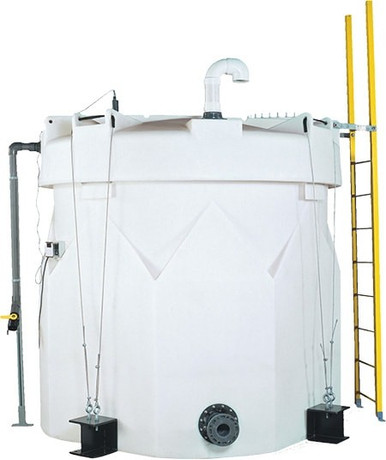
XLPE (crosslinked polyethylene): Snyder's standard for double-wall hypochlorite tanks. The crosslinked structure resists environmental stress cracking better than linear PE, particularly at the wetted-wall and dry-wall interface where antioxidant depletion concentrates. Premium choice for high-temperature or long-hold hypochlorite service.
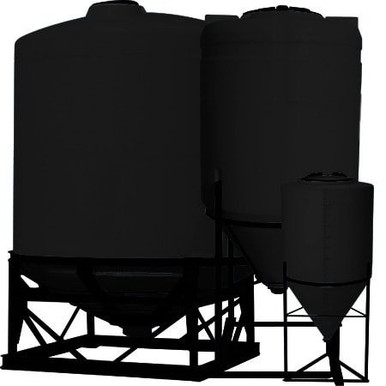
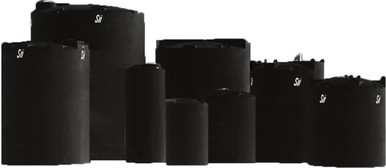
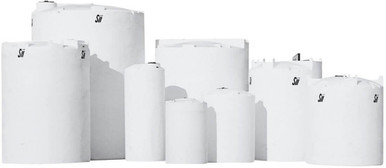
Tank color matters specifically for hypochlorite because Pathway 3 (light-driven decomposition) is photo-active. The selection: black is best for inventory protection but eliminates visual level monitoring; natural is worst for inventory protection but provides level visibility; pigmented blue or green offers the practical compromise of moderate light blocking with limited level visibility. AWWA B300 facilities increasingly default to pigmented or black tanks for 12.5 percent storage.
Reference 5-brand SKUs for 12.5 percent NaOCl service:
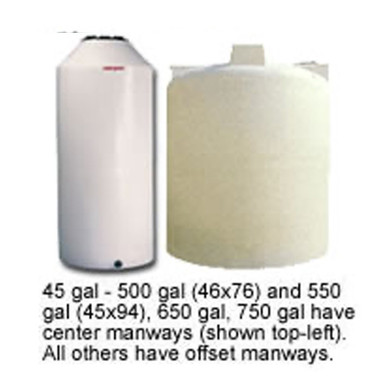
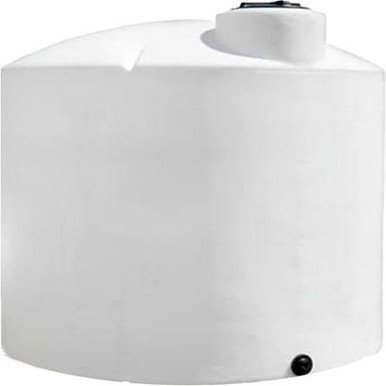
- Norwesco vertical: standard rotomolded MDPE in 1.9 specific-gravity rating. Reference N-40146 1,500 gallon for moderate volume; N-40164 5,000 gallon for bulk storage; N-43128 10,000 gallon for high-volume municipal.
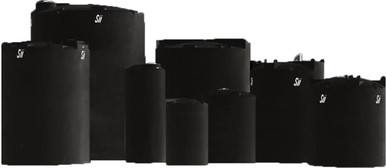
- Snyder Captor double-wall XLPE: integrated annular containment plus crosslinked-PE chemistry resistance. Reference SII-5990102N42 1,000 gallon and SII-5490000N42 1,550 gallon.
- Chem-Tainer HDPE vertical: reference TC6446IA 500 gallon for small-volume on-site dosing storage.
5. Pathway-Specific Mitigation Engineering
Each decomposition pathway has a specific mitigation that the operator can implement without changing the chemistry.
Pathway 1 mitigation (transition metals): source-control transition-metal contamination. Specify 100 percent PVC, CPVC, or PVDF wetted parts on all transfer piping. Avoid stainless-steel quick-disconnect fittings on hose ends — they leach trace iron and chromium. Verify carrier-truck tank lining and hose specifications; some carriers use steel hose ends that contaminate the receiving tank with iron. A carrier-side QA conversation can reduce on-arrival contamination by 80 percent. The Snyder Captor double-wall XLPE design with PVC bulkhead fittings and proper hose discipline can sustain less than 5 percent decomposition over 90 days at moderate temperatures, vs 25-40 percent decomposition with iron-contaminated fittings.
Pathway 2 mitigation (chlorate formation): temperature is the only practical lever. Chlorate formation is fundamentally thermodynamic; the only way to slow it is cold storage. The chiller architecture above is the operational response.
Pathway 3 mitigation (UV-driven): tank color and shade. Pigmented or black tanks block the relevant UV-visible spectrum. A shade canopy or building enclosure adds margin and is the standard architecture at southern-US plants where summer ambient and direct sun add 15-20 degrees F to tank-skin temperature beyond shade temperature.
6. Sample and Monitor Protocol for Inventory Quality
The operator should know the actual available-chlorine concentration of the inventory before it is dosed. The standard protocol:
- On-receipt sample: grab sample at receiving fitting before tank fill. Test for available chlorine by iodometric titration per AWWA Standard Methods 4500-Cl B. Verify within 0.5 percent of stated trade strength. Reject loads outside spec.
- Weekly tank sample during long hold: grab from a mid-tank sample valve. Test for available chlorine. Trend the data; declining concentration tells the inventory turnover plan when to use up the lot.
- Pre-dose sample: when the dosing pump pulls from the tank, verify concentration is above the operational floor (typically 11 percent). Adjust pump dose rate if available chlorine has dropped.
- Monthly chlorate measurement: ion-chromatography measurement of chlorate concentration. Trend against discharge regulations. Most US municipalities have a 0.7 mg/L chlorate limit at the tap; chlorate-laden hypochlorite stock can push close to that limit if the dose rate is high.
The protocol generates a chemistry record that supports the dose-rate engineering and provides regulatory evidence for any chlorate-related inquiry.
7. Regulatory and Reporting Framework
Sodium hypochlorite at 12.5 percent is an OSHA-regulated chemical (PEL at the chlorine release path), an EPA-regulated SARA Title III chemical at storage thresholds (10,000 lb for many states), and an AWWA-certified product when used in potable-water service (B300 certification on the lot).
SPCC (40 CFR 112): hypochlorite is not technically classified as oil under SPCC, but the AWWA-recommended best practice is to apply equivalent secondary containment and inspection discipline. Most state water agencies require 100 percent secondary containment on bulk hypochlorite storage above 1,000 gallons.
Risk Management Plan (40 CFR 68): hypochlorite is below the threshold quantity for RMP requirement on most plants; however, the chlorine release potential during a tank failure can trigger emergency-response notification.
SARA 313 and Tier II reporting: hypochlorite is reportable under EPCRA Tier II once storage exceeds 10,000 lb (commonly 1,000 gallons of 12.5 percent). The reporting package includes tank size, storage configuration, and emergency-response procedures.
AWWA B300 certification: for potable-water disinfection use, the hypochlorite lot has to carry AWWA B300 certification at delivery. The certification covers heavy-metal trace impurities, perchlorate trace, and other water-quality contaminants. Long-hold inventory that has decomposed but maintained available chlorine within spec is still B300-compliant if the source lot was; the certification is on the source, not the storage condition.
8. Operational Economics of Hold-Time Discipline
The discipline of running NaOCl inventory through a 30-60-day turnover at moderate storage temperature is more economical than running long-hold inventory at warm temperature without chiller cooling. The cost components:
- Inventory cost: 12.5 percent NaOCl at $1.20-$1.80 per gallon delivered to mid-Atlantic and southern-US markets. A 5,000-gallon storage tank holds $6,000-$9,000 of inventory.
- Decomposition cost: at 30 percent decomposition over 60 days (warm-weather no-chiller), roughly 30 percent of the inventory value is lost. On a quarterly turnover that is $1,800-$2,700 per turnover, $7,200-$10,800 per year on a single 5,000-gallon tank.
- Overdose cost: when the operator does not measure available chlorine and assumes 12.5 percent strength, the actual dose at 9.5 percent strength under-disinfects unless pump rates are increased. Under-dosing risks regulatory violation; over-dosing on the assumption of fresh strength wastes chemistry.
- Disposal cost: partially decomposed hypochlorite that has accumulated chlorate above regulatory limits cannot be discharged to drain; it requires controlled disposal at $1-$3 per gallon. A 5,000-gallon dump can run $5,000-$15,000.
The operational architecture that minimizes total cost: chiller-cooled storage, transition-metal-free wetted-parts engineering, weekly concentration sampling, 30-60 day turnover scheduling, and supplier-side delivery quality assurance. The combined discipline reduces waste from 25-30 percent down to 5-10 percent on annualized inventory.
9. Tank Sizing and Turnover Engineering Worked Example
For a municipal water-treatment plant with 200,000-gallon-per-day production and a target free-chlorine residual of 1.0 mg/L at the plant boundary, the daily NaOCl dose at 12.5 percent strength is approximately 2.7 gallons per day. A 30-day inventory is 80 gallons; a 60-day inventory is 160 gallons. The receiving practice is to take delivery in tanker truckloads of 4,000-6,000 gallons; tank storage has to match a multiple of truckload volumes.
The engineering response: pair a 5,000-gallon receiving tank (one tanker truckload) with a 30-day operating cadence. At 2.7 gallons per day, a 5,000-gallon tank lasts about 5 years at this scale, which is far too long for inventory quality. The operator instead specs a 1,000-gallon storage tank that turns over every 12 months, or a 5,000-gallon tank that supplies multiple disinfection points (boundary, intermediate booster, dead-end loop) to bring turnover to under 60 days.
For a regional industrial cooling-water program at 50,000 gallons-per-day disinfection demand with a higher 5 mg/L target, the daily NaOCl is 17 gallons; a 5,000-gallon tank turns over every 290 days, which is slightly long for warm-weather conditions and warrants the chiller architecture or a smaller tank.
OneSource Plastics ships 12.5 percent compatible NaOCl tanks from all 5 brands paired with manufacturer chemistry tables and AWWA B300 storage-suitability documentation. List pricing by SKU is published on each product page; LTL freight to your ZIP is quoted separately via the freight estimator or by phone at 866-418-1777. For complementary reading on hypochlorite tank coloring and ventilation see our decay-rate by tank material and color article and peroxide concentration storage for parallel oxidant chemistry. For broader chemical compatibility see sodium hypochlorite chemical pillar.
Recommended Tanks for This Guide
Live pricing, updated automatically · estimate freight to your ZIP.