The 850 pound 4,100: a 1.5 wall on a 102 inch base
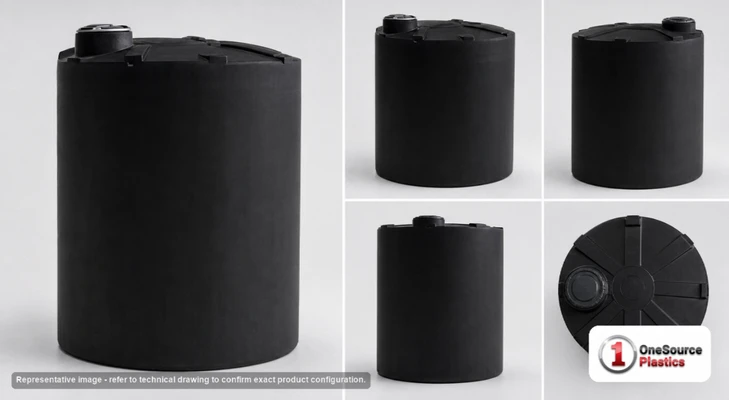
Snyder molds four tanks in this shell and the Snyder 7360000N46 is one of the light ones: 4,100 gallons in a 102 inch circle 130 inches tall, 850 pounds empty, black crosslinked polyethylene. Its own sheet rates the wall for a specific gravity of 1.5, which it reads as 51,291 pounds of maximum contents against 34,194 pounds for plain water at 8.34 pounds per gallon. The listed opening is an 18 inch threaded, vented manway, the sheet lists the outlet as 23, the structural fields give 8 lifting lugs, ladder lugs and 2 flange lines, the service limit is 140 F / 60 C, the warranty is 3 year, and freight is class 300 from Philippi, West Virginia.
Want a second opinion on the size? Call 866-418-1777 with the daily draw and the delivery interval, or price freight to your ZIP and add it to your cart above.
Buying the shell and the color, not the rating
Some tanks are bought for their wall and some for their shape. This one is bought for its shape, and its sheet is what lets you stop there. The 1.5 figure on it reads as 51,291 pounds of allowed contents against 34,194 pounds for plain water, which means water, rinse water, a feed solution or anything at or near 8.34 pounds per gallon is comfortably inside the listing with nothing paid for duty the job cannot call on. If the liquid is genuinely dense, the answer is the 7360000N48, the 1,100 pound molding out of this identical 102 by 130 inch shell rated as its own sheet says, and the pad, the platform and the piping do not change when you switch. If it is not, this is the tank, at 850 pounds empty, which is the lighter lift and the smaller machine on the day. Two other moldings sit in this shell at the same 850 pounds, the 7360000C34 and the 7360000C37-BLACK, each rated as its own sheet gives it, so the choice among the three light ones is a chemistry question rather than a fit question and the sheets are where it gets settled. What all four share is a footprint worth understanding before the order. A 102 inch circle is eight and a half feet of slab, narrow enough to set against a wall or between two vessels already standing but still too wide for a 36 inch doorway, so the route from the dock to the pad gets walked with a tape first. At 130 inches the manway is nearly eleven feet up, which clears a low joist not at all and needs room above it for a fill line and a vent, so the purlin and the sprinkler head get measured with the ceiling. Underneath, plain water puts 34,194 pounds on that circle and the rating allows 51,291, all of it bearing on the full floor because a rotationally molded floor carries on its whole floor. Pour to the concrete pad sizing guide, level and in full contact, inside a berm sized to the tank where the liquid is regulated. An empty 850 pound shell nearly eleven feet tall is the easiest thing here for a gust to move, so the strapping goes on the day it lands and gets checked after the first storm and again at the end of the first summer, because a black wall in the sun grows a little every day. Black passes no light into the liquid and takes the ultraviolet that ages a pale shell, and it hides the level, so a sender and a readout belong in the install. Check 4,100 gallons against the feed rate and the delivery interval in the tank sizing calculator, and read the reserve and the thermal freeboard out of the tank sizing guide.
Four listings out of the 102 by 130 inch mold
| Part | Gallons | Diameter x height | Empty weight |
|---|---|---|---|
| 7360000N46 (this tank, black, rated 1.5) | 4,100 | 102 x 130 in | 850 lb |
| 7360000C34 (same mold, same weight) | 4,100 | 102 x 130 in | 850 lb |
| 7360000C37-BLACK (same mold, same weight) | 4,100 | 102 x 130 in | 850 lb |
| 7360000N48 (same mold, heavier) | 4,100 | 102 x 130 in | 1,100 lb |
| 7421100C34 (wider, lower, larger) | 4,300 | 120 x 104 in | 850 lb |
| 7421100N40 (wider, lower, smaller) | 4,000 | 120 x 104 in | 810 lb |
Three of the four listings in this mold weigh 850 pounds and one weighs 1,100, and that column is a better guide to what is in your hand than the suffix is. This page is one of the 850 pound moldings and its sheet says 1.5. The 7360000N48 is the heavy one, and it is the move only when the liquid is dense enough to want it. The two 7421100 tanks answer a different room entirely: 4,300 gallons at 850 pounds and 4,000 gallons at 810 pounds, both in a 120 inch circle that stops at 104 inches, which is low enough to open from a step and wide enough to need a foot and a half more slab than this shell. Pick the shape off the tape and the rating off the liquid and the part number falls out of the pair. If a rule or an insurer wants the liquid inside a second wall, the double wall freeboard sizing guide works out how much usable volume a contained vessel actually returns at this size, which is never the number on the label.
Not sure which one? Tell us the liquid, the site and the ceiling height at 866-418-1777, or request a written quote with freight to your ZIP.
How much vent 4,100 gallons needs, and where the headspace goes
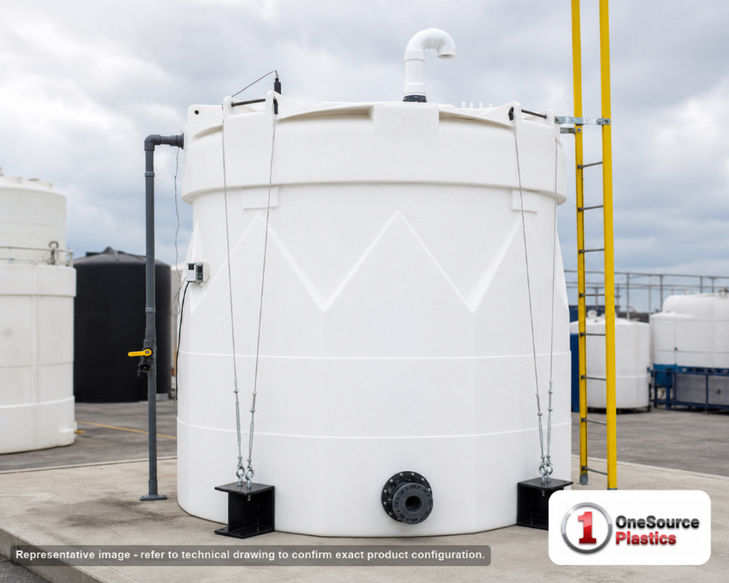
- Vent: size it to the delivery pump and not to the port that happens to be there. Every gallon that enters a closed shell pushes a gallon of air out, and 4,100 gallons arriving at truck-pump rate through a narrow 102 inch shell is a fast column of air through one opening. Pipe it outdoors on anything that fumes, screen it, and put the screen on the maintenance list.
- Fill: a permanent connection landed at the 18 inch threaded, vented manway rather than a driver holding a hose nearly eleven feet up in the dark, with a dip tube to the floor so the incoming stream does not free-fall 130 inches and foam the headspace on the way down.
- Headspace: leave the warm-weather freeboard the sizing guide gives. A narrow shell has a small liquid surface, so the level moves a long way in the last minute of a fill, and the high-level cutout belongs in the install rather than in a later budget on a wall you cannot see through.
- Outlet: the sheet lists the outlet as 23, with no unit, no material and no thread printed beside it. The field is reproduced here as it stands and is not read as a pipe size; this page claims no bulkhead diameter. Tell us the liquid and the draw-off you want at order and we confirm what this molding takes before a hole is cut in it.
- Listed structure: 8 lifting lugs, ladder lugs, 2 flange lines. Service limit 140 F / 60 C. Warranty 3 year. Rating: specific gravity 1.5 as this sheet gives it.
On a 1.5 wall the useful discipline is knowing what is actually in the tank, because a rating is a limit and the fastest way past one is a substitution nobody wrote down. The liquid goes on the wall in letters readable from the truck cab, and the delivery log records what arrived and when. The rest is standard and worth doing anyway: a support off the pad under whatever is fitted at the base, a flexible connector between the shell and hard pipe, a transfer pump below the outlet where the head keeps it primed, and a low-level float so it stops before it pulls air. The ladder lugs the sheet lists are there so that access to a manway nearly eleven feet up is permanent rather than a leaned ladder. Light the band of wall above the liquid line at every opening and write the date down. Where winters bite, the trace heat and the insulation go on the base piping and the first valve, never on the body, which takes ice from the top down.
Light liquids that still want a narrow footprint
This is the tank for the long, thin room with a light duty in it: rinse and process water in a chemical alley, a nursery or greenhouse feed solution that has to stay dark, makeup water on a skid squeezed between equipment, reclaimed water on a site that wants a black shell so nothing grows in it, a wash bay with 4,100 gallons standing against a wall, and a co-op shed with a tall roof and a fixed aisle. Water at 8.34 pounds per gallon is well inside the 1.5 rating, but a private fire reserve is its own specification in a water-rated vessel, which the fire-water reservoir design guide explains plainly. Where a grey water, rainwater or condensate train needs a dark holding stage on a narrow footprint between treatment steps, the industrial water reuse tank topology article shows where a tank this shape sits in the sequence.
Eight hundred and fifty pounds out of Philippi
Class 300 and 850 pounds shipping weight from Philippi, West Virginia is what the sheet gives, so the Mid-Atlantic and the Ohio Valley are short lanes and the far side of the country should be quoted rather than guessed; run the ZIP through the freight cost estimator before the order is cut and read the listed price as before freight. A tall, light parcel prices on the deck space it occupies as much as on the scale, which is why 850 pounds and 130 inches of standing height cost what they do. A forklift or a small crane stands it up with straps under the body and the 8 lifting lugs the sheet lists, never a sling through the manway, and the bands go on before the lifting gear leaves the site. Then water: fill to the manway, hold it, walk the base and the pad edge twice, drain and dry before the working liquid arrives. Walk the base again a week later, because a tank settles a little and the strap that was tight is loose. Chalk the full-water line on the outside after the first fill; it is the level every later reading gets checked against.
Freight and documents
Ships from: Philippi, WV. LTL freight is quoted to your ZIP with the freight cost estimator or by phone at 866-418-1777. The listed price is before freight.
Technical drawing (PDF) for Snyder Industries 7360000N46.
See this tank
Interactive 3D model with live fill. This tank has an interactive 3D model built to its manufacturer dimensions. Rotate it, and set a fill level to see how much liquid it holds at any height. Open the 3D view on the product photo above. Download the 3D model (GLB).
Ready to order?
Add it to your cart at the top of this page, get LTL freight to your ZIP, request a written quote, or call 866-418-1777. The listed price is before freight.