Tank Hot-Tap + Cold-Tap Engineering: Live-Service Tie-In Methods for Existing Tanks
Sooner or later every tank owner faces the question that will not fit in the project schedule: we need to add a fitting to a tank that is already in service, full of product, and tied into a system that cannot be drained without a multi-day plant shutdown. The choice is hot-tap (cut into the live tank wall while pressurized or full), cold-tap (drain, isolate, lock-out, then cut), or a hybrid (partial drain plus blanking plug installation). Each method has explicit code authority, real cost / risk / downtime trade-offs, and specific applicability to polyethylene (HDPE / XLPE) versus steel versus FRP shells. This pillar walks the engineering decision in the order it must be made, with citations to ASTM D1998 (the binding spec for polyethylene rotomolded tank fittings), ASME B31.3 (process piping code), NFPA 30 (flammable / combustible service), API RP 2201 (the canonical hot-tap procedure standard), and OSHA 29 CFR 1910.252 (welding, cutting, and brazing).
The reference codes used in this guide are ASTM D1998 Sections 8 and 9 (fittings, support, retrofit), ASTM F1962 (HDPE pipe horizontal directional drilling), ASME B31.3 Chapter VIII (high-pressure piping), API Recommended Practice 2201 (Procedures for Welding or Hot Tapping on Equipment Containing Flammables), API RP 2009 (Safe Welding, Cutting, and Hot Work Practices), NFPA 30 Chapter 21 (Aboveground Tank Storage), NFPA 326 (Standard for the Safeguarding of Tanks and Containers for Entry, Cleaning, or Repair), OSHA 29 CFR 1910.146 (Permit-Required Confined Spaces), OSHA 29 CFR 1910.147 (LOTO), and OSHA 29 CFR 1910.252 (welding, cutting, brazing).
The Decision Tree: Hot-Tap vs Cold-Tap vs Hybrid
Three questions decide the method:
- Can the tank be drained and isolated within the operational window? If yes, cold-tap is always preferred. It is cheaper, lower-risk, and code-permissible without API 2201 hot-work permits.
- What is the chemistry? Flammable / combustible service triggers NFPA 30 and API 2201 hot-work governance. Aggressive chemistry (sulfuric, caustic, anhydrous ammonia) makes hot-tap operationally unviable. Potable water and benign chemistry allow both methods.
- What is the tank material? Polyethylene rotomolded shells per ASTM D1998 cannot be hot-tapped using metal-style mechanical-saw machines because the cutter generates frictional heat that softens the polymer locally. Polyethylene retrofit uses a different toolset — knife-edge hole cutters operated cold, no live pressure, with the tank dropped to atmospheric and the contents below the planned penetration elevation.
| Tank Material | Hot-Tap Permitted? | Cold-Tap Method | Code Authority |
|---|---|---|---|
| Carbon steel API 650 | Yes (API 2201) | Drain, purge, weld pad + nozzle | API 650, API 2201 |
| Stainless steel | Yes (API 2201) | Drain, purge, weld pad + nozzle | API 650, API 2201, ASME B31.3 |
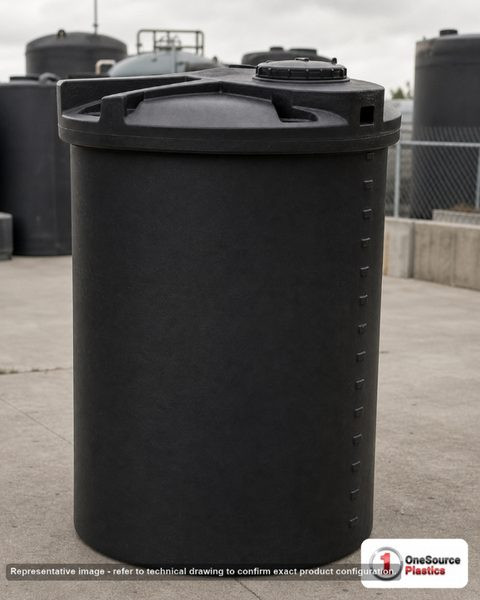
| Polyethylene (HDPE / XLPE) | No | Partial drain, knife-edge hole saw, bolted retrofit bulkhead | ASTM D1998 Section 9 |
| Fiberglass FRP | Limited (specialty) | Drain, hole saw, bonded flange or saddle | ASTM D3299, ASTM D4097 |
| Concrete (precast or cast-in-place) | No | Drain, core drill, mechanical seal or epoxy-grouted bulkhead | ACI 350, ACI 318 |
Method 1 — True Hot-Tap (Steel Tanks Only)
Hot-tap is the engineered procedure of cutting a hole in a pressurized or filled vessel without taking the system out of service. The procedure was developed by API and the gas-pipeline industry to add branch connections to live transmission lines. Adapted to tank service, it allows a new bulkhead nozzle to be welded onto a steel shell while the tank remains in operation.
Hot-tap procedure (API 2201)
- Job Safety Analysis (JSA) and hot-work permit: per OSHA 1910.252 and the site fire-prevention plan. AHJ notification where required.
- Confirm tank wall thickness: ultrasonic thickness (UT) measurement at the planned penetration. Minimum wall thickness for hot-tap per API 2201 Section 4.2 is 0.250 inch for typical service.
- Verify product chemistry and vapor space: for flammable service, lower the liquid level so the planned penetration is at least 3 feet below the liquid surface. The liquid acts as a heat sink and prevents vapor-space ignition.
- Weld a saddle or split-tee fitting onto the shell: qualified welder (ASME Section IX), preheat per material, multi-pass procedure with full visual and dye-penetrant inspection. The saddle is the permanent attachment that will hold the new nozzle.
- Bolt the hot-tap machine to the saddle: isolation valve installed between saddle and machine. The hot-tap machine is a hydraulically- or electrically-driven cutter on a slow-feed mandrel.
- Pressure-test the saddle and isolation valve: 1.5x operating pressure for 30 minutes, no leak, no permanent set. Do not proceed if any leak develops.
- Cut the coupon: the cutter advances slowly through the shell wall. Cooling fluid (water-based, non-flammable) circulated through the cutter head removes chips and prevents heat buildup. The cut takes 20-90 minutes depending on diameter and wall thickness.
- Retract the cutter with the coupon: the cut disc of metal is retained inside the cutter on a pilot pin. Close the isolation valve.
- Disconnect the hot-tap machine, install the new nozzle: piping is connected to the isolation valve. The valve is opened to put the new nozzle in service.
Hot-tap economics
- Equipment day rate: $4,000-$12,000 per day for hot-tap rig and crew (4-8 inch class).
- Permanent attachment cost: saddle $800-$3,500, isolation valve $1,200-$5,000, freight and labor $3,000-$8,000.
- Plant downtime savings: the value driver. A full plant shutdown to drain and modify a strategic tank can run $50,000-$500,000 in lost throughput. Hot-tap typically pays for itself if the alternative is more than 8 hours of full process downtime.
- Inspection / documentation overhead: 1-2 days of additional coordination for hot-work permits and post-procedure NDE (non-destructive examination).
Where hot-tap fails
- Wall thickness below 0.250 inch: the cutter can punch through and into the tank interior, releasing product. API 2201 Section 4.2 explicitly prohibits.
- Severe corrosion or pitting in the tap zone: UT scan must show uniform thickness. Pits create stress-concentration points that can fail under cutter loading.
- Vapor-only or partial-fill condition where flammable vapor is at the tap zone: the heat-affected zone of the saddle weld can ignite the vapor. Lower the liquid to submerge the tap zone, or inert with nitrogen.
- Polyethylene or composite shells: weld attachment is not feasible.
Method 2 — Cold-Tap on Steel Tanks
Cold-tap is the conventional drain-and-modify procedure: drain the tank, lock-out the inlet and outlet, gas-free the interior per NFPA 326, weld or bolt the new fitting in place, then return to service. The procedure is straightforward but consumes 1-3 days minimum for a mid-sized industrial tank.
Cold-tap procedure
- System isolation and LOTO: physically lock and tag inlet, outlet, vent, and any auxiliary lines per OSHA 1910.147.
- Product transfer or drain: pump remaining product to a temporary tank or process holdup. Verify low-level cutoff with mechanical level indicator.
- Confined-space entry preparation: verify atmosphere with calibrated 4-gas meter (oxygen, LEL, CO, H2S). Apply NFPA 326 cleaning if hydrocarbon residual. Issue confined-space permit per OSHA 1910.146.
- Mechanical work: mark cutout, drill pilot hole, hole-saw or plasma-cut the new opening. Weld the saddle or bolted-flange retrofit fitting in place.
- Inspection and pressure test: visual + dye-penetrant on welds; hydrostatic test of the new fitting at 1.5x operating pressure.
- Return to service: remove LOTO in reverse order, refill, monitor first 24 hours of operation.
Cold-tap economics
- Labor and equipment: $5,000-$15,000 for a typical retrofit on a 5,000-15,000 gallon steel tank.
- Plant downtime cost: the dominant variable. Typical 1-3 day downtime; mission-critical service can push this to $100,000+.
- Total cost vs hot-tap: for low-throughput operations cold-tap is cheaper; for mission-critical 24/7 operations hot-tap is cheaper.
Method 3 — Polyethylene Tank Retrofit (Cold-Tap Only)
ASTM D1998 Section 9 governs retrofit penetrations on polyethylene rotomolded tanks. The shell cannot be hot-tapped (no welding feasible) and cannot be cut with metal-style hole saws under load (the cutter heats the polymer and seals over with melt). The correct procedure is partial drain plus knife-edge hole saw, plus bolted double-flange bulkhead retrofit.
Polyethylene retrofit procedure
- Drain to below the planned penetration elevation: the tank does not need to be empty, just dry at the cut zone. Confirm with manual stick gauge.
- Mark the cutout and pilot-drill: 1/4 inch pilot hole in the center of the planned bulkhead.
- Use a knife-edge hole saw rated for polyethylene: typical specification is a Lenox Tri-Fold or Milwaukee Big Hawg cutter at low RPM (60-150) with continuous feed. Do not use a metal-cutting hole saw — it generates excess heat. Lubricant is water or a mild surfactant; no oil-based cutting fluid (it remains on the polyethylene and contaminates downstream chemistry).
- Deburr the cut: a chamfering tool removes the burr that the hole saw leaves. The burr will tear the gasket on installation.
- Install a bolted double-flange retrofit bulkhead: Snyder MPN 34700436 (1-1/2 inch CPVC double-flange with Viton and stainless encapsulated washers) or MPN 34700889 (6 inch CPVC double-flange with Viton and Hastelloy hardware) for chemistry service. For potable water, use the NSF 61 listed equivalent. Single-hole bulkheads (Snyder MPN 34100053 for 4 inch, 34200179 for 1 inch, 34400338 for 1-1/2 inch) are acceptable for low-pressure non-aggressive service.
- Torque the bolts in cross-pattern in three passes: first pass to 30 percent of final torque, second to 60 percent, third to 100 percent. Polyethylene relaxes under load, so a fourth re-torque after 24 hours under operating fill is recommended.
- Hydrostatic test: fill above the new bulkhead and hold for 4 hours minimum, monitor for any seepage.
Common polyethylene retrofit mistakes
- Cutting with hole saw at high RPM: the polymer heats to 250-300 F at the cut edge and re-fuses behind the cutter, locking the tool. Drop RPM, use water lube.
- Using a single-hole bulkhead where double-flange is required: on retrofit, the existing wall has no factory-aligned hole; off-axis loading can pull a single-hole bulkhead through the wall. Default to double-flange for any retrofit larger than 2 inch.
- Not re-torquing: polyethylene cold-flows under bolt-load over 24-72 hours. The initial torque drops 20-40 percent. Re-torque or specify Belleville spring washers for self-compensating bolt load.
- Reusing the original gasket from the cut-out: the gasket is sized for the original bulkhead, not the retrofit. Always specify a new gasket matched to the new bulkhead pattern and chemistry.
Comparison Matrix
| Criterion | Hot-Tap (Steel) | Cold-Tap (Steel) | Polyethylene Retrofit |
|---|---|---|---|
| Plant downtime | Zero | 1-3 days | 2-8 hours (partial drain only) |
| Equipment day rate | $4,000-$12,000 | $1,000-$3,000 | $500-$1,500 |
| Hardware cost | $5,000-$15,000 | $2,000-$5,000 | $200-$1,500 per bulkhead |
| Crew skill | API 2201 specialist + qualified welder | Qualified welder + confined-space entry | Industrial mechanical / pipefitter |
| Permits required | Hot-work, JSA, AHJ notification | Confined-space, hot-work, LOTO | Standard work permit + LOTO |
| Service inclusion at risk | Flammable / combustible (special procedure) | All chemistries | All polyethylene chemistries |
| Best fit | Mission-critical 24/7 process steel tanks | Routine retrofit, planned outage | All polyethylene retrofit |
Sizing the Retrofit Bulkhead vs the Existing Plumbing
The retrofit penetration is not a free choice — it must be sized to the downstream piping and to the maximum draw or fill rate of the new line. Pipe-velocity rule of thumb is 7-10 feet per second maximum on the suction or discharge pipe. Calculate from gallons-per-minute and pipe inside diameter:
velocity_fps = (GPM × 0.4085) / (pipe_ID_inches squared)
For a 100 GPM line at 7 fps target, pipe ID must be at least 2.4 inches; specify 2.5-inch nominal. For 250 GPM at 7 fps, pipe ID must be at least 3.8 inches; specify 4-inch nominal. The bulkhead opening must match the pipe nominal.
Wall Thickness and Stress Considerations
Polyethylene tank shells
ASTM D1998 wall thickness scales with diameter and specific gravity (SG) of the contained fluid. A 1.0 SG tank at 8-foot diameter has a base wall thickness of approximately 0.500 inch at the bottom course, decreasing to 0.250-0.350 inch at mid-shell. Retrofit bulkheads should be installed in the upper-third of the tank where wall thickness is uniform and stress is lower. Avoid the bottom course where bending stress concentrates.
Steel tank shells
API 650 tanks have shell thickness calculated per API 650 Section 5.6 using the 1-foot method. A 30-foot-tall, 50-foot-diameter water tank has bottom-course thickness of approximately 0.500 inch and top-course of 0.187 inch. Hot-tap is acceptable on any course where UT-verified thickness exceeds 0.250 inch.
Permitting and Documentation
Every tank retrofit, hot-tap or cold-tap, generates a permanent record. The records should include:
- Pre-retrofit UT scan with signed witness and instrument calibration certificate.
- Welder qualification certificates (ASME IX or equivalent) for any weld procedure.
- Chemistry compatibility certification for the new bulkhead, gasket, and hardware (manufacturer datasheet plus chemistry reference).
- Hydrostatic test record with test pressure, hold time, and observed leakage.
- Permit closeout for hot-work, confined-space entry, and LOTO.
- As-built drawing showing the retrofit location, bulkhead specifications, and downstream piping. Update the tank Mechanical Integrity (MI) record per OSHA 1910.119(j).
Common Retrofit Mistakes
Mistake 1 — Hot-tapping a polyethylene tank
Periodically a contractor will quote a hot-tap on a polyethylene tank using saddle clamps and metal hole saws. The polymer melts, the cutter seizes, and the tank wall is destroyed. ASTM D1998 explicitly governs polyethylene fittings and does not permit hot-tap. Always cold-tap polyethylene.
Mistake 2 — Skipping the UT scan before hot-tap
API 2201 Section 4.2 requires UT verification of wall thickness. A tank with 30 years of corrosion may have wall thickness below the hot-tap minimum. Do not assume; measure.
Mistake 3 — Welding on a vapor-space-only tank
Welding above the liquid level on a flammable-service tank ignites the vapor. Either lower the liquid to submerge the work zone, or inert the headspace with nitrogen and verify with continuous LEL monitoring.
Mistake 4 — Using a single-hole bulkhead on a retrofit larger than 2 inch
Retrofit holes have unknown wall thickness profile around the cut. Default to double-flange for any opening above 2 inch nominal — the bolt circle distributes load uniformly.
Mistake 5 — Skipping the re-torque after 24 hours
Polyethylene relaxes 20-40 percent under load. The initial torque drops, the gasket loses compression, the seal weeps. Re-torque after 24 hours of operation, then again at 7 days for critical service.
Mistake 6 — Reusing the original tank-cutout coupon as the bulkhead blank
The cutout is a circular disc with a single pilot hole. It is not a bulkhead. Discard it and install a manufacturer-listed retrofit bulkhead with the gasket, washers, and hardware specified for the chemistry.
Mistake 7 — Skipping hydrostatic test
A retrofit that passes visual inspection but fails under fill is the silent leak that contaminates secondary containment. Always pressure-test or hydrostatic-test before return to service.
Mistake 8 — No closeout documentation
Two years later when the bulkhead leaks, no one remembers who installed it, what gasket material, or what the chemistry compatibility certificate said. The MI record book is the institutional memory; populate it at retrofit, not after the next leak.
Internal Resources
- Tank Plumbing System Design Walkthrough
- Tank Fitting and Bulkhead Sizing Guide
- Tank Connection Engineering: Bulkhead vs Welded vs Threaded
- Tank Fitting Torque Specifications
- Tank Failure Mode Analysis
- Tank Inspection SOP
- Chemical Compatibility Database
- Freight Cost Estimator
Source Citations
- ASTM D1998 — Standard Specification for Polyethylene Upright Storage Tanks (Sections 8 and 9: Fittings, Retrofit)
- ASTM F1962 — Standard Guide for Use of Maxi-Horizontal Directional Drilling for Placement of Polyethylene Pipe
- ASME B31.3 — Process Piping (Chapter VIII: High Pressure Piping)
- API Recommended Practice 2201 — Procedures for Welding or Hot Tapping on Equipment Containing Flammables
- API RP 2009 — Safe Welding, Cutting, and Hot Work Practices in Refineries, Gasoline Plants, and Petrochemical Plants
- API 650 — Welded Tanks for Oil Storage (Section 5.6: Shell Design)
- NFPA 30 — Flammable and Combustible Liquids Code (Chapter 21)
- NFPA 326 — Standard for the Safeguarding of Tanks and Containers for Entry, Cleaning, or Repair
- OSHA 29 CFR 1910.146 — Permit-Required Confined Spaces
- OSHA 29 CFR 1910.147 — The Control of Hazardous Energy (LOTO)
- OSHA 29 CFR 1910.252 — General Welding, Cutting, and Brazing
- OSHA 29 CFR 1910.119 — Process Safety Management of Highly Hazardous Chemicals (Mechanical Integrity)
- ACI 350 — Code Requirements for Environmental Engineering Concrete Structures
Recommended Tanks for This Guide
Live pricing, updated automatically · estimate freight to your ZIP.