Tank Lifecycle Cost Math: 20-Year HDPE Replacement Cycle vs 50-Year Steel Cost-of-Ownership
The cheapest tank to buy is rarely the cheapest tank to own. The HDPE polyethylene tank quoted at $1,389 list looks dramatically cheaper than the equivalent steel tank quoted at $9,500 list — until you walk forward 50 years and count the replacements, the foundation work, the lining, the inspections, the cathodic protection, and the disposal. Then the math gets interesting.
This guide walks the actual lifecycle cost-of-ownership math for plastic vs steel tanks across a 50-year property planning horizon. We use real Norwesco / Snyder / Chem-Tainer / Bushman / Enduraplas SKUs and real list prices from the master catalog as 2026 baseline. We cite ASTM D1998 (polyethylene service life), AWWA D100 (steel tank standards), API 650 (welded steel storage tanks), API 653 (steel tank inspection), and EPA SPCC for compliance overhead. No fabrication; no oversimplified TCO scenarios.
The Two Service-Life Curves
Polyethylene tanks have a relatively predictable service life: 15-25 years depending on resin (HDPE vs XLPE), color (black vs white), exposure (outdoor full-sun vs indoor), and chemistry (water vs aggressive). ASTM D1998 governs the design but does not specify a service life. Field data from Norwesco, Snyder, Chem-Tainer, Bushman, and Enduraplas — published in their warranty documents and warranty performance records — converges on these ranges.
Steel tanks have a longer but more variable service life: 25-75+ years depending on coating system, cathodic protection, water chemistry, and inspection regimen. AWWA D100 (welded steel water tanks) and API 650 (petroleum service) define the manufacturing standard; API 653 governs in-service inspection.
The honest TCO math comparing these two materials requires a 50-year horizon — long enough to capture two complete polyethylene replacement cycles AND a steel tank's mid-life recoating event. Shorter horizons systematically favor whichever material is cheaper up front; longer horizons can flip the math.
The 50-Year Horizon: 1,500-Gallon Service Use Case
Use case: 1,500-gallon water storage for a fire-suppression reserve at a rural commercial facility. Outdoor installation, southern Texas climate, full-sun exposure. Serves as design baseline for the comparison.
Option A: Polyethylene (HDPE) Replacement Cycle
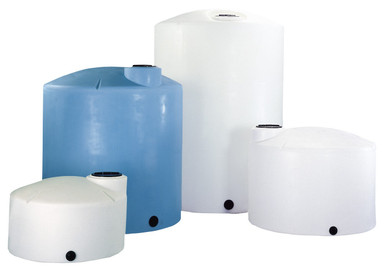
Tank: Norwesco MPN 41504 (1500 gallon natural-white vertical, $1,389.00 list) or equivalent class from Snyder Industries (representative MPN class WB46/WB47 1500-gal at $1,540 list), Chem-Tainer, Bushman (MPN WW-1500-GL-NAT at $1,699.99), or Enduraplas. Average list price across manufacturers in this class: ~$1,500.
Service life expectation:
- Black HDPE in full-sun southern climate: ~25 years (carbon black UV stabilization performs well)
- White HDPE in full-sun southern climate: ~15-18 years (TiO2 + HALS package degrades faster)
- For this scenario use 20-year service life as the planning average
Replacement cycle over 50 years: install Year 0, replace Year 20, replace Year 40. Three tank purchases.
| Year | Event | Cost (2026 dollars) | Notes |
|---|---|---|---|
| 0 | Initial tank + foundation pad + plumbing | $1,500 + $2,000 pad + $800 plumbing = $4,300 | Crushed stone pad with geotextile |
| 5 | First inspection / fitting check | $200 | Visual + bulkhead torque verification |
| 10 | Mid-life inspection | $400 | Visual + ultrasonic wall thickness check |
| 15 | Pre-replacement evaluation | $400 | Wall thickness + UV degradation assessment |
| 20 | Tank replacement (Tank #2) | $1,500 tank + $1,500 install + $300 disposal = $3,300 | Old tank to recycler; pad reusable |
| 25-35 | Periodic inspection (3 events) | $1,000 total | $300-400 per event |
| 40 | Tank replacement (Tank #3) | $1,500 tank + $1,500 install + $300 disposal = $3,300 | Pad refurbished if needed (additional $1,000) |
| 45-50 | Final-cycle inspection | $600 | 2 events |
| Total | 3 tanks + foundation + ongoing | $13,500-15,000 nominal | 2026 dollars, no inflation adjustment |
Note on inflation: the table uses 2026 dollars. Real 50-year inflation typically pushes nominal totals 2-4× higher; net-present-value at 4% discount rate brings replacement-cycle costs back near the nominal figures shown. Different assumptions produce different totals; the structural insight (three tank purchases over 50 years) remains.
Option B: Welded Steel (AWWA D100) with Coating Maintenance
Tank: 1,500-gallon welded steel water tank with epoxy interior coating, exterior alkyd primer + topcoat, equipped for cathodic protection. Note: welded steel storage tanks are NOT in our master polyethylene catalog. We sell engineered metal tanks via our Certified Steel Tanks custom fabrication line. The pricing below reflects industry-typical 2026 fabricated-steel cost; verify with quotation.
Steel tank lifecycle:
| Year | Event | Cost (2026 dollars) | Notes |
|---|---|---|---|
| 0 | Welded steel tank + concrete foundation + plumbing + cathodic protection | $9,500 tank + $4,000 foundation + $1,200 plumbing + $1,500 CP = $16,200 | Concrete pad on engineered footing |
| 5 | First API 653-style inspection | $1,500 | External UT + visual |
| 10 | Cathodic protection rectifier replacement | $1,800 | Anode wear assessment |
| 15 | Internal coating recoat (5-year coating life shortest) | $8,500 | Drain, blast, recoat, recommission |
| 20 | API 653 internal inspection (mandatory) | $3,500 | Drain, internal entry, inspection report |
| 25 | External recoating (alkyd typically 15-20 year life) | $6,500 | Sandblast + prime + topcoat |
| 30 | Mid-life major refurbishment (interior + exterior + CP system) | $15,000-20,000 | Combined recoat event |
| 35-40 | Periodic API 653 inspection + minor coating touch-up | $5,000-8,000 | 2-3 events |
| 45 | Major refurb or replacement decision | $20,000+ refurb OR $25,000+ replacement | Depends on shell condition |
| 50 | Final inspection or replacement | $3,000-5,000 inspection OR replacement cost | End of horizon |
| Total | 1 tank (potentially) + maintenance | $70,000-95,000 nominal | 2026 dollars, no inflation adjustment |
The headline contrast: $13,500-15,000 polyethylene 50-year nominal vs $70,000-95,000 steel 50-year nominal. Steel does NOT win on water service.
Where Steel Actually Wins
The above analysis is for water service in a moderate climate. The math changes for specific scenarios where polyethylene's service life shortens or steel's coating cycle lengthens.
Aggressive Chemical Service
For 50% sodium hydroxide caustic, polyethylene XLPE service life is 10-15 years (heat aging from SG 1.53 fluid + chemical stress). Replacement cycle becomes 4× over 50 years. Steel with epoxy interior coating + dedicated coating cycle (typical 7-10 year coating recoat) hits 5-7 recoat events but the shell can run 50 years.
For 93% sulfuric acid, polyethylene HDPE service life is 5-10 years (heat aging + chemical stress; SG 1.84 produces fluid load above PE design rating). 5-10 replacement cycles over 50 years. Steel with phenolic-epoxy interior + careful coating maintenance becomes more economically rational.
The crossover: aggressive chemistry pushes the polyethylene cycle below 10 years, AND the chemistry exists in steel-compatible coating systems. See Sodium Hydroxide Storage, Sulfuric Acid Storage, and our Where Polyethylene Stops Working guide for the chemistry-specific decision tree.
Very Large Capacity (10,000+ Gallons)
Polyethylene rotomolded tanks hit a manufacturing ceiling around 16,500 gallons (some manufacturers extend to 20,000+ for specific designs). Above that, fiberglass-reinforced plastic (FRP) and welded steel are the only practical options. For 50,000-gallon water storage, polyethylene is not a viable specification regardless of cost-per-gallon math.
For 25,000-gallon polyethylene service that requires multiple tanks (2x of the Enduraplas MPN TLV10000 10,000-gallon vertical at $12,415.99 list each, plus a 5,000-gallon completion), a single 25,000-gallon welded steel tank may compete on first-cost. The lifecycle math then depends on coating cycle vs replacement cycle for the multi-tank polyethylene system. This is the territory where engineering review of both options is justified.
Pressure or Elevated-Temperature Service
Atmospheric polyethylene tanks are not pressure vessels. Service above 100°F continuous and above zero gauge pressure is outside ASTM D1998 design conditions. For pressurized service or hot-fluid storage, steel (or stainless steel for corrosive hot service) is the structural choice. No lifecycle math reverses this.
Long-Term Asset Class Buildings (50+ Year Design Life)
For municipal water tank infrastructure (water tower, ground storage at treatment plant), AWWA D100 steel tanks are designed and warrantied for 50-75 year service life with proper coating maintenance. These are capital-asset-class installations that depreciate over decades. Plastic tanks are not specified for that asset class — the recurring replacement at 20 years is operationally untenable for municipal infrastructure.
The Real Decision Framework
| Scenario | PE 50-yr nominal | Steel 50-yr nominal | Winner |
|---|---|---|---|
| 1,500-gal water storage | $13,500-15,000 | $70,000-95,000 | PE by 5-7x |
| 5,000-gal water storage | $25,000-32,000 | $120,000-150,000 | PE by 4-6x |
| 2,500-gal NaOH 50% (XLPE) bulk | $50,000-70,000 (4-5 cycles) | $60,000-90,000 | ~Even, PE slight edge |
| 2,500-gal H2SO4 93% bulk | $70,000-100,000 (8-10 cycles) | $70,000-95,000 | ~Even, steel slight edge |
| 25,000-gal water storage | $80,000-120,000 (multi-tank) | $150,000-200,000 | PE wins on cost; steel wins on simplicity |
| 100,000-gal water tower | Not feasible | $300,000-500,000 | Steel only |
| Pressurized hot-water (175°F) | Not specified | Steel + insulation | Steel only |
The Hidden Costs Most TCO Analyses Miss
Disposal
HDPE tank disposal: in most U.S. states, polyethylene tanks go to recycling rather than landfill. Recycling fee typically $200-500 for a 1,500-gallon tank. In jurisdictions without polyethylene recycling, landfill disposal $400-800.
Steel tank disposal: rarely disposed of; usually refurbished or sold. Demolition + scrap value typically nets $0-1,000 for a 1,500-gallon tank.
Foundation Reuse
Polyethylene tank replacement on existing foundation: pad typically reusable for 2-3 tank cycles before refurbishment is required. Foundation cost is amortized over multiple tanks.
Steel tank: foundation typically lasts the entire 50-year horizon. Single foundation event over 50 years.
Compliance Inspection Cost
Polyethylene under ASTM D1998: visual annual inspection, internal access if site is occupied. Typical $200-500 per event per facility.
Steel under API 653: extensive inspection regimen — external annual visual ($1,000-2,000), 5-year internal/external (many states require), 10-year ultrasonic. Typical $20,000-50,000 over 50 years for a 1,500-gallon tank in regulated service.
Insurance Premium Differential
Property insurance carriers price coating-protected steel tanks at lower base premium for fire (steel doesn't burn or melt at gasoline ignition temperatures). Polyethylene fuel storage typically commands 15-25% premium loading on the policy.
For water service, no insurance differential. Both materials are insurance-equivalent for water tanks.
Operational Downtime During Replacement
Polyethylene tank swap: typically 4-12 hours service interruption. Tank truck or service contractor handles direct.
Steel tank major recoat: typically 2-6 weeks service interruption for drain, blast, recoat, cure, recommission. Bypass storage required during outage. This downtime cost is significant for facilities that can't tolerate the outage.
Worked Decisions
Decision 1: Rural farm water storage, 1,500 gallons
Choose polyethylene. Norwesco MPN 41504 ($1,389 list) or equivalent. 50-year ownership cost ~$15,000. Steel would cost $70,000-95,000 with no operational advantage.
Decision 2: Pretreatment plant 50% NaOH, 3,000 gallons
Run the chemistry math. For chemistry that pushes XLPE service life below 12 years, the multi-cycle polyethylene cost approaches steel cost. Specify either XLPE polyethylene with documented 4-cycle lifecycle plan OR coated steel with documented 8-10 year recoat plan. Engineering review justified.
Decision 3: Municipal water reservoir, 1,000,000 gallons
Steel only. Polyethylene not feasible at scale. AWWA D100 welded steel with documented 50-year coating maintenance plan.
Decision 4: Industrial fire-suppression reserve, 5,000 gallons
Polyethylene wins. The use case is occasional drawdown, mostly static storage. Snyder Industries / Norwesco / Bushman vertical tanks at $4,000-7,000 list deliver 50-year service with 2-3 replacement cycles. Steel cost-of-ownership 4-6× higher for no operational benefit.
Decision 5: Brewery process tank, 5,000 gallons
Stainless steel. Process service with cleaning chemistry (caustic + acid CIP cycles), pressure rating requirement, and 25-50 year asset class. Polyethylene not specified for this service. See Brewery & Cellar Tanks.
The Asset Class Question
The tank choice is upstream of the cost math. Polyethylene is a 15-25 year operating asset; steel can be a 50-75 year capital asset. Whether your facility plans in operating-asset cycles or capital-asset cycles determines which framework is appropriate.
For municipal water utilities, federal facility infrastructure, and large-scale industrial operations with 30+ year planning horizons, steel is the asset-class match. The polyethylene replacement cycle creates planning friction at scale.
For commercial agricultural, light industrial, fire suppression reserve, on-site sewage treatment, and most other 20-year-or-shorter operating-cycle scenarios, polyethylene is the asset-class match. Lower first-cost, predictable replacement cycle, no specialty maintenance trade.
Common Lifecycle Cost Mistakes
Mistake 1: Comparing first-cost only
"Polyethylene is $1,500 and steel is $9,500 — polyethylene is cheaper." That comparison ignores the next 49 years.
Mistake 2: Comparing 50-year nominal without inflation adjustment
2026 dollars vs 2076 dollars are not the same currency. Either inflate forward and discount back, or use net present value at a stated discount rate. Both materials get expressed in current-equivalent dollars or the comparison is meaningless.
Mistake 3: Assuming polyethylene service life independent of climate / chemistry
20-year HDPE in southern Texas full-sun with sodium hypochlorite is not the same as 20-year HDPE in northern Minnesota indoor with potable water. The service-life input drives the entire model.
Mistake 4: Assuming steel coating cycle is 25 years
Manufacturer marketing says 25 years; field experience says 10-20 years for typical industrial epoxy systems. Use 10-15 year as planning assumption unless you have specific high-performance coating system documentation.
Mistake 5: Ignoring downtime cost
For a process plant where the tank is in continuous service, recoat downtime cost can exceed the recoat material cost. For a fire-suppression reserve where the tank can be offline 6 weeks with backup, downtime is near-zero.
Mistake 6: Forgetting disposal
Both materials carry disposal cost. Polyethylene recycling fee is typically lower than steel demolition cost, but neither is zero. Include it in the model.
Mistake 7: Not documenting the model
A 50-year TCO model has 30+ assumptions. Without writing them down, the next operator or buyer cannot validate or update the model when conditions change. Document explicitly: service life assumption, replacement cost, inspection cost, disposal cost, downtime cost, coating cycle, climate factor, chemistry factor.
Internal Resources
- Tank Material Selection
- ASTM D1998 Service Life Methodology
- Replace vs Reline Engineering Decision
- UV Degradation: 30-Year Service Curve
- Where Polyethylene Stops Working
- Certified Steel Tanks (Custom Fabrication)
- Freight Cost Estimator
- Contact OneSource
Source Citations
- ASTM D1998 — Standard Specification for Polyethylene Upright Storage Tanks
- ASTM D7254 — Resin testing methodology referenced in service-life modeling
- AWWA D100 — Welded Carbon Steel Tanks for Water Storage
- AWWA D102 — Coating Steel Water Storage Tanks
- API 650 — Welded Tanks for Oil Storage
- API 653 — Tank Inspection, Repair, Alteration, and Reconstruction (5-year + 10-year inspection regimen)
- API 575 — Inspection Practices for Atmospheric and Low-Pressure Storage Tanks
- NACE SP0388 — Standard Practice for Inspection and Repair of Coatings on Steel Tanks
- 40 CFR Part 112 — EPA Spill Prevention, Control, and Countermeasure Rule (compliance overhead reference)
- SSPC — Society for Protective Coatings, surface preparation and coating standards
- OneSource Plastics master catalog data — 9,419 products, 2026-03-26 snapshot
Recommended Tanks for This Guide
Live pricing, updated automatically · estimate freight to your ZIP.