Tank Liner Selection: Bare HDPE vs Coated vs Multi-Wall vs Boot - When Each Wins
Every storage-tank specification ends at the same fork: do you trust the primary wall alone, or do you add a barrier? The answer drives capital cost, leak-detection capability, regulatory compliance under 40 CFR 112 (SPCC) and 40 CFR 280 (UST), and the lifetime maintenance burden of the asset. The four real choices on the table for a polyethylene tank operator in 2026 are bare HDPE, coated / lined HDPE, integrally double-wall, and externally bermed (boot or pan). This pillar walks each option, the failure modes each one prevents, the failure modes each one introduces, and the SKUs in the OneSource Plastics catalog that represent each path.
The reference codes that govern this decision are 40 CFR 112.7 (SPCC secondary containment requirement, 110% of largest tank), 40 CFR 280 Subpart D (UST release detection methods including interstitial monitoring), NFPA 30 Chapter 21 (aboveground tank containment), ASTM D1998 (Standard Specification for Polyethylene Upright Storage Tanks, including Section 10 chemical resistance and Section 11 service life), API 12P (Specification for Fiberglass Reinforced Plastic Tanks - referenced for lining-failure modes), NACE SP0294 (Design, Fabrication, and Inspection of Storage Tank Systems), and ASTM G154 (UV exposure of plastics) for liner-aging analysis. Cited SKUs in this guide are Snyder MPN 5740102N95703 (275 gallon double-wall waste-oil), MPN 5780102N95703 (500 gallon double-wall), MPN 5990102N95703 (1000 gallon double-wall), MPN 5490000N42 (1550 gallon vertical double-wall XLPE chemical), MPN 1006600N43 (10,000 gallon HDLPE Captor double-wall, 1.5 SG), MPN 5760102N52 (360 gallon HDLPE double-wall containment, 1.9 SG opaque), MPN 1000112N45 (35 gallon double-wall dual-containment), and Norwesco MPN 42771 (140 gallon containment tray) - all real OEM-built assemblies in current production.
The Four Containment Architectures
| Architecture | Primary Containment | Secondary Containment | Leak Detection | Capex Multiplier |
|---|---|---|---|---|
| Bare HDPE / XLPE | Tank wall | External (dike, pad) | Visual only | 1.0x |
| Coated / Lined | Inner liner + tank wall | External | Liner-loss visible from interior | 1.2 - 1.6x |
| Integrally Double-Wall | Inner tank | Outer tank (annular space) | Interstitial sensor (continuous) | 1.7 - 2.4x |
| Boot / Berm / Pan | Tank wall | External pan / berm | Visual on pan | 1.1 - 1.3x |
Each architecture wins in a specific operational envelope. The remainder of this pillar walks the wins case by case.
Architecture 1: Bare HDPE / XLPE
What it is
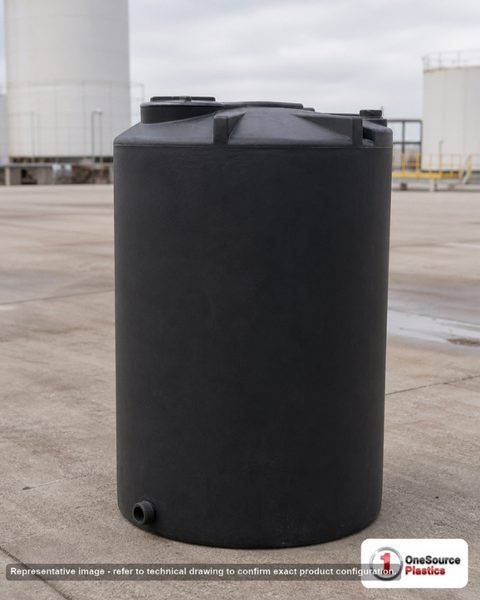
A single-wall polyethylene tank rotomolded from a single resin charge - either HDPE (high-density polyethylene) for general service or XLPE (cross-linked polyethylene) for higher chemical and temperature tolerance. The tank wall itself is the only barrier between the stored fluid and the outside environment. Compliance with 40 CFR 112.7(c) is met by the external concrete dike, earthen berm, or impervious pad sized to 110% of the tank's working volume.
When bare HDPE wins
- Water service (potable, fire reserve, irrigation, livestock): the chemistry is not aggressive, the leak risk is low, and the regulatory framework (state plumbing code, NFPA 22 fire reserve) does not mandate dual containment. Bare HDPE is the clear default; the dollar-per-gallon cost is the lowest in the market.
- Brine and agricultural fertilizer in lined containment basins: if your site already has a poured-concrete pad with curbing rated to 110% volume, additional double-wall is duplicative spend. Bare HDPE plus engineered containment satisfies SPCC.
- Temporary or seasonal staging: harvest-season agricultural feed tanks, construction water, mobile potable. Replacement cost on damage is low; bare HDPE makes sense.
- Process tanks inside a building floor with curb-and-trench drainage: the building shell IS the secondary containment. Adding double-wall to the tank is unnecessary cost.
When bare HDPE fails
- Petroleum, hazardous, or aboveground hydrocarbon service where NFPA 30 / EPA SPCC require leak detection beyond visual.
- Underground installation - 40 CFR 280 mandates either double-wall + interstitial monitoring or alternate detection methods that are more expensive than the cost of double-wall up front.
- Aggressive chemistry (concentrated acids, hot caustic) where ASTM D1998 service-life tables show wall thinning over the 10 - 25 year life. The OEM service-life calc starts taking the safety factor down.
- Sites adjacent to surface water or wells where a single-event leak is a regulatory or insurance catastrophe.
Real bare HDPE SKUs in catalog
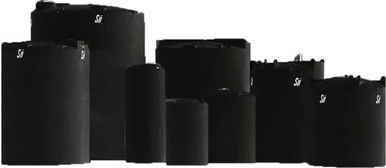
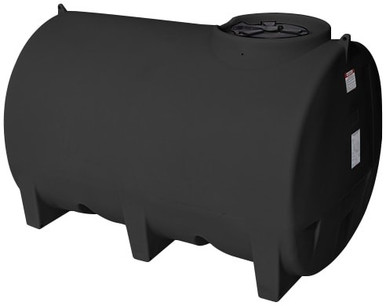
Most of the 9,400-product OneSource catalog falls in this category - Norwesco MPN 41514 (2,000 gallon vertical water in black HDPE), MPN 47109 (2,000 gallon vertical liquid storage), MPN 40627 (1,550 gallon vertical), MPN 43808 (1,525 gallon vertical), Snyder MPN WB45 (1,500 gallon black water), MPN WB60 / WB61 (2,500 gallon vertical), MPN WB70P (3,000 gallon vertical). These are general-service single-wall tanks; specify the SG rating against the chemistry, install on engineered pad, and add external containment to satisfy SPCC.
Architecture 2: Coated / Lined HDPE
What it is
A polyethylene tank with a secondary internal layer applied by the OEM - either an additional resin layer co-rotomolded during the molding cycle (factory liner), or a flexible insert (drum liner / bag liner) installed after molding for chemistry isolation. The classic catalog example is the Chem-Tainer drum liner MPN TC2235DA (55 gallon liner that drops into a steel or polyethylene drum to isolate the contained fluid from the drum wall). Larger lined-tank assemblies use specialty resins or factory-applied PVDF / ETFE / PTFE inner barrier layers.
When coated / lined wins
- Aggressive chemistry that exceeds the resistance of the base resin but you need polyethylene economics: a PE tank with a fluoropolymer factory liner can store hot concentrated acids that bare PE would not survive.
- Cross-contamination prevention in batch service: a flexible liner allows the same tank to be re-used for sequential batches of dissimilar product without inter-product contamination - swap liners between batches rather than scrub the tank.
- Hazardous-waste drum service: RCRA 40 CFR 264 Subpart I containers; a Chem-Tainer drum liner like TC2235DA isolates aggressive waste from a steel drum that would otherwise corrode.
- Food-grade re-purpose of industrial tanks: a food-grade liner inside a non-food-grade tank when sourcing a dedicated food tank is impractical.
When coated / lined fails
- Liner failure modes (pinhole, delamination, abrasion-through) are silent on bare exterior monitoring - by the time the operator sees liquid in the secondary containment, the liner has been failing for an unknown duration. NACE SP0294 specifically calls out this failure mode and recommends interstitial monitoring rather than relying on liner-only protection.
- Inspection access is harder; you cannot see the chemistry-side surface of the liner without entering the tank under confined-space rules (29 CFR 1910.146).
- Liner replacement on permanent factory-bonded liners is impractical; you replace the tank.
- UV degradation of liner material from translucent tank walls (ASTM G154) can degrade the liner from outside-in if the resin is light-sensitive. Choose opaque tanks for UV-sensitive liners.
Architecture 3: Integrally Double-Wall (the SPCC Default for Hazardous Service)
What it is
A tank-within-a-tank configuration. The inner tank holds the product; the outer tank surrounds it with a small annular gap (typically 1 - 4 inches). The annular space is the secondary containment volume, sized at minimum to 110% of inner-tank volume per 40 CFR 112.7(c) for SPCC compliance and required for any UST under 40 CFR 280. The annulus is monitored by either a hydrostatic level sensor, a hydrocarbon-sensitive probe, or a liquid-vacuum monitoring system that continuously reports interstitial-space integrity.
When integrally double-wall wins
- Petroleum aboveground tanks under NFPA 30 and SPCC: the integrally double-wall is the simplest path to compliance. No site-built dike, no 110% earthen berm, just the tank assembly. SPCC inspection passes on the equipment certification rather than the site-built containment.
- Waste-oil collection (40 CFR 279): double-wall is the industry default. Real catalog SKUs: Snyder MPN 5700102N95703 (120 gallon yellow waste-oil), MPN 5740102N95703 (275 gallon waste-oil), MPN 5780102N95703 (500 gallon waste-oil), MPN 5990102N95703 (1000 gallon waste-oil). Each has a yellow safety-color outer tank to denote used-oil service per 40 CFR 279.22 marking requirements.
- Concentrated chemistry with regulatory leak-detection mandates: Snyder MPN 5490000N42 (1,550 gallon vertical double-wall XLPE) handles the chemical-storage envelope where bare polyethylene would not pass an SPCC plan review.
- Underground storage tanks (UST): 40 CFR 280.43 requires interstitial monitoring on new UST installs. Double-wall + sensor is the cleanest compliance path.
- Sites with high groundwater or environmental sensitivity: the continuous interstitial monitoring catches a leak in hours rather than months. The cost premium is justified by liability reduction.
- Large-volume bulk storage where field-built containment is impractical: Snyder MPN 1006600N43 (10,000 gallon HDLPE Captor double-wall, 1.5 SG) ships as one unit; the equivalent bare tank would require a 11,000+ gallon concrete dike.
When integrally double-wall fails
- Capex overshoot for low-risk service: putting a double-wall on a livestock-watering tank is wasted money. Match the architecture to the regulatory and risk profile.
- Annulus contamination: if the outer tank wall is breached (vehicle impact, vandalism, fire), the annulus floods with rainwater or external fluid that triggers false alarms or, worse, masks a real inner-tank leak.
- Limited footprint flexibility: the outer tank diameter is larger than equivalent single-wall capacity. Site planning must account for the larger footprint and the heavier transport weight (LTL freight class shifts on heavier units; quote freight separately via the OneSource estimator).
- Repair complexity: a damaged outer wall on a double-wall is harder to field-repair than the equivalent bare-tank. Most insurers will require manufacturer-certified repair or replacement.
Real integrally double-wall SKUs
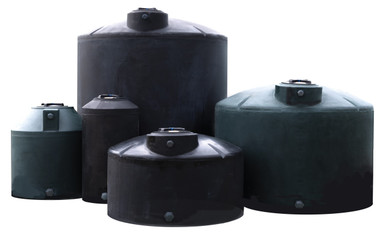
OneSource stocks the full Snyder Captor double-wall family from 35 gallon (MPN 1000112N45) through 10,000 gallon (MPN 1006600N43), and the waste-oil series in 120 / 275 / 500 / 1000 gallon configurations. Snyder MPN 5760102N52 (360 gallon HDLPE 1.9 SG opaque) handles the high-density chemistry envelope. Snyder MPN 5990702N95703 (405 gallon used-oil containment) is the standard choice for fleet-shop waste-oil collection.
Architecture 4: Boot / Berm / Pan (the External-Secondary Approach)
What it is
A bare single-wall tank installed inside a separate polyethylene containment pan, berm, or boot that sits on the pad below. The containment vessel is sized to hold 110% of the tank volume per SPCC and provides visual leak detection. Containment pan SKUs include Norwesco MPN 42771 (140 gallon containment tray in black) and the Snyder containment-tank family. The Snyder Chemical Feed Station family (MPN 5750103CF30 for sulfuric acid feed station with containment basin, MPN 5750104CFWS30 with stand) bundles tank + containment + pump-platform as a pre-engineered SPCC-compliant skid.
When boot / berm wins
- Existing bare-tank site that needs SPCC retrofit: dropping a containment pan around an existing tank is the cheapest path to compliance. No new tank purchase required.
- Modular skid systems: pre-engineered chemical-feed skids ship as one unit with pump, tank, containment, and electrical. Snyder MPN 5750104CFWS30 is a real catalog example for sulfuric acid duty.
- Sites with multiple smaller tanks where one engineered berm covers all: a single 110%-of-largest-tank berm with several 55 gallon drums or IBC totes inside is more economical than several individual double-wall units.
- Indoor process tanks where the floor is already curbed: the curb is the berm; a separate boot is unnecessary.
When boot / berm fails
- Outdoor exposure fills the berm with rain: uncovered outdoor berms accumulate rainwater that displaces containment volume. Either roof the berm, install an oil-water separator on the drain, or specify a covered containment vessel.
- Visual-only leak detection delays response: a small inner-tank leak may not be visible in the pan until significant volume has accumulated.
- Tank-to-pan compatibility: the pan must be sized so the tank does not contact the pan wall (thermal expansion clearance) and so a damaged tank does not breach the pan in the same incident.
- Chemistry compatibility of the pan material: a polyethylene pan must tolerate the chemistry of the tank in case of full release. Specify pan resin to match tank resin.
Decision Tree: Which Architecture for Your Service?
| Service | Recommended Architecture | Compliance Driver |
|---|---|---|
| Potable water | Bare HDPE (NSF 61) | Plumbing code |
| Fire-reserve water | Bare HDPE | NFPA 22 |
| Agricultural fertilizer (UAN, ammonia) | Bare HDPE + engineered berm OR double-wall | State agriculture rule + SPCC |
| Diesel / petroleum aboveground | Integrally double-wall | NFPA 30 + 40 CFR 112 |
| Used / waste oil | Integrally double-wall (yellow) | 40 CFR 279 |
| Sulfuric acid feed | Tank in containment basin (skid) | 40 CFR 264 |
| Sodium hypochlorite (12.5% bleach) | Bare XLPE + berm OR double-wall | SPCC + state DW rules |
| Underground petroleum (UST) | Integrally double-wall + interstitial | 40 CFR 280.43 |
| Hazardous waste accumulation | Lined drum or double-wall | 40 CFR 264 Subpart I |
| DEF (urea 32.5%) | Bare HDPE NSF 61 | ISO 22241 |
The Total Cost of Ownership Math
Capex on architectures 2 - 4 is higher than bare HDPE, but TCO can favor the more expensive architecture when you account for SPCC plan-review effort, leak-detection inspection labor (40 CFR 112.8 monthly visual integrity testing on bulk containers), insurance premiums, and the regulatory exposure of a single-event release. A 1,000 gallon diesel release into a tributary stream is, in 2026 dollars, a $250,000+ remediation event before regulatory penalties under the Clean Water Act 33 USC 1321. The price delta between Snyder MPN 5990102N95703 (1,000 gallon double-wall waste oil) and an equivalent bare tank plus site-built dike is a fraction of one such incident.
Apply this rule of thumb: if the worst-case release event would exceed $50,000 in remediation, choose double-wall. Below that, bare HDPE plus engineered external containment is the rational economic choice. Listed prices on all SKUs in this guide are available on the product pages; freight is quoted separately to ZIP via the Freight Cost Estimator.
Liner Aging and Service Life
ASTM D1998 Section 11 provides the polyethylene service-life methodology: design service life is a function of resin grade, specific gravity of stored fluid, operating temperature, UV exposure, and chemistry. Standard HDPE single-wall on water duty: 20 - 30 year design life. The same tank on 1.9 SG sulfuric acid: 7 - 12 year life. The same tank with a fluoropolymer factory liner: extends back to 15 - 20 years. Double-wall: depends on the inner-wall life, but the outer wall isolates the operator from a single-point inner-wall failure event.
Liner failure modes specific to coated tanks: pinhole formation from particulate impact (specify a strainer on inlet), delamination at the bond line from thermal cycling (avoid hot fill-cold dwell-hot fill cycles), chemical permeation through the liner over time (the published permeation rate from the resin supplier is the upper bound on liner life). NACE SP0294 Section 6.4 covers the inspection cadence: visual liner inspection every 2 years for hazardous service, full UT thickness survey every 5 years.
Common Liner / Containment Mistakes
Mistake 1: Specifying double-wall for water service
Wasted capex. Bare HDPE plus an engineered pad is the right answer. The double-wall premium buys leak detection that is irrelevant for non-hazardous fluid.
Mistake 2: Specifying bare HDPE for petroleum without external dike
Out of compliance with 40 CFR 112.7(c). The site fails SPCC inspection and the operator pays for retrofit under deadline pressure.
Mistake 3: Using a non-rated containment pan
Polyethylene pans are not all chemistry-rated. Specify the pan material against the worst-case fluid exposure - for sulfuric acid service, the pan must be the same XLPE or fluoropolymer-lined material as the tank.
Mistake 4: Open-top berm exposed to rain
Containment volume is consumed by accumulated rainwater. Either roof the berm or specify a closed-top containment design.
Mistake 5: Skipping interstitial monitoring on double-wall
The continuous interstitial monitor is what makes double-wall worth the premium. Without it, you have a more expensive single-wall tank.
Mistake 6: Mixed-resin containment
HDPE inner tank in an XLPE outer tank only works at the design service envelope of the weaker material. Specify the outer wall against the worst-case release of inner tank contents.
Mistake 7: Liner without confined-space program
Internal liner inspection requires confined-space entry under 29 CFR 1910.146 with attendant, atmospheric monitoring, and rescue capability. If the operator does not have that program, the liner cannot be properly maintained.
Internal Resources
- Secondary Containment: Requirements, Options, and Best Practices
- Tank Plumbing System Design
- Aboveground vs Belowground Storage Engineering
- Plastic Tank Failure Mode Analysis
- Tank Material Selection: HDPE vs XLPE vs Steel vs FRP
- Chemical Compatibility Database
- Freight Cost Estimator
Source Citations
- 40 CFR 112 - Spill Prevention, Control, and Countermeasure (SPCC); 112.7(c) secondary containment 110% rule; 112.8 monthly integrity testing
- 40 CFR 280 Subpart D - UST release detection methods; 280.43 interstitial monitoring
- 40 CFR 264 Subpart I - Use and Management of Containers (RCRA hazardous waste)
- 40 CFR 279 - Standards for the Management of Used Oil; 279.22 marking requirements
- NFPA 30 - Flammable and Combustible Liquids Code, Chapter 21 aboveground tanks
- NFPA 22 - Standard for Water Tanks for Private Fire Protection
- ASTM D1998 - Standard Specification for Polyethylene Upright Storage Tanks (Sections 10, 11)
- API 12P - Specification for Fiberglass Reinforced Plastic Tanks
- NACE SP0294 - Design, Fabrication, and Inspection of Storage Tank Systems for Concentrated Fresh and Process Sulfuric Acid and Oleum at Ambient Temperatures
- ASTM G154 - Standard Practice for Operating Fluorescent Ultraviolet Lamp Apparatus for Exposure of Plastics
- 29 CFR 1910.146 - Permit-Required Confined Spaces
- 33 USC 1321 - Clean Water Act, oil and hazardous substance liability
- ISO 22241 - Diesel engines - NOx reduction agent AUS 32 (DEF) quality requirements
- OneSource Plastics master catalog data, dated 2026-03-26 snapshot (9,419 products)
Related chemical compatibility resources
For deeper engineering specifications on the chemicals discussed above, see our chemical-compatibility pillars:
- Sulfuric Acid — storage compatibility, recommended resin grade, fittings, secondary containment.
- Sodium Hypochlorite — storage compatibility, recommended resin grade, fittings, secondary containment.
- DEF (Diesel Exhaust Fluid) — storage compatibility, recommended resin grade, fittings, secondary containment.
- Sodium Chloride — storage compatibility, recommended resin grade, fittings, secondary containment.
Recommended Tanks for This Guide
Live pricing, updated automatically · estimate freight to your ZIP.