Tank Loadout Logistics: Crane vs Forklift vs Slide-Off vs Boom-Truck Real-World Trade-Offs
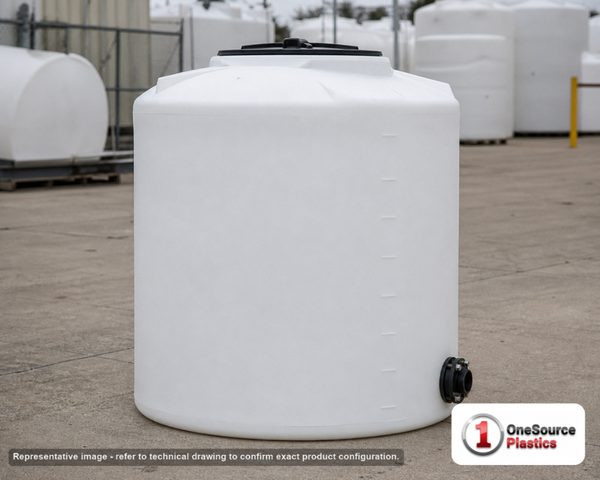
The tank arrives. The driver opens the trailer. Now what? Most buyers think about the tank itself for weeks and the loadout method for ten minutes. That ratio is backwards. The wrong unloading method on a 3,000-gallon polyethylene shell turns a 30-minute delivery into a four-hour ordeal, cracks the tank wall against the trailer side panel, voids the manufacturer warranty, and ends with a freight claim that nobody wins. The four real options for tank delivery in North America are crane lift, forklift, slide-off, and boom-truck. Each method has a tank-size envelope, a site-prep requirement, a cost band, and a risk profile that you need to match to the tank before the truck rolls.
This guide walks the four methods in operating order with real OneSource catalog SKUs as anchors. The recommendations come from years of LTL freight coordination across the Norwesco, Snyder, Chem-Tainer, Enduraplas, and Bushman catalogs and from the OSHA and DOT rules that govern how the cargo can legally come off the truck. Pick the method before you pick the delivery date.
The Four Methods at a Glance
| Method | Tank Size Envelope | Typical Cost | Site Prep Needed | Risk Profile |
|---|---|---|---|---|
| Forklift | 10-500 gallon, under 1,500 lb | $0-150 if onsite forklift available | Concrete pad or compacted gravel; 8 ft overhead clearance for mast | Low — but pinch-point risk on cylindrical loads |
| Slide-Off | 500-3,000 gallon vertical, 3,500-lb practical ceiling | $0-300 driver labor | Sloped landing surface or ground-level pad with no obstructions in slide path | Moderate — wall scrape and tip-over both common with poor execution |
| Boom-Truck | 500-5,000 gallon, up to 8,000 lb dry weight | $400-1,200 incremental over base freight | Outrigger pads (steel plates); 15-25 ft overhead clearance for boom swing | Low-moderate — depends on operator certification and rigging |
| Crane Lift | 2,500-15,000+ gallon, no practical weight ceiling for industrial cranes | $1,200-5,000+ separate crane mobilization | Engineered set-up area, swing radius cleared, rigging plan | Low if certified crane operator runs the lift; high if improvised |
Method 1: Forklift Unloading
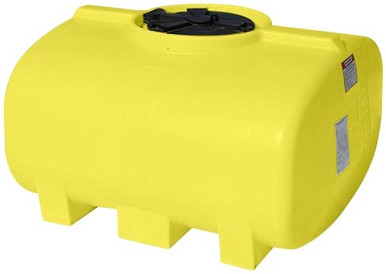
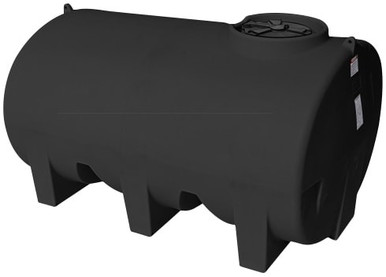
Forklift unloading is the default for tanks under 500 gallons. The catalog SKUs that fit this method include Norwesco MPN 44844 (10-gallon vertical, ships at under 50 lb), Norwesco MPN 60204 (100-gallon applicator saddle), Norwesco MPN 41464 (100-gallon vertical black, ~80 lb), and Norwesco MPN 41520 (200-gallon vertical green, 50 lb). Anything you can lift with a 5,000-lb-class warehouse forklift in standard fork width belongs in this category.
Site requirements
- Forklift capacity: rated capacity must exceed the tank dry weight by 2x for safe handling. A 5,000-lb forklift handles tanks up to 2,500 lb dry weight under OSHA 29 CFR 1910.178 load-handling rules.
- Fork length: 48-inch forks for tanks up to 60 inches diameter; 60-inch forks for 200-300 gallon saddle tanks and rectangular utility tanks.
- Surface: concrete, asphalt, or compacted gravel. Forklifts are not designed for soft ground; pneumatic-tire industrial models can handle packed dirt but mast lift becomes unstable on uneven surfaces.
- Overhead clearance: minimum 8 ft for tanks up to 60 inches tall on standard mast; 12+ ft for tall vertical tanks.
Common forklift mistakes
Cylindrical tanks rest on round bottoms; without a strap or saddle the tank rolls off the forks during transport. Use ratchet strap to fork-frame at minimum. Better: build a wood cradle that matches the tank curvature and lift the cradle. Tanks with bottom outlets must be lifted with the outlet protected — fork tip strikes on the outlet bulkhead are the single most common pre-installation damage event.
Pinch-point risk on tall cylindrical loads is real. A 200-gallon vertical tank standing on its base on the forks has a center of gravity well above the fork plane; a sudden mast tilt or floor irregularity can topple the tank into the operator's compartment. Either lay the tank on its side (cradle required) or use a forklift boom attachment to lift from the top fitting.
Method 2: Slide-Off Delivery
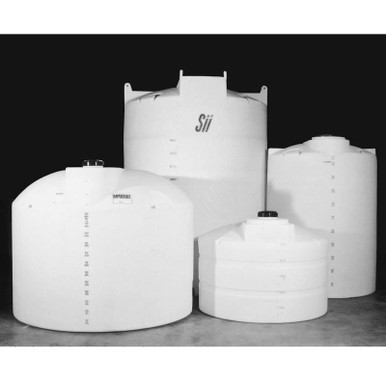
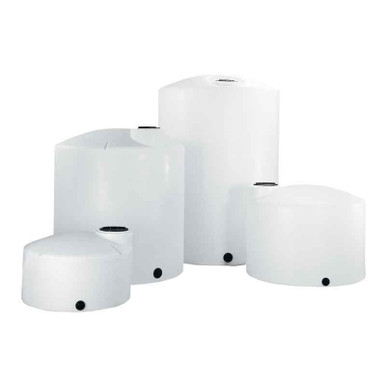
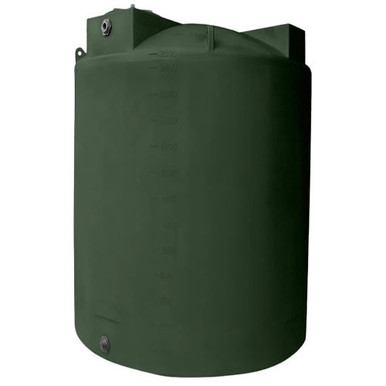
Slide-off is the workhorse method for vertical water tanks in the 500-3,000 gallon range. SKUs that ship slide-off include Norwesco MPN 45246 and 43092 (3,000-gallon vertical, 420-452 lb), Snyder Industries MPN WB46 / WB47 (1,500-gallon vertical), Bushman MPN WW-1500-GL-NAT (1,500-gallon natural), and Enduraplas MPN TLV02100 (2,100-gallon vertical black, 480 lb). The technique: the driver tilts the trailer or uses a sloped tank stand on the trailer floor, secures a guide rope to the tank, and walks the tank backwards off the trailer onto the ground at the customer site.
Site requirements
- Trailer access: driver must be able to back the trailer to within 6-15 ft of the final tank position. Long backing distances require boom-truck or crane instead.
- Landing surface: level, hard surface for the tank to land on. Concrete pad or compacted gravel ideal. Soft soil causes the tank base to sink unevenly and stress-crack on first fill.
- Slide path: 15-25 ft of clear ground from the trailer rear to the tank pad with no obstructions, slopes, or step-changes in elevation.
- Two-person handling: driver plus customer site contact at minimum. Larger tanks (2,500+ gallon) benefit from three-person crews.
What goes wrong on slide-off
The most common failure mode is tank wall contact with trailer side panels during the tilt. A 2,500-gallon vertical tank is 95-105 inches diameter; trailer interior width is 96-102 inches. Tolerances are tight. If the tank shifts during the 1,200-mile haul, it can wedge against the trailer panel and any tilt action grinds the wall against bolt heads. Result: cosmetic gouges that don't void warranty but look ugly, or in worst case shell damage that voids the manufacturer warranty under the "physical damage" exclusion clause common to all polyethylene tank manufacturers.
The second failure mode is tip-over after the tank clears the trailer. The trailer floor is 4-6 ft above grade; the tank is at the trailer floor level when it slides off; gravity pulls the bottom rim down first and the tank rotates 90 degrees from horizontal to vertical during the descent. If the rotation overshoots — or if the landing surface has any tilt — the tank continues past vertical and topples. Walking the guide rope is what prevents that, and walking the rope is operator skill.
When NOT to use slide-off
Tanks above 3,500 lb dry weight (most rectangular tanks above 1,500 gallon, all tanks above 4,000 gallon vertical, every Snyder MPN 32036 / 32076 class 10,000-12,000-gallon unit). Tanks with delicate fittings or pre-installed instrumentation. Sites where the trailer cannot get close to the pad. Sites with frozen ground, mud, or significant slope.
Method 3: Boom-Truck Delivery
Boom-truck (sometimes called knuckle-boom or articulated-crane truck) is the right method for 500-5,000 gallon tanks where forklift is unavailable and slide-off is risky. The truck has a hydraulic boom mounted behind the cab; the boom reaches over the trailer to lift the tank and place it on the customer pad. SKUs that ship boom-truck include Snyder MPN WB46/WB47 (1,500-gallon vertical), Norwesco MPN 45246 (3,000-gallon vertical), Bushman MPN 45466 (2,650-gallon vertical dark green), and Enduraplas MPN THV02500 (2,500-gallon vertical).
Site requirements
- Outrigger pads: the boom-truck deploys 4 outriggers; each must rest on hard, level surface. Steel pads (24-by-24 inch minimum) under each outrigger if the surface is asphalt, gravel, or soil.
- Overhead clearance: 15-25 ft minimum to clear the boom swing arc. Power lines, tree branches, building eaves, and gantry frames all matter. Per OSHA 29 CFR 1926.1408 the clearance from energized power lines is 10 ft for lines up to 50 kV; some jurisdictions require 20 ft.
- Boom reach: typical truck-mounted booms reach 25-50 ft from truck centerline. Confirm reach with the carrier before scheduling — a tank that needs to land 60 ft from the road requires a different truck.
- Operator certification: crane operators must hold NCCCO or equivalent certification per OSHA 29 CFR 1926.1427. Drivers running boom trucks under 7,500-lb capacity may have lower certification thresholds; verify with the carrier.
Cost economics
Boom-truck delivery typically adds $400-1,200 over the base LTL freight quote. The premium pays for the truck-mounted equipment, the extra delivery time (boom set-up and tear-down add 30-60 minutes per stop), and the operator certification overhead. For tanks 1,500 gallon and up, boom-truck is usually cheaper than scheduling a separate crane mobilization at the customer site.
Quote the boom-truck delivery cost at the time of order, not at the time of dispatch. The OneSource Freight Cost Estimator includes boom-truck premium where applicable; phone quotes at 866-418-1777 surface the same data with carrier-specific pricing.
Method 4: Crane Lift
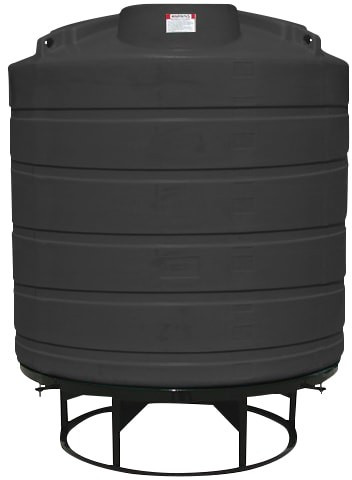
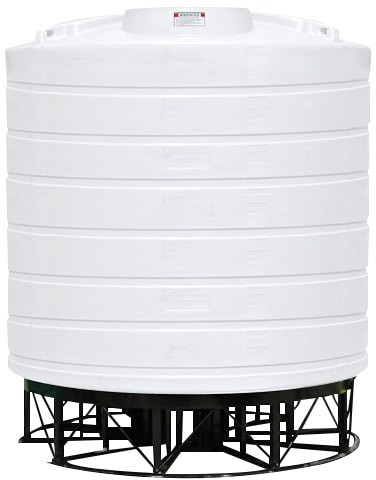
Crane lift is the engineered solution for tanks 5,000+ gallon, tanks landing on tight pads with multiple obstructions, tanks landing on elevated platforms (rooftops, mezzanines, raised concrete pads), and tanks where the customer site has zero outrigger access. SKUs that require crane delivery include Norwesco MPN 47638 (10,500-gallon vertical, 2,158 lb), Snyder MPN 32036 (10,000-gallon HDPE green, ~1,800 lb), Snyder MPN 32076 (12,000-gallon vertical black), Bushman MPN 45549 (4,050-gallon vertical), and Enduraplas MPN TLV10000 (10,000-gallon vertical black, ~2,200 lb).
Site requirements
- Engineered lift plan: per ASME B30.5 and OSHA 29 CFR 1926.1404 mobile crane operations require a documented lift plan showing crane configuration, ground bearing pressure calculations, swing radius, and rigging.
- Set-up area: 30-by-30 ft minimum for medium-class mobile crane (50-ton); 50-by-50 ft for 100-ton class. Surface must support the crane's outrigger ground bearing pressure (typically 2,000-6,000 psf).
- Rigging: tank manufacturer-supplied lift lugs (where present) or wide nylon slings rated for the tank weight with 5x safety factor. ASME B30.9 governs sling specifications.
- Crane operator + rigger + signal person: three-person crew minimum for industrial-scale lifts. NCCCO certification for operator and rigger required on most commercial sites.
The two-truck rule
Crane lifts almost always involve two pieces of equipment at the site: the freight truck delivering the tank and the crane doing the lift. Schedule them for the same window. A $4,500 crane mobilization sitting idle for 90 minutes because the freight truck is late is the single most expensive failure mode in tank delivery. The customer pays either way; coordination prevents the bill.
Method Selection by Tank Size
| Tank Capacity | Typical Dry Weight | Best Method | Backup Method |
|---|---|---|---|
| 10-200 gallon | 15-100 lb | Forklift or hand | Tailgate (small parcel rates) |
| 200-500 gallon | 75-200 lb | Forklift | Slide-off if no forklift |
| 500-1,500 gallon | 175-400 lb | Slide-off | Boom-truck for tight sites |
| 1,500-3,000 gallon | 375-700 lb | Slide-off or boom-truck | Crane for elevated pads |
| 3,000-5,000 gallon | 600-1,400 lb | Boom-truck | Crane lift for difficult sites |
| 5,000-10,000 gallon | 1,200-2,200 lb | Crane lift | Heavy-duty boom-truck (rare) |
| 10,000+ gallon | 2,000+ lb | Crane lift (engineered plan) | No backup — crane is mandatory |
Site Prep Checklist (Before the Truck Arrives)
- Confirm the delivery method with the carrier in writing. "Slide-off acceptable" on the BOL is the binding instruction; verbal agreements at dispatch don't bind the driver.
- Pad surface must be ready. ASTM D1998 Section 9 requires a flat, sand-bedded or compacted-soil pad with no point loads. Concrete pads with embedded anchor bolt rings are the upgrade for high-wind locations or seismic zones.
- Approach path cleared. Trailer is 53 ft long, turning radius 45-55 ft. Verify the truck can get from the public road to the pad without backing across uneven terrain.
- Overhead obstruction survey. Tree limbs, power lines, building eaves, sign frames. Slide-off needs 15 ft, boom-truck needs 20-25 ft, crane lift may need 30-40 ft.
- Ground stability for outriggers (boom-truck or crane). Steel plates required on asphalt, gravel, soft soil. Failed outrigger = tipped truck.
- Two-person customer crew on site. Driver does not unload alone on slide-off or boom-truck. OSHA 29 CFR 1910.178 requires assistance for unstable loads.
- Signed delivery receipt language reviewed in advance. The carrier delivery receipt typically includes "received in good condition" language. The customer must inspect for visible damage BEFORE signing or note exceptions on the receipt; otherwise freight claim windows close.
Common Site Failures by Method
Forklift failures
- Forklift capacity insufficient — driver waits 90 minutes for second forklift to arrive
- Cylindrical tank rolls off forks — wall damage or fitting strike
- Mast lift on uneven gravel — tank teeters above operator and triggers OSHA-stop
Slide-off failures
- Trailer cannot back close enough to pad — slide path becomes 30 ft and tank cannot be walked
- Pad not level — tank lands at angle, stress-cracks on first fill
- Customer absent — driver refuses to slide alone, redelivery scheduled (re-delivery fees apply)
Boom-truck failures
- Outriggers sink into asphalt under summer sun softening — truck tips, tank dropped
- Boom reach insufficient for actual pad location — tank lands wrong spot, second crane required
- Power line clearance violation — utility company notified, work-stop until line de-energized
Crane lift failures
- Crane mobilization arrived; freight truck delayed — crane idle at $400-600 per hour
- Lift plan not pre-approved by AHJ on commercial sites — work-stop pending plan review
- Sling rated insufficient for load + dynamic factor — sling failure mid-lift
Receiving Inspection — The 15-Minute Window
The customer signs the delivery receipt at offload completion. Before signing, inspect:
- Walk the full tank circumference — look for gouges, deep scrapes, deformation, fitting damage
- Check fitting threads — outlet, fill, vent, manway. Cross-threaded or impacted fittings indicate trailer-shift damage
- Inspect base ring — cracks here are the most common slide-off damage and they spread under hydrostatic load
- Verify model and capacity against the BOL — wrong tank deliveries are recoverable only with documentation
- Photograph any concern before signing — phone photo timestamp is admissible in freight-claim proceedings
Note any damage on the carrier's delivery receipt with the words "Damage noted: [description] — concealed damage rights reserved." That language preserves your right to file a claim if hidden damage emerges during installation. Signing "received in good condition" without exception language is the most common reason freight claims get denied.
How OneSource Coordinates Loadout
Every tank order at OneSource Plastics flags a default delivery method based on capacity, manufacturer, weight, and destination ZIP. Buyers can override the default at quote time. Our Freight Cost Estimator surfaces the boom-truck and crane premiums where applicable so the line item shows in the quote, not as a surprise on the invoice. Direct phone coordination at 866-418-1777 is the right call for any of: tanks 5,000+ gallon, sites with overhead obstructions, sites with poor truck access, deliveries to elevated pads, or any installation where tank damage during loadout would be production-critical.
List prices on the BigCommerce catalog do not include LTL freight. Freight is quoted separately per ZIP via the Freight Estimator or by phone. The boom-truck and crane premiums above the base LTL line item are quoted as separate accessorial charges.
Internal Resources
- Loading Dock & Receiving Site Design
- Tank Procurement Lead-Time Drivers
- ASTM D1998 Service Life Methodology
- Spec Sheet Engineering Guide
- Freight Cost Estimator
- Specialty & Metal Fabrication
- Water Storage Tanks Catalog
Source Citations
- OSHA 29 CFR 1910.178 — Powered Industrial Trucks (forklift operations)
- OSHA 29 CFR 1926.1404 — Cranes & Derricks in Construction: Assembly/Disassembly
- OSHA 29 CFR 1926.1408 — Cranes & Derricks: Power Line Safety
- OSHA 29 CFR 1926.1427 — Operator Qualification and Certification
- ASME B30.5 — Mobile and Locomotive Cranes
- ASME B30.9 — Slings (rigging specifications)
- ASTM D1998 — Standard Specification for Polyethylene Upright Storage Tanks (Section 9 foundation requirements)
- NCCCO — National Commission for the Certification of Crane Operators standards
- DOT 49 CFR 392.9 — Inspection of cargo, cargo securement devices and systems
- OneSource Plastics master catalog data, dated 2026-03-26 snapshot (9,419 products)
Recommended Tanks for This Guide
Live pricing, updated automatically · estimate freight to your ZIP.