Tank-Mounted Spray Bar and Nozzle Integration for Chemical Application Equipment: Boom Geometry, Nozzle Selection by Pattern and Pressure, Drift Control Engineering, and the Plumbing Architecture That Avoids Cross-Contamination
The plastic tank mounted on a sprayer skid, a pull-behind trailer, a UTV mount, or a tractor three-point hitch is one half of an integrated chemical application system. The other half is the spray bar — the nozzle boom, the section valves, the pressure-regulation circuit, the rate controller — that converts the contained tank volume into a calibrated chemical application pattern on the target. The integration of the two — the tank, the suction plumbing, the supply manifold, the boom, the nozzles, and the return-and-flush plumbing — is what determines whether the operator gets the calibrated rate the label requires or whether they get drift, streaking, ingredient cross-contamination from the previous load, and a regulatory inspector's notice on the next compliance audit.
This article walks the engineering of tank-mounted spray bar integration for the polyethylene tank platforms in the 5-brand catalog (Norwesco, Snyder, Chem-Tainer, Enduraplas, Bushman). The references are ANSI/ASABE S572 (spray nozzle classification by droplet size), the EPA Pesticide Registration Notice 2001-X-DRAFT and successors on drift management, the nozzle manufacturer technical bulletins from TeeJet, Hypro/Pentair, and John Blue, and the field operating data from agricultural and industrial chemical-application installations. The objective is the spray-system architecture that delivers calibrated rate, droplet size, and pattern uniformity across the boom while keeping the tank, the plumbing, and the operator free of cross-contamination between products.
1. The Application System Has Six Engineered Sub-Systems
A tank-and-boom application rig is not a single piece of equipment; it is six interacting sub-systems that have to be specified together:
- The tank: the polyethylene container that holds the spray solution at the application concentration. Volume sized to match the application area per fill plus a margin for pre-mix, transit, and end-of-row.
- The suction plumbing: the fitting on the tank that connects to the pump suction, the strainer that protects the pump from particulates, and the connection between the tank and the pump.
- The pump: centrifugal, roller, diaphragm, or piston, sized for the boom flow rate at the design pressure plus margin for return-line bypass.
- The pressure-regulation and rate-control circuit: the bypass valve, pressure regulator, flow meter, and rate controller that maintain the calibrated application rate as ground speed and boom condition change.
- The boom and nozzles: the spray bar with section valves, the nozzle bodies, and the nozzle tips that convert the supply flow into the calibrated pattern.
- The flush, rinse, and return plumbing: the clean-water tank and the rinse plumbing that flushes the system between products to prevent cross-contamination.
Each sub-system has a separate engineering envelope. Specifying any one without the others produces an unbalanced rig that fails the calibrated-rate target. The procurement conversation should address all six sub-systems together.
2. Nozzle Selection by Application and Pattern
The nozzle is where the application happens. The nozzle selection determines the droplet size, the pattern shape, the flow rate per nozzle, the pressure range, and the drift class. The standard nozzle types and their applications:
- Flat-fan extended range (XR, TT): the workhorse for broadcast herbicide and insecticide application on row crops and pasture. Droplet size in the medium-to-coarse range (250-450 micron VMD), uniform pattern across the swath at the recommended overlap, drift-prone at the small-droplet end of the range.
- Air-induction (AI, AIXR, Turbo TwinJet): the drift-control nozzle for application near sensitive areas. Droplet size in the very-coarse to extremely-coarse range (500-700 micron VMD), reduced drift potential, slightly less coverage of fine-target organisms (small insects, fine-leaf weeds).
- Hollow cone (TX, ConeJet): the pattern for foliar fungicide and insecticide where deep canopy penetration matters more than even broadcast coverage. Droplet size in the fine-to-medium range (150-300 micron VMD), strong drift potential.
- Flooding flat-fan (TF, TK): the high-volume application pattern for liquid fertilizer broadcast and pre-emergent herbicide where uniform deposition matters. Coarse droplet size (400-600 micron VMD), lower pressure operation.
- Streamer / banding nozzles (Streamer, Boom Buster): the directed-stream pattern for liquid fertilizer between row crops or for banded herbicide application. No fine droplet generation, minimal drift.
The nozzle catalog is broad. The selection rule: match the nozzle pattern and droplet class to the label requirement of the chemical being applied, with drift-class adjustment for the proximity of sensitive areas.
3. Boom Geometry and Coverage
The boom geometry — boom length, nozzle spacing, boom height above target, and section division — determines the pattern uniformity across the swath. The standard configurations:
- Nozzle spacing: 20-inch spacing for most flat-fan nozzles at 20-inch boom height; 30-inch spacing for high-flow flat-fan nozzles at 30-inch boom height. The spacing-and-height combination is engineered together for 100 percent overlap at the target.
- Boom length: 30 to 90 feet typical for agricultural booms, 6 to 20 feet typical for industrial and right-of-way application. The boom is sectioned with independently controllable section valves so the operator can shut off sections at field edges, around obstacles, and during turning.
- Boom height above target: 18-30 inches above the target canopy is typical for flat-fan and air-induction nozzles. Lower height reduces drift but compromises pattern overlap; higher height improves pattern overlap but increases drift.
- Boom level and stability: the boom must remain level across the swath even during ground-speed variation, slope changes, and obstacle encounters. Active boom suspension and break-away wing tips are standard on large agricultural booms; smaller industrial booms typically use rigid mounting with operator skill compensating for terrain variation.
For the small to medium tank platforms in the catalog (50 to 1000 gallon range), the boom length is typically 15 to 40 feet and the section count is two to four. For larger applications (1500 gallon tanks and above), the boom length runs to 60 feet or more with five to eight sections.
4. Pressure Regulation and Rate Control
The application rate (gallons per acre or gallons per linear foot) depends on the boom flow rate, the boom width, and the ground speed. The relationship is:
GPA = (5940 * GPM) / (MPH * W)
Where GPA is gallons per acre, GPM is the total boom flow, MPH is ground speed, and W is the swath width in inches. The 5940 constant converts the units. To maintain a constant GPA as ground speed varies (during turns, terrain changes, end-of-row deceleration), the system must adjust GPM proportionally.
- Constant-pressure regulation: the simplest configuration. A pressure regulator holds the boom pressure constant; the operator maintains a constant ground speed; the GPA stays approximately constant. Adequate for uniform flat fields with experienced operators.
- Pressure-based rate control: a controller that adjusts the bypass valve to vary boom pressure as ground speed varies. Maintains roughly constant GPA across moderate speed variation. The pressure-vs-flow relationship is square-root (doubling pressure increases flow by 1.4x), so pressure-based control has limited dynamic range.
- Flow-based rate control: a controller with a flow meter and a servo-driven control valve that maintains the target GPA across wider speed variation. The standard architecture for modern agricultural sprayers; cost is higher but the rate-accuracy benefit is substantial.
- Sectional and individual nozzle control: the most sophisticated tier. Each section or individual nozzle can be turned on, off, or rate-modulated independently to match field-specific requirements (variable-rate prescription, no-spray zones, automatic boundary control). Standard on precision-agriculture platforms.
For most industrial and small-farm application equipment, flow-based rate control is the right balance of cost, accuracy, and operational simplicity.
5. Tank Mounting Geometry
The tank mounting on the application platform is an engineering decision with consequences for stability, vibration, and tank life. Three common configurations:
- Horizontal leg-tank mount: the tank is mounted on its long axis with integrated mounting saddles or built-in leg structure. Reference N-40089 1025 gallon horizontal leg tank and N-41877 1325 gallon horizontal leg tank. The integrated leg geometry provides stable mounting on a flat skid or trailer deck; the tank is rated for over-the-road transport at full load.
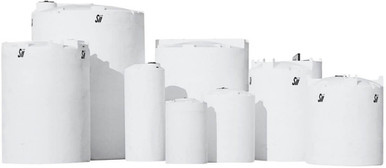
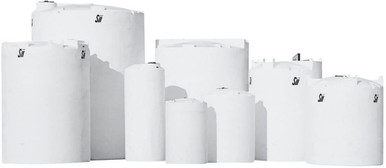
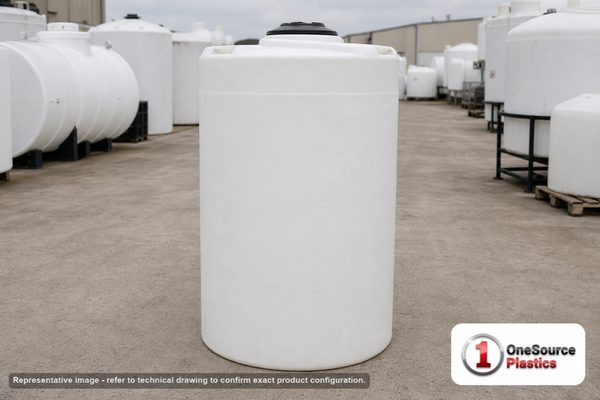
- Vertical bulk-tank mount: a vertical cylindrical tank mounted on a structural skid with engineered tie-downs at the tank base. Used for larger-capacity applications where horizontal leg tanks are not available in the required size. Higher center of gravity requires stiffer tie-down design and lower transport speeds.
- Cone-bottom inductor for chemical induction with a separate spray tank: the cone-bottom inductor is used to mix concentrate into the spray tank during fill. Reference N-45098 35 gallon 45-degree inductor and N-44979 65 gallon 40-degree inductor. The full-drain cone geometry ensures all of the concentrate is delivered to the spray tank without residual buildup in the inductor.
The tank mounting must accommodate the over-the-road dynamic loads (vibration, shock, lateral acceleration during turns) without transferring stress into the polyethylene shell. Engineered tie-downs use saddle straps or band clamps that distribute the load, not point fasteners that concentrate stress at fitting bosses or wall edges.
6. Cross-Contamination Prevention
The application system that handled herbicide on Tuesday and now needs to apply insecticide on Wednesday is the cross-contamination risk. Residual herbicide in the tank, the plumbing, the boom, or the nozzles can carry over to the next product, producing crop damage on the wrong target or off-label residue on the application surface. The engineering architecture for cross-contamination prevention:
- Smooth-walled tank without internal pockets or unflushable cavities. The polyethylene rotational-molded tank is favorable in this respect: smooth interior, no welded seams, no internal pockets. Reference any of the standard vertical, horizontal, or cone-bottom configurations in the catalog.
- Full-drain plumbing geometry. All low points in the plumbing (tank outlets, suction lines, manifold tees, boom sections, nozzle bodies) must drain completely when the system is empty. Trapped pockets retain residue that the rinse cycle does not clear.
- Triple-rinse procedure. The standard chemical-application industry practice is three sequential clean-water rinses with the boom operating between rinses. Each rinse cycle dilutes the previous residue by roughly 100x; three cycles take residue from the original product concentration down to roughly 1 part per million levels.
- Dedicated clean-water tank on the rig. A separate small tank (typically 5-15 percent of the main tank volume) supplies the rinse water without requiring an external water source. Reference N-41867 25 gallon or larger as a dedicated rinse-water tank for medium-sized rigs.
- Dedicated boom strainer and nozzle decontamination. The boom strainers and the nozzle bodies must be opened and cleaned between products for high-sensitivity transitions (sulfonylurea herbicide to broadleaf crop, residual pre-emergent to sensitive species). The cleaning protocol depends on the products being transitioned.
The cross-contamination protocol is application-specific. The label for the next product specifies the rinse-out requirements; the operator follows the label requirement plus a margin for high-consequence transitions.
7. Drift Control Engineering
Drift — the off-target movement of spray particles by wind — is the regulatory and stewardship issue that drives much of the modern application-system design. The drift-control engineering elements:
- Nozzle selection with drift-reduction class. The ASABE S572 droplet-classification system rates nozzles from very fine (high drift) to extremely coarse (low drift). For drift-sensitive applications (near orchards, vineyards, organic farms, water bodies, residential areas), select nozzles in the coarse to extremely-coarse range with documented drift-reduction performance.
- Boom height optimization. Lower boom height reduces drift but increases pattern non-uniformity; the balance point depends on the nozzle pattern and the wind condition. Standard guidance: 18-22 inches above target for low-drift configurations.
- Wind condition limits. Most label restrictions specify maximum wind speed (typically 10-15 mph) and prohibit application during temperature inversion conditions. The operator and the rate controller monitor weather conditions and pause application when conditions exceed the limit.
- Buffer zone management. Modern application controllers integrate GPS boundary maps that automatically shut off the boom or specific nozzles when entering buffer zones around sensitive features.
- Drift-reducing adjuvants. Tank-mix additives (drift-reducing surfactants, polymer drift-control agents) increase droplet-size distribution and reduce the small-droplet fraction. Used as a complement to nozzle selection, not as a substitute.
The combined engineering — nozzle selection, boom height, wind monitoring, buffer management, adjuvant formulation — produces drift control that meets modern regulatory and stewardship expectations.
8. Tank Volume Sizing for Application Logistics
The tank volume on the application rig should be sized for the application logistics — area covered per fill, pre-mix and transit time, end-of-row tank empty handling. The sizing rule:
- Compute the gallons per fill from area times GPA. For 40 acres at 15 GPA, the per-fill requirement is 600 gallons. Add 10-20 percent margin for end-of-row, partial-row, and pre-mix volume.
- Match the standard tank size that exceeds the per-fill requirement. For a 600-gallon target, the next standard size up (1000 or 1025 gallon horizontal leg) is the right choice. The slightly oversize tank handles the per-fill requirement with margin and accommodates application growth without re-engineering.
- Consider the mix-and-load logistics. The fill rate at the supply source, the mix-and-load time, and the transit time to the field together determine the practical capacity per application day. A 1000-gallon tank that requires 30 minutes to fill at the supply and 20 minutes transit each way limits the day to 4-5 fills regardless of application speed.
- Match the platform GVWR. The full tank weight (10 lb/gal for water, more for high-density chemical solutions) plus the platform structure plus the operator must stay within the gross vehicle weight rating of the trailer, truck, or tractor.
- Reference N-41873 55 gallon and N-40298 125 gallon for small UTV and pickup-bed application rigs.
- Reference N-45209 925 gallon and N-40089 1025 gallon for medium agricultural application rigs.
- Reference N-41877 1325 gallon for larger trailer-mounted application rigs.
9. Tank-and-Spray-System Procurement Coordination
The tank-and-spray-system procurement is materially simpler when the tank, the boom, the pump, and the rate controller are specified together as a coordinated package. The procurement conversation should include:
- Application requirement specification: the chemicals to be applied, the GPA target, the boom width, the field operations envelope (acreage, terrain, drift sensitivity).
- Pump and boom specification: the GPM at the design pressure, the section count, the rate-control sophistication, the nozzle selection per application class.
- Tank specification: the volume sized for the per-fill logistics, the mounting configuration appropriate for the platform, the inductor or pre-mix tank if required.
- Plumbing and rinse-system specification: the suction plumbing, the strainer, the rinse-water tank, the cross-contamination-prevention architecture.
- Mounting and platform specification: the trailer, truck-bed, UTV, or tractor platform with the engineered tie-downs that match the tank configuration.
List pricing on the BC product page is the starting point for the tank component. The boom, the pump, the rate controller, and the platform are separate procurement items typically supplied by application-equipment specialists. LTL freight to your ZIP for the tank is quoted separately via the freight estimator or by phone at 866-418-1777.
10. The Application Engineering Conclusion
Tank-mounted spray bar integration is a coordinated engineering scope across six sub-systems: tank, suction, pump, rate control, boom-and-nozzles, and rinse. Specifying any one without the others produces an unbalanced rig that fails the application-rate target. The procurement should treat the system as a single integrated package, with each sub-system documented and matched to the application requirement.
The engineering rule: select the tank volume for the per-fill logistics, the mounting configuration for the platform, the boom and nozzles for the application class, the pump for the boom flow plus margin, the rate controller for the speed-and-terrain envelope, and the rinse system for the cross-contamination protocol. Get the integration right at procurement; do not field-engineer the rig after the first application season.
OneSource Plastics ships the polyethylene tanks across all 5 brands — Norwesco, Snyder, Chem-Tainer, Enduraplas, Bushman — in horizontal leg, vertical, and cone-bottom inductor configurations that fit the spectrum of application platforms. List pricing by SKU is on the product page; LTL freight to your ZIP is quoted separately via the freight estimator or by phone at 866-418-1777. For related application equipment engineering see cone-bottom outlet sizing for slurry and clear-fluid service.
Recommended Tanks for This Guide
Live pricing, updated automatically · estimate freight to your ZIP.