Tank Piping Slope + Drain Engineering: 1/4-Inch-Per-Foot vs Self-Draining Math
The single most common installation defect on tank piping is flat or back-sloped sections. A horizontal run that looks level to the eye usually has a low spot somewhere between the tank fitting and the destination, and that low spot will hold residual fluid forever. In water service the residual stagnates and grows biofilm. In chemical service the residual evaporates and concentrates to the point that pipe attack accelerates. In freezing climates the residual freezes, expands, and ruptures the line. The fix is slope. The question is how much slope, in which direction, and how the connection geometry at the tank itself affects the answer.
This guide walks the slope-engineering math, the codes that govern minimum slope by service class, the tank-fitting geometry that determines whether self-drain is even possible, and the catalog of OneSource tanks where each drain strategy applies. Citations are real and verified: IPC (International Plumbing Code) Section 704 (drainage piping installation), UPC (Uniform Plumbing Code) Section 708, ASTM D2729 (sewer pipe), ASTM F2306 (HDPE drainage), ASCE 7 (loading on supported piping), NFPA 13 (sprinkler pipe slope for drain-down).
Why Slope Matters: Three Failure Modes
Failure Mode 1: Biofilm and Stagnation
In a flat or back-sloped pipe section, residual water remains after a fluid transfer event ends. AWWA M14 documents that water sitting at temperatures above 50 F supports biofilm formation within 72-120 hours. Biofilm is a structured microbial community attached to the pipe wall, protected from chlorine residual by an extracellular polymeric matrix. Once biofilm establishes, intermittent flushing cannot remove it; mechanical or chemical scour is required. For potable-water tanks under AWWA C652 disinfection rules, a back-sloped feed line invalidates the disinfection cycle: the contamination reservoir is in the line, not the tank.
Failure Mode 2: Freeze Damage
Residual fluid in a back-sloped section freezes at the lowest point, expands by 9% volumetrically, and produces approximately 30,000 psi of localized pressure (in unconfined ice expansion). PEX, CPVC, and copper all yield to this pressure. Insulation does not eliminate the failure mode — insulation slows heat loss but a 24-hour outage in 0 F ambient is enough to freeze a 1/2 in residual section regardless of insulation. The only mitigation is heat trace (active and monitored) or self-drain. NFPA 13 requires sprinkler systems in unheated spaces to slope to a drain at minimum 1/4 in per 10 ft of pipe (1/40 slope, 2.5%) for dry pipe systems.
Failure Mode 3: Chemical Concentration in Residual
For chemical-service piping, residual fluid evaporates over time. The dissolved species concentrate in the remaining liquid until saturation, then crystallize. Sodium hydroxide residual in a low spot can concentrate from 25% to 50%+ over weeks of evaporation, attacking aluminum and zinc components in fittings, even if the original specification was within material compatibility limits. Sodium hypochlorite residual decomposes to gas plus salt, and the salt accumulates as crystalline buildup at the low point that eventually plugs the line. Self-draining geometry prevents the concentration cycle from starting.
The 1/4-Inch-Per-Foot Standard
The plumbing-code standard for drain-waste piping is 1/4 inch slope per linear foot, or 1:48 (about 2.08% grade). This is the IPC and UPC default for waste lines 3 inches and smaller. The math behind it:
- Below 1/4 in/ft — flow velocity drops below 2 ft/sec at design fill. Solids carry capacity drops; sediment and biofilm accumulate.
- Above 1/4 in/ft for smaller pipes — velocity exceeds 8 ft/sec, the water races ahead of solids, and you actually get worse solids transport than the standard. Counterintuitive but well-documented.
- Larger pipe (4 in and up) — IPC allows 1/8 in/ft minimum because the larger cross-section sustains carry velocity at lower slope.
- Septic effluent line per IAPMO — 1/8 in/ft minimum with cleanouts every 100 ft and at every change of direction. The Norwesco MPN 41718 (1,000-gallon IAPMO) and Norwesco MPN 43511 (1,250-gallon two-compartment) outlet plumbing must follow IAPMO + state code. State regulations hub documents state-specific deviations from the IAPMO baseline.
Slope Math, Worked Examples
Example 1: 50-ft Run from 3,000-Gallon Vertical Tank to Use Point
Tank fitting is 4 in below grade, low end of pipe must clear a 12 in foundation at the use point. Slope target is 1/4 in/ft.
- Total drop required: 50 ft x 0.25 in/ft = 12.5 in
- Tank fitting elevation: -4 in (below grade)
- Use point elevation required: -4 - 12.5 = -16.5 in (1.4 ft below grade at the use point)
If the use point is at +6 in above grade, the slope is impossible. Solutions: relocate the tank to elevate the fitting, raise the tank on a pad, install a transfer pump rather than gravity, or accept a steeper-than-1/4 short upper section + long flat run (acceptable for non-solids service like clean water but not for waste).
Example 2: Cone-Bottom Tank to Skid Drain
The Norwesco MPN 43852 (1,000-gallon 45-deg cone bottom) outlet sits at the apex of the cone, typically 36-48 in above the floor depending on poly stand. The Norwesco MPN 40813 (1,600-gallon 30-deg with poly stand) is similar, with outlet at apex height. The Norwesco MPN 40359 (1,050-gallon 20-deg with stand) outlet sits at lower elevation but on a less aggressive slope.
For full self-drain, the destination must be lower than the tank outlet. A 30-ft run from a 1,000-gallon cone-bottom tank with outlet at 40 in elevation can drain to a destination at 40 - (30 x 0.25) = 32.5 in elevation. Anything lower is self-draining. Process applications routinely exploit this geometry.
Example 3: Inductor Tank Full-Drain Geometry
The Norwesco MPN 44217 (110-gallon full-drain inductor) is specifically engineered for full evacuation. The cone slope is steep (60+ degrees from horizontal), the outlet is at the apex, and there is no flat-bottomed sump where residual collects. For chemical-batch applications where every batch must fully empty before the next, the full-drain inductor is the correct tank choice. The discharge piping must continue the geometry: 1/4 in/ft minimum slope away from the outlet, no traps, no rises.
Self-Draining Geometry Beyond Pipe Slope
True self-draining requires that the entire fluid path from tank to discharge be continuously sloped without traps. Common violations:
- Inverted U at vacuum-breaker location — air-vacuum breakers must be installed correctly. The breaker port should be on a horizontal run below the high point, not at the top of an inverted U. AWWA M22 covers air valve installation for water transmission lines.
- Filter housings with bottom-side inlet — install with inlet on top, outlet on bottom for self-drain. Flow direction is opposite of natural water flow but the housing is engineered for self-drain in this orientation.
- Check valves at low spots — flapper-style check valves at low points trap residual fluid in the seat area. Install check valves on vertical runs whenever possible.
- Manifold tees with the run-port-down geometry — manifolds should branch off the side of the main run, never off the bottom. Bottom-port manifolds collect debris and residual.
- Flexible hose with sag — flexible hose run between rigid pipe sections will sag in the middle. Either support every 4-6 ft or switch to rigid pipe.
Drain-Down Provisions on Tank Skids
For chemical-service or freeze-vulnerable installations, a dedicated drain-down provision saves the line during outages and seasonal shutdown:
- Low-point drain valve — at the lowest point of every isolatable loop, install a manual ball valve discharging to a recovery container. The valve handle should be color-coded and lockable per OSHA 29 CFR 1910.147 lockout/tagout for chemical service.
- Air break — for potable-water service, the drain-down discharge must include an air break per IPC 802.1 to prevent backflow contamination of the upstream system.
- Heat trace alternative — where slope is impossible, IEEE 515 / IEEE 515.1 cover the design and installation of pipe heat-trace systems. Self-regulating cable, properly insulated and powered through a ground-fault disconnect, prevents freeze without slope.
- Insulation alone is insufficient — insulation is a heat-loss-rate reduction, not a freeze-prevention tool. Combined with heat trace, insulation extends runtime; alone it only delays freezing during outage.
Tank Outlet Height Selection
The OneSource catalog includes tanks across a range of outlet-height geometries. The right choice depends on whether the system is gravity self-draining or pumped:
- Vertical liquid storage with bulkhead fitting at floor level — Norwesco MPN 45246 (3,000-gallon white), Norwesco MPN 47564 (2,000-gallon SG 1.9 blue), Norwesco MPN 42380 (3,000-gallon blue), Norwesco MPN 47620 (6,502-gallon). Floor-level outlet allows full evacuation if the tank sits on a slightly tilted pad and the receiving line slopes downward.
- Cone-bottom (gravity drain via cone apex) — Norwesco MPN 43852 (1,000-gallon 45-deg), Norwesco MPN 40813 (1,600-gallon 30-deg), Norwesco MPN 44420 (1,020-gallon 15-deg), Norwesco MPN 44217 (110-gallon full-drain inductor). Cone-bottom tanks elevate the outlet on a poly stand, providing the head height required for downstream gravity flow.
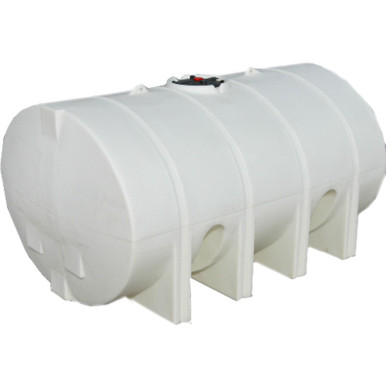
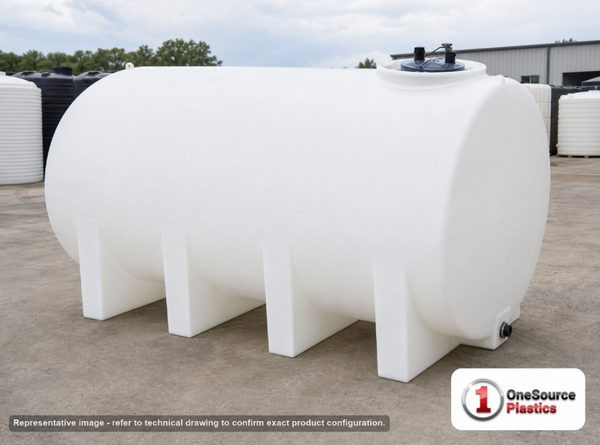
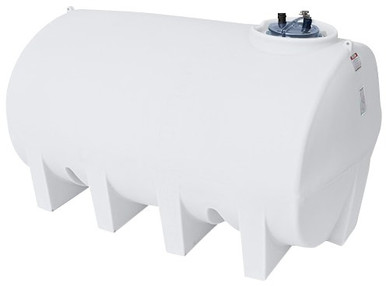
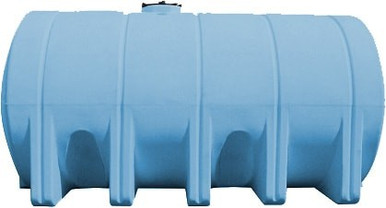
- Horizontal leg tank — Norwesco MPN 40775 (2,035-gallon), Norwesco MPN 41294 (2,635-gallon). Outlet at one end, low-side; full evacuation requires installation with a slight tilt toward the outlet end. Manual or transfer pump for last residual.
- Underground tank — Norwesco MPN 44876 (5,025-gallon underground), Norwesco MPN 41735 (1,000-gallon). Outlet must be pumped (submersible or external) — gravity drain is not an option below grade.
Sloped-Pipe Support Engineering
Sloped pipe still must be supported per ASCE 7-22 dead and live load requirements. Support spacing per pipe diameter and material:
| Pipe Material | 1 in dia | 2 in dia | 4 in dia |
|---|---|---|---|
| Schedule 80 PVC | 5 ft | 7 ft | 9 ft |
| CPVC | 3 ft | 4 ft | 5 ft |
| HDPE SDR 11 | 2.5 ft | 3.5 ft | 5 ft |
| Stainless 316L Sched 10 | 10 ft | 12 ft | 15 ft |
| Schedule 40 black iron | 10 ft | 12 ft | 15 ft |
Hangers per MSS SP-58 (Pipe Hangers and Supports - Materials, Design, Manufacture, Selection, Application, and Installation). Slope must be maintained between supports; under-supported runs sag between hangers and create local low points that defeat the slope-engineering effort.
Slope Verification at Commissioning
The slope is checked, not assumed. Standard verification methods:
- Builder's level / laser level — measure elevation at multiple points along the pipe run. Difference / distance = slope. The reading must be within +/- 10% of design slope.
- Water test — fill the line, drain to a measured volume, repeat. Residual volume divided by pipe interior cross-section gives the residual depth at the worst low point. For 1 in pipe, residual greater than 5 oz indicates a low spot.
- Bubble level on the pipe exterior — quick check for visible deviations. Calibrated bubble levels read 0.25 degrees (~0.5%) accurately, which is too coarse to verify 2% slope. Use as a directional check only, not a precision measurement.
Internal References
- State Regulations Hub — state plumbing code adoptions and septic-effluent piping requirements
- Chemical Compatibility Reference — pipe-material selection by chemistry
- Chemical Tank Recommender — tank selection with self-drain geometry
- Tank Sizing Calculator — capacity and footprint validation
- Freight Cost Estimator — delivered pricing for tanks and components
- Specialty & Metal Fabrication Hub — custom skid layouts with engineered drain geometry
- Environmental Containment Fabrication — secondary containment with engineered slope
Source Citations
- IPC (International Plumbing Code) Section 704 — Drainage Piping Installation
- IPC Section 802.1 — Air Break
- UPC (Uniform Plumbing Code) Section 708 — Cleanouts
- UPC Section 718 — Drainage Pipe Slope
- IAPMO/ANSI Z1001 — Prefabricated Septic Tanks
- ASTM D2729 — Standard Specification for Poly(Vinyl Chloride) (PVC) Sewer Pipe and Fittings
- ASTM F2306 — Standard Specification for 12 to 60 in [300 to 1500 mm] Annular Corrugated Profile-Wall Polyethylene (PE) Pipe and Fittings for Gravity-Flow Storm Sewer and Subsurface Drainage Applications
- ASCE 7-22 — Minimum Design Loads and Associated Criteria for Buildings and Other Structures
- NFPA 13 — Standard for the Installation of Sprinkler Systems (drain-down slope for dry pipe)
- AWWA M14 — Recommended Practice for Backflow Prevention and Cross-Connection Control
- AWWA M22 — Sizing Water Service Lines and Meters
- AWWA C652 — Disinfection of Water-Storage Facilities
- IEEE 515 — Recommended Practice for the Testing, Design, Installation, and Maintenance of Electrical Resistance Heat Tracing for Industrial Applications
- IEEE 515.1 — Recommended Practice for the Testing, Design, Installation, and Maintenance of Electrical Resistance Heat Tracing for Commercial Applications
- OSHA 29 CFR 1910.147 — The Control of Hazardous Energy (Lockout/Tagout)
- MSS SP-58 — Pipe Hangers and Supports - Materials, Design, Manufacture, Selection, Application, and Installation
- OneSource Plastics master catalog data, dated 2026-03-26 snapshot (9,419 products across Norwesco, Snyder, Chem-Tainer, Enduraplas, Bushman)
Recommended Tanks for This Guide
Live pricing, updated automatically · estimate freight to your ZIP.