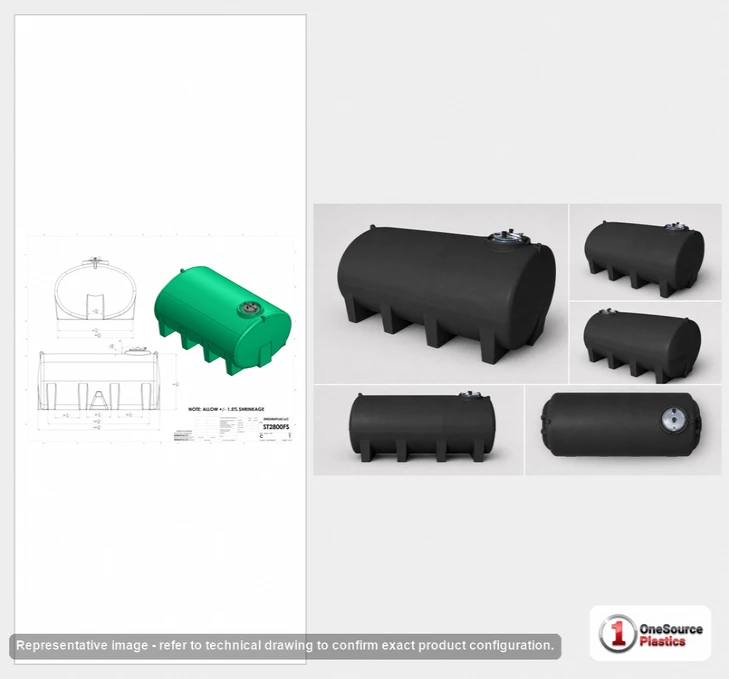
A 3000 gallon horizontal leg tank for water, where a vertical will not fit
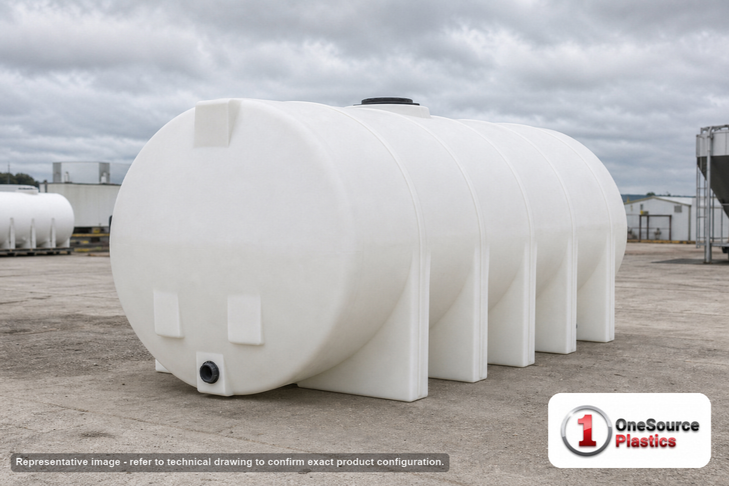
The Snyder Industries 3000 gallon plastic horizontal leg tank for water only, part number 7500000W94303, is a white polyethylene tank 142 inches long, 92 inches wide and 76 inches tall, weighing 1,017 lb empty. Its name says what it is for: Snyder rates this version for liquids up to 1.0 specific gravity, which is water and nothing heavier. Full, it holds 25,020 lb of water. The outlet is 3 inch and the top opening is an 18 inch lid. The moulded legs let it sit flat on a pad or a long deck without a cradle, and at 76 inches tall it goes under a barn eave, a lean-to, a canopy or a set of overhead lines that a vertical tank of this volume would never clear. No inlet is stated for this part, so tell us how you intend to fill it and we will confirm what the tank arrives with.
Is this the right size? Call 866-418-1777 with the site and the daily draw, or get freight to your ZIP and add it to your cart above.
Three thousand gallons of water lying down
The duty is bulk water in a place with no height: a farm or ranch filling stock troughs and sprayers, a fire or emergency supply held at a remote building, a nursery running irrigation off stored water, a contractor holding dust suppression or wash water on a site, a rural property on a hauled supply, a well with a poor recovery rate that needs a buffer between the pump and the demand. A horizontal tank puts the whole 25,020 lb loaded weight on a long, wide bearing area instead of a small circle and keeps the centre of gravity low. The trade is floor: 142 by 92 inches is close to twelve feet by eight, and that whole rectangle has to be flat, continuous and level. A horizontal tank is unforgiving about support in a way a vertical is not, because any part of the bottom left unsupported takes load it was never meant to carry, so the bearing surface runs the full length and the full width with no gaps, no bridging over a low spot and nothing shimmed under one end.
What goes in it
Water. Snyder sells this version for water only at 1.0 specific gravity, and we will not put anything heavier or more aggressive in it on your behalf; if the duty is fertilizer or a chemical, the securing hoop versions of this shell linked below are rated differently and are the ones to ask about. White lets you read the level through the wall in good light. Get the water demand right before the shape: run the daily draw and the refill interval through the tank sizing calculator and take the headspace and outlet position guidance from the tank sizing guide.
Openings and fittings
- Outlet. 3 inch, low in the tank. Your valve, camlock or pipe connects here; support the valve and the first length of pipe on their own so the fitting carries water, not hardware. The fitting type is not listed, so tell us what you are connecting and we will confirm it.
- Lid. An 18 inch lid on top: wide enough to fill from a hose, drop a float in, and get a head and an arm inside to inspect and clean.
- Inlet. None stated. Most buyers fill through the lid or add a bulkhead fitting; tell us your fill arrangement before you order.
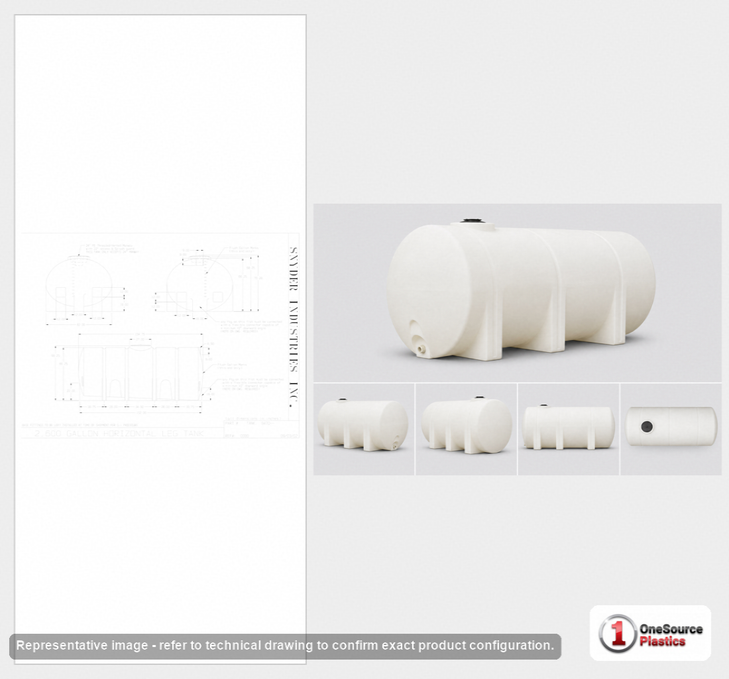
- Drawing. Snyder's drawing is linked under Technical Drawing on this page and shows the outlet position and the leg layout for planning the pad.
Sizes nearby
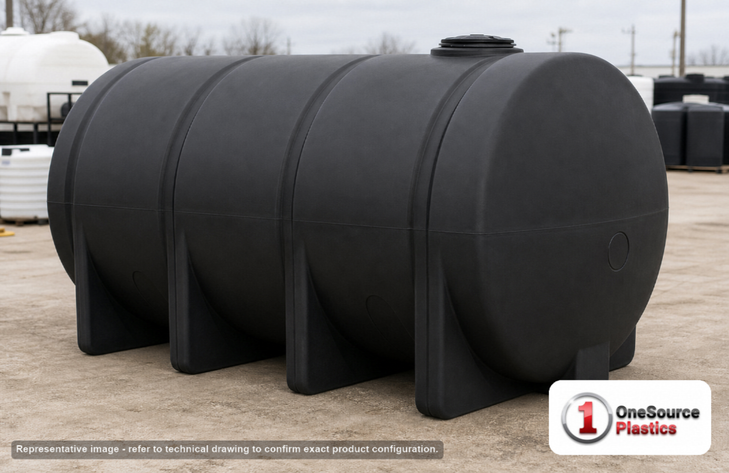
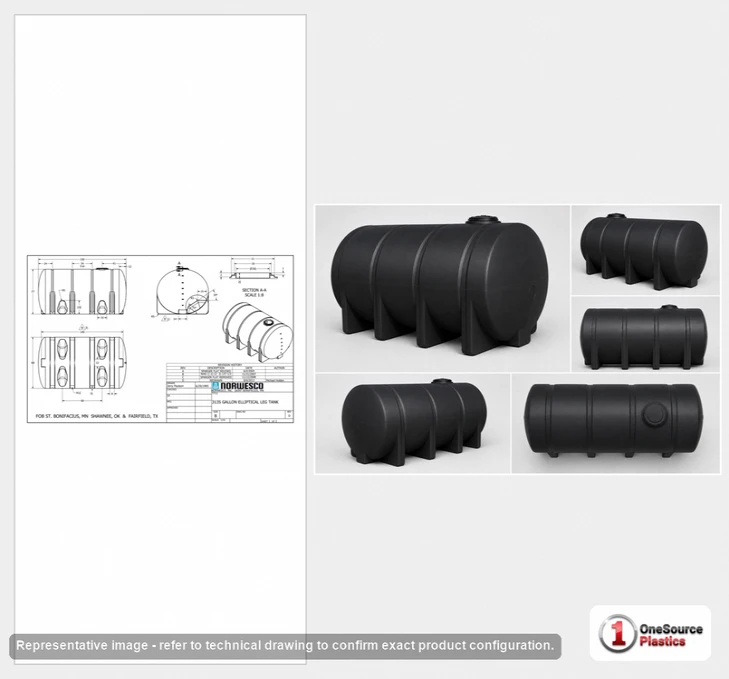
The same 3000 gallon shell with securing hoops, for liquids other than water: the 3000 gallon horizontal leg tank with securing hoops 7500000C37 and the 3000 gallon horizontal leg tank with securing hoops 7500000N43. One size down: the 2600 gallon horizontal leg tank in white. One size up: the 3400 gallon horizontal leg tank with securing hoops. Check the specific gravity rating on each page against your liquid before choosing between them.
Shipping and receiving
This is an oversize load: 142 inches long, 92 inches wide and 76 inches tall at 1,017 lb, from the nearest of Snyder's plants in Chowchilla CA, Lincoln NE, Marked Tree AR or Philippi WV. Add it to your cart at the top of this page, get LTL freight to your ZIP, or call 866-418-1777. The listed price is before freight; the freight cost estimator gives the lane cost to your ZIP, and where a load this size needs a phone quote the estimator will say so. Have a machine and two people at the drop; at the tailgate, check the part number against 7500000W94303 on the bill of lading, look at every leg for transit damage, and fill it with water the first time, slowly, while watching the legs settle on the pad.
Freight and documents
Ships from: Chowchilla, CA; Lincoln, NE; Marked Tree, AR; Philippi, WV. LTL freight is quoted to your ZIP with the freight cost estimator or by phone at 866-418-1777. The listed price is before freight.
Technical drawing (PDF) for Snyder Industries 7500000W94303.
See this tank
Interactive 3D model with live fill. This tank has an interactive 3D model built to its manufacturer dimensions. Rotate it, and set a fill level to see how much liquid it holds at any height. Open the 3D view on the product photo above. Download the 3D model (GLB).
Product video. Watch the Snyder Industries 3000 Gallon Plastic Horizontal Leg Tank -For Water Only video (58 seconds) with dimensions, fittings and shipping notes.
Ready to order?
Add it to your cart at the top of this page, get LTL freight to your ZIP, or call 866-418-1777. The listed price is before freight.