Tank Fitting Cold Flow and Creep Relaxation: A Field Measurement Methodology for Bulkhead, Flange, and Threaded Connection Torque Decay Across the First 90 Days After Installation and the Annual Re-Torque Cadence
Polyethylene is a thermoplastic, and thermoplastics exhibit a time-dependent strain response under sustained stress that engineering literature labels creep, viscoelastic relaxation, or in the field-shop vernacular, cold flow. The phenomenon matters operationally on tank fittings because every bulkhead nut, flanged connection, and threaded fitting installed in a polyethylene tank wall is held by a mechanical compressive preload, and that preload decays over time as the polyethylene material in the load path slowly redistributes under stress. The decay is largest in the first hours and days after installation and tapers across weeks; left unmanaged it produces gasket leakage, fitting loosening, and fluid loss out of joints that were tight at commissioning. This article walks the field measurement methodology for tracking torque decay on tank fittings, the physics that drives the decay, and the re-torque cadence that holds joint integrity across the service life.
The discussion is grounded in polyethylene material science, manufacturer torque specifications across the 5-brand catalog of Norwesco, Snyder, Chem-Tainer, Enduraplas, and Bushman, and field practice for chemistry-service tank installations where joint integrity is non-negotiable. List pricing on each tank product page; LTL freight quoted to your ZIP via the freight estimator or by phone at 866-418-1777.
1. The Cold Flow Phenomenon in Polyethylene Tank Fittings
Cold flow on a polyethylene tank fitting is the time-dependent strain response of the polyethylene material under the sustained compressive stress imposed by the fitting preload:
- The mechanism in molecular terms. Polyethylene is a semi-crystalline polymer with amorphous regions between crystalline lamellae. Under sustained compressive stress the amorphous chains slowly slide and reorient, redistributing the stress and slowly relieving the local strain in the high-stress zones. The crystalline regions resist the motion but the overall material exhibits a measurable time-dependent strain that compounds across hours, days, and weeks.
- The mechanism on a bulkhead fitting. A bulkhead fitting clamps a gasket between an inner flange and an outer flange, with the polyethylene tank wall material sandwiched in the load path. The installer torques the bulkhead nut to a target torque that imposes a calculated compressive preload on the gasket. Over time the polyethylene wall material in the load path creeps, the wall thickness in the clamped zone reduces by a small fraction of a millimeter, and the gasket compression decreases proportionally. The bolt or nut preload decays from the installation value to a lower equilibrium value.
- The decay magnitude. Field measurements on polyethylene bulkhead fittings show torque decay of 20-40 percent across the first 24 hours, additional 5-15 percent across the first week, additional 3-8 percent across the first month, and additional 2-5 percent across the first 90 days. By day 90 the joint typically reaches a quasi-equilibrium where further decay is slow and approximately linear at less than 1 percent per year.
- The decay rate dependence on temperature. Higher temperature accelerates the cold flow rate. A bulkhead at 90 F ambient sees roughly twice the decay rate of the same bulkhead at 60 F. Hot-climate installations and tanks in heated process service experience more aggressive torque decay and demand more frequent re-torque attention.
- The decay rate dependence on initial preload. Higher initial preload accelerates the absolute decay (the higher stress drives faster relaxation) but also leaves more residual preload after decay. The optimum installation torque sits at the manufacturer specification: high enough that residual preload after decay still seals the gasket, low enough that the polyethylene does not exceed its yield strain.
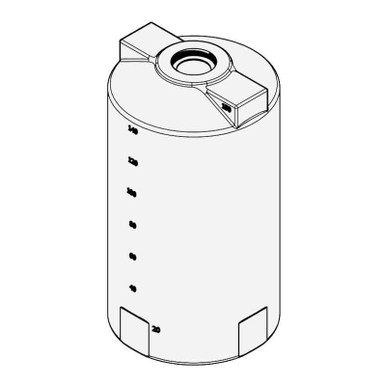
- Reference tank for fitting installation. Reference N-40164 5000 gallon Norwesco vertical as the typical mid-volume tank where bulkhead fitting installations and the associated cold flow management apply directly. The 1.5-inch through 6-inch bulkhead range covers the typical chemistry-service inlet, outlet, and overflow connections.
The cold flow phenomenon is intrinsic to polyethylene; it cannot be eliminated by fitting selection or installation discipline alone. It must be managed through measurement, scheduled re-torque, and gasket selection that tolerates the residual preload range.
2. The Field Measurement Methodology
Field measurement of torque decay requires an instrumented protocol with calibrated tooling and disciplined record-keeping:
- Calibrated torque wrench selection. A click-type or beam-type torque wrench calibrated within the past 12 months is the field standard. The wrench range should bracket the target installation torque (typically 35-50 percent of full-scale for accuracy). For 1.5-inch bulkhead fittings at 30-40 ft-lb target, a 0-75 ft-lb wrench is appropriate. For 4-inch flange fittings at 80-120 ft-lb target, a 0-200 ft-lb wrench is appropriate.
- The break-loose torque method. The field measurement of residual preload is performed by the break-loose torque method: the calibrated wrench is applied to the nut in the tightening direction, the wrench reads the torque required to incrementally rotate the nut, and the breakaway value (the torque at which the nut begins to rotate) approximates the residual installation torque. The method is approximate (friction adds variability of 10-20 percent) but it is the standard field method.
- The installation baseline record. At installation, the technician records: the target installation torque, the actual installation torque applied (tool reading at final tightening), the wrench serial number and calibration date, the gasket part number and installation date, the ambient temperature, and the chemistry temperature. The installation record establishes the baseline against which later measurements are compared.
- The 24-hour measurement. At 24 hours after installation the technician returns and measures the break-loose torque on each fitting. The measurement is recorded in the same fitting log alongside the installation values. The 24-hour reading establishes the rapid-decay portion of the curve; the typical decay at 24 hours is 20-40 percent of installation torque.
- The 7-day, 30-day, and 90-day measurements. Subsequent measurements at 7 days, 30 days, and 90 days track the slowing decay. Each measurement is logged with date, ambient temperature, and chemistry conditions. The 90-day reading approaches the long-term equilibrium where further decay is slow.
- The re-torque decision protocol. If the residual torque measurement falls below 60 percent of installation torque, the joint is re-torqued to the original installation specification. The re-torque restarts the decay curve but at a lower amplitude (the polyethylene has already accommodated much of its accessible strain). After two or three re-torque cycles the joint reaches a stable preload that decays slowly without further re-torque demand.
The field measurement methodology produces an objective record of joint condition. The record protects against unobserved gasket failure and supports the re-torque cadence that holds joint integrity.
3. The Manufacturer Torque Specification Authority
Each tank manufacturer publishes torque specifications for their bulkhead, flange, and threaded fittings:
- Norwesco published torque table. The Norwesco fitting installation guide specifies torque values by fitting size: 1.5-inch bulkhead at 35 ft-lb, 2-inch at 40 ft-lb, 3-inch at 60 ft-lb, 4-inch at 80 ft-lb, 6-inch at 120 ft-lb. The specification assumes a properly compressed Buna-N or EPDM gasket and a clean polyethylene mounting surface. The torque values target an initial preload that survives the expected cold flow decay and still seals the gasket at the residual value.
- Snyder Industries published torque table. The Snyder fitting installation guide publishes similar torque ranges with chemistry-specific gasket recommendations. Snyder's torque table typically references both an installation torque and a 24-hour re-check torque, acknowledging the rapid initial decay that is characteristic of polyethylene fittings.
- Chem-Tainer published torque table. Chem-Tainer's installation literature provides per-fitting-size torque values with similar magnitude to Norwesco and Snyder. The Chem-Tainer guidance includes specific commentary on the re-torque cadence: install, re-torque at 24 hours, re-check at 30 days, and re-check annually thereafter as the standard cadence.
- Enduraplas published torque table. Enduraplas publishes torque values that align with industry standard for bulkhead and flange fittings on polyethylene tanks. The Enduraplas guidance also distinguishes between cold-installed fittings (ambient at installation) and warm-installed fittings (chemistry already in service warming the tank), with adjusted re-torque schedules for the warm-installed case.
- Bushman published torque table. Bushman's fitting installation specification covers the same torque range as the other major manufacturers. Bushman tanks frequently service potable water and similar low-pressure applications where the consequence of joint relaxation is fluid loss rather than chemistry release; the operational risk profile differs but the physics of cold flow is identical.
- The cross-manufacturer convergence on values. The four major polyethylene tank manufacturers publish torque specifications within 10-15 percent of one another for each fitting size. The convergence reflects the common physics: polyethylene wall material with similar properties, gasket materials with similar compressive characteristics, and bolt/nut preload requirements driven by gasket sealing physics.
The manufacturer torque specification is the authoritative installation target. The field measurement methodology compares actual values against the manufacturer target and triggers corrective action when residual torque falls below the acceptable retention threshold.
4. Gasket Selection for Cold Flow Tolerance
The gasket material and design substantially influence the residual sealing capability after cold flow decay:
- Buna-N nitrile rubber gasket. Buna-N gaskets are the standard for water-service and mild-chemistry tank fittings. The compression set of properly cured Buna-N is moderate; the gasket retains 70-85 percent of installation compression after the polyethylene tank wall cold flow stabilizes. Buna-N temperature range is roughly minus 20 F to plus 200 F. The material handles most water and dilute chemistry applications.
- EPDM rubber gasket. EPDM gaskets handle hypochlorite, dilute acids, and oxidizing chemistries where Buna-N is incompatible. EPDM compression set characteristics are similar to Buna-N. Temperature range is comparable. The chemistry compatibility is the primary selection driver.
- Viton fluoroelastomer gasket. Viton gaskets handle aggressive chemistry including concentrated acids, hydrocarbons, and aromatic solvents where Buna-N and EPDM are incompatible. Viton compression set is excellent (lowest among the elastomer families) so the residual sealing capability after cold flow is highest. Cost is 3-5x Buna-N or EPDM per gasket.
- PTFE envelope gasket. PTFE-enveloped rubber gaskets place a PTFE jacket around an elastomer core, combining PTFE chemistry compatibility with elastomer compressive resilience. The PTFE jacket exhibits its own cold flow behavior at higher temperatures but at the typical polyethylene tank service temperatures the jacket is dimensionally stable. PTFE-enveloped gaskets are the premium option for aggressive chemistry on polyethylene tanks.
- Solid PTFE gasket. Solid PTFE gaskets exhibit their own cold flow more than the envelope-style. Solid PTFE on a polyethylene tank fitting typically requires more aggressive re-torque cadence; the combination of two creep-prone materials in the same load path compounds the decay. Solid PTFE is selected only when chemistry compatibility eliminates the alternatives.
- The gasket compression specification. Each gasket type has a recommended compression range, typically 15-30 percent of original gasket thickness. Under-compression leaks at installation; over-compression damages the gasket and produces accelerated cold flow on the polyethylene side. The bolt torque is calibrated against the gasket compression specification and the polyethylene wall material strain limit.
Gasket selection drives the tolerance of the joint to cold flow decay. The right gasket choice for the chemistry, temperature, and compression range produces a joint that holds across the expected re-torque cadence.
5. The Re-Torque Cadence Across the Service Life
The re-torque cadence on a polyethylene tank installation follows a defined schedule across the service life:
- Installation day torque. The fitting is torqued to manufacturer specification with a calibrated wrench. The installation log records target torque, applied torque, wrench identity, and ambient conditions. The fitting is leak-tested with the chemistry or with water hydrostatic test before chemistry fill.
- 24-hour re-torque. Every fitting is re-torqued at 24 hours after installation. The 24-hour re-torque accommodates the rapid initial cold flow and brings the joint back to installation specification. The measurement values before and after re-torque are recorded.
- 7-day check. At 7 days the residual torque is measured by break-loose method on each fitting. If any fitting reads below 70 percent of installation torque, that fitting is re-torqued. Most fittings will sit between 80-95 percent of installation torque at 7 days after the 24-hour re-torque was applied.
- 30-day check. At 30 days the residual torque is measured again. The decay rate has slowed substantially. Fittings reading below 65 percent of installation torque are re-torqued. The 30-day check often catches the last meaningful re-torque opportunity before the joint reaches long-term equilibrium.
- 90-day check. At 90 days the residual torque measurement establishes the long-term baseline. From this point forward the decay rate is slow; the typical loss between 90 days and 1 year is 5-15 percent.
- Annual check. Every year the fitting torque is checked as part of the annual tank inspection. Fittings reading below 60 percent of installation torque are re-torqued; readings above 60 percent are logged and left in service. The annual check is the steady-state cadence that holds joint integrity through the multi-decade service life.
- Reference tank for the cadence walkthrough. Reference N-41524 2500 gallon Norwesco as a typical mid-volume installation where the cadence applies directly. The fitting count on a 2500 gallon tank typically includes a 2-inch outlet, 1.5-inch inlet, 4-inch overflow, and 16-inch manway lid; each receives the cadence treatment.
The re-torque cadence is the discipline that converts the cold flow physics from a problem into a managed condition. Operators who follow the cadence produce installations that hold joint integrity for decades.
6. Common Failure Modes and Field Diagnostics
Field experience produces a catalog of recurring cold flow failure modes:
- Untouched first-year fitting leaks. The most common failure is a fitting that was installed to specification and never re-torqued at 24 hours. The 30-40 percent first-day decay drops the residual torque below the gasket sealing threshold and the joint develops a slow leak that worsens across weeks. The fix is the re-torque that should have been done at 24 hours. The lesson is the cadence discipline.
- Over-torqued fitting with cracked tank wall. An installer attempting to compensate for anticipated cold flow over-torques the fitting at installation, exceeding the polyethylene yield strain. The wall material cracks or crazes around the fitting, producing a slow leak that gets worse with re-torque attempts. The fix is fitting replacement and tank wall repair or, for severe damage, tank replacement. The lesson is that more torque is not always more reliable; the manufacturer specification is the right target.
- Hot-service joint relaxation. A joint installed at ambient temperature and then placed in heated chemistry service (for example, 140 F process chemistry in a tank designed for ambient) experiences accelerated cold flow as the elevated temperature mobilizes the polyethylene molecules. The 24-hour decay can reach 50-60 percent rather than 30-40 percent. The fix is a more aggressive re-torque cadence (re-torque at 8 hours, 24 hours, 48 hours, 7 days, etc.) until the joint stabilizes at the operating temperature.
- Aged gasket reuse leakage. A re-torque on a fitting where the original gasket has been in service for 5-10 years often does not re-establish a seal. The aged gasket has accumulated compression set and chemistry exposure that limits its compression recovery. The fix is gasket replacement at any re-torque event where the gasket is older than 3 years or where the residual sealing is borderline.
- Mismatched bolt or stud material thermal expansion. Stainless steel bolts and carbon steel bolts have similar thermal expansion coefficients close to polyethylene but small differences accumulate across temperature cycles. A stainless bolt in a polyethylene wall through a stainless flange experiences a different effective preload at hot service than at cold service. The fix is bolt material selection that matches the expected service temperature range and the use of Belleville or compression washers for flange preload uniformity.
- Improper bolt pattern tightening sequence. A multi-bolt flange tightened in non-cross pattern produces uneven gasket compression that initiates leak paths even at correct total torque. The fix is the cross-pattern bolt sequence (1-3-2-4 for 4-bolt, 1-5-3-7-2-6-4-8 for 8-bolt) with multiple incremental torque passes (50 percent, 75 percent, 100 percent of target). The sequence discipline applies at installation and at every re-torque event.
The failure mode catalog supports rapid diagnosis when a leak develops on a polyethylene tank fitting. Most leaks fall into one of these patterns and respond to the corresponding fix.
7. Procurement Implications and Tank Selection
The cold flow management discipline has procurement implications for tank selection and fitting inventory:
- Calibrated torque wrench inventory. A tank operator with multiple installations needs a calibrated torque wrench inventory covering the fitting size range. A small operator may rent calibrated wrenches; a large operator stocks them in multiple ranges with annual calibration cycles.
- Gasket spare inventory. The gasket material that matches each tank chemistry should be stocked in the spare-parts inventory. Cold flow re-torque opportunities occasionally extend into gasket replacement; the spare inventory enables the work to proceed without ordering delay.
- Fitting installation training for site personnel. The installation discipline (manufacturer torque target, calibrated wrench use, cross-pattern sequence, 24-hour re-torque cadence) is trainable across site personnel. Investment in training pays back through the reduction of failed installations and the longevity of joint integrity.
- Reference 1000 gallon vertical tank for typical procurement. Reference N-40152 1000 gallon Norwesco vertical as the smaller mid-volume tank where the same fitting installation discipline applies. The 1000 gallon class typically has 1-2 inch outlets, 1 inch inlets, and 16-inch manway lid; the cadence treatment scales directly down from larger tanks.
- Tank replacement timing aligned with fitting replacement. When a tank approaches end of service life, the fitting replacement cycle aligns: aged fittings can be removed with the old tank rather than transferred to a new tank. The capital efficiency improves when fittings are scheduled for replacement at tank replacement.
- Vendor selection on fitting quality. The fitting itself (the bulkhead nut, the flange casting, the threaded boss) varies in manufacturing quality. Premium fittings from established manufacturers exhibit consistent thread engagement, dimensional accuracy, and material quality that supports the cold flow management discipline. Generic low-cost fittings exhibit higher variability that complicates the field measurement.
The procurement discipline supports the operational discipline. Tank selection that includes appropriate fittings, gasket inventory, and trained installation personnel produces installations that operate reliably across the multi-decade service life.
8. The Cold Flow Field Methodology Conclusion
Cold flow on polyethylene tank fittings is intrinsic to the material and cannot be eliminated by fitting selection or installation alone. The field measurement methodology, the manufacturer torque specification authority, the gasket selection for compression resilience, and the re-torque cadence across the service life are the elements that convert the cold flow physics from a chronic operational problem into a managed condition. The discipline is well-established in industry practice and well-documented in manufacturer literature; the challenge is the field execution across many fittings, many tanks, and many years of service.
OneSource Plastics ships polyethylene tanks across the 5-brand catalog (Norwesco, Snyder, Chem-Tainer, Enduraplas, Bushman) with manufacturer-published fitting torque specifications and gasket recommendations. The tank selection for any specific application is performed by the customer site engineer with reference to the chemistry, service temperature, and joint integrity requirements. List pricing on each product page; LTL freight to your ZIP via the freight estimator or by phone at 866-418-1777. For related installation engineering see bulkhead drilling and installation and fitting and bulkhead sizing.
Recommended Tanks for This Guide
Live pricing, updated automatically · estimate freight to your ZIP.