Tank Resin Color Cost & Performance: Black vs White vs Translucent vs Custom Pigmenting
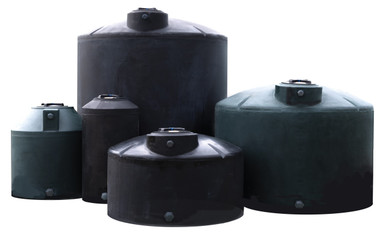
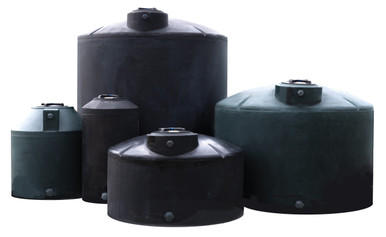
Most tank shoppers pick color because of the way it looks. That is the wrong driver. Tank color is a pigment-chemistry decision with measurable consequences for UV service life, internal algae growth, sight-gauge visibility, NSF 61 potable certification, list price, and resale value if the tank is ever decommissioned. The black vs white vs translucent vs custom-pigmented question deserves an engineering answer, not an aesthetic one.
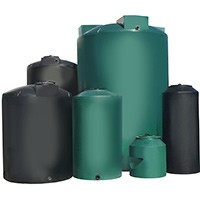
OneSource Plastics' commodity catalog ships the same nominal capacity in 4-7 different colors across Norwesco, Snyder Industries, Chem-Tainer, Enduraplas, Bushman, and Dura-Cast. List-price spread between colors at the same gallons can run $50 to $400 — a 5-15% premium for non-default pigments. This guide walks the chemistry so you can specify color intentionally.
Pigment Chemistry: What "Color" Actually Means in a Polyethylene Tank
Rotomolded polyethylene tanks get color from one of four pigment systems blended into the resin pellets before molding:
- Carbon black: finely-divided amorphous carbon at 2.0-2.5% loading by weight. Carbon black is also the dominant UV stabilizer in dark-pigmented PE; it absorbs UV across the full 290-400 nm spectrum and converts the energy to heat instead of allowing it to break polymer chains. Cost basis: lowest of any pigment system.
- Titanium dioxide (TiO2): the dominant white pigment. Loading 1.5-3.0% by weight. TiO2 is also a UV scatterer (not absorber), reflecting incident UV away from the polymer.
- Hindered Amine Light Stabilizers (HALS): chemical UV stabilizers added to natural / translucent / pastel-pigmented resin where carbon black is absent. HALS scavenge free radicals during photodegradation. Loading 0.1-0.5% by weight. Requires more frequent renewal than carbon-black-stabilized PE.
- Organic and inorganic colorants: green, blue, yellow, dark green chrome oxide, light blue copper phthalocyanine, etc. Loading 0.5-2.0%. These pigments contribute color but provide minimal UV protection on their own; they are paired with HALS for service.
The practical consequence: a black HDPE tank is the most UV-resistant configuration available in the rotomolded industry. A white HDPE tank stabilized with TiO2 + HALS is second-most. A translucent / natural HDPE tank with HALS only is least UV-resistant and degrades fastest in direct sun. We cover the UV-degradation curve in detail in our UV degradation pillar.
Real Color Pricing Across the Catalog
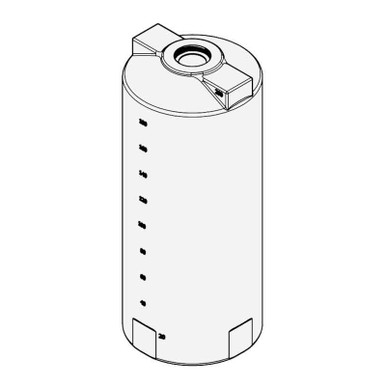
Norwesco ships the 100-gallon vertical (~28 inch diameter, 43 inch tall) in multiple colors:
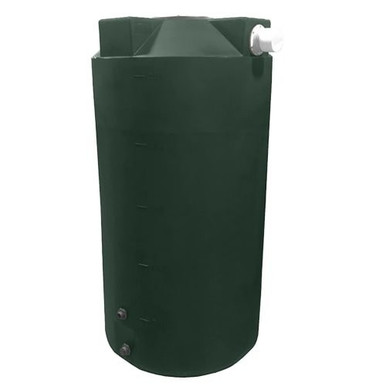
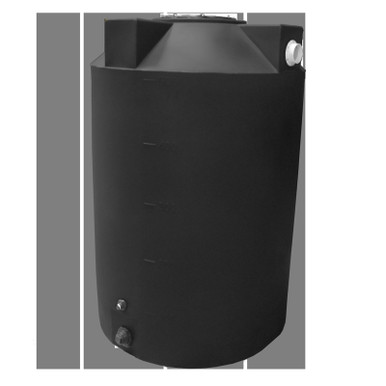
- Norwesco MPN 41464 (black): listed at $393.86. Carbon-black stabilized, 20+ year UV life expectation.
- Norwesco MPN 41861 (natural white): listed at $319.99. TiO2 + HALS stabilized.
The black tank costs 23% more than the natural-white tank at this size — counterintuitive, because carbon black is the cheapest pigment. The premium reflects the heavier UV-stabilization package and the typical use case (outdoor, long-life, agriculture/water). Norwesco's pricing logic varies; at the 2,500-3,000 gallon class the relationship sometimes inverts.
At the 2,500-3,000 gallon class:
- Norwesco MPN 40631 (2,500 gal black water tank, 95"): $2,199.99 list
- Norwesco MPN 41372 (2,500 gal green California-only, 95"): $2,200.00 list
- Norwesco MPN 40754 (3,000 gal white liquid-storage, 95"): $3,101.71 list
- Norwesco MPN 42380 (3,000 gal blue, 102"): $3,718.00 list — 25% premium for the heavy-duty blue pigmentation versus the equivalent white.
- Norwesco MPN 43140 (3,000 gal green, 102"): $2,699.99 list
- Norwesco MPN 42042 (3,000 gal black, 102"): $2,480.00 list
The pattern: blue pigmentation is consistently the most expensive (HD heavy-duty with extra UV package), green and dark-green are mid-tier, black and natural-white are bottom-tier on price. Custom pigments (orange, yellow, specialty regulatory colors) typically run 30-100% premium and require minimum-order quantities.
Black: When and Why
Black is the right choice when:
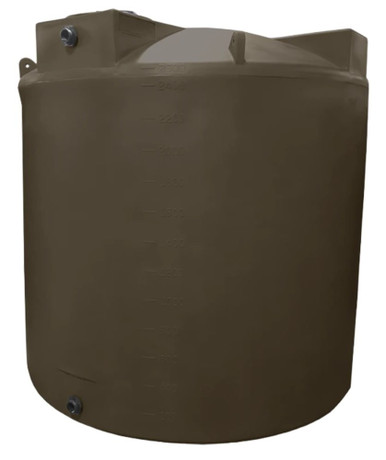
- Outdoor installation, multi-decade service life expected. Carbon-black stabilization gives 20-30 year UV life on water service.
- Algae growth must be prevented in the stored liquid. Black opaque shell blocks photosynthetically active radiation (PAR, 400-700 nm). Algae cannot photosynthesize without light. This is the dominant reason livestock-water and irrigation tanks ship black.
- Visual integration with infrastructure (oil & gas pads, dark-graveled industrial yards). Black blends into industrial settings.
- Heat absorption is a feature, not a bug. A black tank in direct sun runs 15-25F hotter internal liquid temperature than a white tank in the same conditions. For winter freeze protection in moderate climates, this can delay overnight ice formation by 4-8 hours. (The opposite consideration applies in summer, see below.)
Black is the wrong choice when:
- Storing biological products that can grow at warmer temperatures (raw milk, biopharmaceutical feedstocks, beverage process water). Heat accelerates spoilage.
- Storing temperature-sensitive chemicals (DEF, sodium hypochlorite, hydrogen peroxide). DEF degrades above 86F; sodium hypochlorite half-life drops dramatically above 75F per ANSI/AWWA B300; hydrogen peroxide outgasses faster at elevated temperature. Heat is a service-life killer for these chemistries — covered in our sodium hypochlorite pillar and DEF pillar.
- Operator needs to read fluid level visually without a sight-gauge. Opaque tanks require an external level sensor or staff gauge.
White (Natural and Opaque): When and Why
White HDPE comes in two flavors:
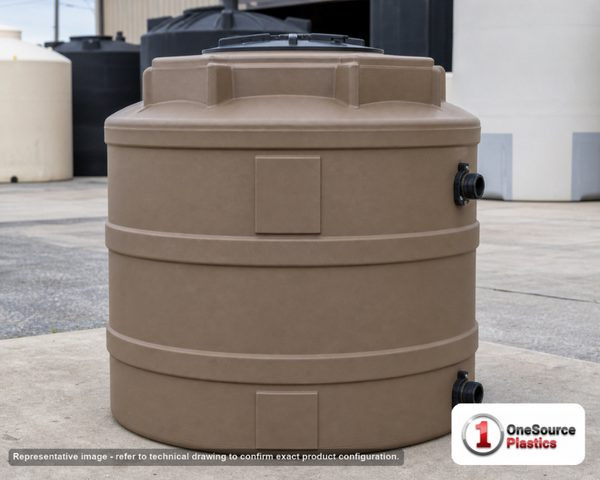
- Natural / translucent white: minimal pigment. Light passes through. Operator can see liquid level from outside the tank. UV life 10-20 years depending on stabilization package.
- Opaque white: heavier TiO2 loading. Light does not penetrate. UV life 15-25 years.
Natural / translucent is the right choice when:
- Visual fluid-level confirmation matters. Operators see at-a-glance whether tank is full, half, empty.
- Indoor installation where UV exposure is minimal. The shorter UV life of HALS-only stabilization is irrelevant inside a building.
- Chemistry is light-sensitive but algae growth is unlikely (DEF, methanol, ethylene glycol, citric acid, food-grade processes). NSF 61 certification is most common on natural-white SKUs because TiO2 and the polymer matrix are both food-contact-approved at standard loadings.
Natural is the wrong choice when:
- Storing water outdoors for any extended period. Algae will bloom in a translucent tank in direct sun within weeks. The Norwesco / Snyder / Chem-Tainer water-tank product lines default to black or dark-green precisely to prevent this.
- Storing UV-sensitive products in direct sun. Sodium hypochlorite degrades by ultraviolet photolysis; potassium permanganate degrades; many oxidizers and certain pharmaceutical feedstocks degrade.
Blue, Green, and Other Pigmented: When and Why
Pigmented tanks (blue, green, dark green, yellow, red) ship with heavier UV stabilization packages because the pigment alone does not block UV. The premium typically runs 10-25% over equivalent black or natural-white. These are the right choice when:
- Color-coding for chemical identification. Many chemical plants color-code: blue = water, green = caustic, yellow = acid, red = flammable. The cost of the pigment is recovered in operator-error reduction. OSHA 29 CFR 1910.1200 (Hazard Communication Standard) does not mandate specific colors but does require effective container labeling, and color-coding is widely used as a supporting practice.
- Regulatory color requirement. Some state agencies and industry standards specify particular tank colors for fire-water (red), potable-water (blue), or non-potable irrigation (purple per AWWA C800 and the IAPMO Uniform Plumbing Code Appendix M for reclaimed water).
- Aesthetic integration with site colors. Common for commercial / institutional installations.
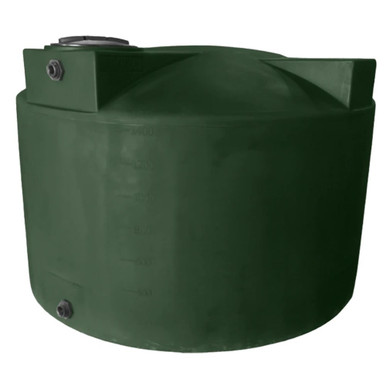
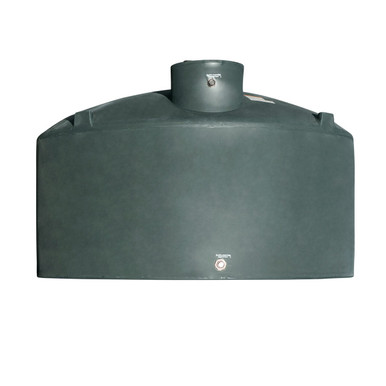
For dark-green and California-green water tanks (Norwesco MPN 41370 / 41372 / 41370B), the color is engineered for visual blending into rural and agricultural landscapes; this is regulatory-driven in some California counties under local visual-impact ordinances.
UV-Stabilization Engineering Detail
ASTM D1998 Section 6.6 requires UV stabilization for outdoor service. The two dominant approaches:
- Carbon black at 2-2.5% loading: permanent absorber. Does not deplete during service. Provides 25-30 years of UV protection on standard outdoor exposure.
- HALS (hindered amine light stabilizers) at 0.1-0.5% loading: renewable scavenger. Slowly consumed by free radicals during photodegradation. Effective for 10-15 years on direct-sun outdoor exposure before depletion. Often paired with UV absorbers (benzotriazoles, benzophenones) at 0.2-0.5% loading for combined defense.
The practical service-life consequence: a black tank in Phoenix, Arizona (UV index 11+) can deliver 25-year service. A natural-white HALS-stabilized tank in the same exposure may need replacement at 12-15 years. Buyers in high-UV zones should default to black for outdoor service unless visual fluid-level reading is required.
Algae Growth and Photosynthetically Active Radiation
Algae require light in the 400-700 nm range (PAR) plus nutrients (nitrogen, phosphorus) plus temperature above ~50F. Translucent tanks transmit 30-60% of incident PAR depending on wall thickness. Opaque-white tanks transmit 1-5% (still measurable). Black tanks transmit effectively zero.
For potable water, algae growth is a public-health concern: cyanobacterial toxins (microcystins, anatoxins) are regulated by EPA Health Advisory levels. For irrigation water, algae plug filters, foul drip emitters, and damage pump seals. Black or opaque-dark-green is the engineered answer for outdoor water tanks intended for long-term storage. We cover this in our rainwater harvesting pillar and California state regulation pillar.
NSF 61 Potable Certification by Color
NSF/ANSI 61 (Drinking Water System Components: Health Effects) tests the polymer + pigment + stabilizer system as a whole. Certification is per-SKU, not per-color generally. Most Norwesco / Snyder / Chem-Tainer potable-water SKUs are certified in:
- Natural / translucent white (TiO2 minimal)
- Opaque white (TiO2 standard loading)
- Black (carbon black, NSF-grade)
- Dark green (food-grade chrome oxide)
Custom-pigmented and specialty colors (red, orange, neon yellow) are often NOT NSF 61 certified because the specific pigment combination has not been tested or because the pigment chemistry is incompatible with food-contact regulations. Verify NSF 61 certification on the specific SKU before specifying for potable service.
Decision Matrix
| Application | Recommended Color | Reason |
|---|---|---|
| Outdoor agricultural water (livestock, irrigation) | Black | Algae prevention + 25-year UV life |
| Outdoor potable water | Black NSF 61 or dark green NSF 61 | Algae prevention + NSF 61 + heat tolerable |
| Indoor potable water | Natural white NSF 61 | Visual level reading, no UV concern |
| DEF storage (outdoor) | Opaque white | Heat reduction + ISO 22241 compliance |
| Sodium hypochlorite 12.5% (indoor) | Natural white or opaque white | Visual level, photolysis minimized in shaded space |
| Sodium hypochlorite 12.5% (outdoor) | Black or opaque dark green | UV photolysis prevention |
| Concentrated sulfuric / hydrochloric acid | Natural or black XLPE | Chemistry-driven, color secondary |
| Chemical color-coding (process plant) | Per plant standard | Operator error reduction worth premium |
| Diesel exhaust fluid (DEF, ISO 22241) | Opaque white NSF 61 | UV + heat protection, food-grade ingress prevention |
| Fire-water reserve | Red NSF 61 (where mandated by AHJ) | NFPA 22 visibility + AWWA standards |
| Reclaimed / non-potable irrigation | Purple per AWWA C800 | Required by California, Texas, Florida code for cross-connection prevention |
Custom Pigmenting: When It's Worth It
Custom-pigmented tanks (specific Pantone or PMS color, brand-color matched, or specialty regulatory color) require:
- Minimum order quantity: typically 10-25 tanks per pour
- Setup fee: $500-2,500 depending on pigment
- Premium per tank: 30-100% over standard color
- Lead time: 6-16 weeks vs 2-4 weeks for standard color
It is worth the premium when:
- Brand-identity color is part of a customer-facing installation (water-park branding, beverage company on-site, agricultural cooperative branding)
- Regulatory requirement (purple for reclaimed water in certain jurisdictions)
- OSHA 29 CFR 1910.1200 hazard-communication color-coding to a corporate standard that does not match a stock color
For most commodity applications, standard stock colors (black, natural white, dark green, blue) cover the use case at 1-2 week lead time. Custom is rarely the right answer for water, agricultural, or basic chemical-storage work; we route specialty-color requests through our Specialty & Metal Fabrication hub when chemistry or capacity demands it.
Heat Absorption and Operating Temperature
A black HDPE tank in full Phoenix summer sun (115F ambient, UV index 11) reaches internal liquid temperature 130-140F. A white HDPE tank in the same exposure peaks at 110-120F. A natural-white tank at 105-115F.
For HDPE rated to 100-120F continuous service (per ASTM D1998 and manufacturer data sheets), a black tank in Phoenix exceeds the polymer's rating during summer afternoons. The polymer doesn't fail catastrophically — the consequence is accelerated creep and reduced service life. Best practice in high-solar-load zones (Arizona, Nevada, southwest Texas, southwestern New Mexico, southeastern California) is to specify white or opaque dark-green over black for HDPE when stored chemistry permits visual indication of liquid level, or to install shade structures.
XLPE tanks rated to 140F continuous (per Snyder Industries, Enduraplas, Norwesco XLPE data sheets) tolerate the temperature swing better. We cover this trade-off in our resin selection pillar and cold-climate field-performance pillar.
Resale Value and Decommissioning by Color
End-of-life tank resale (used water tanks for agricultural reuse, livestock troughs, rain barrels) shows a clear color preference: black retains 50-60% of new-list value at 10 years; natural white retains 25-35%; pigmented (blue, green) retains 30-45%. This is partly because black tanks are the dominant agricultural standard and partly because the residual UV stabilization in carbon-black tanks gives the buyer 5-10 more years of service after acquisition. We cover decommissioning and HDPE recycling in our decommissioning pillar.
How OneSource Specifies
For inbound buyer questions, our color-specification logic follows this sequence:
- What is the chemistry? If photosensitive (NaOCl, KMnO4) or temperature-sensitive (DEF, food-grade) we recommend opaque white or dark-green.
- Outdoor or indoor? Outdoor + water = black default for algae prevention. Indoor + visual level = natural white default.
- Climate zone? High-solar zones get white preference even for water service if chemistry permits.
- Color-coding requirement? Process-plant standards override.
- Regulatory requirement? Purple for reclaimed water, red for fire reserves where AHJ specifies.
We never substitute color across a customer order without explicit sign-off; the operational and regulatory implications belong to the buyer. Every list price quoted is BigCommerce list — LTL freight is quoted separately per ZIP via the Freight Estimator or by phone at 866-418-1777.
Internal Resources
- UV Degradation Service Curve
- Polyethylene Resin Selection
- Cold Climate Field Performance
- Tank Decommissioning
- Sodium Hypochlorite Storage
- Diesel Exhaust Fluid (DEF) Storage
- Chemical Compatibility Database
- Freight Cost Estimator
Source Citations
- ASTM D1998 — Standard Specification for Polyethylene Upright Storage Tanks (Section 6.6 UV stabilization)
- NSF/ANSI 61 — Drinking Water System Components: Health Effects
- ANSI/AWWA B300 — Hypochlorites (decomposition vs temperature)
- ISO 22241 — Diesel Engines NOx Reduction Agent AUS 32 (DEF specifications)
- EPA Health Advisory: Cyanobacterial Toxins (microcystins, anatoxins)
- OSHA 29 CFR 1910.1200 — Hazard Communication Standard
- NFPA 22 — Standard for Water Tanks for Private Fire Protection
- AWWA C800 — Underground Service Line Valves and Fittings (purple reclaimed-water identification)
- IAPMO Uniform Plumbing Code Appendix M — Recycled / Reclaimed Water Systems
- OneSource Plastics master catalog data, 2026-03-26 snapshot
Recommended Tanks for This Guide
Live pricing, updated automatically · estimate freight to your ZIP.