Rainwater Harvesting Tank Sizing by State: Regulations, Rainfall, and Real SKUs
Rainwater harvesting is the practice of collecting rainfall from a roof, conveying it through a gutter and downspout system, screening out debris, and storing it in a tank for later use. The water can be used for landscape irrigation, toilet flushing, laundry, vehicle washing, agricultural irrigation, livestock watering, and (with additional treatment) potable supply. The capture system is mostly plumbing. The storage tank is the system component that costs the most, takes the most space, and lasts the longest. Sizing it wrong wastes money in either direction: oversize and you've spent for capacity you'll never use; undersize and you've built a tank that overflows half the rainstorms.
This guide covers how to size a rainwater harvesting tank correctly using the actual rainfall data for your climate, the regulatory framework in your state, and the real polyethylene tank catalog at OneSource Plastics. Every tank SKU and price is from the live master catalog. Every state regulation citation is to the actual statute or building code chapter, not to a fabricated bill number.
The Rainwater Capture Equation
Capturable rainwater volume from a roof is determined by three numbers:
Catchment area × Rainfall depth × Collection efficiency = Captured volume
- Catchment area is the horizontal projection of the roof, in square feet. A pitched roof captures water based on its plan-view footprint, not the roof surface area.
- Rainfall depth is the total inches of rain in the period you're sizing for (annual, monthly, single-storm).
- Collection efficiency is the fraction of rain that actually makes it into the tank after gutter overflow, splash loss, evaporation, first-flush diversion, and screen losses. A well-designed system captures 75 to 90% of theoretical maximum. Use 80% for sizing as a conservative default.
The conversion factor is: 1 inch of rain on 1 square foot of roof = 0.623 gallons. So a 2,000 square foot roof catching 1 inch of rain at 80% efficiency captures (2000 × 1 × 0.623 × 0.80) = 996 gallons.
The State Regulatory Landscape
Rainwater harvesting is legal in all 50 states as of 2026, but the regulatory environment varies dramatically. Some states actively encourage it with tax incentives. Some require permits and inspections. A few have specific restrictions on use case (potable vs non-potable). Here's the framework for the 10 most common states for rainwater harvesting installs:
Texas
Texas is the most rainwater-harvesting-friendly state in the US. The relevant authorities are:
- Texas Property Code Section 5.205 — HOAs cannot prohibit rainwater harvesting systems on detached single-family homes.
- Texas Tax Code Section 151.355 — sales tax exemption for rainwater harvesting equipment.
- Texas Health and Safety Code Chapter 341 — potable rainwater systems must comply with TCEQ public-water-system rules.
- Texas Administrative Code Title 30 Chapter 290 — TCEQ Public Drinking Water rules apply if the rainwater is used for potable supply on a public-system property.
Sizing context: Texas annual rainfall ranges from about 8 inches in El Paso to 56 inches in Beaumont. Statewide average is approximately 28 inches per year. See our Texas state regulation pillar for full details.
California
California has aggressive water-conservation policy that includes rainwater harvesting:
- California Water Code Section 10573 — Rainwater Capture Act of 2012 authorizing residential collection.
- California Plumbing Code (Title 24 Part 5) Chapter 17 — non-potable rainwater systems for residential and commercial buildings.
- SB 555 (2019) — landlord-tenant water-submetering applies to multi-unit rainwater systems.
Sizing context: California rainfall is highly seasonal (October through April) with negligible summer rainfall in most regions. Annual depths range from 2 to 4 inches in Death Valley to over 100 inches in the northwest coast. See our California state regulation pillar.
Florida
Florida regulates rainwater under building and plumbing codes:
- Florida Building Code Plumbing Chapter 14 — non-potable water reuse, including rainwater.
- Florida Building Code Residential Section R901 — rainwater collection and storage system design.
- Florida Statutes Section 373 — Water Resources, includes water-management-district authority over large catchment systems.
Sizing context: Florida averages 50 to 60 inches per year, heavily concentrated in summer thunderstorm season (June through September). See our Florida state regulation pillar.
Colorado
Colorado historically prohibited rainwater harvesting under prior-appropriation water-rights doctrine. The legislature reversed this in 2016:
- HB 16-1005 — allows residential rainwater collection up to two barrels (110 gallons combined) on single-family and multi-family properties of four units or fewer.
- Colorado Senate Bill 09-080 — provides for larger collection on properties with senior water rights or pilot-program approval.
Sizing context: Colorado averages 15 to 20 inches per year statewide, with most rainfall as summer thunderstorms. The 110-gallon residential cap effectively limits rainwater storage to a single 100-gallon polyethylene tank. See our Colorado state regulation pillar.
Arizona
Arizona encourages rainwater harvesting via tax credit:
- Arizona Revised Statutes Title 43 Chapter 10 Article 5 — tax credit for residential water-conservation systems including rainwater harvesting.
- Tucson Code Chapter 27 Article XII — commercial buildings must source 50% of landscape water from rainwater or grey water.
Sizing context: Arizona averages 8 to 13 inches per year statewide. Rainfall is bimodal (winter Pacific systems, summer monsoon). See our Arizona state regulation pillar.
Washington
Washington explicitly authorizes rainwater harvesting:
- RCW 90.03.005 — Department of Ecology rules that rainwater on a parcel is not subject to water-rights permitting on the parcel where it falls.
- Department of Ecology interpretive policy 1017 — clarifies legality of residential and commercial rainwater collection.
- Washington State Building Code RCW 19.27 — plumbing requirements for non-potable water systems.
Sizing context: Washington annual rainfall is 6 to 12 inches in the eastern dry zone, 30 to 60 inches in the Puget Sound zone, and over 100 inches in the Olympic Peninsula. See our Washington state regulation pillar.
Georgia, North Carolina, Ohio, New York
All four states permit rainwater harvesting, with primary regulation under state plumbing codes (Georgia State Plumbing Code Chapter 13, NC State Plumbing Code Chapter 13, Ohio Plumbing Code Chapter 14, NY Uniform Plumbing Code Chapter 13). For non-potable use, requirements are minimal. For potable use, all four require treatment to drinking-water standards under the relevant state public-water-supply rules. See our state regulations hub for the full 50-state coverage.
Sizing for Annual Demand: The Yield Calculation
The first sizing approach: calculate annual yield from your roof and match it against annual demand.
Annual yield (gallons) = catchment area (sq ft) × annual rainfall (inches) × 0.623 × 0.80
Example: 2,500 square foot roof in Houston (49 inches annual rainfall):
2500 × 49 × 0.623 × 0.80 = 61,054 gallons/year
Example: 1,800 square foot roof in Phoenix (8 inches annual rainfall):
1800 × 8 × 0.623 × 0.80 = 7,179 gallons/year
Annual demand for landscape irrigation is highly site-dependent. A typical estimate: 0.5 inches per week of irrigation depth across the irrigated area during the growing season. For a 2,000 square foot lawn over a 24-week growing season:
2000 × 0.5 × 24 × 0.623 = 14,952 gallons/year
For non-potable indoor reuse (toilet flushing): an average toilet uses 2.5 gallons per flush, 5 flushes per person per day. A 4-person household uses 18,250 gallons/year for toilet flushing alone.
For potable supply on a residential property: EPA WaterSense data suggests 82 gallons per person per day. A 4-person household uses approximately 120,000 gallons/year. Most rainwater harvesting installations cannot fully supply potable demand year-round in most US climates and instead supplement utility water.
Sizing for Storage Capacity: The Reserve Calculation
The second sizing approach: calculate the storage you need to bridge dry periods between rainfall events.
Look up the longest typical dry period in your climate (NOAA ClimateData has historical data per ZIP). Multiply by the daily demand. The result is the minimum storage to maintain continuous supply through the dry period.
Example: Texas Hill Country has typical 30-day dry summer periods. Daily demand 100 gallons/day for landscape irrigation = 3,000 gallons reserve.
Example: Pacific Northwest has typical 60-day dry summer periods. Daily demand 50 gallons/day for landscape irrigation = 3,000 gallons reserve.
Example: Phoenix can have 90-day dry periods. Daily demand 50 gallons/day = 4,500 gallons reserve.
The smaller of (annual yield / 12 months × reserve months) and (reserve calculation) gives you a practical sizing answer. You can't store more than you can collect; you don't need to store more than your reserve period requires.
Tank Selection: Real SKUs by Capacity Range
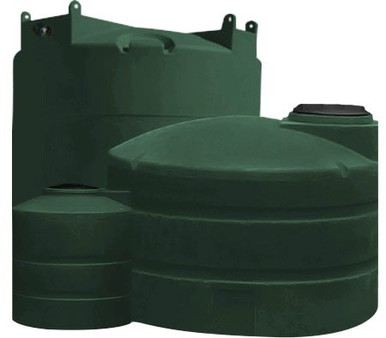
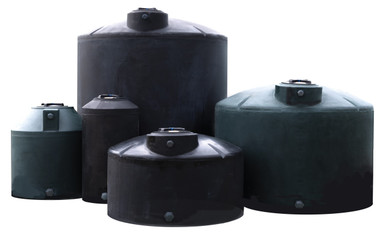
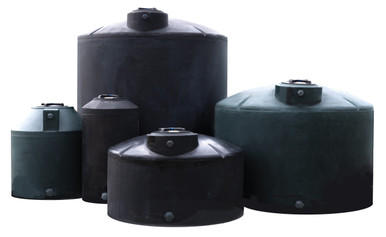
Once you know the target capacity, here are the matched polyethylene tanks from the OneSource Plastics catalog. All tanks listed are HDPE, FDA / NSF/ANSI 61 compliant where so noted, and rated for water service (1.0 to 1.1 ASTM SG).
Small residential systems (50 to 500 gallons)
| Capacity | MPN Suggestion | Form Factor | Notes |
|---|---|---|---|
| 50 to 100 gallon | N-44800 (100g doorway), N-44986 (100g black) | Doorway / under-eave | Colorado-cap, garage installs |
| 150 gallon | N-45716 | Doorway slimline | Tight-clearance install |
| 250 gallon | N-42337, N-45722, N-41526 | Doorway, multiple colors | Single-rainstorm capture for small roof |
| 300 to 400 gallon | N-44960, N-44330, N-44549, N-44361 | Doorway | Mid-size residential |
| 500 gallon | N-43616 (500g doorway) | Doorway | Outdoor-ready in dark green or black |
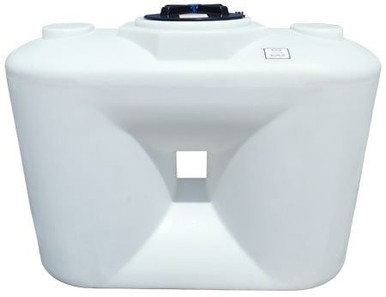
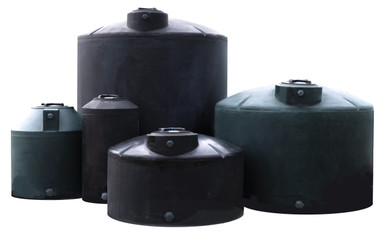
For small systems, dark-colored tanks (black or dark green) are the preferred choice for outdoor installation because they block UV light from entering the tank, which prevents algae growth in the stored water. White or natural tanks are fine for indoor or shaded installations and have the benefit of visual fluid-level inspection through the wall. See our doorway tank sizing guide for the doorway-form-factor deep dive.
Mid-size residential to small commercial (750 to 2,500 gallons)
| Capacity | MPN Suggestion | Form Factor | List Price |
|---|---|---|---|
| 750 gallon | N-44310 (doorway) | Doorway | $1,722.30 |
| 1000 gallon | N-44045 (doorway) | Doorway | $2,469.99 |
| 1500 gallon | Standard vertical 90″ dia × 50″ H | Vertical | From $1,400 |
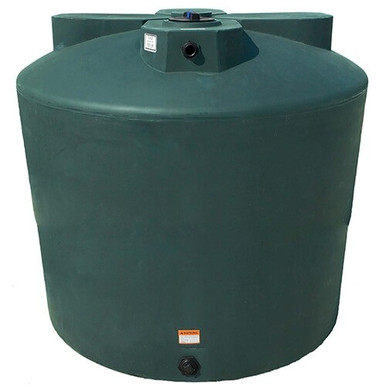
| 2000 gallon | N-44129 (white), N-44131 (dark green agricultural) | Vertical 90″ dia × 84″ H | $1,960.50 to $2,200.00 |
| 2500 gallon | Norwesco 2500-gallon vertical | Vertical | From $2,500 |
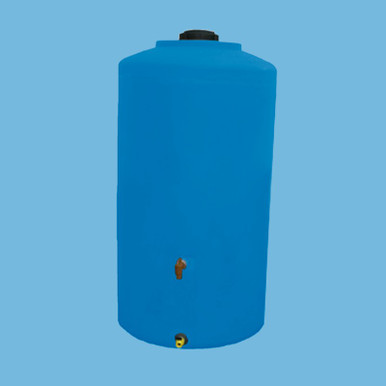
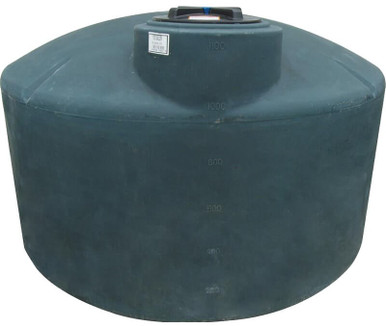
At this capacity range the form factor switches from doorway to standard vertical because vertical tanks are cheaper per gallon and the install is typically outdoor (or in a barn / pole barn) where the wider footprint isn't a problem. For Texas, Florida, and Pacific Northwest installations the 2,000-gallon dark-green Norwesco N-44131 is the most-quoted SKU because the dark color blocks algae and the capacity matches typical residential annual demand.
Large residential and small agricultural (3,000 to 10,000 gallons)
| Capacity | Form Factor | Typical Use |
|---|---|---|
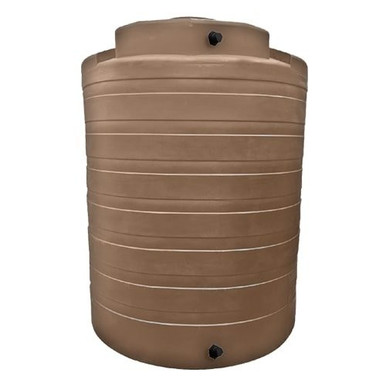
| 3000 to 5000 gallon | Vertical 102″ or 119″ dia | Large residential, small farm |
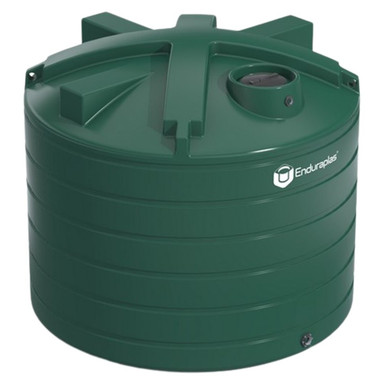
| 5000 to 7500 gallon | Vertical 119″ or 142″ dia | Mid-size agricultural irrigation reserve |
| 10000 gallon | Vertical 142″ dia | Large agricultural, fire suppression cistern |
Above 5,000 gallons the polyethylene tank starts to compete with concrete cisterns on a cost-per-gallon basis. Concrete is heavier, harder to install, and longer-lived (50+ years vs 20 to 30 years for polyethylene). Polyethylene is faster to install, lighter to ship, and can be relocated. Choose based on lifecycle and operational considerations.
Underground Cistern Tanks
For installations where above-ground tanks are visually unacceptable (HOA constraints, aesthetic requirements, freezing climates), Norwesco builds underground cistern tanks designed to be buried with proper backfill engineering:
- N-44593 — 2000 Gallon Plastic Multi-Use Underground Liquid Storage Tank ($4,759.99)
- N-42559 — 2000 Gallon Underground Water Storage Cistern Tank ($4,759.99)
Underground tanks have specific install requirements: the surrounding backfill must be pea-gravel or sand (not native clay or rock), the tank must be completely full before backfill to prevent collapse from external pressure, and the install must comply with local building code burial requirements. Underground tanks are also subject to freeze protection requirements in northern climates — the inlet, outlet, and vent piping must be insulated and the tank itself must be buried below the frost line for the local climate zone.
State-by-State Sizing Worked Examples
Austin, Texas (Texas Hill Country)
Catchment: 2,500 sq ft single-family roof. Annual rainfall: ~34 inches.
Annual yield: 2500 × 34 × 0.623 × 0.80 = 42,364 gallons.
Annual demand for landscape + toilet flushing: ~30,000 gallons. Reserve calc: 30-day dry summer × 80 gpd = 2,400 gallons.
Recommended: 2,500-gallon vertical or two 1,500-gallon tanks in parallel.
Sacramento, California (Central Valley)
Catchment: 2,000 sq ft. Annual rainfall: ~18 inches concentrated October-April.
Annual yield: 2000 × 18 × 0.623 × 0.80 = 17,942 gallons.
Demand: highly seasonal mismatch — supply in winter, need in summer. Reserve calc: 6-month dry season × 50 gpd irrigation = 9,000 gallons.
Recommended: 5,000 to 7,500 gallon vertical to bridge the seasonal gap.
Tampa, Florida
Catchment: 2,200 sq ft. Annual rainfall: ~52 inches concentrated June-September.
Annual yield: 2200 × 52 × 0.623 × 0.80 = 57,002 gallons.
Demand: relatively constant year-round. Reserve calc: 30-day dry winter × 100 gpd = 3,000 gallons.
Recommended: 2,500 to 3,000 gallon vertical, oversized capture system to handle summer thunderstorms.
Denver, Colorado (residential, regulatory cap)
Catchment: 1,800 sq ft. Annual rainfall: ~14 inches.
Annual yield (theoretical): 1800 × 14 × 0.623 × 0.80 = 12,560 gallons.
Regulatory cap: 110 gallons combined per HB 16-1005.
Recommended: Two 50-gallon barrels OR one 100-gallon tank (N-44800 doorway, $369.99). Capture rate is regulator-limited, not roof-limited.
Tucson, Arizona
Catchment: 1,500 sq ft. Annual rainfall: ~12 inches bimodal.
Annual yield: 1500 × 12 × 0.623 × 0.80 = 8,971 gallons.
Reserve calc: 90-day summer dry × 30 gpd = 2,700 gallons.
Recommended: 3,000-gallon vertical, dark color for UV / algae control.
Seattle, Washington
Catchment: 2,200 sq ft. Annual rainfall: ~38 inches concentrated October-May.
Annual yield: 2200 × 38 × 0.623 × 0.80 = 41,702 gallons.
Reserve calc: 60-day dry summer × 40 gpd = 2,400 gallons.
Recommended: 2,500-gallon vertical for above-ground or 2,000-gallon underground cistern for HOA-restricted properties.
First-Flush Diversion (Often Forgotten in Sizing)
The first 0.05 to 0.10 inches of rainfall on a roof carries the dust, bird droppings, leaf litter, and atmospheric deposition that accumulated since the last storm. A first-flush diverter routes this contaminated water to a drain or to ground rather than into the storage tank.
For a 2,500 sq ft roof, a 0.05-inch first-flush diverts (2500 × 0.05 × 0.623) = 78 gallons per storm event. The diverter capacity needs to be at least this volume. Commercial first-flush diverters in the 25 to 100 gallon range cover most residential roofs. Larger commercial roofs need correspondingly larger diversion.
The first-flush volume is part of the system loss already accounted for in the 80% collection efficiency factor in the yield equation, so don't double-count it in sizing.
Common Rainwater Sizing Mistakes
Mistake 1: Using roof slope area instead of horizontal catchment area
The catchment area for the rainwater equation is the horizontal projection (plan-view footprint), not the actual roof surface. A pitched roof with 2,500 sq ft of roofing material may only have 2,000 sq ft of horizontal projection.
Mistake 2: Sizing for theoretical maximum rather than realistic yield
The 80% collection efficiency factor accounts for gutter overflow during heavy storms, splash loss, evaporation, screen losses, and first-flush diversion. Using 100% capture in your sizing math gives you a tank that's 25% too small for the actual demand it needs to serve.
Mistake 3: Ignoring the dry period
If your climate has a 4-month dry season, you need enough storage to bridge that period. Annual yield calculations alone don't tell you whether the supply matches the demand at the time of year you need it.
Mistake 4: Using a translucent tank in sun-exposed installation
White and natural-color polyethylene tanks pass UV light into the stored water, which promotes algae growth. For outdoor sun-exposed installations always specify dark green, black, or a tank with a UV-blocking pigment additive package. Indoor installations or shaded outdoor installations can use white for visual fluid-level inspection.
Mistake 5: Forgetting overflow management
The tank fills. Then it overflows. The overflow needs somewhere to go — ideally to the storm drain that the gutter would have fed before the rainwater system was installed, with an air gap to prevent backflow. Failure to plan overflow leads to foundation moisture problems and tank-rim failure when freezing weather causes ice expansion at the overflow point.
Internal Resources
- Water Storage Tanks Category — full water storage catalog
- State Regulations Hub — all 50 states
- Doorway Tank Sizing Guide — small-tank deep dive
- 2000-Gallon Brand Comparison
- ASTM SG Decoded
- Freight Cost Estimator
How to Order
Send your roof catchment area (horizontal projection in square feet), your ZIP, and your intended use (irrigation, indoor non-potable, potable supplement) to [email protected] or call 866-418-1777. We'll size the right tank, recommend a matched first-flush diverter and overflow plumbing, and quote freight to your delivery ZIP.
Source Citations
- Texas Property Code Section 5.205, Texas Tax Code Section 151.355, Texas Health and Safety Code Chapter 341, Texas Administrative Code Title 30 Chapter 290
- California Water Code Section 10573 (Rainwater Capture Act of 2012), California Plumbing Code Title 24 Part 5 Chapter 17, California SB 555 (2019)
- Florida Building Code Plumbing Chapter 14 and Residential Section R901, Florida Statutes Section 373
- Colorado HB 16-1005 (2016) and SB 09-080
- Arizona Revised Statutes Title 43 Chapter 10 Article 5, Tucson Code Chapter 27 Article XII
- Washington RCW 90.03.005 and Department of Ecology interpretive policy 1017
- Georgia State Plumbing Code Chapter 13, NC State Plumbing Code Chapter 13, Ohio Plumbing Code Chapter 14, NY Uniform Plumbing Code Chapter 13
- EPA WaterSense average residential water use data
- NOAA National Climatic Data Center rainfall normals
- OneSource Plastics master catalog data, 2026-03-26 snapshot
Recommended Tanks for This Guide
Live pricing, updated automatically · estimate freight to your ZIP.