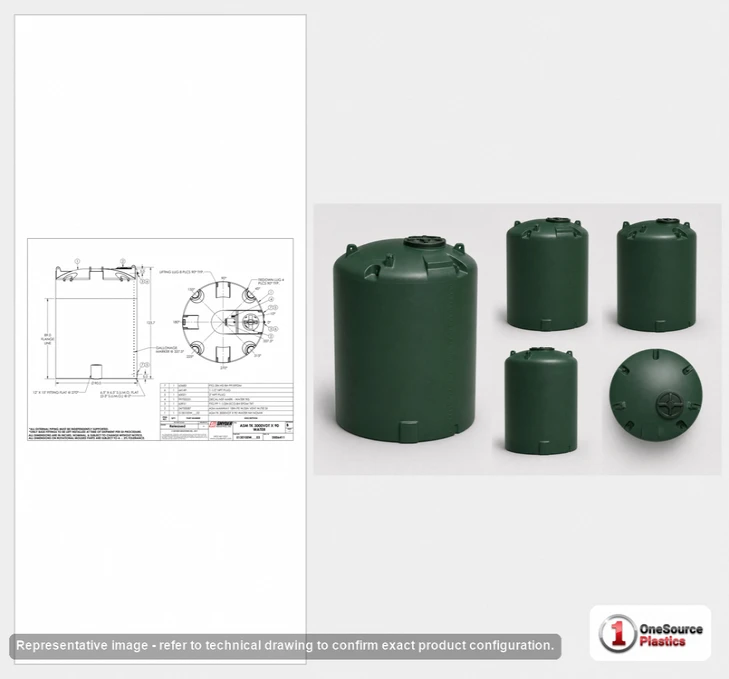
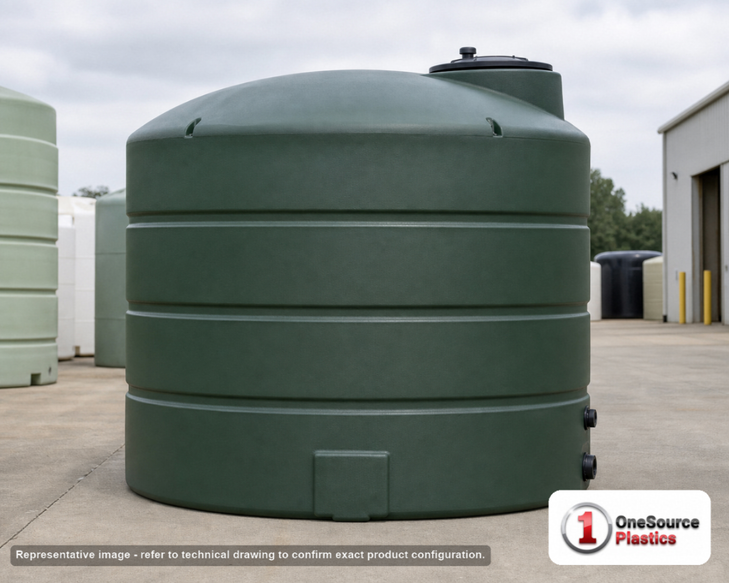
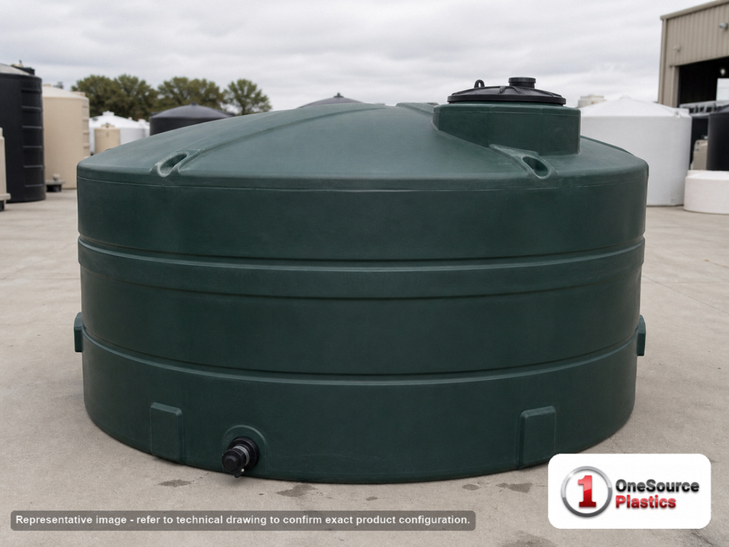
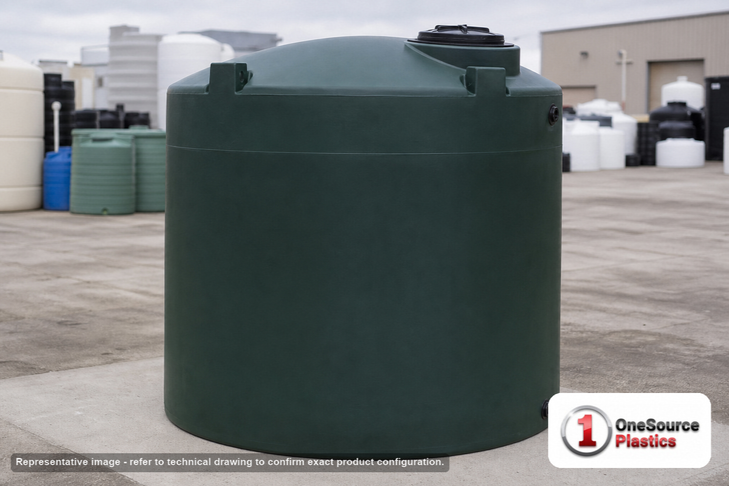
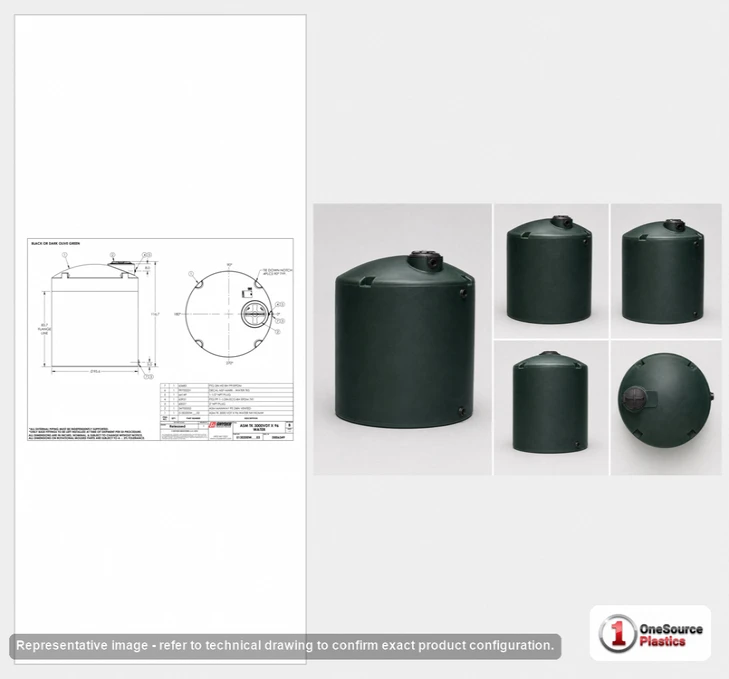
3,000 gallons of green water storage, eight feet one inch over a 102 inch circle
Wide, low and green: the Snyder SII-32783 holds 3,000 gallons in a high density linear polyethylene shell 102 inches across and 97 inches tall, and weighs 353 pounds empty. The sheet rates the wall at a specific gravity of 1, which is water, so the 25,020 pounds of contents it lists is the same 25,020 pounds the tank weighs full of water at 8.34 pounds per gallon, with nothing claimed beyond that. It arrives fitted with a 26 inch threaded vented manway, the largest access in this group, a 1-1/2 inch polypropylene female NPT bulkhead inlet and a 2 inch polypropylene female NPT bulkhead outlet. Freight is class 500 as an oversize load from Merced, California. No temperature limit and no warranty term appear on this sheet, so this page states neither; ask us and we will get Snyder's current terms in writing.
Want it on the pad this month? Check freight to your ZIP, add it to your cart above, and 866-418-1777 will confirm the ship date.
A wide pad, a low roof line, and 25,020 pounds carried on 102 inches
Height is what this shell gives away and the site is what it buys back. At 97 inches the tank stands eight feet one inch, which clears the eaves of most open-sided farm buildings and machine sheds, sits below a fence line and a mature hedge, stays out of the sightline restrictions a county or an association will impose, and puts the manway at the top of a short ladder instead of the top of a tower. Nothing needs a crane to set it and nobody needs a platform to open it. What it costs is ground, and the ground has to be right. The base is 102 inches, eight feet six inches across, and every pound of the 25,020 a full tank weighs is carried through a rotationally molded floor that bears on the whole surface it is resting on and on nothing else, so a low corner or a hollow washed out under the middle is not cosmetic, it is the new bearing point. Engineer the slab or the compacted base to the framework in the concrete pad sizing guide, level and continuous, poured wider than the tank rather than out to its edge, and crown the surround so the overflow runs away from the pad instead of along the joint at its edge, because a wide tank undercutting one side of its own base is the common failure on a farm install. At 353 pounds empty it is light enough that one storm can move it before there is water in it, so band it while it is empty; that is the window when tanks walk. Then check the gallons against the real duty: run your daily draw and your refill interval through the tank sizing calculator, and take the reserve you should never dip into, plus the freeboard water wants as it warms, from the tank sizing guide.
Five ways to hold 3,000 gallons, and the one with the 26 inch lid
| Part | Gallons | Diameter x height | Empty weight |
|---|---|---|---|
| SII-32783 (this tank, green, widest base, largest manway) | 3,000 | 102 x 97 in | 353 lb |
| 32781 (black, straight wall, same dimensions) | 3,000 | 102 x 97 in | 350 lb |
| SII-32569 (green, narrower and taller) | 3,000 | 96 x 109 in | 427 lb |
| SII-32567 (black, narrower and taller) | 3,000 | 96 x 109 in | 382 lb |
| SII-WG62 (smaller, green) | 2,600 | 96 x 91 in | 427 lb |
| SII-32294 (larger, black, tall) | 3,500 | 96 x 125 in | 535 lb |
The thing that separates this tank from the rest of the group is the lid. A 26 inch threaded vented manway is the largest access here, and on a wide shell that is what makes the difference between a tank you can genuinely clean out and a tank you can only look into, which matters on any stored water that will sit through a warm season. Beyond that, read the family as two silhouettes. The 96 by 109 inch pair put the same 3,000 gallons on a base six inches narrower and stand a foot taller, the green SII-32569 at 427 lb and the black SII-32567 at 382 lb, which is the right buy where the yard is tight and the sky is free. This tank and the black straight wall 32781 share the 102 by 97 inch shape exactly, and the sheet lists 353 lb against 350 lb for the pair; green is the wall for a tank that has to disappear into a tree line and keep daylight off the water, and 32781 is the black straight wall for anyone who wants it that way. Either side on volume, SII-WG62 holds 2,600 gallons at 91 in on the narrower base and SII-32294 goes to 3,500 gallons at 125 in and 535 lb when the site would rather add height than floor. The shape argument across the wide 3,000s is worked through in the complete buyers guide to the wide green 3,000.
Which wall for your chemical? Call 866-418-1777 with the name and the concentration, or send a quote request and we will pick the row.
A 2 inch bulkhead outlet at the bottom, a 26 inch vented manway at the top
- Outlet: a 2 inch polypropylene female NPT bulkhead fitting at the base, as the sheet lists it. Make the thread up once, correctly, with a sealant suited to the water and the plastic, and then put a union or a flange a short way downstream so a valve can be changed without anyone touching the tank fitting. Leave clear space for a wrench and keep the fitting out of a buried box.
- Head at that outlet: 97 inches of shell gives eight feet one inch of water over the fitting at full, which is useful suction head but only if the pump sits below it. Put the pump low, on its own base, with a short falling run into the suction port; a pump lifted level with a tank this low throws away the only head the shape gives you.
- Prime and protection: a cleanable strainer before the pump, a check valve where the line lifts, and a float, probe or run-dry cut-out that stops the pump with water still over the fitting. On a 102 inch circle the last inches of level spread across a lot of floor, so a dry run arrives suddenly and without warning.
- Inlet: a 1-1/2 inch polypropylene female NPT bulkhead fitting, which is where a tanker hose or a well line lands so a delivery is not hammering water down through the manway and driving air into the top of the tank.
- Access: a 26 inch threaded vented manway on the crown at eight feet one inch, reachable from a short ladder. It is the largest lid in this family and the reason a sediment layer can actually be removed rather than stirred. Keep it closed against dust, birds and light, and keep the vent clear, because a pump drawing against a blocked vent will pull the wall inward.
On a wide, low tank the suction line is long and shallow and every high point in it is somewhere air will sit, so slope the run down toward the pump and keep the elbows to the ones you need. Break the first joint at the outlet with a flexible connector so thermal movement and pump starts land on a connector rather than on the bulkhead, carry the first valve on its own support off the pad, and set a kerb or a bollard between the fitting and anywhere machinery turns. Where the site freezes, trace or insulate the valve and the exposed pipe and leave the body to ice from the surface down. Fit a level reading where the operator stands, because 3,000 gallons drawn from a circle this wide barely moves the surface per hundred gallons and a wide tank hides its own level better than a tall one.
Spray fill, stock water and one stage of a reuse train
The work a wide green 3,000 does is high-draw and repetitive, with the tank acting as the buffer between a slow source and a fast demand: filling a spray rig or a nurse trailer from a well that cannot keep pace, irrigation and drip supply for a block, livestock and trough water on a farm or ranch, wash-down and equipment rinse water on a yard, construction water for dust control and compaction, and hydrant flushing or main testing water at a district yard. Water held as a reserve against fire is a different exercise from water held for work, and the sizing, draw rate, connection and freeze discipline that make a reserve real rather than nominal are set out in the fire-water reservoir design guide. Where this tank is one stage in a system that collects, holds and re-uses water rather than a standalone vessel, the industrial water reuse tank topology article places a vessel of this size in the sequence and says what has to be true upstream of it.
Merced to the gate at class 500, 353 pounds empty
The SII-32783 is molded at Merced, California, ships at class 500 as the sheet lists it, and moves as an oversize load crated at 102 inches by 102 inches by 97 inches. The width is the constraint rather than the 353 pounds: eight feet six inches is wider than a trailer is meant to carry, so it is a permitted load that needs a place to stop, a gate wider than the tank, and an approach firm enough that a loaded trailer does not sink into a field entrance after rain. Walk the route for gates, cattle grids, turns and low branches, since those refuse more farm deliveries than the rate ever does. The freight cost estimator prices the lane to your ZIP, and the listed price is before freight. Unload with a forklift or telehandler and slings under the body, never a hook through the manway, and set it straight onto the finished pad rather than parking it on the dirt alongside, because 353 pounds is easy to move today and impossible once there is water in it. Then chalk or mark the full-water line on the outside of the shell after the first fill; every later reading gets checked against that mark. Walk the base after the first hard rain; a pad that shifts shows it at the edge first.
Freight and documents
Ships from: Merced, CA. LTL freight is quoted to your ZIP with the freight cost estimator or by phone at 866-418-1777. The listed price is before freight.
Technical drawing (PDF) for Snyder Industries SII-32783.
See this tank
Interactive 3D model with live fill. This tank has an interactive 3D model built to its manufacturer dimensions. Rotate it, and set a fill level to see how much liquid it holds at any height. Open the 3D view on the product photo above. Download the 3D model (GLB).
Ready to order?
Add it to your cart at the top of this page, get LTL freight to your ZIP, request a written quote, or call 866-418-1777. The listed price is before freight.