Tank Reverse Osmosis Pre-Treatment Tank Selection: Material vs Capacity Trade-Offs
Reverse osmosis (RO) systems live or die on the quality of pre-treatment storage. The membrane manufacturer's warranty depends on a feed-water spec sheet that the pre-treatment train must hit consistently: silt density index (SDI) under 5, free chlorine under 0.1 ppm, langelier saturation index between -0.5 and +0.5, temperature swing under a few degrees per hour, and turbidity below 1 NTU. The pre-treatment tank is where chlorine contact, anti-scalant injection, pH adjustment, and 5-micron cartridge feed all happen in a single vessel. Pick the wrong tank material, the wrong capacity, or the wrong color, and the membrane goes from a 5-year asset to a 9-month replacement cycle.
This pillar walks the engineering trade-offs across material (polyethylene grades, polypropylene, FRP, stainless), capacity (sized to RO permeate flow plus surge), color (UV ingress and biofilm risk), and code citations. Real SKUs from the OneSource Plastics catalog and AWWA / NSF / ASTM references throughout.
What the RO Pre-Treatment Tank Actually Does
The pre-treatment tank serves as buffer storage between the well or municipal source and the RO skid. It performs five distinct functions, often simultaneously:
- Chlorine contact time (CT): raw water dosed with sodium hypochlorite must hold a free-chlorine residual long enough to inactivate pathogens. AWWA G100 and 40 CFR 141 (Surface Water Treatment Rule) define minimum CT values.
- Anti-scalant residence: phosphonate or polymer anti-scalants need 30 to 60 seconds of mixing before the membrane to coat the feed water uniformly.
- Sodium bisulfite contact: if the source uses chlorine, bisulfite is dosed downstream of the contact tank to scavenge the residual; the membrane sees zero free chlorine within the warranty spec.
- Surge buffer: RO permeate demand is rarely steady. The pre-treatment tank decouples membrane flow from end-use demand.
- Cartridge filter feed: the tank discharge supplies the booster pump that drives water through the 5-micron pre-filter and into the RO membrane housing.
Material Decision Tree
HDPE (High-Density Polyethylene)
HDPE is the industry default for non-chlorinated water and ambient-temperature service. NSF/ANSI 61 and 372 listings cover potable water contact. ASTM D1998 governs polyethylene upright storage tank fabrication. Density 0.94 to 0.96 g/cm3. Service life 20+ years on shaded installations.
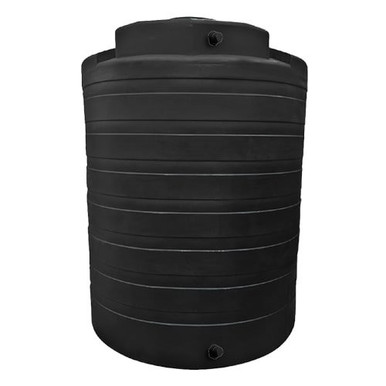
Where HDPE wins: well water with low chlorine demand, low chemical injection rate, ambient temperature, indoor or shaded outdoor install. Black HDPE blocks UV transmission and prevents algae.
Where HDPE fails: continuous chlorine contact above 5 ppm, hot service above 100 F sustained, applications where free chlorine attacks the polymer matrix.
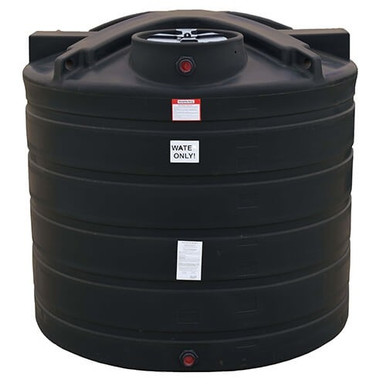
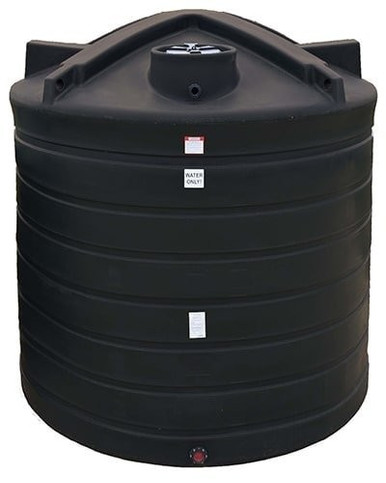
Real SKUs: Norwesco MPN 40892 (1,000 gallon Vertical Water Storage in black HDPE, SG 1.1), MPN 41500 (1,000 gallon Vertical Water Storage in black HDPE), MPN 42040 (2,500 gallon Vertical Water Storage in black HDPE).
XLPE (Cross-Linked Polyethylene)
XLPE is HDPE chemically cross-linked during the rotational mold cycle. The cross-links improve environmental stress crack resistance (ESCR), chemistry tolerance, and temperature ceiling. ASTM D1998 Type II classification. Higher initial cost than HDPE but extends service life on aggressive chemistry and elevated temperature.
Where XLPE wins: sustained chlorine residual above 5 ppm, continuous service above 100 F, anti-scalant chemistry that contains acidic carriers, applications where the SG is 1.9 (concentrated feed waters or brine reject return).
Real SKUs: Snyder MPN 1800000N42 (550 gallon XLPE Vertical Liquid Storage, max temp 140 F), MPN 1002100N42 (5,000 gallon XLPE Vertical Liquid Storage with ASTM certification, max temp 140 F), MPN 7360000N42 (4,100 gallon XLPE Vertical Liquid Storage in white, max temp 140 F).
Polypropylene (PP)
PP is the standard for elevated-temperature service. Crystallization range 320 to 340 F; service ceiling 180 F continuous. Better resistance to oxidative chlorine attack than polyethylene but more expensive and slightly more brittle at low temperature. Used downstream of RO when permeate is heated for process loads.
FRP (Fiberglass Reinforced Plastic)
FRP is the legacy choice for large-volume RO pre-treatment, especially in municipal plants and seawater desalination. Resin systems (vinyl ester for chlorine resistance, isophthalic for general water) line the inner surface; chopped or filament-wound glass provides structural strength. Service life 25 to 40 years. Higher cost and longer fabrication lead times push smaller systems toward polyethylene.
Stainless Steel (304 / 316)
Stainless tanks are the spec for high-purity / pharmaceutical-grade RO pre-treatment. AWWA D100 covers welded steel; ASME BPE covers bio-pharma. Capital cost is 4 to 8x equivalent polyethylene. Justified only when the downstream use case (USP water, WFI feed, ultrapure semiconductor) demands surface finish certifications.
Capacity Decision Tree
Sizing rule: 30 to 60 minutes of permeate at design flow
The classic sizing rule for RO pre-treatment tank volume is 30 to 60 minutes of design permeate flow, with longer dwell times when chlorine contact is required and shorter dwell times when biological growth is a risk. Worked example: a 30,000 GPD RO skid produces about 21 GPM continuous; 30-minute dwell is 630 gallons, 60-minute dwell is 1,260 gallons. A 1,500-gallon vertical (Norwesco MPN 41500 in HDPE black, or Snyder MPN 1800000N42 in XLPE) is the practical pick.
| RO Skid Permeate Flow | 30-min Dwell Tank | 60-min Dwell Tank | Recommended SKU class |
|---|---|---|---|
| 5,000 GPD (3.5 GPM) | ~100 gal | ~200 gal | 200-500 gal HDPE vertical |
| 15,000 GPD (10 GPM) | ~300 gal | ~600 gal | 500-1000 gal HDPE/XLPE |
| 30,000 GPD (21 GPM) | ~630 gal | ~1,260 gal | 1000-1500 gal (MPN 41500) |
| 75,000 GPD (52 GPM) | ~1,560 gal | ~3,120 gal | 2500-3000 gal (MPN 42040 / 45246) |
| 150,000 GPD (104 GPM) | ~3,120 gal | ~6,240 gal | 5000+ gal XLPE (MPN 1002100N42) |
Why oversizing is a real risk
Bigger is not better in RO pre-treatment. A 5,000-gallon tank fed by a 30,000-GPD skid stagnates: chlorine residual decays, microbial growth kicks off, biofilm forms on the tank walls, and silt density index climbs. The membrane sees a worse feed water than if the tank were sized correctly. Industry rule: never exceed 2x the 60-minute dwell volume without active recirculation.
Color: The Underrated Engineering Choice
Translucent white tanks let visible-spectrum and UV light penetrate the wall. Light is photosynthetic energy for algae and biofilm. Black tanks block both, ending the algae problem outright. The trade-off: black tanks absorb solar heat. In Phoenix-class climates, an outdoor black tank can hit 110 F internal in summer afternoons, accelerating chlorine decay and stressing the polymer.
Decision rule: black HDPE for outdoor indirect-sun installs, white HDPE / XLPE for indoor and shaded installs, white opaque (pigmented) for outdoor full-sun installs that need biofilm protection without the black-tank heat penalty. Norwesco MPN 42382 (2,500 gallon white vertical) and MPN 45246 (3,000 gallon white vertical, SG 1.5) cover the white option.
Pre-Treatment Chemistry and Tank Material Compatibility
| Pre-Treatment Chemical | HDPE | XLPE | Notes |
|---|---|---|---|
| NaOCl (5-15% bleach) | Marginal | Recommended | Long-term oxidation; XLPE preferred |
| Free chlorine residual <1 ppm | OK | OK | Standard service |
| Sodium bisulfite (food grade) | OK | OK | Use Viton gaskets |
| Phosphonate anti-scalants | OK | OK | Verify pH range 4-10 |
| Sulfuric acid (pH adjust) | No | Marginal | Use Snyder sulfuric acid resin (MPN 1002100N30) |
| Soda ash / caustic (pH adjust) | OK | Excellent | XLPE preferred above 50 F |
Plumbing the Pre-Treatment Tank
The pre-treatment tank needs four penetrations beyond the standard six: chemical injection ports, mixer or recirculation tee, level instrumentation for chlorine-residual sampling, and a top access manway for cartridge filter pre-conditioning. Detailed plumbing rules in our pillar on tank plumbing system design.
- Inlet at top with a stilling tube to dampen splash and surface aeration.
- Outlet at bottom, oversized one nominal size beyond skid suction (prevents pump-cavitation surge).
- Atmospheric vent sized 4 inches minimum; chlorine-saturated vapor cannot be confined.
- Recirculation port mid-height for sub-second chemistry mixing on injection.
- Level transmitter (ultrasonic preferred; chlorine attacks float-switch elastomers).
Maintenance Cadence
- Daily: chlorine residual sampling at the tank discharge; SDI test at the booster suction.
- Weekly: visual inspection of the tank wall (algae streaks indicate UV ingress; black tank or opaque pigmenting required).
- Monthly: drain and inspect bottom sediment; sediment indicates upstream filtration failure.
- Annual: full chlorine shock and tank flush per AWWA G100 disinfection procedure.
- 5 years: ultrasonic wall thickness check at the high-stress lower third per ASTM D1998 Section 9.
Common Failure Modes
Failure 1: Translucent tank in full sun
Algae bloom inside 60 days. Membrane fouling at 90 days. Specify black HDPE or opaque white pigmented for any outdoor install.
Failure 2: Tank oversized 3x the dwell rule
Stagnation, biofilm, free chlorine collapse. Right-size to 30-60 minute dwell per design flow.
Failure 3: HDPE tank on continuous 10 ppm chlorine
Polymer wall degradation at 18-24 months. Specify XLPE (Snyder MPN 1002100N42 class) for sustained chlorine.
Failure 4: White tank at 110 F summer afternoon outdoor
Surprise: white absorbs less heat but loses chlorine residual to UV photolysis. Black tank in shade is the correct outdoor answer.
Failure 5: Inlet without stilling tube
Surface aeration drives off free chlorine; CT contact-time calculations fail. Always specify a fill diffuser on RO pre-treatment service.
Capital Cost Math (Reference Year 2026)
| Tank | Material | List (USD) | Service Life |
|---|---|---|---|
| 1,000 gal HDPE black (MPN 41500) | HDPE | $700-$900 | 15-20 yr |
| 2,500 gal HDPE black (MPN 42040) | HDPE | $1,400-$1,800 | 15-20 yr |
| 3,000 gal white vertical (MPN 45246) | HDPE | $1,800-$2,400 | 15-20 yr |
| 5,000 gal XLPE (MPN 1002100N42) | XLPE | $5,000-$6,500 | 25-30 yr |
| 4,100 gal XLPE white (MPN 7360000N42) | XLPE | $4,200-$5,500 | 25-30 yr |
Listed at the price ranges above; LTL freight quoted separately to ZIP via the OneSource Freight Estimator.
Internal Resources
- Tank Plumbing System Design Pillar
- HDPE vs XLPE Resin Selection
- Tank Color Selection by Use Case
- Water Treatment Plant Chemical Storage Stack
- Chemical Compatibility Database
- Freight Cost Estimator
- How to Read a Tank Spec Sheet
Source Citations
- ASTM D1998 - Standard Specification for Polyethylene Upright Storage Tanks
- NSF/ANSI 61 - Drinking Water System Components: Health Effects
- NSF/ANSI 372 - Drinking Water System Components: Lead Content
- AWWA G100 - Water Treatment Plant Operation and Management
- AWWA D100 - Welded Carbon Steel Tanks for Water Storage
- 40 CFR 141 - National Primary Drinking Water Regulations (Surface Water Treatment Rule)
- ASME BPE - Bioprocessing Equipment
- Manufacturer product datasheets: Norwesco, Snyder Industries
- OneSource Plastics master catalog data, 2026-03-26 snapshot (9,419 products)
Recommended Tanks for This Guide
Live pricing, updated automatically · estimate freight to your ZIP.