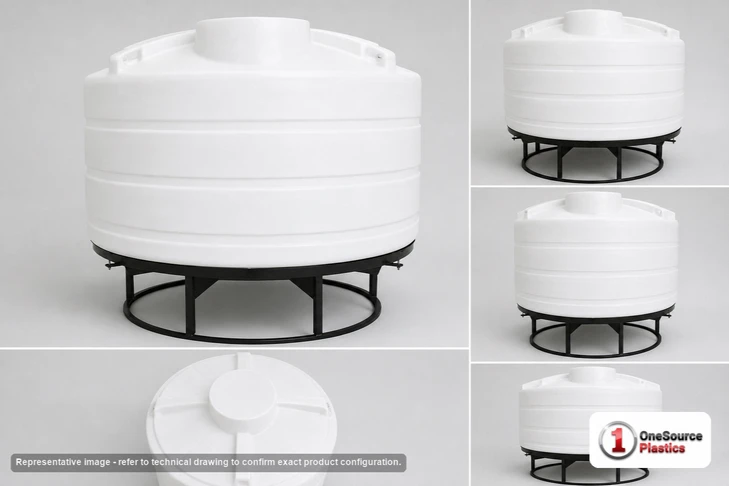
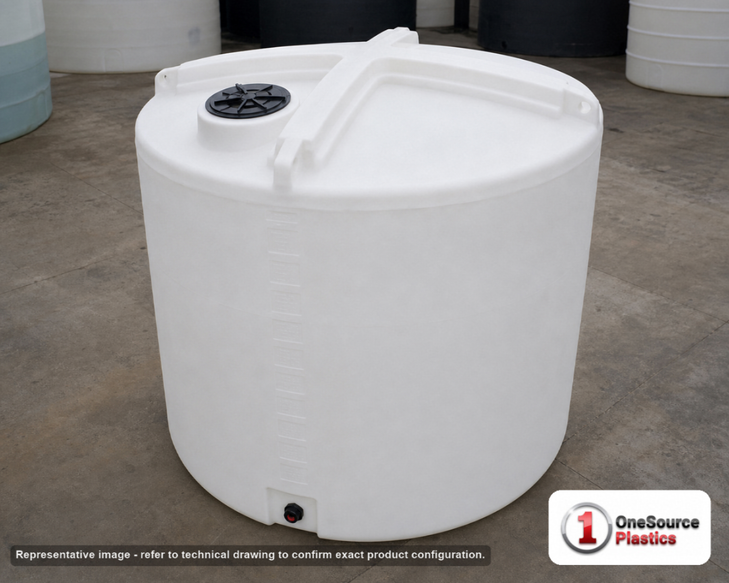
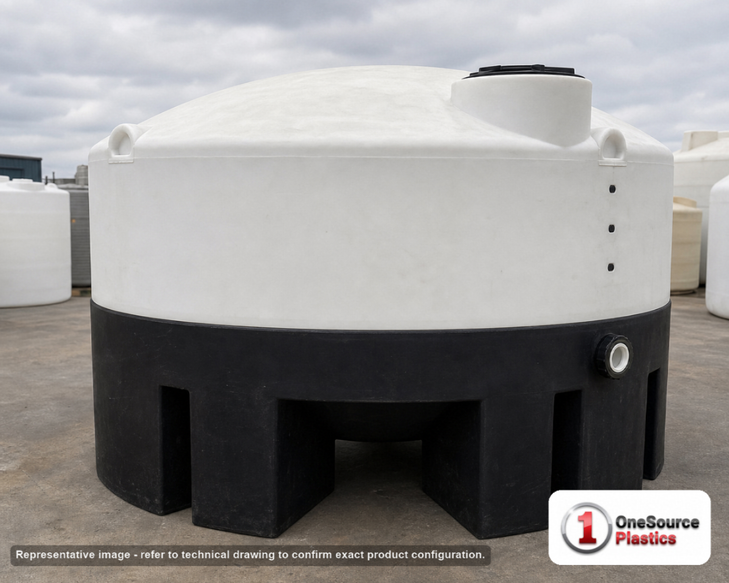
The Enduraplas 1350 Gallon White Cone Bottom Tank is a Neche, North Dakota-built polyethylene cone-bottom vessel rated to specific gravity 1.9, which makes it one of the few stock cone tanks engineered to hold dense industrial chemistries rather than just water. At 75 inches tall on an 85 x 85 inch footprint, the natural white tank holds 1,350 gallons. The cone bottom drains toward the outlet, so batching, dosing, and full clean-outs leave little heel behind - the reason a cone tank is favored in water-treatment, agricultural, and chemical-feed work over a flat-bottom design.
Will it work for your application
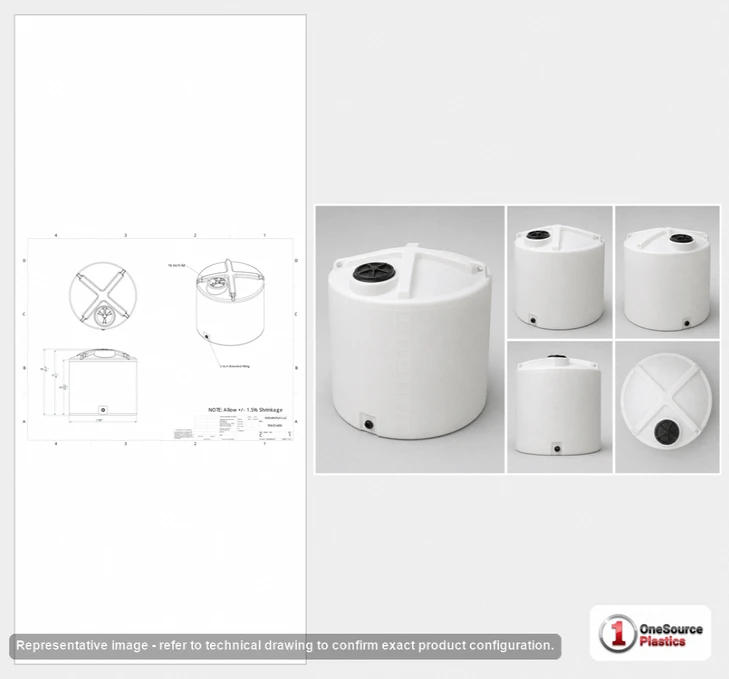
Two weights decide the answer. Filled with water this tank carries roughly 11,259 lb; loaded to its full 1.9 SG rating it reaches about 21,392 lb of contents. Your stand, ring, or structural skirt has to be sized for the LOADED figure that matches your actual liquid - sizing a stand for water weight and then filling with a 1.9 SG chemical is the most common and most dangerous mistake on a cone tank. Plan your slab, ring wall, or secondary containment around the 85 x 85 inch footprint. Cross-check your support against our Cone Bottom Tank Stand Compatibility Matrix, and use the Tank Sizing Calculator and Tank Sizing Guide to confirm capacity and headspace before you commit. Outlet and fitting sizes for this unit are shown on the technical drawing on this page - they are not pre-configured in our listing data, so confirm the size you need before ordering.
Chemical compatibility
This is a polyethylene tank with a 1.9 specific gravity rating - the heaviest-duty cone rating we stock. If your chemistry sits below 1.9 SG you have full margin, so there is no need to step up to a denser tank. The resin in our data is shown as "HDLPE?" with a question mark, so before any chemical service confirm with us whether your unit is HDLPE versus XLPE (cross-linked) - the two resins behave differently with oxidizers and solvents, and that single detail governs service life. Compatibility below is concentration- and temperature-specific; verify YOUR concentration and temperature before any chemical service, because a chemical that is fine cold can attack the wall when hot.
Chemicals this tank is rated to handle, with the recommended fitting and gasket materials, include acetic acid (60%) with PP/PVC fittings and EPDM gaskets, aluminum sulfate (50%) with PVC fittings and EPDM gaskets, calcium chloride (40%) with PVC fittings and EPDM gaskets, diesel exhaust fluid / DEF (32.5%) with 316SS fittings and EPDM gaskets, ethylene glycol (100%) with PVC fittings and EPDM gaskets, ferric chloride (50%) with PVC fittings and EPDM gaskets, ferric sulfate (60%) with PVC fittings and EPDM gaskets, ferrous sulfate (20%) with PVC fittings and EPDM gaskets, hydrochloric acid (37%) with PVC fittings and Viton gaskets, hydrofluoric acid (48%) with PP/PVC fittings and Viton gaskets, hydrofluosilicic acid (26%) with PP/PVC fittings and Viton gaskets, hydrogen peroxide (50%) with PVC fittings and Viton gaskets, magnesium chloride (30%) with PVC fittings and EPDM gaskets, peracetic acid (30%) with 316SS fittings and Aflas gaskets, phosphoric acid (85%) with PVC fittings and Viton gaskets, polyaluminum chloride with PVC fittings and EPDM gaskets, potassium carbonate (50%) with PVC fittings and EPDM gaskets, potassium hydroxide (saturated) with PVC fittings and EPDM gaskets, propylene glycol with PP/316SS fittings and EPDM gaskets, sodium bisulfate with PVC/PP fittings and EPDM gaskets, sodium bisulfite with PVC/PP fittings and EPDM gaskets, sodium carbonate (30%) with PVC fittings and EPDM gaskets, sodium hypochlorite (<16.5%) with PVC fittings and Viton gaskets, sodium thiosulfate (40%) with PVC fittings and EPDM gaskets, sulfuric acid (98%) with CPVC fittings and Viton gaskets, urea solution (50%) with PP/PVC fittings and EPDM gaskets, zinc orthophosphate with PP/316SS fittings and EPDM gaskets, and ozonated water (up to 10 PPM) with PVC fittings and EPDM gaskets. Watch the exceptions to the default PVC/EPDM build: DEF and peracetic acid call for 316SS fittings; 98% sulfuric acid needs CPVC rather than plain PVC; the strong acids and oxidizers (hydrochloric, hydrofluoric, hydrogen peroxide, phosphoric, sulfuric, sodium hypochlorite) take Viton gaskets; and peracetic acid takes Aflas. Full ratings live in our Chemical Compatibility Database.
Freight and how to order
This 1350 gallon Enduraplas cone bottom tank ships LTL freight from the Neche, ND plant, quoted live to your ZIP - get your number through the Freight Cost Estimator or by calling 866-418-1777. Because a cone tank rides on a stand and loads tall, confirm your support structure for the loaded weight first; if you are still choosing instrumentation, our guide on level gauge selection for chemical service walks through radar, ultrasonic, hydrostatic, and magnetostrictive options for a tank like this one. Questions on fitting layout, resin confirmation, or freight - call us at 866-418-1777 and we will spec it with you.
Freight and documents
Ships from: Neche, ND. LTL freight is quoted to your ZIP with the freight cost estimator or by phone at 866-418-1777. The listed price is before freight.
See this tank
Interactive 3D model with live fill. This tank has an interactive 3D model built to its manufacturer dimensions. Rotate it, and set a fill level to see how much liquid it holds at any height. Open the 3D view on the product photo above. Download the 3D model (GLB).
Ready to order?
Add it to your cart at the top of this page, get LTL freight to your ZIP, request a written quote, or call 866-418-1777. The listed price is before freight.