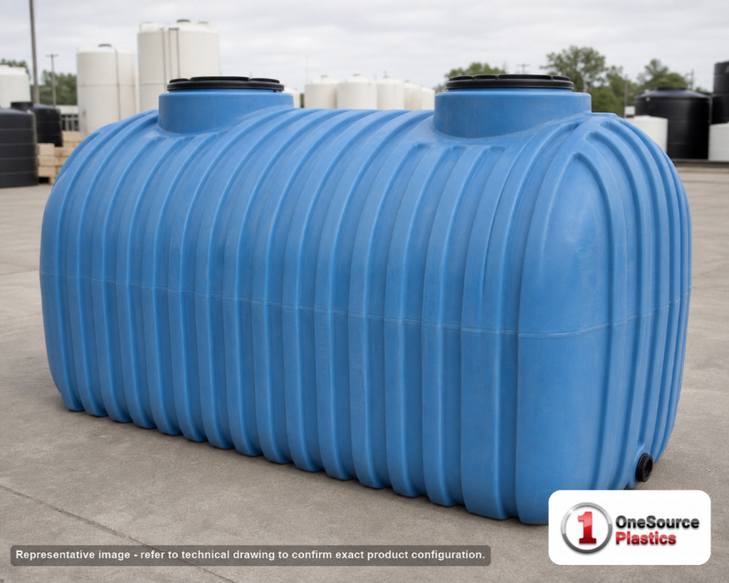
The Enduraplas 1200 Gallon White Cone Bottom Tank is built for full-drain chemical batching, mixing, and dosing where you need every drop to evacuate through the bottom.The cone-bottom geometry forces complete drainage to the center outlet, which makes it a natural fit for the cone bottom tank work buyers reach for when settling, decanting, or running aggressive solutions you can't leave sitting in a flat-bottom sump.This is a 1200-gallon Enduraplas cone tank molded in natural white polyethylene with a 1.9 specific gravity rating - the number that lets it carry dense chemistries a standard cone tank cannot.
Will it work for your job?
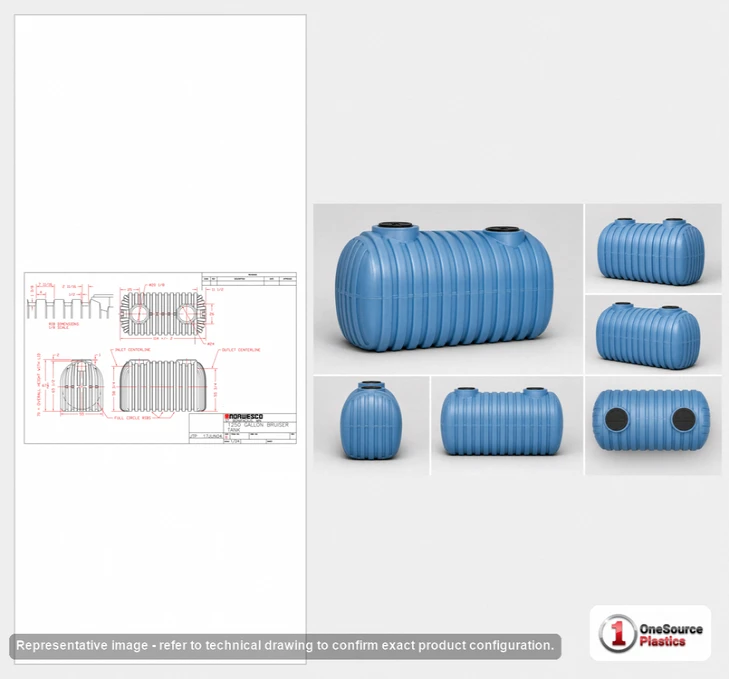
This cone tank holds 1,200 gallons and stands 73 inches tall on a 90 x 90 inch footprint, so plan your stand and overhead clearance around those numbers before you order.Filled with plain water at full capacity, expect roughly 10,008 lb on the stand; the 1.9 specific gravity rating supports a maximum rated contents weight of about 19,015 lb.That is the buying argument here - a typical 1.9 SG cone tank could not legally hold a full 1,200 gallons of the dense solutions below (ferric chloride at 50%, phosphoric acid at 85%, sulfuric acid at 98%), and this tank can.Because a cone-bottom tank carries its entire load on an elevated stand, matching the stand to the tank is the single most important sizing decision - work through our Cone Bottom Tank Stand Compatibility Matrix and run your numbers through the Tank Sizing Calculator and Tank Sizing Guide so the support, fittings, and outlet line up with your process.The technical drawing on this page shows the molded dimensions and outlet detail.
Chemical compatibility
This tank is molded in polyethylene with a 1.9 specific gravity rating, which is what allows it to hold the dense, high-SG chemistries listed here.One honest note on resin: it is recorded as HDLPE in our data but not yet confirmed, so for crosslinked-only oxidizer service - high-concentration sodium hypochlorite or peracetic acid in particular - call 866-418-1777 to confirm HDLPE versus XLPE before ordering, because the two resins resist different chemicals.Fitting and gasket selection is concentration- and temperature-specific, so verify every choice against the OEM chemical-resistance chart for your exact conditions.To make the pairing actionable, watch the exceptions: most chemistries below run PVC fittings with EPDM gaskets, but the strong oxidizers and acids (hydrochloric, hydrofluoric, hydrogen peroxide, phosphoric, sulfuric, sodium hypochlorite) require Viton; peracetic acid requires Aflas; and DEF, peracetic acid, propylene glycol, and zinc orthophosphate call for 316SS fittings rather than PVC.The full set this tank has been paired with, at the listed concentrations:
- Acetic Acid (60%) - PP/PVC fittings, EPDM gaskets
- Aluminum Sulfate (50%) - PVC fittings, EPDM gaskets
- Calcium Chloride (40%) - PVC fittings, EPDM gaskets
- DEF (32.5%) - 316SS fittings, EPDM gaskets
- Ethylene Glycol (100%) - PVC fittings, EPDM gaskets
- Ferric Chloride (50%) - PVC fittings, EPDM gaskets
- Ferric Sulfate (60%) - PVC fittings, EPDM gaskets
- Ferrous Sulfate (20%) - PVC fittings, EPDM gaskets
- Hydrochloric Acid (37%) - PVC fittings, Viton gaskets
- Hydrofluoric Acid (48%) - PP/PVC fittings, Viton gaskets
- Hydrofluosilicic Acid (26%) - PP/PVC fittings, Viton gaskets
- Hydrogen Peroxide (50%) - PVC fittings, Viton gaskets
- Magnesium Chloride (30%) - PVC fittings, EPDM gaskets
- Peracetic Acid (30%) - 316SS fittings, Aflas gaskets
- Phosphoric Acid (85%) - PVC fittings, Viton gaskets
- Polyaluminum Chloride - PVC fittings, EPDM gaskets
- Potassium Carbonate (50%) - PVC fittings, EPDM gaskets
- Potassium Hydroxide (saturated) - PVC fittings, EPDM gaskets
- Propylene Glycol - PP/316SS fittings, EPDM gaskets
- Sodium Bisulfate - PVC/PP fittings, EPDM gaskets
- Sodium Bisulfite - PVC/PP fittings, EPDM gaskets
- Sodium Carbonate (30%) - PVC fittings, EPDM gaskets
- Sodium Hypochlorite (<16.5%) - PVC fittings, Viton gaskets
- Sodium Thiosulfate (40%) - PVC fittings, EPDM gaskets
- Sulfuric Acid (98%) - CPVC fittings, Viton gaskets
- Urea Solution (50%) - PP/PVC fittings, EPDM gaskets
- Zinc Orthophosphate - PP/316SS fittings, EPDM gaskets
- Ozonated Water (up to 10 PPM) - PVC fittings, EPDM gaskets
Confirm every selection against the concentration- and temperature-specific OEM chemical-resistance chart, and browse our full Chemical Compatibility Database for the chemical you plan to run.
The mistake to avoid
This ships as a bare tank - fittings and bulkheads are not pre-configured, which is exactly why material selection is your call at order time, and exactly where the costliest error happens.Buyers spec the tank correctly, then bolt on the wrong gasket or a PVC fitting where the chemistry demands stainless or Viton, and the failure shows up at the joint under full head pressure.Lock your fitting and gasket materials to the chart - and your resin (HDLPE versus XLPE) for oxidizer duty - before you order.For high-oxidation service like sodium hypochlorite or peracetic acid, a level gauge that tolerates the same chemistry is part of the spec, not an afterthought; see our guide on Tank Level Gauge Selection for Chemical Service.
This tank ships LTL freight from the single Enduraplas plant in Neche, ND, quoted live to your ZIP.Because there is only the one far-north origin, LTL cost scales with distance from North Dakota - so pull a real number against your ZIP before you buy using the Freight Cost Estimator, or call 866-418-1777 and we'll quote the cone tank, a matching stand, and the right fittings together so everything arrives ready to install.
Freight and documents
Ships from: Neche, ND. LTL freight is quoted to your ZIP with the freight cost estimator or by phone at 866-418-1777. The listed price is before freight.
Technical drawing (PDF) for Enduraplas THC01200W.
See this tank
Interactive 3D model with live fill. This tank has an interactive 3D model built to its manufacturer dimensions. Rotate it, and set a fill level to see how much liquid it holds at any height. Open the 3D view on the product photo above. Download the 3D model (GLB).
Ready to order?
Add it to your cart at the top of this page, get LTL freight to your ZIP, request a written quote, or call 866-418-1777. The listed price is before freight.