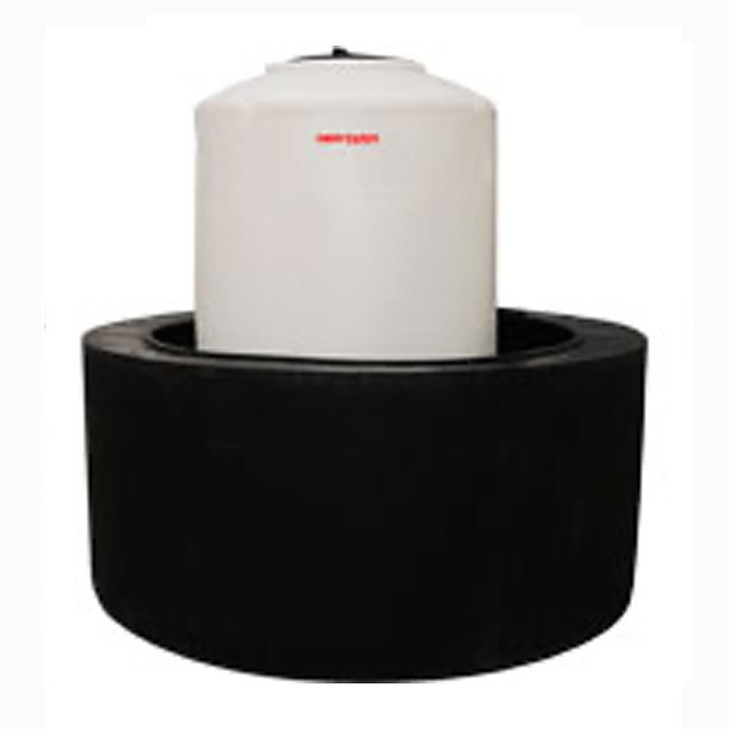
The Enduraplas 3000 Gallon White Cone Bottom Tank is a full-drain vessel built for process and chemical service where you need every gallon out the bottom. It holds 3,000 gallons in a polyethylene body that measures 90 x 90 in (W x L) overall and stands 136 in tall, molded in natural white so you can read your liquid level at a glance. What sets this tank apart for chemical duty is its 1.9 specific gravity rating - it is engineered to carry dense liquids, not just water, and 1.9 is the top SG tier in this line.
Will it work for your liquid?
Start with weight. Filled with water this tank carries about 25,020 lb. At its full 1.9 specific gravity rating it is built to hold contents weighing up to 47,538 lb, so heavy solutions like sulfuric acid or ferric chloride are within its design envelope where the chemical itself is compatible. The cone bottom is the reason buyers in batching, dosing, and water-treatment operations choose this geometry - it self-drains for clean transfers and easy cleanout, which is why it shows up under searches for a cone bottom tank, cone tank, and 3000 gallon cone bottom. A 30-degree cone-bottom tank does not sit flat on the ground; it must drop into a matching steel stand rated for the loaded weight, so size that stand before you buy. Our Cone Bottom Tank Stand Compatibility Matrix and the Tank Sizing Calculator walk you through it, and the 3000 Gallon Cone Bottom Tank buyer's guide covers cone-angle tradeoffs.
Chemical compatibility
This is a polyethylene tank with a 1.9 specific gravity rating. The resin grade is recorded as HDLPE but is unconfirmed - call 866-418-1777 to verify HDLPE versus XLPE before specifying this tank for oxidizers or concentrated acids, because crosslinked and linear polyethylene behave very differently with aggressive chemistries. The compatibility below comes from the OEM chemical-resistance chart and is concentration- and temperature-specific; match it to your exact conditions.
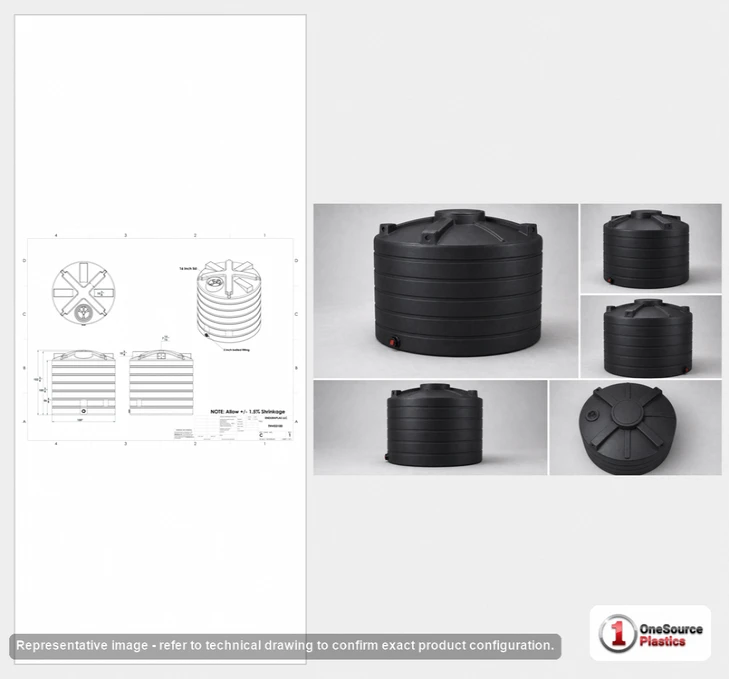
Documented compatible chemicals for this tank, with the recommended fitting and gasket material, include: Acetic Acid (60%, PP/PVC fittings, EPDM gasket), Aluminum Sulfate (50%, PVC, EPDM), Calcium Chloride (40%, PVC, EPDM), DEF (32.5%, 316SS fittings, EPDM gasket), Ethylene Glycol (100%, PVC, EPDM), Ferric Chloride (50%, PVC, EPDM), Ferric Sulfate (60%, PVC, EPDM), Ferrous Sulfate (20%, PVC, EPDM), Hydrochloric Acid (37%, PVC fittings, Viton gasket), Hydrofluoric Acid (48%, PP/PVC, Viton), Hydrofluosilicic Acid (26%, PP/PVC, Viton), Hydrogen Peroxide (50%, PVC, Viton), Magnesium Chloride (30%, PVC, EPDM), Peracetic Acid (30%, 316SS, Aflas), Phosphoric Acid (85%, PVC, Viton), Polyaluminum Chloride (PVC, EPDM), Potassium Carbonate (50%, PVC, EPDM), Potassium Hydroxide (saturated, PVC, EPDM), Propylene Glycol (PP/316SS, EPDM), Sodium Bisulfate (PVC/PP, EPDM), Sodium Bisulfite (PVC/PP, EPDM), Sodium Carbonate (30%, PVC, EPDM), Sodium Hypochlorite (under 16.5%, PVC, Viton), Sodium Thiosulfate (40%, PVC, EPDM), Sulfuric Acid (98%, CPVC fittings, Viton gasket), Urea Solution (50%, PP/PVC, EPDM), Zinc Orthophosphate (PP/316SS, EPDM), and ozonated water (up to 10 PPM, PVC, EPDM). Verify every selection against the full Chemical Compatibility Database, which is concentration- and temperature-specific. See the technical drawing on this page for the tank's dimensional layout.
The mistake to avoid
The most common error on a tank this size is treating "plastic tank" as "plastic fittings and EPDM seals everywhere." It is not that simple, and the chart is specific. Eight chemicals here require a Viton or Aflas seal, not EPDM: Hydrochloric Acid, Hydrofluoric Acid, Hydrofluosilicic Acid, Hydrogen Peroxide, Phosphoric Acid, Sodium Hypochlorite, Sulfuric Acid (with a CPVC fitting), and Peracetic Acid (with Aflas and a 316SS fitting). Four also call for metal rather than plastic fittings: DEF and Peracetic Acid need 316 stainless, and Propylene Glycol and Zinc Orthophosphate call for PP or 316SS. Spec an EPDM gasket on a hypochlorite or concentrated sulfuric line and it will fail long before the tank does. The second mistake is treating the resin question as settled - confirm HDLPE versus XLPE with us first, because that single answer changes what this tank can safely store.
One more item before you order: the factory fitting and bulkhead configuration is not listed here, so the chart above tells you what materials to use, not what ports the tank ships with - confirm outlet size, bulkhead, and lid spec by phone. This tank ships LTL freight from the nearest Enduraplas plant - Converse, TX or Neche, ND - quoted live to your ZIP. Get your exact number with the Freight Cost Estimator or call 866-418-1777 to talk through fittings, the resin question, and stand sizing before you order. For sizing help, see the Tank Sizing Guide.
Freight and documents
Ships from: Neche, ND; Converse, TX. LTL freight is quoted to your ZIP with the freight cost estimator or by phone at 866-418-1777. The listed price is before freight.
Technical drawing (PDF) for Enduraplas THC03000W.
See this tank
Interactive 3D model with live fill. This tank has an interactive 3D model built to its manufacturer dimensions. Rotate it, and set a fill level to see how much liquid it holds at any height. Open the 3D view on the product photo above. Download the 3D model (GLB).
Ready to order?
Add it to your cart at the top of this page, get LTL freight to your ZIP, request a written quote, or call 866-418-1777. The listed price is before freight.