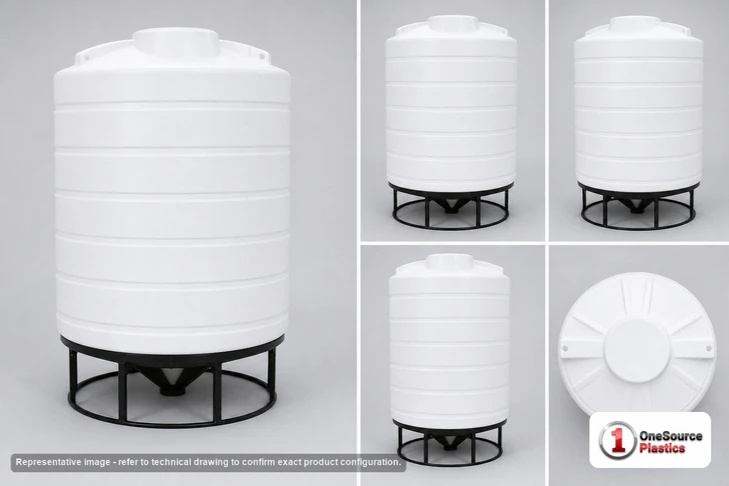
The Enduraplas 3200 Gallon White Cone Bottom Tank is a full-drain vessel built for process chemistry where you need every gallon to evacuate cleanly. Molded in natural white polyethylene with a 1.9 specific gravity rating, it holds 3,200 gallons and stands 116 inches tall on a 110 x 110-inch footprint. The cone geometry has no flat base, so it must sit in a structural stand or support tower rated for the loaded weight - plan that foundation before the tank arrives. This page lists the tank itself at list price; a cone stand is sized and ordered separately.
Will this cone bottom tank work for your job?
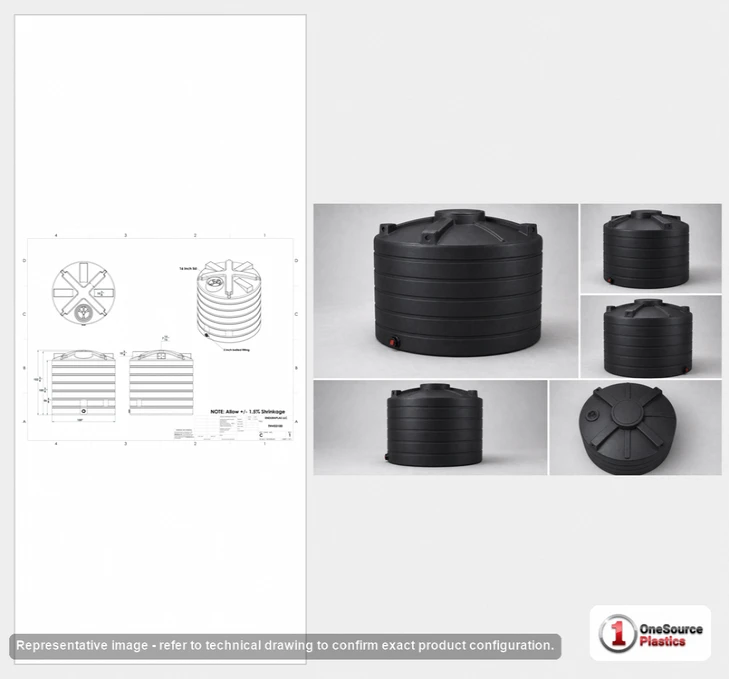
The 1.9 SG rating is the number to design around. Water fills this tank to roughly 26,688 pounds, but it is rated to carry up to 50,707 pounds of contents - that is the same 26,688 pounds of water multiplied by 1.9, which means any fluid up to about 15.8 pounds per gallon can fill it to nameplate. Before you commit, back-check your chemical's actual weight per gallon and specific gravity against that ceiling: a heavy brine or concentrated acid can push a lower-rated tank past what it tolerates, and a cone concentrates the entire load onto the stand and outlet. Use the Tank Sizing Calculator to convert your fluid's SG and fill height into real working weight, and the Tank Sizing Guide if you are still narrowing between sizes. The 110 x 110-inch footprint is the area you need to grade and pad. See the technical drawing on this page for the fitting layout and exact dimensional callouts; we confirm the cone outlet size and location at order time, since that outlet is the single highest-load point on the tank.
Chemical compatibility
This tank is molded from polyethylene with a 1.9 SG rating. Confirm linear (HDLPE) versus crosslinked (XLPE) construction with us before placing it into chemical service - the two behave differently with certain oxidizers and solvents, and we verify which resin your tank is per order on the line below before SG sign-off. The chemicals below are workable in this tank when paired with the correct fitting and gasket materials; always cross-check against the OEM chemical-resistance chart, which is concentration-specific and temperature-specific for your exact conditions:
- Acetic Acid (60%) - PP/PVC fittings, EPDM gaskets
- Aluminum Sulfate (50%) - PVC fittings, EPDM gaskets
- Calcium Chloride (40%) - PVC fittings, EPDM gaskets
- DEF (32.5%) - 316SS fittings, EPDM gaskets
- Ethylene Glycol (100%) - PVC fittings, EPDM gaskets
- Ferric Chloride (50%) - PVC fittings, EPDM gaskets
- Ferric Sulfate (60%) - PVC fittings, EPDM gaskets
- Ferrous Sulfate (20%) - PVC fittings, EPDM gaskets
- Hydrochloric Acid (37%) - PVC fittings, Viton gaskets
- Hydrofluoric Acid (48%) - PP/PVC fittings, Viton gaskets
- Hydrofluosilicic Acid (26%) - PP/PVC fittings, Viton gaskets
- Hydrogen Peroxide (50%) - PVC fittings, Viton gaskets
- Magnesium Chloride (30%) - PVC fittings, EPDM gaskets
- Peracetic Acid (30%) - 316SS fittings, Aflas gaskets
- Phosphoric Acid (85%) - PVC fittings, Viton gaskets
- Polyaluminum Chloride - PVC fittings, EPDM gaskets
- Potassium Carbonate (50%) - PVC fittings, EPDM gaskets
- Potassium Hydroxide (saturated) - PVC fittings, EPDM gaskets
- Propylene Glycol - PP/316SS fittings, EPDM gaskets
- Sodium Bisulfate - PVC/PP fittings, EPDM gaskets
- Sodium Bisulfite - PVC/PP fittings, EPDM gaskets
- Sodium Carbonate (30%) - PVC fittings, EPDM gaskets
- Sodium Hypochlorite (<16.5%) - PVC fittings, Viton gaskets
- Sodium Thiosulfate (40%) - PVC fittings, EPDM gaskets
- Sulfuric Acid (98%) - CPVC fittings, Viton gaskets
- Urea Solution (50%) - PP/PVC fittings, EPDM gaskets
- Zinc Orthophosphate - PP/316SS fittings, EPDM gaskets
- Ozonated Water (up to 10 PPM) - PVC fittings, EPDM gaskets
Notice how the gasket and fitting material shift with the chemical. EPDM handles most salts and bases, but strong oxidizers and acids - sulfuric at 98%, phosphoric at 85%, hydrogen peroxide at 50%, and sodium hypochlorite under 16.5% - call for Viton, and peracetic acid at 30% is the lone case that needs Aflas. Watch the metal-fitting outliers too: DEF at 32.5% and peracetic acid both require 316 stainless, not PVC. Matching the wrong elastomer or fitting is the most common and most expensive cone-tank mistake. For the full picture across concentrations and temperatures, see our Chemical Compatibility Database.
Stand, fittings, and the mistake to avoid
A cone bottom tank is only as sound as the stand under it, so never improvise a support under the cone. Our Cone Bottom Tank Stand Compatibility Matrix covers how Enduraplas cone tanks pair with the right stand. If you are still comparing cone sizes and angles, the 3000 gallon cone bottom buyer's guides walk through the trade-offs, and for instrumenting a chemical cone tank the tank level gauge selection guide compares radar, ultrasonic, hydrostatic, and magnetostrictive sensing for aggressive media. The single mistake to avoid: spec'ing this white cone tank to gallons alone and ignoring specific gravity - the wrong fitting material, the wrong gasket, or an undersized stand will each fail in service no matter how big the tank is.
This Enduraplas cone bottom tank ships LTL freight from the Enduraplas plant in Neche, North Dakota, quoted live to your ZIP. Get your freight quote with the Freight Cost Estimator, or call 866-418-1777 to confirm resin (HDLPE vs XLPE), fitting layout, stand pairing, and SG sign-off before you order.
Freight and documents
Ships from: Neche, ND. LTL freight is quoted to your ZIP with the freight cost estimator or by phone at 866-418-1777. The listed price is before freight.
Technical drawing (PDF) for Enduraplas THC03200W.
See this tank
Interactive 3D model with live fill. This tank has an interactive 3D model built to its manufacturer dimensions. Rotate it, and set a fill level to see how much liquid it holds at any height. Open the 3D view on the product photo above. Download the 3D model (GLB).
Ready to order?
Add it to your cart at the top of this page, get LTL freight to your ZIP, request a written quote, or call 866-418-1777. The listed price is before freight.