
-

Cortina
SKU: 97-1700-12DG
T3 Kits - 12' Type III Kit, Sheeted one side - 12 foot Kit with Diamond Grade Striped Sheeting
$467.34 -

Cortina
SKU: 97-1700-62DG
T3 Kits - 6' Type III Kit, Sheeted both sides - 6 foot Kit with Diamond Grade Striped Sheeting
$481.54 -
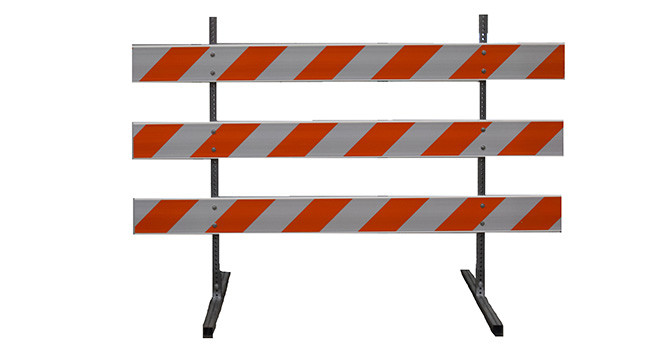
Cortina
SKU: 97-1700-82DG
T3 Kits - 8' Type III Kit, Sheeted both sides - 8 foot Kit with Diamond Grade Striped Sheeting
$554.50 -
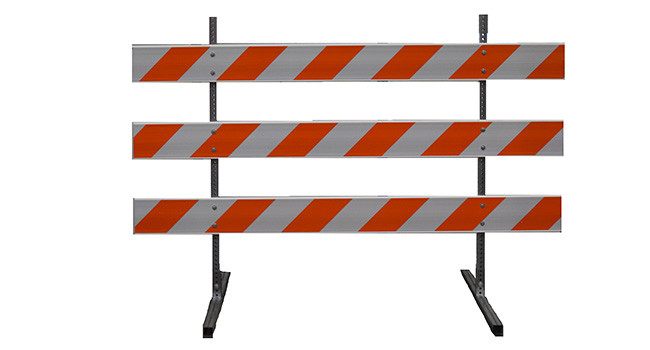
Cortina
SKU: 97-1700-102DG
T3 Kits - 10' Type III Kit, Sheeted both sides - 10 foot Kit with Diamond Grade Striped Sheeting
$651.29 -

Cortina
SKU: 97-1700-112DG
T3 Kits - 12' Type III Kit, Sheeted both sides - 12 foot Kit with Diamond Grade Striped Sheeting
$799.24
Barricades
Barricades
Barricades are classified by how many reflective rails face traffic, and that class is usually dictated to you — by the MUTCD-based standard your agency adopted, or by the traffic control plan attached to your permit. Get the class right first, then the sheeting. 137 items, $6.35 to $799.24, 1.5 lb to 73 lb.
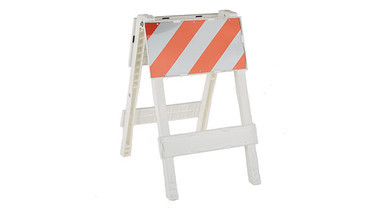
- Type I — one rail. Sidewalk closures, short-duration work, utility cuts.
- Type II — two rails. Higher visibility, longer-duration setups.
- T3 Kits (35 items) — frame and boards supplied together as one assembly.
Sheeting grade is the decision that costs money
The same frame ships with Engineer Grade, High Intensity Prismatic, Diamond Grade, or Diamond Grade Fluorescent Orange striped sheeting. Four part numbers, four retroreflective performances, four prices. Sheeting is applied at manufacture — there is no field upgrade — so if your contract or DOT special provision names a grade, order that grade. Buying down a grade to save money is the most common way a delivered barricade fails inspection.
Buy boards, not new barricades
Rails are stocked separately in 1" x 8" and 2" x 8" (23 items each), sheeted or unsheeted. A struck barricade usually loses a board, not a frame. Yards that stock spare boards replace a $20 rail instead of a $200 assembly, and crews stop running damaged units because it is easier.
Frame types
Plastx and Plastx FF are plastic frames — light, they survive being dropped off a tailgate, and they do not rust in a salt yard. M-Cade (13 items) folds flat for transport. Panel geometry is explicit in every part number: a top sheet 24"w x 12"h over a bottom 24"w x 8"h is a different item from two 24" x 8" panels, so match the drawing rather than the picture. Pallet quantities ship LTL, freight quoted to your ZIP.