HDPE Tank Color Pigment Chemistry: How Carbon Black Loading, Titanium Dioxide, Iron Oxide, and Organic Dye Selection Drive UV Inhibition Mechanisms and Chemical Resistance Margins in Polyethylene Storage Tanks
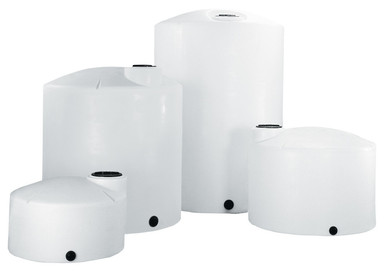
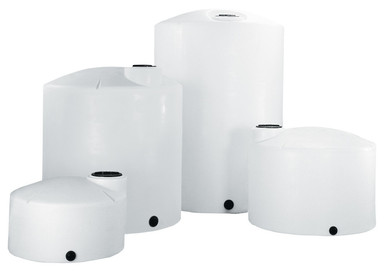
The choice of pigment in a polyethylene storage tank is not aesthetic. The pigment system determines the tank's UV stability, sets the chemical-resistance envelope at the tank wall, and influences the tank's effective service life by 5 to 15 years depending on the pigment chemistry and loading rate. The black tank, the white tank, the natural translucent tank, the green tank, and the blue tank are not five color choices for the same product; they are five different chemical-resistance and UV-inhibition specifications that happen to also be five different visual presentations. This article walks the pigment chemistry that determines those specifications — the UV-inhibition mechanisms of carbon black, the photoreactive behavior of titanium dioxide, the inert-pigment behavior of iron oxides and natural mineral colorants, and the failure modes of the wrong organic dye selection in chemical service.
The references cited are ASTM D1998 (rotomolded polyethylene tank standard), ASTM D4329 (fluorescent UV exposure of polymers), ASTM D2565 (xenon-arc accelerated weathering), ASTM D3892 (color and color difference of plastics), and the resin manufacturer technical data sheets that publish pigment-system specifications. The intent is the field-operations selection decision, not a polymer-chemistry textbook treatment.
1. The UV Degradation Mechanism HDPE Pigments Must Counter
Polyethylene degrades under UV exposure through a free-radical chain reaction. Solar UV in the 290-380 nm wavelength range is energetic enough to break C-H and C-C bonds in the polymer backbone. Each broken bond creates a radical that combines with atmospheric oxygen to form a hydroperoxide, which then decomposes into more radicals, propagating the degradation through the polymer matrix.
The visible consequences:
- Surface chalking — the surface oxidizes and a powdery layer of degraded polymer develops, eventually washing off in rain and exposing fresh polymer beneath.
- Color fade — the original pigment is partially destroyed by the same UV that breaks the polymer bonds.
- Stress crazing — surface microcracks develop where the degraded surface is mechanically weaker than the underlying polymer.
- Embrittlement — the polymer's elongation-at-break drops as the molecular weight decreases through chain scission. A tank that originally tolerated 200-300 percent elongation may break at 30-50 percent after 15 years of UV exposure.
- Wall-thickness erosion — over 20-30 years, the chalked surface erosion accumulates to measurable thickness loss, reducing the tank's structural rating.
Pigment selection determines how this degradation cascade is interrupted. The two primary mechanisms: UV absorption (the pigment absorbs UV photons before they can break polymer bonds) and radical scavenging (the pigment intercepts free radicals after they form, terminating the chain reaction). Different pigments use different mechanisms with different efficiencies.
2. Carbon Black: The Gold Standard UV Inhibitor
Carbon black is the most effective single-component UV inhibitor for polyethylene. The mechanism:
- UV absorption. Carbon black absorbs across the entire UV spectrum (290-400 nm) with near-unity efficiency. The UV energy that would have broken polymer bonds is absorbed by the carbon black particles and dissipated as heat.
- Free-radical scavenging. Carbon black surfaces have radical-trapping sites that intercept the free radicals that form when UV does penetrate. The radicals bond to the carbon surface and the chain reaction terminates.
- Loading rate efficiency. Effective UV protection is achieved at carbon-black loading of 1.5-2.5 percent by weight. Above 2.5 percent, the UV-protection benefit plateaus while the polymer's mechanical properties begin to suffer (carbon black at high loading can act as a stress concentrator).
- Particle size and dispersion. Carbon black grade matters. Channel-grade carbon black with 15-25 nm particle diameter and good dispersion in the resin gives the best protection. Furnace-grade carbon black with larger particles and poor dispersion gives marginal protection at similar loading rates.
The black HDPE tank with proper carbon-black loading delivers 25-30 year UV-exposure service life in moderate-latitude US conditions. The same tank in coastal Florida or Arizona may deliver 20-25 years; in inland Pacific Northwest, 30+ years. Carbon black is the chemistry that allows polyethylene to function as a long-service outdoor material at all.
The trade-off: black absorbs solar heat. A black tank in summer sun may run 15-25 degrees F hotter than a white tank, accelerating chemical degradation reactions inside the tank for some chemistries (sodium hypochlorite, hydrogen peroxide, certain organic chemistries). For these cases, the white pigment system or the white tank with a translucent overlay is the right choice.
3. Titanium Dioxide: White Pigment Chemistry
Titanium dioxide (TiO2) is the standard white pigment for polyethylene. Its UV behavior is more complex than carbon black:
- UV absorption. TiO2 absorbs UV in the 290-380 nm range with high efficiency. The mechanism is band-gap excitation of the rutile or anatase crystalline form.
- Photocatalytic side reaction. Anatase TiO2 (the more chemically active polymorph) photocatalyzes the oxidation of nearby polymer chains under UV exposure. The same UV absorption that protects the bulk polymer accelerates degradation at the pigment-polymer interface.
- Rutile vs anatase selection. Rutile TiO2 is the photocatalytically less-active polymorph and is the standard for outdoor polymer applications. Anatase is acceptable for indoor applications and as a brightener in unweathered service. Tank-grade TiO2 must be specifically rutile.
- Surface treatment. Modern tank-grade TiO2 is surface-coated with alumina or silica to passivate the photocatalytic surface and minimize the side reaction. This is the industry standard for outdoor polymer applications.
- Loading rate. Effective white-pigment loading is 1.0-2.0 percent by weight. Higher loading does not improve UV protection appreciably and increases pigment cost.
The white HDPE tank with rutile, surface-treated TiO2 at 1.5 percent loading delivers 18-22 year UV-exposure service life in moderate latitudes. The same tank with untreated anatase TiO2 may show fiber-bloom equivalent (chalking and surface degradation) within 8-12 years. The difference is invisible at delivery — the tanks look identical at the point of sale — but it is the most consequential pigment specification for service life.
White HDPE pairs well with chemistries that are heat-sensitive. Sodium hypochlorite at 12.5 percent trade strength decays at half the rate in a white tank versus a black tank because the temperature inside the white tank is 15-20 degrees F lower under solar load. This thermal management is the operational reason white is the standard for hypo storage despite the slightly shorter UV service life versus carbon black.
4. Natural Translucent: No Pigment, No UV Protection
Natural translucent HDPE has no added pigment. The polymer is the slightly milky natural color of polyethylene. The UV protection situation:
- UV absorbers added separately. Translucent HDPE may include UV absorbers (HALS — hindered amine light stabilizers, benzotriazoles, or benzophenones) at 0.2-0.5 percent loading. These molecules absorb UV without coloring the polymer.
- Service life shorter than pigmented HDPE. Translucent HDPE with UV absorbers typically delivers 8-12 year UV-exposure service life — shorter than black or white pigmented tanks. The trade-off is the visible-content advantage (operators can see the liquid level through the wall).
- Indoor service or short-term outdoor. Translucent HDPE is best for indoor applications, short-service outdoor (under 5 years), or applications where the level-visibility benefit outweighs the service-life trade-off.
- UV absorber depletion. Unlike carbon black (which is consumed only slowly), HALS and benzotriazole UV absorbers deplete over time as they perform their UV-quenching function. After 8-12 years of outdoor service, the absorbers are depleted and degradation accelerates.
Natural translucent is appropriate for short-service tanks where chemistry visibility is the dominant requirement. It is not appropriate as a substitute for pigmented HDPE in long-service outdoor applications.
5. Iron Oxide and Mineral Colorants: Inert Pigment Chemistry
Iron oxide pigments (yellow, red, brown) and other mineral colorants (chromium oxide green, ultramarine blue) are inert pigments — they do not chemically interact with the polymer matrix, do not photocatalyze degradation, and provide modest UV absorption.
- UV protection mechanism. Iron oxide and chromium oxide absorb some UV in the longer-wavelength UV-A range (320-400 nm) but are weak absorbers in the more damaging UV-B range (290-320 nm). They are pigments first and UV inhibitors second.
- Compatible with carbon black or TiO2. Most colored polyethylene tanks (green, blue, brown, red) use a mineral colorant in combination with carbon black or rutile TiO2 for UV protection. The carbon black or TiO2 is the UV inhibitor; the mineral colorant determines the visible color.
- Service life similar to pigmented base. A green tank using chromium oxide green plus 1.5 percent rutile TiO2 has UV service life equivalent to the white tank — roughly 18-22 years.
- Color shift over time. Mineral pigments are typically color-stable, but the underlying polymer degradation can shift the apparent color as surface chalking develops. A bright green tank at year 1 may appear faded green at year 15 even though the chromium oxide content is unchanged.
Iron oxide and mineral colorants give the tank manufacturer a wide color palette without compromising service life, provided the UV-protection package is correctly engineered.
6. Organic Dyes: The Wrong Choice for Long-Service Tanks
Organic dyes (azo, anthraquinone, phthalocyanine) are common in plastic colorants but are generally unsuitable for long-service outdoor tanks. The reasons:
- UV-driven dye degradation. Organic dye molecules are themselves UV-degradable. The same UV that pigment systems are designed to absorb destroys the dye molecules. Color fade is observable within 2-5 years on organic-dye-colored polyethylene in outdoor service.
- Photoreactive byproducts. Some azo dyes degrade into reactive species that catalyze additional polymer degradation, accelerating the tank's overall service-life decay.
- Limited chemical resistance. Organic dyes can extract into stored chemistries, contaminating the contents. This is a particular concern for potable water (NSF/ANSI 61) and food-grade applications.
- Manufacturer practice. Tank-grade polyethylene resins are formulated with mineral pigments and approved UV inhibitors, not organic dyes. The 5-brand catalog (Norwesco, Snyder, Chem-Tainer, Enduraplas, Bushman) uses mineral pigment systems exclusively for tank-shell coloration.
Where organic dyes appear in plastic products is mostly in short-service consumer goods, indoor applications, and decorative uses. The industrial tank market has standardized on mineral pigment systems for the service-life reasons above.
7. Pigment Effects on Chemical Resistance
The pigment system also influences chemical resistance at the tank wall. The mechanisms:
- Pigment particle as defect site. Each pigment particle is a discontinuity in the polymer matrix. Aggressive chemistries can attack the polymer-pigment interface preferentially, creating local degradation that does not occur in unpigmented HDPE.
- Pigment dispersion quality. Well-dispersed pigment minimizes interface area and the related chemical-attack vulnerability. Poorly dispersed pigment creates clusters that act as concentrated stress points and chemical-attack initiation sites.
- Specific pigment-chemistry interactions. TiO2 reacts with strong fluoride solutions (extracts the metal), iron oxide reacts with strong reducing agents, and certain mineral colorants are unstable in highly acidic or basic environments.
- Carbon black inertness. Carbon black is chemically inert to nearly all stored chemistries, which is one reason black HDPE has the broadest chemical-resistance envelope among pigmented polyethylenes.
For aggressive chemistry service (sulfuric acid, sodium hydroxide above 30 percent, sodium hypochlorite at trade strength), the manufacturer's chemical compatibility chart should be consulted with attention to the specific pigmented variant. A tank rated for hypochlorite in white may have different ratings in black or natural; the rating is pigment-specific because the chemistry attacks the pigment system as well as the polymer.
8. The Pigment-Loading Verification Chain
The actual pigment loading in a delivered tank is set by the resin formulation and the rotomolding process. Verification options:
- Manufacturer Certificate of Analysis. The tank manufacturer can provide pigment loading specification on request for a specific lot. This is the standard documentation for industrial buyers.
- Thermogravimetric analysis (TGA). Laboratory test that burns off the polymer and measures residual ash. Carbon black content is determined by the residual mass; mineral pigment content by elemental analysis of the ash.
- UV-VIS spectrophotometry. Surface reflectance measurements at specific wavelengths can estimate pigment loading non-destructively. Less precise than TGA but useful for field verification.
- Accelerated weathering testing. ASTM D4329 (fluorescent UV) and D2565 (xenon arc) generate UV-induced degradation rapidly in laboratory conditions. The rate of property degradation correlates with pigment-system effectiveness. Used by manufacturers for QC and by buyers for spec verification.
For most buyers, the manufacturer's specification on the tank tag and the published Certificate of Analysis is sufficient documentation. For high-stakes industrial procurement, third-party TGA testing on representative samples may be appropriate.
9. Tank Selection by Pigment System and Service
The 5-brand polyethylene catalog offers pigment-system options tuned to specific service:
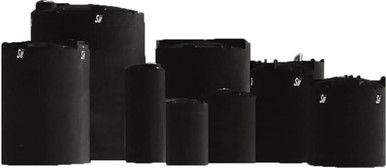
- Black HDPE (carbon-black pigmented): standard for water-storage tanks, septic tanks, and outdoor chemical storage where heat absorption is acceptable. Reference N-41500 1,000 gallon in black for above-ground water service. Carbon black gives 25-30 year UV-exposure life.
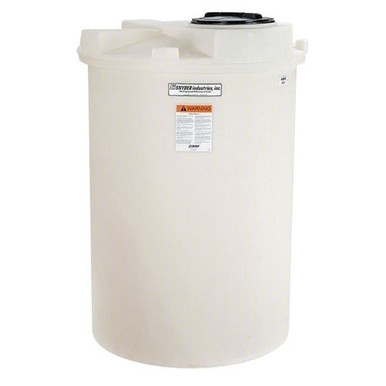
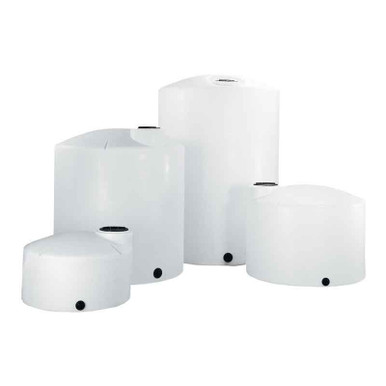
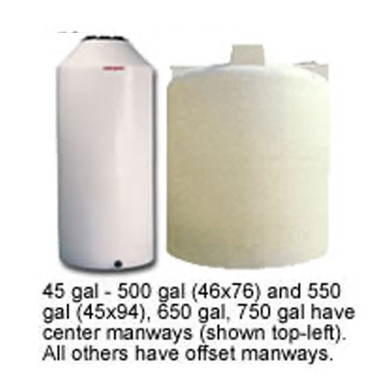
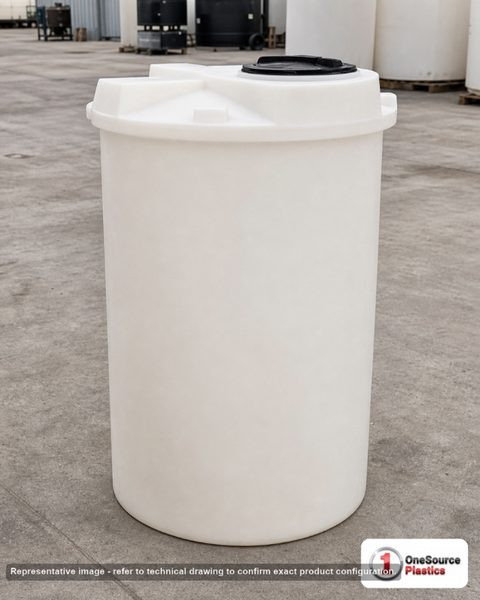
- White HDPE (rutile TiO2): standard for chemical storage where heat absorption is undesirable. Reference N-40164 5,000 gallon natural-white for sodium hypochlorite, hydrogen peroxide, and other heat-sensitive chemistries. White TiO2 gives 18-22 year UV-exposure life with rutile, surface-treated grade.
- Natural translucent HDPE (HALS UV absorbers): for short-service applications where liquid-level visibility through the wall is a primary requirement. Reference N-40213 300 gallon in natural-white-translucent. UV-absorber-protected service life 8-12 years outdoors, longer indoors.
- Snyder Captor double-wall (TiO2 outer shell): outer containment shell uses TiO2 white pigment with surface-treated rutile grade for durability under SPCC inspection schedules. Reference SII-5990102N42 1,000 gallon Captor Plus.
- Bushman water (carbon black): rural water-storage tanks where service life is the dominant requirement and the water inside is not heat-sensitive. Reference BM-WW-1500-GL-NAT 1,500 gallon; the carbon-black variant gives the longest practical service life for the rural-water application.
The pigment-system selection upstream is more consequential than most buyers realize. The wrong pigment system can shorten a tank's service life by half; the right pigment system can extend it by 40-60 percent versus the same tank in a poorly chosen color.
10. The Decision Framework
Synthesizing pigment chemistry and chemistry-of-service into a decision framework:
- Outdoor water storage, heat tolerable: black HDPE (carbon black). Longest UV service life, lowest cost, broadest chemical resistance.
- Outdoor chemical storage, heat sensitive: white HDPE (rutile TiO2 surface-treated). Manages internal temperature for chemistry stability while maintaining 18-22 year service life.
- Outdoor short-service or indoor with level visibility: natural translucent HDPE with HALS package. 8-12 year outdoor or longer indoor.
- Outdoor chemical storage with strong oxidizer or UV-sensitive chemistry: white HDPE with elevated UV-absorber package, or carbon-black HDPE with insulation jacket to manage temperature.
- Aesthetic color requirements (green, blue, brown, etc.): mineral-pigment colored HDPE with carbon-black or TiO2 base UV protection. Verify the pigment system is mineral-based, not organic-dye-based.
- Coastal, high-UV, equatorial latitude: carbon black at 2.0-2.5 percent loading or specialty UV-stabilized resin. Standard pigment systems may have shorter service life in these conditions.
OneSource Plastics ships polyethylene tanks across all 5 brands with manufacturer-specified pigment systems and published Certificate of Analysis on request. Our engineering team supports pigment-system selection for service-life optimization including chemistry-specific and latitude-specific recommendations. List pricing by SKU is published on each product page; LTL freight to your ZIP is quoted separately via the freight estimator or by phone at 866-418-1777. For related material content see UV stabilizer loading deep-dive and black vs white tank performance comparison.
Recommended Tanks for This Guide
Live pricing, updated automatically · estimate freight to your ZIP.