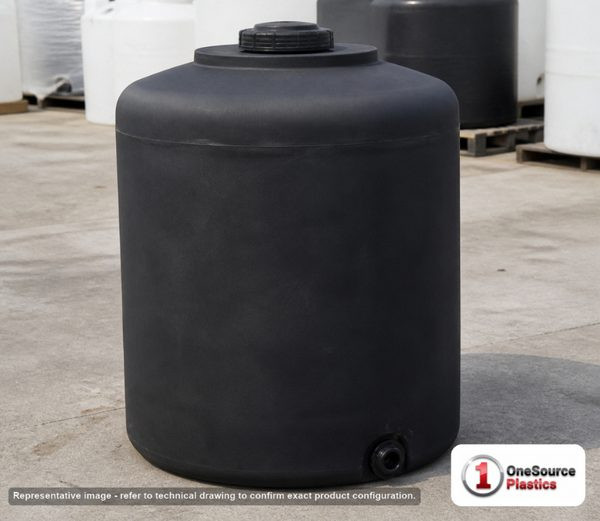
Industrial Tank Installation: Site Survey + Pad-Prep + Plumbing Tie-In Walkthrough
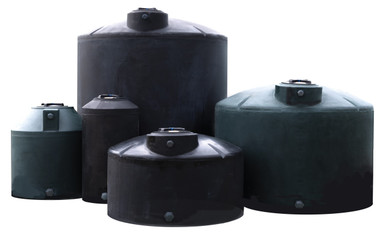
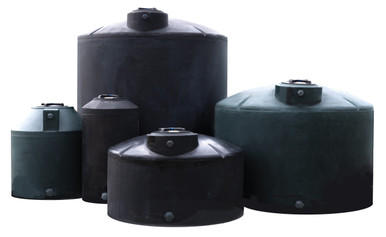
Industrial tank installations fail at the install, not at the manufacturer. The tank arrives on the freight truck within manufacturer spec; six weeks later the wall is cracking at a fitting, the pad is settling differentially, the relief valve is popping under fill, and the chemistry log shows the wrong gasket material. None of those are tank defects. They are install defects masquerading as product problems.
This guide is the install playbook used by experienced industrial-tank operators. End-to-end: site survey, pad-prep, tank set and leveling, plumbing tie-in, commissioning, documentation. We cite ASTM D1998 (rotomolded polyethylene tank specification), 40 CFR 112 (SPCC), 40 CFR 264.193 (RCRA secondary containment), NFPA 30 (flammable and combustible liquids), and reference real SKUs from the OneSource Plastics catalog. This is operations content, not a substitute for a licensed engineer's stamp on the design.
Phase 1: Site Survey (2-4 weeks before delivery)
The site survey is the most under-budgeted phase of a tank install. Skipping it is how installations end up with the wrong pad size, wrong access, missing setbacks, and last-minute change orders that cost 3-5x what the survey would have caught.
Survey deliverables
- Footprint plan. Tank outer diameter plus 4-foot inspection access on all sides. Access for lift truck or crane during set. Truck approach for delivery and future fill operations.
- Setback verification. Distance to property line, building, ignition source per NFPA 30 (flammable / combustible) or state DEQ rules (chemistry / petroleum). Distance to drinking water well (typically 50-100 feet minimum), surface water (variable by state), septic system (typically 25 feet minimum).
- Soil bearing capacity. Bearing test or geotechnical estimate. Native soil bearing capacity in psf determines pad sizing. 1,500-2,500 psf is typical for compacted earth; 3,000-4,000 psf for engineered fill; 4,000+ for native rock or properly placed concrete.
- Drainage assessment. Where does surface water go? Tank pad must shed water away from tank base. Site grading must not pond water around the pad.
- Utility verification. Water supply for fill (size, flow, pressure). Electrical service for any pumps, heating, monitoring. Communication (for level monitoring or process control).
- Frost depth. Pad foundation must extend below frost depth in cold climates. International Residential Code maps frost depth state-by-state; verify local code.
Site survey checklist (printable)
- Tank gallons: ____ Diameter: ____ Height: ____ Empty weight: ____ Full weight: ____
- Pad outer dimensions (tank + 4 ft each side): ____ x ____
- Setback to property line: ____ Required: ____ OK?
- Setback to building: ____ Required: ____ OK?
- Setback to ignition source: ____ Required: ____ OK?
- Setback to potable well: ____ Required: ____ OK?
- Setback to surface water: ____ Required: ____ OK?
- Soil bearing (estimated or tested): ____ psf
- Frost depth: ____ in
- Drainage direction: ____ Slope: ____%
- Truck delivery access: ____ ft straight pull, ____ ft turn radius
- Crane / lift truck access: yes / no
- Water supply at pad: ____ in line, ____ gpm available
- Electrical at pad: ____ V, ____ A available
- SPCC plan exists and updated: yes / no
- Fire department notification needed: yes / no
Phase 2: Pad Preparation (1-2 weeks before delivery)
The pad is the structural foundation of the tank. ASTM D1998 Section 5 requires "a smooth, level, and uniformly supportive base." That language gets translated into engineering as:
Pad sizing
| Tank Capacity | Pad Thickness | Base Compaction | Reinforcement |
|---|---|---|---|
| 100-500 gal | 3-4 in | 4 in compacted base | #3 mesh or fiber |
| 500-1,500 gal | 4-6 in | 6 in compacted base | #3 rebar 18 OC |
| 1,500-3,000 gal | 5-6 in | 8 in compacted base | #4 rebar 12 OC |
| 3,000-5,000 gal | 6-8 in | 8-10 in compacted base | #4 rebar 12 OC, both ways |
| 5,000-10,000 gal | 8-10 in | 12 in compacted base | #5 rebar 12 OC, both ways |
| Above 10,000 gal | PE-engineered | PE-engineered | PE-engineered |
Concrete spec: typically 3,500-4,000 psi 28-day compressive strength, air-entrained for freeze-thaw climates. Cure 7-14 days before placing the tank. Detailed analysis in our Tank Foundation Pad Engineering guide.
Pad geometry
- Level: 1/4 inch over 10 feet maximum slope. Tighter than 1/8 inch over 10 feet preferred.
- Smooth: Steel-troweled finish. Coarse broom finish acceptable. Aggregate exposed finish is not — sharp edges damage tank base over time.
- Drainage: Surrounding ground sloped 1-2% away from pad. Pad itself level, but the area around it sheds water.
- Anchor bolts (if specified): Cast in place per manufacturer hold-down detail. Hurricane and high-wind areas require seismic / wind anchoring.
Secondary containment construction
For petroleum, chemistry, and any tank under 40 CFR 112 SPCC or 40 CFR 264.193 RCRA, secondary containment is part of the pad-prep phase:
- Containment volume: 110% of largest tank capacity (some states 100%, some 125%).
- Material: reinforced concrete with sealed joints (most durable), lined earth berm with 60 mil HDPE or EPDM liner (mid-cost), or integral double-wall tank (eliminates separate berm).
- Drainage: rainwater accumulation drained through manual valve with leak detection, never through automatic outlet to grade.
- Inspection: documented monthly visual inspection per SPCC plan.
Phase 3: Receiving and Set (delivery day)
Receiving inspection
Before the freight driver leaves:
- Walk the tank perimeter. Look for cracks, deep gouges, flat spots, deformation. Polyethylene scratches and minor abrasions are cosmetic; cracks and gouges deeper than 1/16 inch are damage.
- Inspect the manway and lid. Open the lid and look inside for shipping damage to fittings, internal supports, or sumps.
- Verify all factory-installed fittings are present and oriented per the approved drawing.
- Photograph the tank from all four sides, plus close-ups of any concerning marks.
- Sign the bill of lading "subject to inspection" or note specific damage. Do not accept "as is" without noting.
- Carrier-damage claims must be filed within carrier-specific windows (typically 7 days for visible damage, 60-90 days for concealed). Documentation at receipt is the basis for the claim.
Lifting and setting
Polyethylene tanks have rigging points engineered into the manufacturer drawing. Use those, not random straps under the tank.
- Manway lifts: small tanks under 1,000 gallons can sometimes be lifted by the manway. Verify with manufacturer drawing. Wrong manway lift cracks the manway boss.
- Strap lifts: most mid-size tanks (1,000-5,000 gal) lift with two slings around the tank body, spreader bar above. Pad straps where they contact the tank corners.
- Boom truck or crane: required for tanks over ~3,000 gallons or where forklift access is limited. Crane operator should be told the tank is rotomolded plastic — handling differs from steel.
- Set straight onto the pad. Do not drag or skid the tank — bottom abrasion damages the wall and creates stress risers.
Leveling check
Once set:
- Place a 4-foot spirit level across the top of the tank in two perpendicular directions.
- Tank should read level within 1/4 inch over 4 feet.
- If not level, the pad is not level. Do not shim the tank — shimming creates stress concentration. Re-level the pad.
- Document level condition with photos before plumbing.
Anchoring (where required)
Hurricane zones, high-wind regions, and seismic zones require positive anchoring per state code. See our Hurricane Tie-Down guide. Common anchoring approaches:
- Strap-and-cable: tank wraps with stainless or galvanized strap, cable to pad-cast anchors. Suitable for most wind cases.
- Hold-down ring: manufacturer-supplied ring bolts through pad-cast anchor bolts.
- Concrete encasement of base: rare except for specialty applications.
Phase 4: Plumbing Tie-In
Inlet plumbing
Inlet sizing is determined by fill source — see our Tank Fitting Sizing Decision Tree for details. Install considerations:
- Anti-siphon device or check valve on the inlet line if the supply is pressurized municipal or pumped well — prevents tank backflow into the supply.
- Quick-disconnect (camlock) for tank-truck delivery; threaded permanent connection for plumbed inlet.
- Drop tube to bottom of tank for hypochlorite and any chemistry where vapor evolution at the surface is a concern (drop tube dumps below liquid level, no splash).
- Air gap for potable per local plumbing code. Cross-connection control is non-optional for NSF 61 service.
Outlet plumbing
- Full-bore ball valve at the tank outlet. Avoid gate valves (slow, leak-prone) and butterfly valves (chemistry-sensitive).
- Pipe support within 18 inches of the tank fitting. Long unsupported pipe runs put fatigue load on the fitting.
- Union or flange tie-in within reach for service disconnect.
- Discharge piping sloped slightly downward to prevent backflow into the tank.
Vent installation
Every closed tank needs atmospheric communication. Vent sizing rules:
- Vent must pass at minimum 1.5x the maximum fill rate to prevent over-pressurization during truck-fill.
- Vent must pass at minimum 1.5x the maximum drain rate to prevent vacuum collapse during pump-out.
- NFPA 30 has explicit vent sizing tables for petroleum AST. Use them for petroleum service.
- Hypochlorite tanks should have vapor-phase carbon scrubber on the vent — chlorine off-gas damages adjacent equipment.
- Acid tanks should have packed-bed scrubber or wet scrubber on vent to capture acid mist.
- Vent termination above tank top, with rain hood or screen to prevent debris ingress, sized for full vent flow.
Overfill prevention
Required by NFPA 30 for petroleum and most state regulations for chemistry:
- High-level alarm at 90% of capacity (audible + visible).
- High-high level shutoff at 95% of capacity (interlock to inlet pump or fill valve).
- Mechanical overfill prevention valve (gravity-actuated check at the inlet) for tank-truck delivery.
- Spill bucket at the fill point to catch hose disconnect spills.
Heating, insulation, and freeze protection (cold climates)
For chemistry that crystallizes at low temperature (NaOH 50%, urea solutions, certain brines) or operations that cannot tolerate fluid freezing:
- Heat trace cable wrapping the tank wall, controlled by thermostat at 40-50F.
- Insulation jacket (foam-in-place, fiberglass, or removable blanket) over the heat trace.
- Buried or bermed installations gain thermal mass and need less active heating.
- See our Tank Insulation and Heat Tracing guide.
Phase 5: Commissioning
Commissioning verifies the install before product hits the tank. Skipping commissioning is how leaks find product instead of water.
Hydrostatic test
- Fill the tank with water (potable for any food / water service; non-potable for chemistry tanks).
- Hold full for 24 hours. Walk the perimeter at hours 1, 4, 12, and 24. Look for any wall seepage, fitting drip, gasket weep, or pad-water accumulation.
- Inspect every fitting connection. Confirm thread sealant cure (PTFE tape needs no cure; pipe dope cures over 24-72 hours).
- Document the test with photos and a signed checklist.
Operational test
- With water still in the tank, run the pump suction (if any) at full design flow. Verify no cavitation, no excessive vibration.
- Open and close every valve in the manifold. Confirm no leaks at the unions and flanges.
- Test the high-level alarm — fill to alarm level, verify alarm activates, fill to high-high, verify shutoff activates.
- Test the overfill prevention valve (where installed).
- Test the vent — confirm air flows freely under fill and drain conditions.
Drain and refill with product
- Drain the test water completely. For potable, follow with a chlorine flush per NSF 61 disinfection procedure (typically 50 ppm chlorine for 24 hours).
- For chemistry tanks, rinse with deionized water if the chemistry requires (acid tanks especially — residual hardness causes precipitation issues).
- Fill with product per normal operating procedure.
Documentation handoff
Final install documentation should include:
- Tank serial number, manufacturer, capacity, resin grade, color.
- As-built dimensions and orientation.
- Pad design drawing and concrete pour records.
- Secondary containment volume calculation and material.
- Fitting schedule with size, NPT/BSPT, gasket material.
- Photographs of each construction phase.
- Hydrostatic test record.
- SPCC plan update (if applicable).
- State agency notifications (if applicable).
- Manufacturer warranty card and registration.
Real Install Example: 3,000-Gallon HDPE Outdoor Stock Water
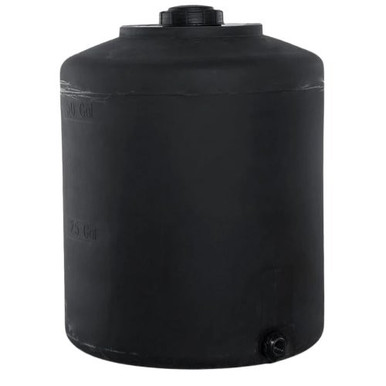
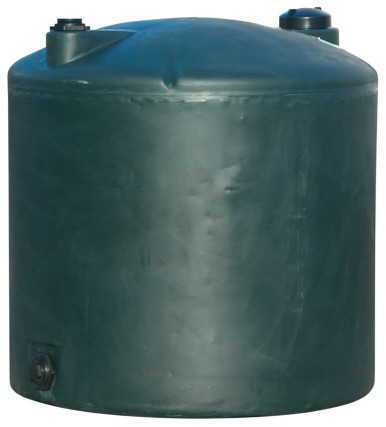
Service: agricultural stock water, central Texas, full sun, 50 cattle. Tank: EP-TLV03000BK (Enduraplas 3,000 gal vertical black HDPE) or N-41468 (Norwesco 3,000 gal vertical black). Pad: 12 ft x 12 ft reinforced concrete, 6 inches thick on 8 inches compacted base, #4 rebar 12 OC both ways. Tank weight empty: ~750 lb. Tank weight full: ~26,000 lb (water). Pad bearing load: ~180 psf — well under typical 1,500-2,500 psf bearing capacity.
Site survey: 30-foot setback from cattle yard fence (not a regulated setback but operational), 75 feet from drinking well (above 50 ft state minimum), 12 feet from existing well-pump shed for inlet plumbing. Utility: 1-inch water service from well, 25 gpm peak capacity.
Plumbing: 1-inch threaded inlet at top with float valve for automatic fill; 2-inch bulkhead outlet at base with full-bore ball valve and union; 2-inch atmospheric vent at top. Gasket: EPDM throughout (water service). No anchoring required (low wind zone, full tank weight resists wind by mass).
Commissioning: 24-hour hydrostatic test with water; verified fill rate at 18 gpm through the float valve; verified gravity drain through 2-inch outlet at ~38 minutes empty (matches our drain-rate table). Total install cost: tank ~$2,500, pad and labor ~$3,500, plumbing and fittings ~$600, install crew 2 days. Project completed for ~$7,000 plus freight.
Common Install Mistakes
Mistake 1: No site survey
The tank arrives, the pad is the wrong size, the truck cannot back in, the inlet plumbing has to be re-routed. Documented at every install where the survey was skipped.
Mistake 2: Pad too thin or under-reinforced
4-inch unreinforced pad cracks under a 5,000-gallon tank within 12-24 months. The crack propagates and the tank tilts. Engineering the pad for full water weight plus safety factor is non-optional.
Mistake 3: Skipping the hydrostatic test
Filling with product instead of water means the first leak contaminates instead of soaking. 24 hours of water before product is the cheapest insurance on a tank install.
Mistake 4: Wrong gasket on the fittings
EPDM in petroleum service. Buna-N in hypochlorite service. Both fail, both contaminate. Specify gasket material on the install drawing, verify at install, document on the handoff.
Mistake 5: Forgetting the SPCC update
New AST without SPCC plan update is a violation under 40 CFR 112. The plan must reflect the new tank within the inspection window. Verify SPCC update is on the project schedule.
Mistake 6: No anchoring in high-wind zones
Empty polyethylene tanks have low mass relative to wind load on the cylindrical surface. Hurricane Florence (2018) and others scattered un-anchored tanks across multiple southeastern states. Verify wind code and anchor accordingly.
Mistake 7: Ignoring future access
The tank installs with 18 inches between tank and adjacent equipment. Three years later the inspector cannot get around the tank to walk the perimeter. Maintain 4 feet of inspection access on all sides.
Install Quick-Reference Checklist
| Phase | Critical Items |
|---|---|
| Site survey | Footprint, setback, soil bearing, drainage, frost depth, utility, access |
| Pad-prep | Sizing, level, smooth finish, drainage, secondary containment, anchor cast |
| Receiving | Walk-around inspection, fitting verification, photo documentation, BOL annotation |
| Set | Manufacturer rigging points, no skidding, level check, anchoring per code |
| Plumbing | Inlet anti-siphon, outlet ball valve, vent sizing, overfill prevention, gasket per chemistry |
| Heat / insulation (cold climate) | Heat trace cable, insulation jacket, thermostat at 40-50F |
| Commissioning | 24-hour hydrostatic, operational test, alarm test, vent verification |
| Documentation | As-built drawings, SPCC update, agency notifications, warranty registration, photo record |
Internal Resources
- Tank Foundation Pad Engineering
- Tank Fitting Sizing Decision Tree
- Hurricane Tie-Down Engineering
- Tank Insulation and Heat Tracing
- Multi-Tank Manifolding
- Tank Storage Compliance Audit Checklist
- Below-Grade Site Engineering Reality
- Freight Cost Estimator
- Contact OneSource — install consultation, pad spec review, fitting schedule
Source Citations
- ASTM D1998 — Standard Specification for Polyethylene Upright Storage Tanks (Section 5: foundations)
- ACI 318 — Building Code Requirements for Structural Concrete (pad reinforcement)
- 40 CFR 112 — Spill Prevention, Control, and Countermeasure (SPCC) Plan
- 40 CFR 264.193 — RCRA Secondary Containment for Tank Systems
- NFPA 30 — Flammable and Combustible Liquids Code (vent sizing, setback)
- NFPA 30A — Code for Motor Fuel Dispensing Facilities and Repair Garages
- NSF/ANSI 61 — Drinking Water System Components: Health Effects
- ASCE 7 — Minimum Design Loads for Buildings and Other Structures (wind, seismic)
- International Residential Code (IRC) — frost depth tables
- Manufacturer install instructions: Norwesco, Snyder Industries, Chem-Tainer, Enduraplas, Bushman Equator
- OneSource Plastics master catalog data, dated 2026-03-26 snapshot
Recommended Tanks for This Guide
Live pricing, updated automatically · estimate freight to your ZIP.