Industrial Water Reuse Tank Topology: Grey-Water and Rainwater and HVAC Condensate Aggregation, Quality-Banded Storage Trains, Treatment Stage Sequencing, and the Reuse-Capable Polyethylene Bulk Storage Architecture
Industrial water reuse moves a facility from the linear water budget (purchase potable, use it once, send it to wastewater) to the cyclical water budget (capture multiple non-potable streams, treat and store at appropriate quality grades, supply non-potable demands from reuse before drawing on potable). The economics improve as municipal water and sewer rates rise; the regulatory environment supports reuse for non-potable applications including cooling tower makeup, irrigation, equipment washdown, and industrial process water that does not contact food or pharmaceutical product. The engineering is the storage topology — how many tanks, at what quality grade, with what treatment between them — that takes raw captured water from grey-water, rainwater, and HVAC condensate streams and supplies it as fit-for-purpose reuse water.
This article walks the reuse-capable storage topology for industrial and commercial polyethylene bulk tank installations. The structure follows the source streams, the quality bands, the treatment stages, and the storage train that produces multi-grade reuse water from mixed-source captured water. The references are EPA guidelines for water reuse, the IAPMO Z1349 Water Reuse Standard, ASHRAE Standard 191 for cooling tower makeup water reuse, and operational data from facilities operating reuse systems supplying 30-70 percent of total facility water demand from captured streams.
1. The Three Captured-Water Source Streams
The captured-water sources at a typical industrial or commercial facility:
- Rainwater from rooftops and stormwater from impervious surfaces. Highly variable in volume (driven by precipitation events), generally high quality (atmospheric water with minor surface contamination from roof or pavement contact), but seasonally inconsistent and requires storage volume to bridge dry periods. The capture rate is approximately 600 gallons per inch of rainfall per 1000 square feet of catchment surface.
- Grey-water from sinks, showers, laundry, and other non-fecal drain streams in the building. Continuous low-volume flow (driven by occupancy and use patterns), moderate quality (organic loading from soaps and surfactants, biological contamination from skin contact, low total dissolved solids), requires treatment to achieve any usable reuse quality. The capture rate is approximately 25-40 gallons per occupant per day for commercial buildings.
- HVAC condensate from cooling coils. Continuous low-volume flow during cooling season (driven by latent cooling load), high quality (essentially distilled water with minor contamination from coil and drain pan surfaces), requires minimal treatment for most reuse applications. The capture rate is approximately 0.1-0.3 gallons per ton-hour of cooling.
The three streams have complementary characteristics. Rainwater provides volume but is intermittent. Grey-water provides continuous flow but needs treatment. HVAC condensate provides high quality but only during cooling season. The integrated topology aggregates the streams to capture the volume from all three while routing each stream through appropriate treatment for its source quality and the target reuse application.
2. The Quality Bands for Industrial Reuse Applications
Reuse water serves multiple end-use applications at different quality requirements:
- Band 1: Lowest quality, irrigation and dust suppression. Acceptable for outdoor non-potable use with no human contact. Low organic loading acceptable; biological contamination managed by on-application contact and natural die-off. The least demanding treatment requirement; rainwater with simple filtration meets this band.
- Band 2: Moderate quality, equipment washdown and floor cleaning. Acceptable for non-potable industrial cleaning. Some biological control required (operator skin contact possible). Filtration plus disinfection meets this band.
- Band 3: Higher quality, cooling tower makeup and HVAC system makeup. Required to meet ASHRAE 191 quality requirements for cooling tower water (specific limits on conductivity, hardness, biological contamination, suspended solids). More demanding treatment including pH adjustment, biological control, and possibly softening or partial demineralization.
- Band 4: Highest quality, process water for non-product-contact industrial use. Required to meet specific process requirements that may exceed potable water standards in specific dimensions (e.g., low conductivity for rinsing, low hardness for boiler feed, biological-free for sensitive process). Demanding multi-stage treatment.
- Outside reuse: potable water and product-contact water. Reused water is not used for these applications under most regulatory frameworks. Potable water is from the municipal supply or a permitted on-site source; product-contact water meets food, pharmaceutical, or product-specific quality standards.
The reuse system designs for the specific quality bands needed at the facility. A facility with cooling towers, irrigation, and washdown demand has Band 1, 2, and 3 demands. A facility with pharmaceutical or food production has potable demand outside the reuse boundary plus possibly Band 1, 2, or 3 demands inside it. The storage topology serves the actual demand mix at the specific site.
3. The Quality-Banded Storage Train
The integrated reuse system uses multiple storage tanks at different quality grades, with treatment stages between them that upgrade water from one quality band to the next. The storage train architecture:
- Raw-capture tanks at the source-stream level. Separate raw-capture storage for rainwater (sized for storm capture), grey-water (sized for daily flow with surge buffer), and HVAC condensate (typically commingled with rainwater due to similar quality). The raw storage provides flow buffering between intermittent or variable source flow and the treatment system that operates at a more constant rate. Capacity sized to bridge the source-flow variation: rainwater storage to capture the design storm minus the treatment-rate during the storm; grey-water storage for 1-3 days of flow.
- Treated-water Band 1 tank: irrigation and outdoor reuse. Receives water from the raw rainwater capture after simple sediment filtration. Storage capacity sized for irrigation demand patterns (daily or weekly cycles depending on landscape design). Reference N-41524 2500 gallon or N-42960 3000 gallon Norwesco water tanks for the irrigation-reuse storage envelope.
- Treated-water Band 2 tank: washdown and cleaning. Receives water from Band 1 tank after disinfection (chlorination, UV, or ozone) plus polishing filtration. Storage capacity for daily washdown demand with surge for production scheduling. Reference N-41506 1500 gallon or N-41500 1000 gallon for the moderate-volume reuse-water envelope.
- Treated-water Band 3 tank: cooling tower makeup. Receives water from raw rainwater and HVAC condensate (the higher-quality sources) after pH adjustment, biological control, and ASHRAE 191 conformance treatment. Storage capacity for cooling tower makeup demand with surge for high-load periods. Reference N-40164 5000 gallon Norwesco vertical for the cooling-tower-makeup envelope.
- Treated-water Band 4 tank: high-quality process reuse. Receives water from Band 3 after additional polishing (deionization, RO, or specific treatment for the process requirement). Storage capacity for process demand. Site-specific design.
The cascade architecture allows water to flow from lower to higher quality bands through treatment, and demand at each band draws from the appropriate band's tank. The lowest-quality demand (irrigation) draws from the Band 1 tank without consuming the higher-quality Band 3 water. The highest-quality demand (process makeup) draws from the Band 4 tank, which the system has invested treatment energy to produce.
4. Treatment Stage Sequencing Between Storage Tanks
The treatment stages between the storage tanks each address specific quality dimensions:
- Sediment filtration: 50-100 micron screening. First-stage treatment for raw captures. Removes leaves, insects, and gross debris from rainwater; removes lint and hair from grey-water. Inexpensive and easy to maintain. Required upstream of any other treatment to prevent fouling of downstream stages.
- Polishing filtration: 1-5 micron cartridge. Second-stage filtration for Band 1 to Band 2 transition. Removes finer suspended solids that affect visual clarity and downstream disinfection efficiency. Cartridge replacement at flow-volume or pressure-drop intervals.
- Biological treatment: settling, biofiltration, or membrane bioreactor. For grey-water sources with significant organic loading. Reduces BOD and removes biodegradable contamination. Settling is simple but slow; biofiltration is moderate cost and effective; membrane bioreactor is highest cost and produces highest quality. Selected based on grey-water flow volume and target reuse band.
- Disinfection: chlorination, UV, or ozone. Required for any reuse application where biological contamination is a concern. Chlorination is established and inexpensive but introduces chlorine residual and disinfection byproducts. UV is residual-free but requires good water clarity. Ozone is most powerful but most expensive. Selected based on downstream application's residual tolerance and cost considerations.
- pH adjustment and chemistry control. Required for cooling tower makeup (alkalinity and pH targets per ASHRAE 191). Sulfuric acid for pH reduction, sodium hydroxide for pH increase. Chemistry monitoring and dosing pumps; storage tanks for the dosing chemicals.
- Demineralization or softening. Required for high-quality process reuse. Ion exchange softening for hardness reduction; reverse osmosis for total dissolved solids reduction; mixed-bed deionization for highest purity. Stages selected based on the specific process requirement.
The treatment train sequence is source-to-target: each stage addresses the specific quality gap between the input water and the output requirement. The integrated system designs the stages to minimize energy and consumable cost while meeting the quality targets.
5. Tank Sizing for Reuse Storage
The reuse tank sizing combines the source-stream variability with the demand-stream variability to determine the storage volume needed at each band:
- Rainwater raw capture volume. Sized for the design storm capture minus the treatment rate during the storm. A 1-inch rainfall event over a 10,000 square foot roof produces approximately 6,000 gallons of capture; the storage size accommodates this less the treatment rate over the storm duration. Typical rainwater capture tanks for commercial buildings range 5,000-50,000 gallons.
- Grey-water raw capture volume. Sized for 1-3 days of building grey-water flow with surge for occupancy variation. A building with 100 occupants generates approximately 2,500-4,000 gallons per day grey-water flow; the storage size is 3,000-12,000 gallons for typical operations.
- Band 1 irrigation reuse volume. Sized for irrigation demand patterns. Daily irrigation at 1-2 inches per week over 5,000 square feet of landscape is 600-1,200 gallons per day; the storage size accommodates several days of demand with refill from treatment.
- Band 2 washdown reuse volume. Sized for daily washdown demand. Production-floor washdown at 200-500 gallons per shift across 1-3 shifts per day is 200-1,500 gallons per day; storage at 1-2 days of demand.
- Band 3 cooling tower makeup volume. Sized for cooling tower makeup rate during peak cooling load. Cooling tower at 100-1,000 ton capacity with 5-15 percent makeup rate is 50-1,500 gallons per hour during operation; storage at 4-12 hours of operation provides surge for treatment outages.
The total storage capacity across all bands typically runs 30,000-200,000 gallons at a mid-size commercial building or industrial facility implementing reuse, distributed across 4-8 individual tanks at the various quality bands. The polyethylene tank product family across the 5 brands serves the typical sizes; bulk rainwater and large makeup storage uses 5,000-10,000 gallon and larger tanks. Reference N-43128 10,000 gallon Norwesco vertical for the bulk rainwater capture envelope.
6. Mixing, Cross-Contamination, and Air Gap Engineering
The reuse system has to prevent any cross-contamination between the reuse water and the potable water supply that serves the facility's potable demands. The cross-connection control is regulatory (plumbing code, IAPMO Z1349) and engineering (physical air gaps, backflow prevention, color-coded piping):
- Air gap at potable supplies into reuse tanks. If potable water is used to top up a reuse tank during low-capture periods, the potable supply line discharges into an air gap above the tank's high-water level rather than connecting directly to the tank. The air gap prevents any back-siphoning of reuse water into the potable supply. Code-compliant air gaps are typically 2 inches or twice the supply diameter, whichever is greater.
- Backflow prevention on reuse-water distribution. The reuse-water distribution piping has backflow preventers at any point where it could connect to potable water. The pump suction from a reuse tank does not connect to the potable supply; the pump discharge to use points has backflow prevention to prevent reuse water from migrating back through cross-connections.
- Color-coded piping for reuse and potable. Plumbing code typically requires reuse-water piping in distinctive color (purple is the common code) with marker labels at intervals. The color coding prevents mistaken identification by maintenance workers who might cross-connect during repairs.
- Separated tank labeling. Reuse tanks labeled clearly as non-potable, with NSF-relevant markings absent (the tank is not for potable service even if the polyethylene resin is NSF-certified for potable use; the contained water is not potable). Operator-station signage at any reuse tank indicates the quality band and the approved end-uses.
The cross-contamination engineering is the regulatory checkpoint for any reuse system installation. The plumbing inspector and the local water utility verify the air gaps, backflow prevention, and labeling at installation and at any major modification. The site that engineers the cross-contamination protection from the start passes these inspections; the site that retrofits protection after a violation faces enforcement and possibly water-service interruption during remediation.
7. Operational Monitoring of the Reuse System
The reuse system requires monitoring to confirm the water quality at each band stays within the band specification and to detect any treatment failure before it propagates to use points:
- Source-flow monitoring. Flow meters at each source stream (rainwater capture, grey-water collection, condensate collection) to track capture rates against expected patterns. Significant deviation (excess capture from undetected runoff, deficit from leaks or capture-system failure) flags for investigation.
- Tank level monitoring. Level sensors at each storage tank to track inventory and to trigger treatment-system operation. Low-level alarms trigger potable makeup if equipped; high-level alarms trigger overflow handling and capture-system shutdown.
- Quality monitoring at each band. Sample points and on-line analyzers as appropriate for the quality dimension. Conductivity for total dissolved solids; turbidity for suspended solids; chlorine residual for disinfection effectiveness; pH for chemistry control. Online instruments for continuous monitoring; grab samples for periodic comprehensive analysis.
- Treatment-stage performance monitoring. Pressure drop across filters (rising drop indicates cartridge loading); flow rates at each stage; consumable use rates (chlorine, acid, base) to track inventory and detect dosing anomalies.
- Distribution monitoring. Pressure and flow at each use-point to confirm supply meets demand; backflow preventer testing on the regulatory schedule (typically annual).
The monitoring data feeds the operational dashboard and the periodic reuse-system reports. Sites with years of monitoring data refine the system sizing and operation based on actual capture rates and demand patterns; the second-generation reuse system improves on the first based on this data.
8. Tank Selection That Supports Reuse Operations
The reuse storage tank selection optimizes for the specific reuse-system characteristics:
- UV-resistant exterior for outdoor rainwater capture tanks. Standard Norwesco, Snyder, and other 5-brand polyethylene tanks include UV stabilization adequate for outdoor service. Rainwater capture tanks typically install outdoors at the catchment area. Reference N-42042 3000 gallon for the outdoor rainwater capture envelope.
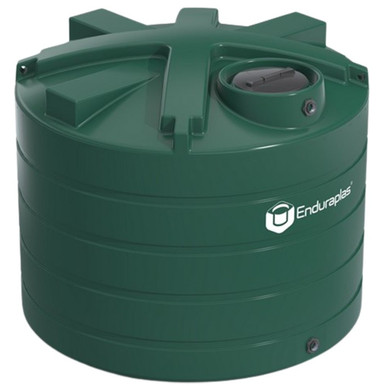
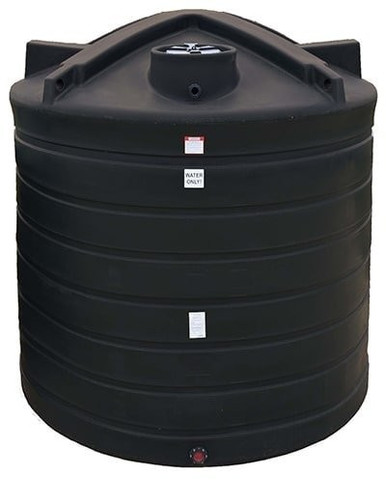
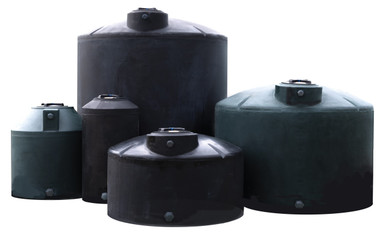
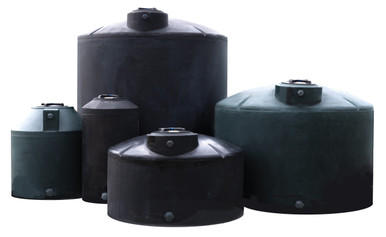
- Light-blocking shell for biological-growth control. Reuse tanks holding water with potential biological contamination benefit from opaque (black or dark colored) shells that block UV light from supporting algae growth inside the tank. Translucent natural tanks support algae growth in stored water; opaque tanks suppress it.
- Multiple fittings for capture inlet, treatment loop, distribution outlet, and overflow. Reuse tanks typically have more fittings than simple storage tanks: inlet from capture, treatment loop suction and return (when treatment is recirculating), distribution outlet to use points, overflow to drain or cascade, drain valve, and instrumentation ports for level and quality. Plan the fitting layout at order to avoid field modifications.
- Color and material consistent with non-potable service. Avoid colors and tank specifications that suggest potable use; even if the tank is physically suitable, the labeling and color help prevent operational confusion. Reference N-40703 550 gallon for the smaller-format reuse storage envelope.
The tank selection is a small fraction of total reuse-system cost; the treatment, controls, and integration drive most of the capital. The tank choice should optimize the operational characteristics and avoid the costly field modifications. List pricing on each product page; LTL freight to your ZIP via the freight estimator or by phone at 866-418-1777.
9. The Reuse Topology Engineering Conclusion
Industrial water reuse from grey-water, rainwater, and HVAC condensate aggregation produces 30-70 percent of facility water demand from captured streams when the storage topology is engineered for the demand mix. The quality-banded storage train uses multiple tanks at different quality grades, with treatment stages between them, to take raw captured water through the necessary upgrades to meet each end-use's quality requirement. The architecture is more complex than a single-tank reuse system but produces materially better water-quality matching to demand and materially better treatment efficiency by avoiding the over-treatment that single-band systems produce.
The cross-contamination engineering is the non-negotiable layer. Air gaps, backflow prevention, color-coded piping, and clear labeling protect the potable water supply from any reuse-water contamination. The site that engineers this protection from the start passes regulatory inspections and operates safely; the site that omits it faces enforcement and water-service interruption.
OneSource Plastics ships polyethylene tanks across the 5 brands — Norwesco, Snyder, Chem-Tainer, Enduraplas, Bushman — for reuse storage at every band of the topology. The tank selection optimizes UV-resistance for outdoor capture, biological-growth control through opaque shell selection, and fitting layout for the multiple inlet, outlet, treatment, and instrumentation connections. The reuse-system design is site-specific operations engineering; the tank selection is the bulk-storage hardware that supports it. List pricing on each product page; LTL freight to your ZIP via the freight estimator or by phone at 866-418-1777. For related operations engineering see secondary containment requirements and tank specification sheet reading.
Recommended Tanks for This Guide
Live pricing, updated automatically · estimate freight to your ZIP.