Tank Geometry Trade-Offs: Vertical, Horizontal, Cone, and Leg Tank Use Case Selection
Tank geometry is the most undertheorized variable in industrial liquid storage purchasing. Two tanks of identical capacity, identical resin, and identical price can serve very different operating roles based purely on the shape of the shell. Vertical wins about 90% of the time. Horizontal leg tanks own a specific niche. Cone bottoms eat the slurry and full-drain market. Each has structural, hydraulic, and operational implications that the gallon number alone cannot describe. This guide walks the four major polyethylene tank geometries, explains the engineering reasons each exists, and gives operations managers a defensible framework for picking the right one before bringing freight cost into the conversation.
The OneSource Plastics commodity catalog spans every geometry across the five primary brands (Norwesco, Snyder, Chem-Tainer, Enduraplas, Bushman). The selection problem is not lack of options — it is lack of vocabulary for matching geometry to operating role. We will give you that vocabulary, walk worked examples from real installed equipment, and call out the failure modes when geometry is mismatched to service.
The Four Polyethylene Tank Geometries
Vertical Cylindrical (the default)
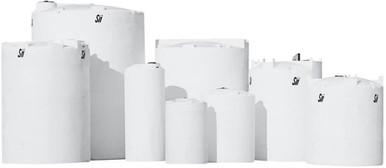
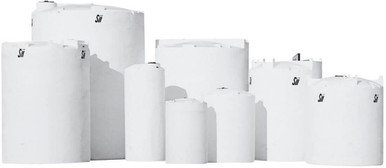
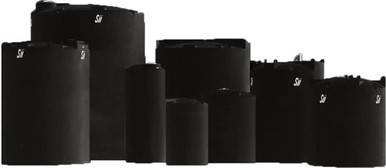
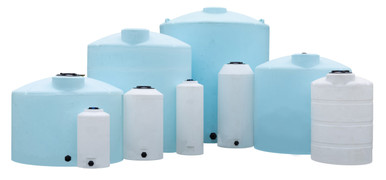
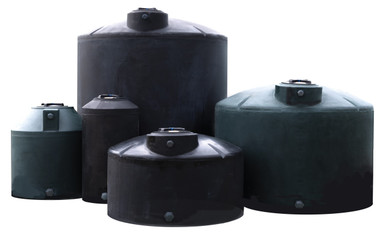
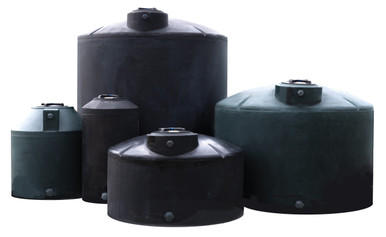
A vertical cylindrical tank is a closed-top, flat-bottom cylinder with the major axis aligned with gravity. The shell carries hoop stress; the bottom carries hydrostatic load distributed across the full footprint pad. About 85-90% of polyethylene storage tanks shipped in North America are this geometry because it solves the most common storage problem (bulk inventory in a fixed location) at the lowest manufactured cost per gallon.
- Capacity range: 10 gallons (Norwesco MPN 44844, $99.99 list) to 16,500 gallons (commodity rotomold ceiling).
- Footprint efficiency: highest gallons per square foot of any geometry. A 1,000-gallon vertical (Norwesco MPN 41500, $1,339.00 list) occupies roughly 28 sq ft of pad area.
- Hydrostatic head: generates the highest static head per gallon, which is good for gravity-feed and hydraulic delivery but stresses bottom-fitting outlets the most.
- Mixing: hardest geometry to mechanically mix end-to-end without forced circulation. Stratification is the default state.
- Drain residual: approximately 1-3% of total capacity left after gravity drain because the flat bottom retains a heel until aspirated.
- Representative SKUs: Norwesco MPN 41500 (1,000 gal black, $1,339.00 list), MPN 41856 (200 gal natural white 30"x72"), MPN 43804 (1,075 gal black, $1,299.99 list), MPN 40860 (1,350 gal black, $1,669.99 list), MPN 43808 (1,525 gal black, $1,459.99 list).
Horizontal Cylindrical / Leg Tank
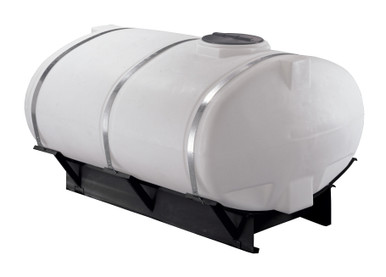
A horizontal leg tank lays the cylinder on its side with integrated saddle legs molded into the shell or supplied as bolt-on cradles. The major axis is horizontal. Hydrostatic head is reduced (compared to a vertical of equal volume) because the liquid column is shorter. Footprint is larger but height is lower.
- Capacity range: 35 gallons (Norwesco MPN 45223, $138.74 list) to 2,635 gallons (Norwesco MPN 41294, $7,151.00 list, HDPE elliptical leg tank).
- Footprint: 2-3x the floor area of an equivalent vertical, but maximum height typically 60-70" even at 2,500+ gallon size.
- Hydrostatic head: roughly 35-50% of an equivalent vertical, easing pump suction conditions and outlet fitting stress.
- Mixing: long, narrow profile encourages plug-flow circulation when inlet and outlet are positioned at opposite ends. Better for first-in-first-out service than vertical.
- Drain residual: 0.5-1% if outlet is at the lowest geometric point, which it typically is on saddle-mounted leg tanks.
- Representative SKUs: Norwesco MPN 45223 (35 gal white horizontal leg tank, $138.74 list), MPN 45191 (65 gal white horizontal leg tank, $279.99 list), MPN 45209 (925 gal white horizontal leg tank, $1,781.76 list), MPN 40327 (300 gal white horizontal elliptical cradle tank, $829.99 list), MPN 40328 (500 gal white horizontal elliptical cradle tank, $1,159.99 list), MPN 40775 (2,035 gal black HDPE horizontal elliptical leg tank, $4,638.43 list), MPN 41294 (2,635 gal black HDPE horizontal elliptical leg tank, $7,151.00 list), MPN 40283 (2,635 gal blue HDPE horizontal elliptical leg tank, $6,589.80 list).
Cone Bottom (Vertical with Sloped Discharge)
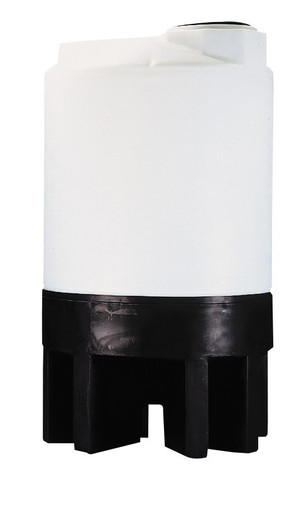
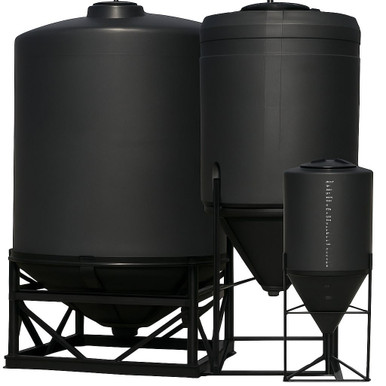
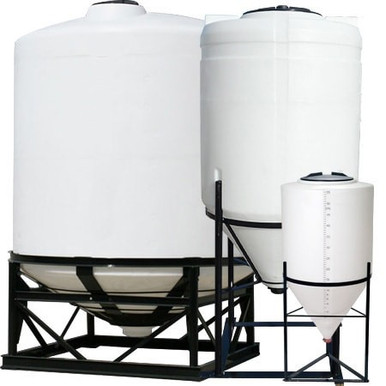
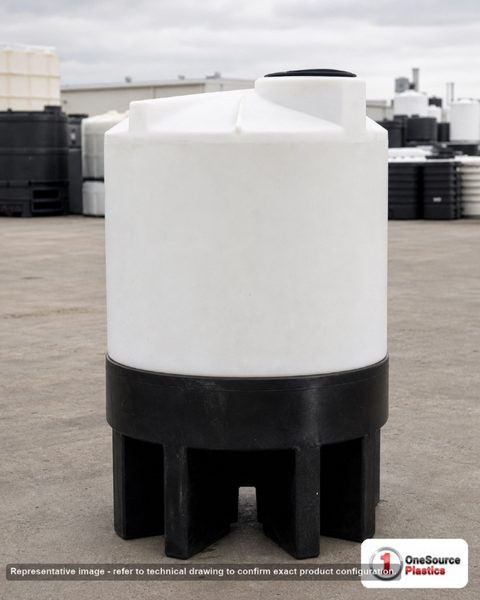
A cone-bottom tank is a vertical cylinder terminating in an integrally molded cone at the lower end. The cone angle (measured from horizontal) is typically 15°, 30°, 45°, or 60°. Steeper cone = better solids discharge, more pad height, more cost. Cone bottoms must be supported on a structural stand because the apex cannot rest on a pad.
- Capacity range: 110 gallons (Norwesco MPN 44217, full-drain inductor) to 14,000 gallons (commodity rotomold ceiling for cone bottoms).
- Cone angle selection: 15° for free-flowing liquids that do not settle (Norwesco MPN 41484, 300 gal 15° cone, $789.99 list); 30° for slow-settling slurries (Norwesco MPN 40817, 1,600 gal 30° cone, $2,097.99 list); 45° for fast-settling solids (Norwesco MPN 43852, 1,000 gal 45° cone, $1,606.93 list, and MPN 43854, 1,500 gal 45° cone, $2,141.09 list); 60° for sticky materials (rare in commodity catalog).
- Drain residual: < 0.1% with proper cone angle and full-port outlet. The reason cone bottoms exist.
- Stand requirement: structural support to elevate the cone apex above the discharge piping. Polyethylene molded stands (integrated, e.g. Norwesco MPN 40359, 1,050 gal 20° cone with poly stand, $2,689.99 list) or steel stands (separately purchased, taller).
- Hydrostatic head: highest of any geometry per gallon because the cone height adds to the static column without adding capacity.
- Representative SKUs: Norwesco MPN 43852 (1,000 gal 45°, $1,606.93 list), MPN 44420 (1,020 gal 15°, $1,636.00 list), MPN 40359 (1,050 gal 20° with poly stand, $2,689.99 list), MPN 40817 (1,600 gal 30°, $2,097.99 list), MPN 43854 (1,500 gal 45°, $2,141.09 list), MPN 41484 (300 gal 15°, $789.99 list), MPN 44217 (110 gal full-drain inductor, $319.50 list); Chem-Tainer MPN TC3148JP (100 gal cone with poly stand, $1,020.00 list), MPN TC3166JP (150 gal cone with poly stand, $1,190.00 list).
Specialty Geometries (Loaf, Saddle, Doorway)
Three sub-geometries serve niche transport and access roles. The loaf utility tank (D-cross-section, low-profile) fits truck beds and tight clearance applications — Norwesco MPN 44963 (100 gal portable loaf utility, $324.72 list) is the workhorse. The applicator saddle tank fits agricultural applicator frames — Norwesco MPN 60204 (100 gal applicator saddle, $347.00 list). Doorway tanks have shells engineered narrow enough to fit through a 30" or 36" standard interior door, allowing installation in basements and mechanical rooms without wall demolition.
The Geometry Selection Matrix
| If the operating priority is... | Geometry | Why |
|---|---|---|
| Maximum gallons in minimum floor area | Vertical cylindrical | Highest gallons/sqft. Default unless overridden. |
| Low overhead clearance constraint (basement, garage) | Horizontal leg tank or doorway tank | Maximum height stays under 70" even at 2,500 gal. |
| Mounted on truck or trailer for transport | Horizontal leg tank, loaf utility, or applicator saddle | Lower center of gravity and saddle/foot integration. |
| Slurry, settling solids, or full-drain required | Cone bottom (15° to 60° per material) | Sloped discharge eliminates heel; angle matches material. |
| First-in-first-out plug flow desired | Horizontal leg tank | Long narrow profile with end-to-end inlet/outlet. |
| Minimum capital cost per gallon | Vertical cylindrical | Simplest mold geometry; widest manufacturer competition. |
| Maximum static head for gravity feed | Tall vertical or cone bottom on stand | Liquid column height drives downstream pressure. |
| Frequent inspection / cleaning access | Horizontal leg tank or vertical with manway | Walk-in or arm-in access through end manway easier than vertical top access. |
The 90/10 Rule
For approximately 90% of polyethylene storage tank purchases, vertical cylindrical is the right answer. The reasons:
- Cost: simplest mold tooling. Largest manufacturer competition. Lowest $/gallon at every capacity tier.
- Footprint: highest density. Pad pours are smaller; site footprint is contained.
- Manufacturer support: verticals account for 70-85% of every brand's catalog. Spare parts, retrofit fittings, manway accessories all stocked.
- Freight class: verticals nest tighter onto trucks for outbound freight. NMFC class is typically 100 or 125 vs 150-200 for sprawling horizontals.
The 10% where another geometry wins is where one of these conditions dominates the decision:
- Overhead clearance is hard-capped (basement install, low-ceiling utility room, mobile equipment).
- Material settles or is a slurry requiring full drain (water treatment, food processing, paint).
- Plug-flow turnover is required for chemistry stability (chlorine dosing buffer, polymer makedown).
- The tank is mounted on a vehicle or trailer for transport (water hauling, agricultural application).
- Inspection and entry frequency is high (potable water, food, pharma) and end manway access is preferred.
Worked Geometry Decisions
Case 1: 1,000-gallon agricultural water reserve at remote pasture
Operating role: gravity-fed livestock waterer. Site is open pasture; no overhead constraint. Refill via tank truck monthly.
Recommendation: vertical cylindrical, 1,000-1,100 gallon. Norwesco MPN 41500 (1,000 gal black) at $1,339.00 list or MPN 40704 (1,100 gal black) at $1,232.23 list. Vertical wins on cost, footprint, and freight. No reason to add cost or complexity.
Case 2: 1,500-gallon water storage in residential basement
Operating role: emergency water reserve. Site is interior basement with 78" ceiling and 32" door clearance.
Recommendation: horizontal leg or doorway tank required. A 1,500-gallon vertical is approximately 95" tall — it cannot be installed and could not pass through the door if it could. Norwesco MPN 45209 (925 gal horizontal leg tank, $1,781.76 list) at maximum 65" tall, paired with a second tank or upgraded to a 2,035 gal horizontal MPN 40775 ($4,638.43 list).
Case 3: 1,000-gallon polymer makedown for water treatment plant
Operating role: dilute polyacrylamide flocculant from concentrate, mix, dose to clarifier. Material settles within 48 hours if undisturbed.
Recommendation: 45° cone bottom. Norwesco MPN 43852 (1,000 gal 45° cone, $1,606.93 list) plus separately specified steel stand. Cone discharge eliminates settled polymer heel that would require manual cleanout from a flat-bottom vertical every 60-90 days.
Case 4: 2,000-gallon herbicide for agricultural spray season
Operating role: bulk herbicide stored on-site at applicator yard, dispensed into 100-300 gallon spray tanks. Solids settle if undisturbed for > 7 days.
Recommendation: 30° cone bottom on poly or steel stand at 2,000-2,500 gallon. Cone enables full discharge and reduces settled herbicide loss. The Snyder XLPE cone-bottom line covers this capacity range with chemistry rating for most agricultural concentrates.
Case 5: 300-gallon agricultural sprayer trailer-mount
Operating role: spray boom feed tank mounted on towed sprayer frame.
Recommendation: horizontal elliptical cradle. Norwesco MPN 40327 (300 gal white horizontal elliptical cradle tank, $829.99 list). Lower center of gravity essential for trailer stability; integrated cradle bolts to sprayer frame.
Case 6: 100-gallon applicator-mounted saddle tank
Operating role: side-mounted spot-treatment tank on agricultural sprayer.
Recommendation: dedicated saddle tank. Norwesco MPN 60204 (100 gal applicator saddle tank, $347.00 list). Geometry purpose-built for the role; vertical or horizontal generic tanks would not bracket-mount correctly.
Case 7: 100-gallon portable utility for pickup truck bed
Operating role: water haul for jobsite or remote livestock fill.
Recommendation: loaf utility tank. Norwesco MPN 44963 (100 gal portable loaf utility tank, $324.72 list). D-cross-section sits flat in pickup bed; the rounded top eliminates sharp corners and standardizes the load profile.
Geometry-Specific Failure Modes
Vertical: bottom-outlet stress fracture
The lowest fitting on a vertical tank carries the full hydrostatic load 24/7. Outlet sizing per ASTM D1998 must match the tank wall thickness; oversized cuts in undersized walls crack within months. Verify hub-fitting match before drilling.
Horizontal: end-cap deflection on partial fill
A horizontal leg tank at 30-50% fill has the heaviest load concentrated against the bottom end caps. Long-axis flexure can pull the end caps outward over years of cycling. Engineered legs distribute this load; aftermarket cradle modifications often do not.
Cone: stand collapse from undersized base
Cone-bottom tanks transfer 100% of the loaded weight through the stand. A 1,500-gallon water-filled cone is 12,500 lb on the stand legs. Steel stands sized to the manufacturer load chart are essential; molded poly stands are rated for the tank they ship with and should not be substituted. Verify stand rating matches loaded weight on every cone install.
Saddle/Loaf: strap-down chafe failure
Vehicle-mounted tanks are held by ratchet straps that abrade the polyethylene shell over thousands of road-vibration cycles. Inspect strap contact zones every 90 days; any visible polyethylene flaking or scoring requires strap re-padding or shell replacement.
Pricing and Freight
Geometry affects freight class as much as it affects manufactured cost. Verticals nest efficiently; horizontals consume more truck deck. A 2,500-gallon vertical and a 2,500-gallon horizontal at identical resin and identical fittings can have $200-$600 different LTL freight cost to the same ZIP because the horizontal occupies more linear feet on the truck.
OneSource list prices are catalog list, freight excluded. Use the Freight Cost Estimator to quote LTL to your ZIP for any of the SKUs cited above. For multi-tank orders, freight savings on consolidated full-truckload shipments can change which geometry wins on total delivered cost — reach out via the contact form or 866-418-1777 for consolidated freight quotes.
Internal Resources
- Tank Material Selection: HDPE vs XLPE vs Steel vs FRP
- Tank Plumbing System Design
- Aboveground vs Belowground Storage Engineering
- Lead Time and Tank Logistics
- Tank Sizing Calculator
- Freight Cost Estimator
- Specialty & Metal Fabrication
- Contact OneSource
Source Citations
- ASTM D1998 — Standard Specification for Polyethylene Upright Storage Tanks
- NMFC Item 156600 — Plastic Tank Freight Classification
- Norwesco published technical drawings, MPN library 2026 catalog
- Snyder Industries Cone-Bottom Application Guide
- Chem-Tainer Cone-Bottom Engineering Datasheet
- OneSource Plastics master catalog data, 2026-03-26 snapshot (9,419 products)
Recommended Tanks for This Guide
Live pricing, updated automatically · estimate freight to your ZIP.