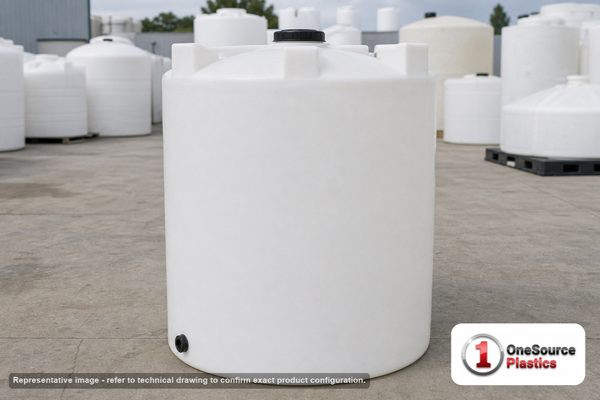
Tank Site Survey Checklist: 30 Pre-Install Considerations
The week before a tank shows up on a freight truck is the wrong time to discover the offload route is too narrow, the foundation pad isn't level, the local code requires permits you didn't pull, or the secondary containment dike isn't sized to receive the tank you ordered. The site survey is the cheapest hour you'll spend on a tank install and the most expensive one you'll skip. This pillar walks the 30 items every commercial-scale tank installation should verify before the truck leaves the manufacturer's dock.
OneSource Plastics ships polyethylene tanks from Norwesco, Snyder, Chem-Tainer, Enduraplas, and Bushman across the contiguous United States plus into Canada and Mexico. Tanks ranging from a 100-gallon Norwesco MPN 41464 to a 16,500-gallon vertical bulk water tank impose progressively heavier site demands. The survey items below are organized in the order you encounter them at the site: access, foundation, plumbing, instrumentation, regulatory, safety. Use this as a punch-list before placing the order, not after delivery.
Section A: Access and Logistics (Items 1-7)
1. Truck Access Path Width and Turning Radius
Standard tractor-trailer freight requires 60-65 feet of straight-line approach, 12-foot minimum lane width, and a 50-foot inside-radius turning circle. Verify the entire route from public road to the offload point. Branches over the route, mailbox posts, gate posts, fence corners, and parked vehicles all become obstacles. Walk the route with a tape measure. Map any choke points narrower than 12 feet.
2. Overhead Clearance
Vertical tank shipments stand on the trailer at near-full tank height. A 2,500-gallon vertical tank rides at 11-13 feet on the trailer; a 5,000-gallon vertical at 13-15 feet. Power lines, tree branches, building eaves, and gate canopies along the route must clear the tank silhouette plus approximately 18 inches of safety margin.
3. Offload Equipment Plan
Tanks under 1,000 gallons can typically be hand-rolled or strap-lifted by 2-3 people using the manufacturer's molded lifting lugs. Tanks 1,000-3,000 gallons need a forklift or skid-steer with sufficient capacity. Tanks above 3,000 gallons need a boom truck or crane. Confirm equipment availability and operator certification before the truck arrives.
4. Driver Wait Window
LTL freight drivers work 30-60 minute offload windows. Detention charges run $75-125 per hour after the free window expires. Have your offload crew, equipment, and pad ready before the ETA, not after the truck arrives.
5. Forklift Surface Conditions
Pneumatic-tire forklifts handle gravel and packed earth; cushion-tire (warehouse) forklifts will not. Verify surface conditions match the equipment plan. Soft turf, fresh fill, and saturated mud all produce stuck-truck and stuck-forklift events that turn a 30-minute offload into a half-day recovery.
6. Onsite Storage Pad for Staging
If the foundation isn't ready when the tank arrives, plan a staging pad. Tanks left on bare ground can take soil-imprint distortion within days, and tanks left on uneven surfaces accept long-term creep deformation. Stage on flat lumber or pallets if the final pad isn't ready.
7. Notification of Permitting Authority
Many jurisdictions require notification or inspection of the install before backfill or final connection. The notification window can be 24-72 hours. Pull permits and schedule inspections before the tank ships, not on delivery day.
Section B: Foundation and Pad (Items 8-14)
8. Pad Footprint vs Tank Diameter
ASTM D1998 Section 7.2 requires the foundation pad to extend a minimum of 6 inches beyond the tank diameter on all sides. A 95-inch-diameter 2,500-gallon vertical tank needs a 108-inch-minimum pad. Larger pads are better for high-wind and seismic regions.
9. Pad Levelness
ASTM D1998 Section 7.3 requires pad level within 1/8 inch per foot. A 95-inch tank pad must be level within 1 inch corner-to-corner. Out-of-level pads produce uneven hoop stress, accelerated wall stress at the high side, and warranty exclusion if failure occurs.
10. Pad Material
- Compacted sand bed (4-6 inches over compacted subgrade): the polyethylene-tank industry standard. Sand absorbs minor settlement and conforms to the tank bottom without point loads.
- Compacted gravel (3/8-inch minus, 4-6 inches): acceptable for sub-2,500 gallon tanks; finer surface layer recommended.
- Concrete pad with sand cap: required for high-wind, seismic, or anchored installations. The concrete provides the structural anchor; the sand cap provides the bedding.
- Bare concrete: not recommended for polyethylene tanks. Concrete imperfections become point-load stress concentrators on the tank floor.
11. Drainage Around the Pad
Standing water around a tank base accelerates galvanic corrosion of metal hardware, attracts mosquitoes and rodents, and can undermine the foundation. Slope grade away from the pad at minimum 1/4 inch per foot for the first 10 feet. Provide French drain or surface swale in high-rainfall locations.
12. Frost Depth Compliance
In cold climates, the foundation must extend below the local frost depth or include frost-proof design. Frost depths range from 0 inches in gulf coast to 60+ inches in northern Minnesota and North Dakota. Check your IRC R403.1.4 frost-depth requirement; tank pads bridging frost depth heave on every freeze cycle.
13. Bearing Capacity
A 5,000-gallon water tank weighs approximately 41,650 pounds (water only) plus 800-1,500 pounds tank shell. The pad and underlying soil must support that load with safety factor. Most engineered fill at 2,000-3,000 psf bearing capacity handles tanks up to 10,000 gallons; soft, organic, or saturated soils require engineered foundation.
14. Anchor Provisions for Wind / Seismic
Empty tanks in high-wind locations float / tip. Anchor strap kits or molded-in anchor lugs (manufacturer-specific) must engage embedded anchor bolts in the concrete pad. Verify wind speed (per ASCE 7) and seismic category for your location, and engineer anchorage accordingly. Hurricane and tornado-zone installs often require professional engineer stamp.
Section C: Plumbing Tie-Ins (Items 15-21)
15. Inlet Source Identified and Sized
Where does the fill water / chemistry come from? Municipal supply line, well pump discharge, supplier truck offload, rainwater catchment, process effluent. Verify the supply pipe size, max flow rate, and any backflow-prevention requirements before sizing the tank inlet.
16. Outlet Destination Defined
Where does the liquid go? Distribution system, irrigation manifold, process feed pump, truck loading. The downstream system sets the outlet sizing and any required check-valve / pressure-regulator hardware.
17. Vent Termination Location
The atmospheric vent must terminate at the highest point of the tank with screen and weather cap. For petroleum service, a separate emergency vent is required by NFPA 30 Section 21.4.3. For indoor installations, the vent often must terminate outside the building per local mechanical code.
18. Overflow Destination
Where does overflow go? Per IPC 608.16.4, water-tank overflows require a 4-inch minimum air gap. Chemistry and petroleum overflows must terminate inside secondary containment per SPCC 40 CFR 112. Define and verify the destination before install.
19. Drain / Cleanout Access
Plan how the tank gets emptied for cleaning or end-of-life. The drain valve must terminate where waste can be collected (truck-tank manifold, sump, drum). Drain to ground is not an acceptable plan for any service except contained fresh water.
20. Pipe Support Plan
Per ASTM D1998 Section 8.4, the first pipe hanger or support must be within 18 inches of the tank shell. Verify the wall, floor, or ceiling where the supports will mount has the structural capacity for the static + dynamic pipe load.
21. Freeze Protection
In any climate where freeze is possible, identify which tank components are most freeze-vulnerable. The exterior fittings, the suction outlet (water column above), and any narrow inlet / overflow pipes freeze first. Heat-trace tape or insulation jacket is the typical mitigation; budget and schedule accordingly.
Section D: Regulatory and Permitting (Items 22-26)
22. State Tank Permit / Notification
Above-ground storage tanks (AST), underground storage tanks (UST), septic tanks, and chemical storage tanks all have state-level regulatory regimes. Most states regulate AST above 1,100 gallons (some as low as 660 or 110 gallons for petroleum). Septic tanks in every state require state or county permit before install. Verify your state requirements before purchase.
23. Local Zoning and Setback
Municipal zoning typically sets minimum setback distances from property lines, structures, and water sources. Common rules: 5-10 feet from property line, 10-50 feet from drinking-water wells, 50-100 feet from surface water for chemistry and petroleum, 100+ feet for septic absorption fields. Check both county and municipal codes.
24. SPCC Plan Requirement
Per 40 CFR 112, oil storage facilities with aggregate aboveground capacity over 1,320 gallons (or any single underground tank over 42,000 gallons) require a Spill Prevention, Control, and Countermeasure plan. Includes secondary containment, training, inspection, and recordkeeping. Adds significant install scope.
25. NSF / Drinking Water Certification
Potable water tanks require NSF/ANSI 61 certification on the tank, fittings, gaskets, and hose. Verify that all wetted components carry NSF 61 listings; a single non-NSF gasket invalidates the certification chain.
26. Stormwater and Containment Permits
Construction phase may trigger NPDES stormwater permits (over 1 acre of disturbance), and chemistry tanks always require secondary containment sized to 110% of the largest tank capacity per SPCC and most state regs. Containment design must intercept rainfall — open-top dikes accumulate water and reduce effective containment volume.
Section E: Safety and Operations (Items 27-30)
27. Fire Code Clearances
NFPA 30 specifies tank-to-property-line and tank-to-building distances based on capacity, contents flash point, and tank construction. A 1,000-gallon UL-142 diesel tank may require 5-foot setback from a building; the same tank with gasoline may require 10-25 feet. Check Table 22.4.1.1 for AST setback requirements.
28. Confined-Space Entry Plan
Any tank larger than approximately 250 gallons that requires interior maintenance is OSHA-defined confined space (29 CFR 1910.146). Entry requires written permit, atmospheric monitoring, attendant, retrieval system, and rescue plan. Establish the entry procedure during install, not after a sediment buildup forces an emergency entry.
29. Spill Response Equipment
Locate spill kits within 50 feet of the tank for chemistry and petroleum. Stock with appropriate sorbent type (universal for water-based, hydrocarbon-specific for fuel, neutralizer for caustic / acid). Verify staff is trained on the response procedure.
30. Maintenance Access
Plan routine inspection access. Top-mounted manways must be reachable by ladder without obstructions. Sight glass and gauge displays must be visible from the operator station. Drain and sample ports must be reachable from grade. A tank that requires scaffolding for routine inspection will not get inspected.
Site Survey Worksheet (Print and Use)
| # | Item | Pass / Fail | Notes / Action |
|---|---|---|---|
| 1 | Truck access width >= 12 ft, turning radius >= 50 ft | _______ | _______ |
| 2 | Overhead clear of tank height + 18 in | _______ | _______ |
| 3 | Offload equipment confirmed | _______ | _______ |
| 4 | Crew available within driver detention window | _______ | _______ |
| 5 | Forklift surface compatible (pneumatic vs cushion) | _______ | _______ |
| 6 | Staging pad ready or tank pad ready | _______ | _______ |
| 7 | Permit / inspection notification posted | _______ | _______ |
| 8 | Pad extends 6 in past tank diameter (ASTM D1998 7.2) | _______ | _______ |
| 9 | Pad level within 1/8 in per ft (ASTM D1998 7.3) | _______ | _______ |
| 10 | Pad material per spec (sand / gravel / concrete + sand cap) | _______ | _______ |
| 11 | Drainage slope >= 1/4 in / ft away from pad | _______ | _______ |
| 12 | Foundation below frost depth (IRC R403.1.4) | _______ | _______ |
| 13 | Bearing capacity > (full tank weight / pad area) × FoS | _______ | _______ |
| 14 | Anchor plan per ASCE 7 wind / seismic | _______ | _______ |
| 15 | Inlet source identified, sized, backflow plan | _______ | _______ |
| 16 | Outlet destination defined | _______ | _______ |
| 17 | Vent terminates at highest point + weather cap | _______ | _______ |
| 18 | Overflow destination defined and code-compliant | _______ | _______ |
| 19 | Drain / cleanout access plan | _______ | _______ |
| 20 | First pipe support within 18 in of shell (ASTM D1998 8.4) | _______ | _______ |
| 21 | Freeze protection plan (heat trace / insulation) | _______ | _______ |
| 22 | State AST / UST / septic permit pulled | _______ | _______ |
| 23 | Local zoning setback verified | _______ | _______ |
| 24 | SPCC plan in place if > 1,320 gal aggregate oil | _______ | _______ |
| 25 | NSF/ANSI 61 chain verified for potable | _______ | _______ |
| 26 | Stormwater / containment per SPCC and state | _______ | _______ |
| 27 | NFPA 30 Table 22.4.1.1 setback verified | _______ | _______ |
| 28 | Confined-space entry plan (29 CFR 1910.146) | _______ | _______ |
| 29 | Spill kit located within 50 ft | _______ | _______ |
| 30 | Maintenance access without scaffolding | _______ | _______ |
Common Site-Survey Failures
Failure 1: Skipping the access route walk
The most common pre-install miss. The buyer assumes the truck can deliver because "trucks have been here before." The 53-foot tractor-trailer that delivered standard pallets is a different vehicle profile from a flatbed carrying a 13-foot-tall vertical tank. Always re-walk the route for the specific tank dimensions.
Failure 2: Out-of-level pad accepted
Visual inspection misses 1/2 inch deflection over 8 feet that becomes a warranty exclusion when the tank cracks at year 7. Use a contractor-grade laser level or surveyor's transit, not a 4-foot bubble level.
Failure 3: Underground utility unmarked before pad excavation
Call 811 (or the local one-call equivalent) at minimum 48 hours before any excavation. Strikes on gas, electric, telecom, or water lines turn a tank install into a multi-week catastrophe.
Failure 4: SPCC threshold crossed without recognition
An operator with a 1,000-gallon waste-oil tank, a 500-gallon diesel tank, and three 50-gallon hydraulic-oil drums has 1,650 aggregate gallons of oil — over the 1,320-gallon SPCC threshold. The new tank purchase tips the calculation. EPA inspection on a non-compliant facility runs $25,000-50,000+ in fines.
Failure 5: NFPA 30 setback not verified before pad pour
A diesel tank installed 4 feet from a building when code requires 5 feet means the tank moves or the building moves. Tank usually loses. Verify setbacks before pouring the pad.
Failure 6: Foundation below frost depth ignored
Frost heave in northern climates lifts shallow pads several inches per freeze cycle. The pad cracks, the tank goes out of level, the warranty is void. Cheap to design correctly; expensive to retrofit.
Failure 7: Anchor strap kit not ordered with the tank
High-wind locations need anchor kits that are tank-specific. Ordering after delivery means the install schedule slips. Order anchor kits with the tank if your wind exposure is significant.
Failure 8: Pipe support assumed instead of designed
The contractor "knows what to do" until you watch eight feet of full PVC line bow off the tank fitting. Specify pipe support drawings before the install crew arrives.
Survey Timeline
- 4-6 weeks before delivery: Site survey items 1-14 complete. Permits pulled. Pad design approved. Anchor kits ordered if needed.
- 2-3 weeks before delivery: Pad poured and cured. Drainage verified. Inlet / outlet / vent / overflow rough-in installed.
- 1 week before delivery: Final inspection of pad level. Offload equipment confirmed. Crew scheduled. Spill kits and PPE staged.
- Delivery day: Crew on site 30 min before ETA. Forklift / crane / dolly staged. Driver greeted at gate.
- 1-2 days after delivery: Plumbing connections complete. Hydrostatic test on water before chemistry transfer. Final permit inspection.
Internal Resources
- Foundation Pad Engineering
- Hurricane & Tornado Tank Tiedown
- Aboveground vs Belowground Storage
- Tank Plumbing System Design
- Lead Time and Logistics
- SPCC Compliance Audit Checklist
- Freight Cost Estimator
Source Citations
- ASTM D1998 — Standard Specification for Polyethylene Upright Storage Tanks (Sections 7 and 8: foundation, fittings)
- ASCE 7 — Minimum Design Loads and Associated Criteria for Buildings and Other Structures (wind / seismic)
- IRC R403.1.4 — International Residential Code, frost depth provisions
- NFPA 30 — Flammable and Combustible Liquids Code (Table 22.4.1.1: AST setback)
- NFPA 30 Section 21.4.3 — Emergency Relief Venting
- 40 CFR 112 — Spill Prevention, Control, and Countermeasure (SPCC) Rule
- 29 CFR 1910.146 — Permit-Required Confined Spaces
- NSF/ANSI 61 — Drinking Water System Components
- IPC 608 — International Plumbing Code, Backflow Prevention
- OneSource Plastics master catalog data, dated 2026-03-26 snapshot (9,419 products)
Recommended Tanks for This Guide
Live pricing, updated automatically · estimate freight to your ZIP.