Refurbishing Existing FRP Storage Tanks: Structural Assessment Methodology, Relining and Recoating Decision Logic, and the Honest Cost-Per-Year Math That Says Replace With Polyethylene Instead
Fiberglass-reinforced plastic (FRP) tanks were the dominant chemical-storage material from roughly 1965 through the early 2000s, and a large installed base remains in service today. The owner of a 25-year-old FRP tank that is showing visible weathering, fiber bloom, or minor weep at a fitting almost always asks the same question: do I refurbish, or do I replace? The honest answer requires a structural assessment first, a defensible refurbishment scope second, and a 10-year cost-per-year calculation third. This article walks the methodology — the inspection regime that diagnoses an FRP tank's remaining service life, the relining and recoating options that can extend it, and the polyethylene-replacement decision logic that often turns out to be the lower-cost path despite the higher up-front capital.
The references cited are ASTM D3299 (filament-wound FRP tank standard), ASTM D4097 (contact-molded FRP tank standard), ASTM E165 (liquid penetrant inspection), ASTM D2583 (Barcol hardness testing of FRP), ASME RTP-1 (reinforced thermoset plastic vessels), the FRP manufacturer recommended practice documents from CPMC and the Composites Institute, and ASTM D1998 for the polyethylene replacement comparison. The intent is the field-operations decision, not the laboratory composites-engineering treatment.
1. The FRP Failure Modes That Drive the Refurbishment Question
FRP tanks fail in characteristic ways that are different from polyethylene tanks. Understanding the failure-mode landscape determines what an inspection should be looking for and what a refurbishment can actually fix:
- Fiber bloom (UV and chemical weathering of the resin matrix). The exposed glass fibers become visible at the tank surface as the resin oxidizes and erodes away. Fiber bloom is cosmetic until it is not — once the fibers are exposed, the chemical attacks the fiber-resin interface and structural integrity decays rapidly. Fiber bloom on an outdoor tank that is more than 15 years old is the primary indicator that recoating is overdue.
- Liner blistering and delamination. Internal liner failure shows as raised blisters, soft spots, or visible delamination of the corrosion barrier. Once the liner is breached, the chemical attacks the structural laminate beneath, and the tank's pressure rating drops. Liner failure is usually relinable if caught early.
- Stress crazing in the structural laminate. Hairline cracks visible on the outer surface of the tank, often radiating from fittings or stress concentrations. Crazing indicates the laminate is approaching its fatigue limit. Crazing on a 25-year-old tank is end-of-life; crazing on a 10-year-old tank suggests the original design was undersized for the actual service.
- Bottom-knuckle cracking. The transition between vertical sidewall and bottom slab is the highest-stress region of the tank. Cracking at the bottom knuckle is a structural failure indicator; relining cannot fix it because the underlying laminate has lost load-bearing capacity.
- Fitting-area resin loss. Around bulkhead penetrations and welded inlets, resin erosion or pinhole leakage is common. Fitting-area repair is possible with a localized recoating campaign but the inspection must verify the laminate behind the fitting has not been compromised.
- Catastrophic structural failure. A bottom seam separation or a wall blowout is the worst-case outcome. The FRP tank that fails this way usually showed warning signs (crazing, weep, bottom-knuckle distress) for years before the catastrophic event. Refurbishment is not on the table; the tank is gone.
The inspection scope therefore must cover: the outer-surface condition for fiber bloom and crazing, the liner condition for blistering and delamination, the bottom knuckle for structural cracking, the fittings for resin loss and weep, and the laminate thickness for residual structural capacity.
2. The Structural Assessment Inspection Regime
A defensible refurbishment decision requires a documented assessment, not a walk-around. The standard inspection sequence:
Visual external (Stage 1). Photographic survey of every tank surface — sidewall, top, bottom, fittings, manways, vents. Documenting fiber bloom area percentage, crazing length and density, fitting weep, and any structural concerns. The output is a tank-condition map with severity scoring.
Barcol hardness testing (Stage 2). ASTM D2583. A Barcol impressor measures the resin matrix hardness at multiple points around the tank. New FRP reads 35-45 Barcol; aged or degraded FRP reads 25-30; chemically attacked FRP reads under 20. Barcol mapping identifies the regions where the resin matrix has softened and refurbishment is most urgent. A tank with overall Barcol below 25 is approaching its end of structural life.
Wall-thickness measurement (Stage 3). Ultrasonic thickness gauging at a defined grid of points around the tank. Original wall thickness is on the manufacturer drawing; current readings show how much material has been lost to chemical attack and weathering. A 15-percent thickness loss is a refurbishment trigger; a 30-percent thickness loss is a replacement trigger.
Internal liner inspection (Stage 4). Tank empty, ventilated, confined-space-entry permitted per OSHA 1910.146. Visual inspection of the corrosion barrier for blisters, delamination, soft spots, and fiber exposure. Acetone wipe test on suspect areas; a reactive resin will swell or soften on acetone contact, indicating chemical attack.
Spark testing on the liner (Stage 5). A high-voltage spark tester (10-15 kV) traverses the liner surface. Any pinhole or breach in the corrosion barrier sparks to the underlying laminate, locating defects that visual inspection missed. This is the most sensitive test for liner integrity.
Liquid penetrant inspection at fittings (Stage 6). ASTM E165. Dye penetrant applied to the laminate around each fitting, allowed to dwell, then wiped off and developer applied. Cracks pull penetrant from the surface and become visible. This catches stress cracks at fittings before they become weeping leaks.
The assessment output is a written report with photographic documentation, Barcol map, thickness map, and a remaining-service-life estimate. A tank with no Stage 5 spark indications and overall Barcol above 30 is a refurbishment candidate. A tank with multiple spark indications, Barcol below 25, or significant thickness loss is a replacement candidate.
3. Refurbishment Option A: Recoating the Exterior
Exterior recoating addresses fiber bloom and surface weathering without touching the structural laminate. The standard procedure:
- Surface preparation. Pressure wash to remove debris and loose fibers. Light sanding to scuff the existing surface and remove oxidized resin. Solvent wipe to clean.
- Resin selection. The recoat resin must match the original laminate chemistry — vinyl ester recoat over vinyl ester laminate, isophthalic polyester recoat over isophthalic. A mismatch creates a delamination risk because the new layer does not bond to the old laminate.
- Application. Roller or spray application of the recoat resin, typically 15-25 mils dry film thickness. UV-resistant pigment incorporated into the recoat resin. Two coats typical.
- Cure verification. Barcol hardness testing on the recoat surface 7-14 days after application. A correctly cured recoat reads 35-40 Barcol.
Exterior recoating extends the tank's UV-exposure life by 8-15 years depending on the resin system and the local UV intensity. The recoat does not address internal chemistry attack or structural laminate fatigue. Cost per square foot of tank surface area is roughly $4-12 depending on access and resin system.
4. Refurbishment Option B: Internal Liner Repair or Full Reline
Internal liner work is the more involved refurbishment. Two scope variants:
Localized liner patching. When spark testing identifies discrete defects (typically a half-dozen or fewer pinholes), each defect is ground out, the surrounding laminate inspected for chemical attack, and a patch laminate applied with the original liner resin chemistry. Cure-time and Barcol verification follows. Patching is appropriate when the bulk of the liner is sound and only isolated defects exist.
Full reline. When the liner shows widespread blistering, delamination, or chemical attack, the entire corrosion barrier is removed (mechanical grinding, hand sanding, or in some cases sandblasting). The exposed structural laminate is inspected for chemical penetration. A new corrosion barrier is then applied — typically a chemical veil layer of resin-rich glass mat, followed by 100 mils or more of corrosion-resistant resin. Cure and Barcol verification at each layer.
Full reline is the most expensive single-tank refurbishment, often $25-80 per square foot depending on resin system, layer count, and access. For a 5,000-gallon vertical FRP tank with roughly 800 square feet of internal surface, a full reline runs $20,000-65,000. The reline restores the tank's chemical service rating and extends life by 10-20 years if the structural laminate behind the liner is sound.
The decision between localized patching and full reline depends on the spark-test result density. A tank with 1-3 discrete defects per 100 square feet is patchable; a tank with widespread defect density or any visible delamination is a full-reline candidate.
5. Refurbishment Option C: Structural Laminate Wrap
When the structural laminate itself shows distress — crazing, thickness loss, bottom-knuckle cracking — exterior wrapping with an additional structural laminate may extend service life. The procedure adds 2-6 layers of fiberglass mat and roving wet out with structural resin to the tank exterior, increasing wall thickness and restoring section modulus.
Structural wrap is technically possible but rarely economical on a tank that has already shown laminate distress. The reasons:
- Tank-to-laminate bonding requires aggressive surface preparation that may further damage the existing tank.
- The added wrap weight increases the foundation load; the existing pad may not accept it.
- The tank's manufacturer is no longer responsible for performance, eliminating warranty coverage for the entire assembly.
- The cost of structural wrap on a 5,000-gallon tank often runs $30,000-60,000, rivaling replacement cost.
- The remaining service life of a wrapped tank is uncertain; the underlying laminate is still aging while the wrap stops further degradation only at the surface.
Structural wrap is appropriate in narrow circumstances: a critical-availability asset that cannot be taken out of service for replacement, or a tank in a location where replacement requires a major site disturbance. Outside those cases, structural laminate distress is the cue to plan replacement, not wrap.
6. The Honest Cost-Per-Year Math
The replace-vs-refurbish decision hinges on cost per year of remaining service. Worked example: a 5,000-gallon FRP vertical tank, 22 years old, in sodium hypochlorite service, showing fiber bloom over 60 percent of exterior, Barcol mapping at 28-32 average, four small liner defects on spark test, no bottom-knuckle distress. The decision matrix:
- Refurbishment Option A (exterior recoat only): $8,000-12,000. Adds 8-12 years of UV-exposure life. Liner defects unaddressed; chemical service-life remains a question.
- Refurbishment Option B (recoat plus liner patching): $14,000-22,000. Adds 8-12 years of UV-exposure life and addresses the four spark-test defects. Tank stays in service 10-15 years if the structural laminate holds.
- Refurbishment Option C (recoat plus full reline): $35,000-75,000. Restores chemical service rating to near-new. Tank life extended 15-20 years.
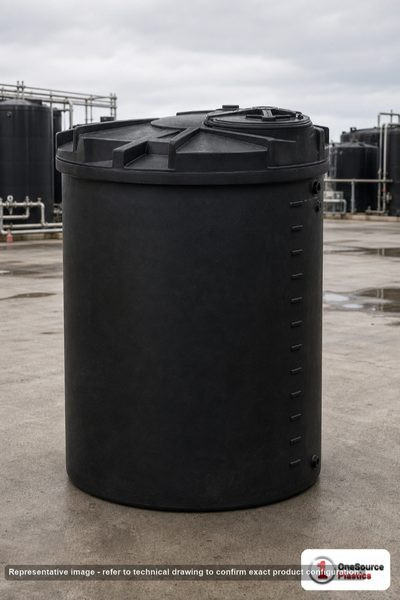
- Replacement (new XLPE polyethylene tank, 5,000 gallon): $9,000-14,000 list-price plus freight to ZIP, plus install labor of $3,000-6,000. Tank life 30+ years per ASTM D1998 service-life methodology.
The cost per year of remaining service:
- Option A: $1,000/year over 10 years.
- Option B: $1,600/year over 12 years.
- Option C: $4,000/year over 17 years.
- Replacement with polyethylene: $700/year over 30 years (allowing for $20,000 total cost amortized).
The polyethylene replacement is the lowest cost-per-year in nearly every scenario where the FRP tank shows any structural distress beyond surface fiber bloom. Refurbishment Option A makes economic sense when the tank is structurally sound and only cosmetic UV protection is needed. Options B and C are usually justified only when replacement is operationally infeasible, not when it is simply higher capital cost.
7. Polyethylene Replacement Tank Selection
When the math points to replacement, the polyethylene tank selection follows the chemistry-and-volume requirements of the original FRP service:
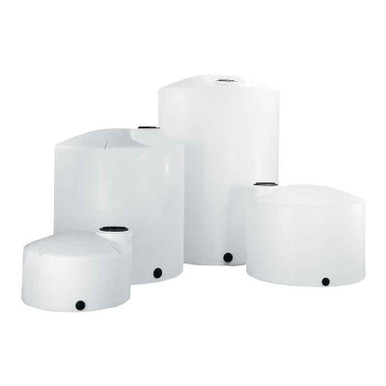
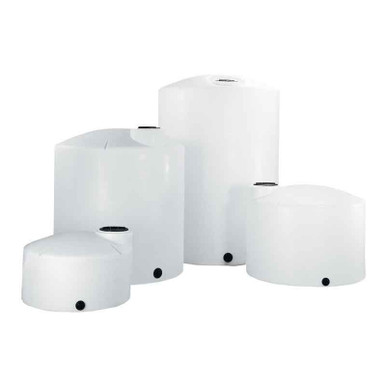
- Norwesco vertical bulk: for general chemical and water-treatment storage in the 1,500-10,000 gallon range. Reference N-40164 5,000 gallon as the direct mid-range replacement and N-43128 10,000 gallon for larger industrial-scale. Both are XLPE for the chemistry-resistance margin that FRP traditionally provided.
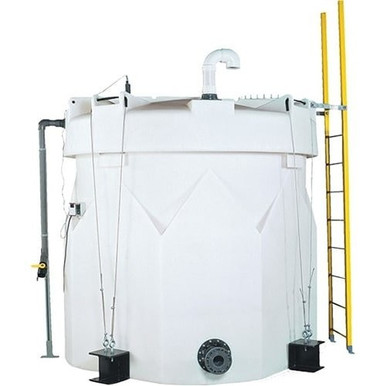
- Snyder Captor double-wall: when the original FRP tank was the secondary-containment compliance vessel for a hazardous chemical, the polyethylene replacement is a double-wall tank that consolidates primary tank and containment. Reference SII-5990102N42 1,000 gallon and SII-5490000N42 1,550 gallon Captor Plus units.
- Norwesco cone-bottom: when the FRP tank was a process or solids-handling vessel that needed full drainage. Reference N-43852 1,000 gallon 45-degree cone; the cone geometry handles solids-laden chemistries that flat-bottom FRP tanks struggled with.
The polyethylene replacement carries an ASTM D1998 service-life expectation of 25-30 years in chemistry-appropriate service, a manufacturer warranty of 3-5 years, and a chemical-resistance envelope that overlaps most chemistries that FRP previously served (with the exception of strong oxidizers above 50 percent concentration and certain halogenated solvents).
8. The Refurbishment Decision Framework
Pulling the assessment, refurbishment options, and cost analysis together into a decision framework:
- FRP tank under 15 years old, no structural distress, fiber bloom only: exterior recoat (Option A). Continue normal service.
- FRP tank 15-20 years old, minor liner defects on spark test, no structural distress: recoat plus liner patching (Option B). Re-inspect at 5-year cadence.
- FRP tank 15-20 years old, widespread liner defects but sound structural laminate: recoat plus full reline (Option C). Re-inspect at 5-year cadence.
- FRP tank over 20 years old, any structural laminate distress (crazing, thickness loss, bottom-knuckle cracking): replace with polyethylene. Refurbishment economics do not work.
- FRP tank with chemistry change in service: replace with polyethylene matched to new chemistry, regardless of age. Original FRP resin chemistry was matched to original service; chemistry change voids the original specification.
- FRP tank with no manufacturer drawings or service history: assessment cost is high relative to value; default to replacement unless tank is structurally young.
The framework rewards honest inspection and penalizes deferred maintenance. An owner who runs a 5-year inspection cadence and addresses defects when they are still small typically gets 30+ years of FRP service. An owner who defers inspection until visible weep or structural distress appears typically gets 18-22 years and then faces a replacement decision in unplanned circumstances.
9. Documentation and Record-Keeping
The inspection and refurbishment record is the foundation of future decisions on the same tank. The minimum documentation set:
- Original tank manufacturer specification, drawings, and material data sheet (preserved for the life of the tank).
- Inspection reports from each assessment campaign, dated and signed by the inspector with credentials.
- Barcol hardness maps and ultrasonic thickness maps with each inspection, allowing trend analysis.
- Spark-test result density per inspection, with locations of defects and disposition (patched, monitored, or driving full reline).
- Refurbishment work records — surface preparation methodology, resin batch numbers, application thickness, cure verification, post-application Barcol.
- Service history — chemistry, concentration, temperature range, pressure cycles. Service log changes that may have stressed the tank beyond original design.
This documentation set supports the next-cycle refurbishment-vs-replacement decision and meets the inspection-record requirements of insurance carriers, AHJs, and (for hazardous-material service) RCRA and SPCC compliance frameworks.
10. The Honest Conclusion
FRP tank refurbishment is a real engineering option with a real economic envelope, but the envelope is narrower than the FRP-refurbishment industry sometimes implies. A tank that is structurally sound and shows only surface UV degradation is a good recoat candidate. A tank that shows liner defects but no structural distress is a candidate for relining. A tank that shows structural laminate distress is a replacement candidate, full stop, and the polyethylene replacement usually wins on cost-per-year despite the higher up-front capital because polyethylene service life is materially longer than refurbished FRP service life.
OneSource Plastics ships polyethylene replacement tanks across all 5 brands — Norwesco, Snyder, Chem-Tainer, Enduraplas, Bushman — with chemistry-matched material selection (HDPE or XLPE) and full ASTM D1998 specification compliance. Our engineering team supports the FRP-replacement transition including chemistry compatibility review, foundation load analysis (polyethylene tanks are typically lighter empty than FRP, often allowing the existing pad), and freight-to-site quoting. List pricing by SKU is published on each product page; LTL freight to your ZIP is quoted separately via the freight estimator or by phone at 866-418-1777. For related material-selection content see polyethylene vs fiberglass material comparison and replace vs reline decision tree.
Recommended Tanks for This Guide
Live pricing, updated automatically · estimate freight to your ZIP.