Tank Heater Element Sizing: 5kW vs 10kW vs 25kW for Frost Protection vs Process Heat
Heater sizing on a polyethylene, FRP, or steel tank is a math problem and a code problem at the same time. Get the math wrong and you over-pay every winter on electricity for the life of the asset. Get the code wrong and you scorch the polyethylene shell at the immersion-heater interface or trip GFCI on every cold-snap. This pillar walks the explicit kW sizing math for three duties — frost protection, process maintenance, and process heat-up — against tank sizes from 500 to 12,000 gallons, and lays out the heater hardware decision tree (immersion electric vs heat-trace cable vs jacketed steam vs glycol loop) with real Norwesco, Snyder, Chem-Tainer, Enduraplas, and Bushman SKUs from the OneSource catalog.
Reference standards in this guide: ASTM D1998 Section 7 (polyethylene tank service-temperature limits), ASHRAE Fundamentals Chapter 26 (heat transfer through tank walls), ASHRAE 90.1 Section 6.4 (insulation requirements for industrial-process heating), NEC Article 427 (fixed electric heating equipment for pipelines and vessels), NEC Article 426 (fixed outdoor electric deicing and snow-melting equipment), NSF/ANSI 61 (potable contact for immersion elements), NFPA 70 hazardous-location requirements when heaters drive in classified areas, and IEEE C57.96 for transformer thermal aging when the heater load is significant fraction of site electrical service. Polyethylene tanks have a hard service-temperature ceiling (manufacturer-rated; typically 100°F continuous, 140°F intermittent for HDPE; 120°F continuous, 150°F intermittent for XLPE) and exceeding the limit destroys the tank.
Three Heater Duties — Pick the Right One Before Sizing
- Frost protection (winter freeze prevention): hold the tank contents above approximately 35–40°F so it never freezes. Lowest kW. Standard for water tanks, agricultural sprayer storage, exterior fuel tanks, fire-suppression reserves.
- Process maintenance (steady-state at elevated temperature): hold the tank contents at a process setpoint (e.g., 80°F for polymer make-down, 100°F for biodiesel feedstock, 120°F for asphalt emulsion). Mid-range kW. Standard for chemistry processing, food-grade applications.
- Process heat-up (batch warm-up from cold to setpoint): heat the tank from ambient to setpoint within a target time. Highest kW. Required when the duty cycle is batch (heat, dose, drain, refill, repeat) rather than continuous.
The three duties have very different math. Sizing a frost-protection heater for batch heat-up duty leaves you 8× under-sized; sizing a heat-up heater for frost protection wastes 8× the capital cost. Pick the duty first.
Frost Protection Sizing Math
Frost protection is a steady-state heat-loss calculation. The required heat input equals the conductive heat loss through the tank wall plus radiative and convective surface losses. ASHRAE Fundamentals Chapter 26 gives the standard formulation:
Q = U × A × ΔT
where Q is heat loss (BTU/hr or watts), U is overall heat-transfer coefficient (BTU/hr·ft²·°F or W/m²·°C), A is tank surface area exposed to ambient, and ΔT is the temperature difference between tank contents setpoint and design winter low.
U-values (typical)
| Tank Wall Configuration | U (BTU/hr·ft²·°F) | Notes |
|---|---|---|
| Bare polyethylene (1/2 inch wall) | 1.0–1.4 | No insulation, exposed to wind |
| Bare steel (3/16 inch wall) | 1.5–2.0 | Highest baseline loss |
| 2-inch foam-board insulation | 0.10–0.13 | R-value approximately 8 |
| 3-inch sprayed polyurethane | 0.06–0.08 | R-value approximately 13 |
| 4-inch insulation jacket with weather skin | 0.04–0.06 | R-value 16+ |
Worked example: 1,500 gallon Norwesco bare polyethylene tank in Minneapolis
Norwesco MPN 43854 (1,500 gal 45-degree cone-bottom) has approximately 100 ft² exposed surface area. Minneapolis design winter low is 0°F. Setpoint 40°F. ΔT = 40°F. U = 1.2 BTU/hr·ft²·°F (bare polyethylene with wind).
Q = 1.2 × 100 × 40 = 4,800 BTU/hr = 1,407 watts = approximately 1.5 kW.
Round up for safety factor (1.25×) and intermittent wind gusts: 2 kW heater rated for the duty. A 5 kW heater would work but is over-specified by 2.5×; a 1 kW heater would fall behind on the coldest nights and lose temperature.
Same tank with 3-inch sprayed insulation jacket
U drops to 0.07; Q = 0.07 × 100 × 40 = 280 BTU/hr = 82 watts = 0.08 kW. With 1.25× safety factor, a single 250-watt heat-trace cable would maintain frost protection, and the energy cost drops by 95%. Insulation pays back the heater capital and energy difference in 1–2 winters. See Heat Trace + Insulation Cost-Benefit by Climate Zone for the full economic analysis.
Process Maintenance Sizing Math
Process maintenance is the same Q = U × A × ΔT equation but with higher ΔT. Holding a tank at 100°F when ambient is 0°F has ΔT = 100°F — 2.5× the frost-protection load.
Worked example: 2,500 gallon Snyder bleach tank held at 70°F in process plant
Snyder MPN 5580000N52 (2,500 gallon Sodium Hypochlorite UV Captor double-wall) has approximately 130 ft² surface area. Indoor process plant ambient 50°F (cool warehouse). Setpoint 70°F (sodium hypochlorite stability and dosing-pump viscosity). ΔT = 20°F. Tank has factory double-wall construction; effective U on the outer wall approximately 0.5 (still air, no insulation).
Q = 0.5 × 130 × 20 = 1,300 BTU/hr = 381 watts. With 1.5× safety factor and dosing-pump heat addition: 1.5 kW heater. Specifying 5 kW or 10 kW for this duty is wasteful. See Sodium Hypochlorite Storage for the full bleach-tank specification.
Process Heat-Up Sizing Math
Heat-up is a sensible-heat calculation: the energy required to raise the tank contents from ambient to setpoint, divided by the target time.
Q = (m × cp × ΔT) / t + Qloss
where m is fluid mass (lb), cp is specific heat (BTU/lb·°F), ΔT is temperature rise, and t is target time (hours). Qloss is the steady-state loss at setpoint (calculated as in the maintenance section).
Worked example: 1,000 gallon Norwesco tank, water, 60°F to 100°F in 4 hours
Mass: 1,000 gal × 8.34 lb/gal = 8,340 lb. cp water = 1.0 BTU/lb·°F. ΔT = 40°F. t = 4 hr.
Sensible heat: (8,340 × 1.0 × 40) / 4 = 83,400 BTU/hr = 24,440 watts = approximately 24 kW.
Add steady-state loss at setpoint (100 ft², indoor 60°F ambient, U = 1.0): Qloss = 1.0 × 100 × 40 = 4,000 BTU/hr = 1,170 watts = approximately 1.2 kW.
Total: 25 kW heater for this duty. The published 25 kW size class fits.
Same tank, 8-hour heat-up window
Doubling the time halves the sensible-heat term: 12 kW + 1.2 kW = approximately 13 kW. Round to 10 kW heater with extended heat-up window. Halving the kW drops capital cost approximately 30–40% and lets the heater run on a smaller electrical service.
The 5kW vs 10kW vs 25kW Decision Matrix
| Tank Size | Frost Protection (insulated) | Frost Protection (bare) | Maintenance (process ΔT 20°F) | Heat-Up (8 hr, ΔT 40°F) |
|---|---|---|---|---|
| 500 gal | 0.25 kW | 1.5 kW | 1 kW | 5 kW |
| 1,000 gal | 0.5 kW | 2 kW | 1.5 kW | 10 kW |
| 1,500 gal | 0.5 kW | 2 kW | 2 kW | 15 kW |
| 2,500 gal | 1 kW | 3 kW | 3 kW | 25 kW |
| 5,000 gal | 2 kW | 5 kW | 5 kW | 50 kW (engineered) |
| 12,000 gal | 5 kW | 12 kW | 10 kW | 100 kW+ (engineered) |
Real OneSource catalog tanks at each size: Snyder MPN 32419 (60 gal mix tank), Norwesco MPN 41484 (300 gal cone-bottom), Snyder MPN 32101 (150 gal cone-bottom), Norwesco MPN 43852 (1,000 gal cone-bottom), Norwesco MPN 43854 (1,500 gal cone-bottom), Snyder MPN 5580000N52 (2,500 gal sodium hypochlorite double-wall). Heater hardware is sized to match.
Heater Hardware Decision Tree
1. Immersion electric heater
- Construction: sheathed resistance element bolted through a flange or bulkhead into the tank, fully submerged in the fluid.
- Watt density: the kW per square inch of element surface drives whether the polyethylene shell can survive. ASTM D1998 plus manufacturer data limit watt density on poly tanks to approximately 12–15 W/in² with thermostatic control. Above that, the fluid film at the element scorches the polyethylene at the bulkhead interface.
- Element materials: Incoloy 800 for water and mild chemistry; titanium for sodium hypochlorite, seawater, and chloride service; PTFE-coated stainless for aggressive acids.
- Code: NEC Article 427 governs immersion heater installation. NSF/ANSI 61 listing required for potable contact.
- Polyethylene tank rule: never specify an immersion heater above the tank's manufacturer-rated continuous service temperature. The fluid temperature at the element is higher than the bulk fluid temperature; specify with margin.
2. External heat-trace cable
- Construction: self-regulating or constant-wattage electric cable wrapped around the tank exterior under insulation jacket.
- Watt output: 3–15 W/ft typical; sized to match the heat-loss calculation. Cable spacing and wraps determined by manufacturer engineering.
- Best fit: frost protection on small to mid-sized tanks. Excellent on Norwesco / Snyder cone-bottom or vertical tanks where penetrations are minimized.
- Code: NEC Article 427.6 covers heat-trace cable; GFCI protection required.
- Advantage: no penetration of the tank wall; chemistry-isolation maintained; potable-contact issue avoided.
3. Steam jacket / steam coil
- Construction: steel tank with welded steam jacket on outer wall, OR internal coil. Polyethylene tanks cannot be steam-heated above 140°F intermittent / 100°F continuous; XLPE 150°F / 120°F.
- Best fit: high-throughput process heat where utility steam is already on-site (food processing, biodiesel, asphalt emulsion).
- Code: ASME Section VIII for jacketed pressure vessels; B31.1 for steam piping.
- Tank platform: typically requires fabrication of stainless or carbon-steel vessel; refer to Certified Steel Tanks.
4. Glycol loop with external heat exchanger
- Construction: closed glycol loop with external boiler / heat-exchanger; tank-side coil or internal pumped glycol element.
- Best fit: when the chemistry forbids direct electric immersion (e.g., flammable solvents); heat trace would not deliver enough kW; and the site has heat-source flexibility.
- Code: ASME B31.3 process piping; NFPA 70 for the boiler / heat-source electrical.
Watt Density: The Polyethylene Killer
Watt density is the load on the heater element surface, expressed as watts per square inch of element. ASTM D1998 and manufacturer data limit immersion-heater watt density on polyethylene tanks because the fluid boundary layer at the element runs hotter than the bulk fluid. Exceed the limit and the polyethylene wall around the element bulkhead softens, deforms, and eventually cracks.
| Service | Max Watt Density (W/in²) | Notes |
|---|---|---|
| Clean water in poly tank | 12–15 | Standard limit |
| Light chemistry / dilute | 8–10 | Reduce for boundary-layer heating |
| Viscous fluid / glycol / oil | 5–8 | Lower convective coefficient |
| Sludge / settleable solids | 3–5 | Risk of fouling on element |
If the kW you need divided by element surface area exceeds the watt-density limit, you need a longer or larger element — or you need to switch to external heat-trace, steam jacket, or glycol loop on a steel or FRP vessel.
Electrical Service Sizing
- Single-phase 240V: standard for heaters up to approximately 12 kW (50A circuit).
- Three-phase 208V or 480V: required for heaters above 12 kW. 25 kW at 480V is approximately 30A per phase.
- NEC 427.4: heater branch circuit must be sized at 125% of the heater nameplate amperage.
- Disconnect: NEC 427.55 requires within sight of the heater.
- GFCI / GFEP: required per NEC 427.22 on most installations.
- Hazardous location: Class I Div 1 / Div 2 heaters cost 3–5× standard. Always verify area classification before specifying.
Insulation: The Multiplier
Per ASHRAE 90.1 Section 6.4, industrial-process heated tanks above approximately 105°F require insulation. Beyond code, the economic case for insulation on any heated tank operating below freezing is overwhelming. A 3-inch sprayed polyurethane jacket (R-13) cuts the heat-loss term by 90%. The heater can drop one to two size classes (e.g., from 5 kW to 1 kW for frost protection on a 1,500-gallon tank), the energy bill drops by the same fraction, and the capital cost premium for insulation pays back inside two winters in zone 5+ climates. See Cold-Climate Tank Insulation and Heat Tracing for the full pillar.
Pricing Doctrine
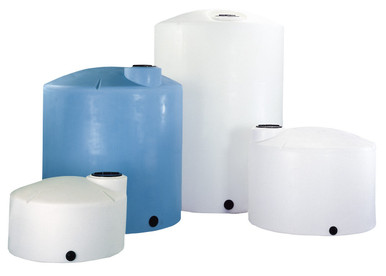
OneSource Plastics provides the heated-tank platform: cone-bottom mixing tanks, vertical chemical-feed tanks, and double-wall containment vessels. Real catalog SKUs cited in this pillar include Snyder MPN 32419 (60 gal mix), MPN 32101 (150 gal mix), MPN 5580000N52 (2,500 gal bleach double-wall), Norwesco MPN 41484 (300 gal cone-bottom), MPN 43852 (1,000 gal cone-bottom), MPN 43854 (1,500 gal cone-bottom). Tank platforms are listed at $2,496.36 before freight. Heater hardware (immersion elements, heat-trace cable, controls) is quoted per project. Freight quoted separately per ZIP via the Freight Cost Estimator or by phone.
Common Heater Sizing Errors
Error 1: Specifying for batch heat-up when duty is frost-protection
The tank only needs to hold setpoint, not heat from cold every cycle. A 25 kW heater for a 1,500-gallon water tank in frost-protection duty is 12× over-specified.
Error 2: Specifying for frost protection when duty is batch heat-up
The reverse error. A 2 kW heater on a 1,000-gallon batch heat-up duty falls behind production schedule on every cold winter morning.
Error 3: Skipping insulation on a heated tank
Doubles to triples the heat-loss term. The energy waste is permanent for the life of the asset.
Error 4: Watt density above ASTM D1998 limit on polyethylene
Scorches the polyethylene at the element interface. Specify a longer or lower-density element, or switch to external heat-trace.
Error 5: Wrong element material for the chemistry
Stainless 304 element in sodium hypochlorite pits and fails inside 90 days. Titanium or PTFE-coated. See Sodium Hypochlorite Storage.
Error 6: Missing thermostatic control or high-limit cutout
Single-element heater on a polyethylene tank with no backup cutout will run runaway if the thermostat fails closed. Always specify dual control: operating thermostat plus high-limit cutout per NEC Article 427.
Error 7: Underspecified electrical service
25 kW heater on a 100A panel will trip whenever the heater coincidence fires with other site loads. Calculate site coincident load before the heater install.
Error 8: Hazardous-location class mismatch
Standard heater specified for an ethanol storage room (Class I Div 2) creates an ignition source. Always verify NEC Article 500 area classification first.
Internal Resources
- Heat Trace + Insulation Cost-Benefit by Climate Zone
- Cold-Climate Insulation Engineering
- Tank Plumbing System Design
- Sodium Hypochlorite Storage
- Ethylene Glycol Storage
- Certified Steel Tanks
- Freight Cost Estimator
Source Citations
- ASTM D1998 Section 7 — Polyethylene Upright Storage Tanks: Service Temperature Limits
- ASHRAE Fundamentals Handbook Chapter 26 — Heat, Air, and Moisture Control in Building Assemblies
- ASHRAE 90.1 Section 6.4 — Energy Standard for Buildings: HVAC and Service Water Heating
- NEC NFPA 70 Article 427 — Fixed Electric Heating Equipment for Pipelines and Vessels
- NEC NFPA 70 Article 426 — Fixed Outdoor Electric Deicing and Snow-Melting Equipment
- NEC NFPA 70 Article 500 — Hazardous (Classified) Locations
- NSF/ANSI 61 — Drinking Water System Components: Health Effects
- ASME Section VIII Division 1 — Rules for Construction of Pressure Vessels (jacketed)
- ASME B31.1 — Power Piping
- ASME B31.3 — Process Piping
- IEEE C57.96 — Loading Dry-Type Distribution and Power Transformers
- OneSource Plastics master catalog data, dated 2026-03-26 snapshot (9,419 products)
Recommended Tanks for This Guide
Live pricing, updated automatically · estimate freight to your ZIP.