Tank-Mounted Instrumentation Integration: Level Transducer, Pressure, and Temperature Sensor Patterns for Polyethylene Storage Tanks
The instrumentation package on a polyethylene storage tank is the operator's window into what is happening inside the wall. Without instrumentation, the operator knows the tank's contents only at fill events, drain events, and physical inspection cycles. With a properly engineered instrumentation package, the operator has continuous visibility into liquid level, headspace pressure, internal temperature, and (depending on the chemistry) compositional or contamination indicators that drive operational decisions in real time. The hardware ranges from simple sight-tube level indicators that cost under fifty dollars to multi-loop telemetry systems with cellular reporting and historian integration. The choice of what to install is dictated by the chemistry, the operational consequence of unmonitored deviation, and the regulatory framework. This article walks the integration patterns for the four core measurements (level, pressure, temperature, level-rate) on polyethylene rotomolded tanks: the sensor types available, the mounting and connection patterns that work on polyethylene, and the data-handling architecture that converts the raw signal into operational insight.
References cited: ASTM D1998 (the polyethylene tank dimensional and mechanical specification that governs sensor mounting); the published instrumentation cut sheets from major level-transmitter manufacturers (radar, ultrasonic, pressure-based, capacitive); manufacturer guidance from Norwesco, Snyder, Enduraplas, Chem-Tainer, and Bushman on factory-installed instrumentation provisions; OSHA 1910.106 monitoring requirements for atmospheric storage; and the consolidated industry guidance on intrinsic-safety classification for instrumentation in chemical service. The numerical thresholds below are drawn from these sources; the field implications come from instrumentation deployments that captured (or missed) operational events that mattered.
1. The Four Core Measurements and Why Each Matters
Liquid level. The most consequential measurement on any storage tank. Level drives inventory accounting, fill-and-drain alarming, low-level pump protection, and overflow prevention. Level is also the most common spec-out: many polyethylene tanks ship with no level instrumentation and the operator runs on visual sight-checks or post-event inventory reconciliation. The cost of adding even a simple level transducer is small relative to the operational value, especially at higher tank capacities.
Headspace pressure. Critical when vent hardware is more complex than a mushroom cap, when the tank is fitted with a PVRV that defines a sealed envelope, or when the chemistry generates vapor at non-trivial rates. Pressure measurement reveals vent blockage (rising pressure with no fill activity), PVRV malfunction (pressure outside the cracking-pressure envelope), and vapor-generation events (rising pressure tied to chemistry change). On simple atmospheric water tanks with mushroom-cap vents, pressure measurement is rarely justified.
Internal temperature. Critical when chemistry has a viscosity-temperature relationship (motor oil, glycol, polymer solutions), when chemistry has a stability-temperature relationship (DEF, certain biocides), when chemistry has a service-life-temperature relationship (hypochlorite, polyethylene tanks at high ambient), or when freeze risk is operative. Temperature measurement also informs dispatching decisions: a heated tank that is at design temperature is dispatch-ready, one that is below design temperature is not.
Level rate (the derivative of level over time). Often computed rather than directly measured. Rising level when no fill is in progress indicates an operational anomaly: external water ingress, contamination, or instrumentation drift. Falling level when no drain is in progress indicates a leak. Rate-based alarming catches issues that absolute-level alarming misses.
2. Level Transducer Types and Polyethylene Compatibility
Level measurement on polyethylene tanks has four common sensor architectures, each with strengths and weaknesses on polyethylene-specific geometries.
Submersible pressure transducer. A pressure transducer mounted at the bottom of the tank measures hydrostatic head, which converts to liquid level via the chemistry's specific gravity. The transducer is wired to the surface via a sealed cable through a top-mounted connection. Strengths: chemistry-agnostic (no line-of-sight required), resistant to vapor and condensation effects, accurate to plus or minus 0.25 percent of full scale. Weaknesses: requires SG calibration that has to be updated on chemistry change, drifts over time and requires periodic recalibration, sensor-replacement requires tank entry. Polyethylene-compatible because the only tank penetration is for the cable, not for the sensor body.
Ultrasonic level transmitter. A non-contact transducer mounted on the dome looks down through the headspace and measures the distance to the liquid surface. The result is converted to level. Strengths: no chemistry contact, no calibration to SG, easy installation on a top dome flange. Weaknesses: vapor and foam interfere with the signal, condensation on the transducer fouls it, dome geometry has to be free of obstructions to the line-of-sight, accuracy degrades at large tank diameters (over 12 ft) where echo-pattern complexity increases. Polyethylene-compatible because the transducer mounts on a 2-inch or 3-inch flange or threaded fitting on the dome.
Radar level transmitter. Same architecture as ultrasonic but uses microwave frequencies rather than acoustic. Strengths: less affected by vapor and foam, more accurate at large diameters, longer service life. Weaknesses: higher cost (typically 3-5x ultrasonic), requires more sophisticated configuration, microwave reflections from tank wall can confuse the signal on small tanks. Polyethylene-compatible; mount on a 4-inch flange on the dome.
Capacitive level probe. A vertical probe extends from the dome to the floor and measures the capacitance change as liquid covers more or less of the probe. Strengths: continuous level measurement with high resolution, no SG calibration. Weaknesses: chemistry contact across the full level range, calibration drift on chemistries with variable dielectric constant, mechanical fouling from solids or sticky media. Polyethylene-compatible if the probe is rigid and the tank dome has a 2-inch or larger flange for mounting.
Float-and-cable mechanical level. Simple mechanical level indication with a float in the tank, a cable over a pulley on top, and a counter-weight indicator on the outside wall. Strengths: low cost, no electrical, no calibration. Weaknesses: low resolution, not telemetered without additional hardware, mechanical wear over time. Common on Norwesco and Bushman water tanks for visual-only level indication.
3. Sensor Mounting Patterns on Polyethylene Tanks
Polyethylene tank dome geometry constrains the available sensor mounting options. The factory-installed flanges and threaded ports define the practical attachment points; field-installed penetrations are possible but require careful execution and may compromise the wall integrity if not done by qualified personnel.
The standard top-mount provisions on most polyethylene rotomolded vertical tanks include:
- Primary fill port: typically 8-inch, 12-inch, or 16-inch threaded or flanged opening at the dome center. Used for filling and for manway access; not the preferred sensor location because of the access conflict.
- Vent port: typically 4-inch threaded or flanged. Required for vent hardware; shared use with sensors only where engineering review supports it.
- Sensor port: typically 2-inch or 4-inch threaded or flanged. Provided on tanks intended for instrumented service. The standard mounting point for ultrasonic, radar, or capacitive level sensors.
- Wash-down port: typically 2-inch threaded. Used for spray-ball wash-down piping; can be shared with cable-routing for submersible sensors.
For tanks without a factory-installed sensor port, the field-installation options are:
- Field-drilled bulkhead at the dome. A polyethylene bulkhead fitting is installed at a field-drilled location on the dome. Standard fitting hardware applies. Risk: drilling tolerance affects gasket performance; an out-of-spec bore is a permanent leak path. Best practice: have the field bulkhead installed by the manufacturer's authorized service technician at the time of original installation, not retroactively.
- Vent-port adapter. A T-fitting or splitter at the existing vent port allows the vent function to remain while adding a sensor mounting on the side branch. Requires careful sizing to avoid degrading vent capacity and careful routing to avoid sensor-vent interference.
- Manway flange adapter. A custom plate replacing the standard manway cover with a plate that has integrated sensor mounts plus a smaller manway opening. Trades manway access for sensor capacity; appropriate where instrumentation density justifies the trade.
Snyder Captor double-wall configurations like the SII-5490000N42 1,550 gallon and the SII-5990102N42 1,000 gallon commonly include factory-installed sensor ports plus annulus monitoring connections; the factory configuration accommodates both primary-tank level instrumentation and annulus leak detection without field modification. The SII-5740102N95703 275 gallon waste oil tank includes a dipstick port that doubles as a level-sensor mounting in instrumented installations.
4. Headspace Pressure Measurement Patterns
Pressure measurement on polyethylene atmospheric tanks is a low-pressure, high-resolution measurement: the pressure envelope is plus or minus 0.5 inch water column on the static state, plus or minus 5 inches water column on the transient envelope. Pressure transducers in this range are inexpensive (under 200 dollars) but require careful selection.
Sensor type. A piezoresistive or capacitive low-pressure transducer with a range of plus or minus 5 to 10 inches water column and resolution of plus or minus 0.05 inch water column is the standard. The transducer connects to the tank headspace through a small-bore tap on the dome (typically 1/4-inch NPT or 1/2-inch NPT). Output is a 4-20 mA loop or a 0-10 V signal compatible with PLC or telemetry input.
Tap location. The pressure tap should be on the dome, away from the vent inlet/outlet flow path. A vent-stream pressure measurement is dominated by the dynamic pressure of vent flow rather than the static headspace pressure; the result is a noisy, biased measurement that does not reflect tank state. A dedicated tap on the dome, separated from the vent, gives clean static pressure.
Tap protection. The pressure tap is a small-bore connection that can be plugged by condensed liquid, polymerized vapor, or insect activity. Protection options: a small filter at the tap inlet, a heat-traced tap line that prevents condensation, periodic blow-down (manually open a valve to clear any accumulation), or a back-pressure regulator that maintains a slow purge gas through the tap to keep it clear. The protection level should match the chemistry's vapor characteristics.
Alarm thresholds. Default alarm thresholds: high pressure at +0.5 inch water column (warning) and +1.0 inch water column (alarm), low pressure at -0.5 inch water column (warning) and -1.0 inch water column (alarm). The warning level prompts operator inspection; the alarm level halts fill or drain operations and requires immediate response.
5. Internal Temperature Measurement Patterns
Temperature measurement on polyethylene tanks varies by chemistry and operational context. Three common patterns:
Bulk liquid temperature via dipstick thermocouple. A thermocouple or RTD sealed into a thermowell that extends 12-18 inches into the bulk liquid. The thermowell is mounted through a top-mount port and the sensor cable exits to the wall-mounted enclosure. Pattern: simple, accurate, low-cost (typically under 300 dollars installed). Use case: any tank where bulk liquid temperature drives an operational decision (DEF freeze risk, motor oil viscosity, hot-water hydronic).
Multi-point temperature profile via thermocouple stack. A vertical stack of thermocouples at multiple depths (top, mid, bottom) provides a temperature profile through the liquid column. Pattern: detects stratification, mixing-effectiveness, and heat-input or heat-loss patterns. Use case: large tanks where thermal stratification is operationally consequential (chemistry change-over, hot-water tanks where stratification reduces effective fill).
Wall-temperature spot measurement. A surface-mount thermocouple on the tank exterior gives wall temperature, which approximates ambient-driven heat transfer rate. Pattern: simple add-on, no penetration. Use case: cold-weather monitoring on tanks where wall temperature near freezing prompts heat-trace activation.
The five-brand catalog includes water and chemistry tanks across the temperature-sensitivity spectrum. Norwesco potable water tanks like the N-40635 3,000 gallon in cold climates may include freeze-risk monitoring; Enduraplas industrial verticals like the EP-THV02500FG 2,500 gallon in fertilizer service track temperature for chemistry stability; Chem-Tainer verticals like the TC6446IA 500 gallon HDPE in industrial service track temperature for service-life management.
6. Level Rate Computation and Alarm Logic
Level rate is the derivative of level with respect to time and is one of the most operationally useful derived measurements. Computation: take a moving-average level over a 5-minute window, compare to the moving-average level from a 30-minute window, and convert the difference to gallons per hour using the tank's volume-per-inch geometry.
Alarm logic on level rate:
- Fill in progress, expected positive rate. Compare measured rate to expected rate based on pump characterization. Deviation greater than 25 percent indicates a possible flow path issue (partial valve closure, tank wall flexing under fill stress). Operator notification.
- Drain in progress, expected negative rate. Same logic, opposite sign. Deviation indicates downstream issue.
- No fill, no drain, expected zero rate. Any non-zero rate is an anomaly. Positive rate indicates external ingress or instrumentation drift; negative rate indicates a leak. Negative rate is the higher-consequence anomaly and warrants immediate alarm.
- Fill rate matches drain rate during a transfer. Mass-balance checking across coupled tanks; differences indicate leak or instrumentation issues.
The level-rate alarm is the most effective single addition to a tank instrumentation package because it transforms slow leak detection from a weekly inventory-reconciliation exercise into an immediate-alarm event. The hardware cost is essentially zero (rate is computed in software from the level signal); the engineering cost is the tuning of thresholds against the operational noise floor.
7. Wiring, Enclosures, and Hazardous-Area Classification
Polyethylene tanks in chemical service may be in classified areas requiring intrinsic-safety or explosion-proof instrumentation. The classification depends on the chemistry and the plant's hazardous-area drawings (Class I Division 1, Class I Division 2, etc.). Polyethylene tanks themselves generate no ignition source; the area classification comes from the chemistry and from neighboring equipment.
The wiring discipline:
- Cable type. 18-22 AWG twisted shielded pair for instrumentation signals; 14-12 AWG for power if the sensor is loop-powered.
- Conduit and seal. Rigid conduit from the sensor to the local enclosure, with a seal-off fitting at the boundary into a classified area. The seal-off prevents flammable vapor migration through the conduit.
- Local enclosure. NEMA 4X if outdoor or wash-down, NEMA 7 if explosion-proof, NEMA 12 if indoor non-classified.
- Junction box. Mount on the tank's dedicated instrumentation pole or on a nearby structure, not directly on the polyethylene tank wall (the wall flexes and the cable can fatigue at the entry point).
- Telemetry. Cellular modem for remote sites without wired LAN, wired Ethernet to plant LAN for sites with infrastructure.
8. Common Instrumentation Failure Modes
Field experience with tank instrumentation reveals a small number of repeating failure modes:
Submersible level transducer cable failure at the entry point. The cable that exits the tank dome experiences flexing as the tank wall expands and contracts under fill, drain, and thermal cycles. Over years, the cable jacket fatigues and the conductors may break. Mitigation: cable strain relief at the dome entry, slack loop in the cable, periodic inspection.
Ultrasonic transducer fouling. Condensation, polymer deposit, or insect activity on the transducer face attenuates the signal and degrades accuracy. Mitigation: heated transducer, periodic cleaning, vapor seal between transducer and tank dome.
Capacitive probe drift on changing chemistry. Dielectric constant varies with chemistry concentration and temperature; a probe calibrated on one chemistry reads incorrectly on another. Mitigation: dedicated calibration per chemistry, multi-chemistry probe firmware that compensates for known dielectric variations.
Temperature sensor break. Thermocouple junctions can break or short over years of service. Mitigation: dual-element thermocouple with redundancy, periodic verification against a calibrated reference probe.
Pressure transducer plug or freeze. Small-bore pressure tap is the highest-failure-rate component. Mitigation: protection options listed in section 4, plus periodic verification by manual blow-down.
9. Brand-by-Brand Instrumentation Defaults and Upgrade Paths
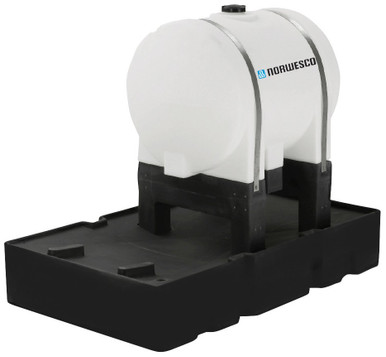
- Norwesco vertical and horizontal water tanks: standard product ships with no instrumentation; level via visual sight or float gauge, no temperature, no pressure. Upgrade path: dome-mounted ultrasonic level + wall-mount thermocouple is the typical add-on package. Reference: N-40146 1,500 gallon, N-40164 5,000 gallon, N-43128 10,000 gallon.
- Snyder Captor double-wall: instrumented configuration available with factory-installed sensor port, annulus leak detector, and primary-tank level transducer. Reference: SII-5490000N42 1,550 gallon, SII-5990102N42 1,000 gallon.
- Snyder waste oil double-wall: dipstick port doubles as level-sensor mounting; factory annulus leak detector. Reference: SII-5740102N95703 275 gallon.
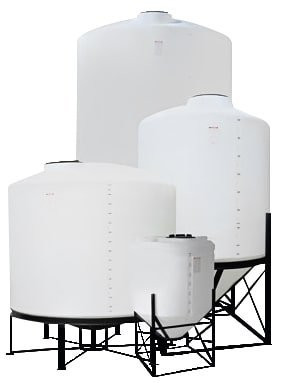
- Norwesco cone-bottom: dome-mount level + side-mount drain valve with optional flow indicator. Reference: N-43852 1,000 gallon 45-degree.
- Enduraplas industrial vertical: includes dome-mount sensor port for ultrasonic or radar level. Reference: EP-THV02500FG 2,500 gallon.
- Chem-Tainer vertical: dome-mount ports support standard sensor packages. Reference: TC6446IA 500 gallon HDPE.
- Bushman water reserve: standard product is non-instrumented water service; add-on sensor packages available for site-specific monitoring needs. Reference: BM-WW-1500-GL-NAT 1,500 gallon.
OneSource Plastics ships polyethylene tanks with the manufacturer's standard configuration plus optional instrumentation packages where available. List pricing on standard SKUs is published on each PDP; instrumentation upgrade pricing is quoted per configuration; LTL freight to your ZIP is quoted via the freight estimator or by phone at 866-418-1777. For installations where instrumentation drives operational and regulatory outcomes, OneSource offers a sensor-and-telemetry package consultation matched to your operating envelope.
For complementary reading, see our tank gauge calibration article for the SPCC-aligned calibration cadence and our level monitoring telemetry for the data-handling architecture beyond the sensor.
Recommended Tanks for This Guide
Live pricing, updated automatically · estimate freight to your ZIP.