Tank Power Backup for Pumps + Sensors: 12V vs 24V vs 120V AC Sizing
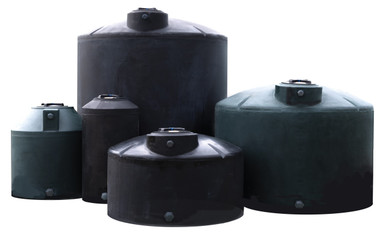
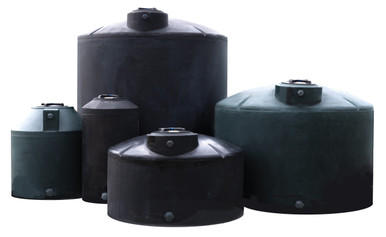
A 1,000-gallon dosing tank feeds chlorine into a small public water system. The dosing pump is electric. The level sensor is electric. The local high-level alarm is electric. When utility power drops at 3 AM in a windstorm, the question is not whether power is restored quickly. The question is whether the tank's instrumentation continued to function during the outage and whether the operator gets an alert. The answer is determined entirely by the power-backup architecture chosen at design time.
This guide walks the three voltage classes — 12V DC, 24V DC, 120V AC inverter — that dominate tank ancillary power backup. Each has a different cost envelope, a different runtime characteristic, and a different code-compliance profile. The math, codes, and citations are real and verified: NEC Article 480 (storage batteries), NEC Article 690 (PV solar interface for off-grid), NFPA 110 (emergency and standby power), IEEE 1187 (VRLA battery installation), UL 1973 (stationary battery enclosure), ANSI/IEEE 1184 (battery sizing).
What Equipment Needs Backup Power on a Tank Skid
| Equipment | Typical Voltage | Typical Continuous Load | Typical Inrush |
|---|---|---|---|
| Hydrostatic level sensor (4-20 mA) | 12-24 VDC | 0.025 A (24 V) | negligible |
| Ultrasonic level sensor | 12-24 VDC | 0.05-0.1 A | negligible |
| Radar level sensor | 24 VDC loop or 120 VAC | 0.04 A (24 V) | negligible |
| Float switch (passive contact) | n/a | 0 A | n/a |
| Capacitive proximity switch | 10-30 VDC | 0.02 A | negligible |
| Diaphragm dosing pump (small) | 120 VAC or 24 VDC | 0.5-2 A (120 V) | 2-3x running |
| Centrifugal pump 1 HP | 120 / 240 VAC | 10-15 A (120 V) | 40-60 A LRA |
| Submersible well pump 1.5 HP | 240 VAC | 10-12 A | 60-80 A LRA |
| SCADA / RTU / cellular modem | 12-24 VDC | 0.2-1 A | negligible |
| Local high-level alarm (audible/visual) | 120 VAC or 12 VDC | 0.1 A | negligible |
| Solenoid valve (small) | 24 VAC/DC or 120 VAC | 0.1-0.5 A | 2x running |
Voltage Class 1: 12V DC Backup
12V DC is the workhorse for instrumentation-only backup. The architecture: a sealed lead-acid (SLA) or lithium iron phosphate (LFP) battery, a float charger from utility power, optional photovoltaic input, and 12V loads connected directly. No inverter required.
When 12V Is Right
- Total continuous load is under 3-5 amps (under ~50 watts continuous).
- Loads are native 12 VDC (most level sensors, RTU, cellular modem, low-power controllers).
- Runtime requirement is 4-72 hours depending on outage duration design point.
- Site is remote or solar-only; PV inputs naturally feed 12V battery via charge controller.
Sizing Math
Battery capacity in amp-hours = (load in amps) x (runtime in hours) / (depth-of-discharge factor) / (temperature derate).
For SLA with 50% DOD limit and 0.85 temperature derate at typical outdoor enclosure temperatures, the formula simplifies to: required Ah = (load A x runtime h) / 0.425.
Worked example: 24V loop instrumentation drawing 0.2 A continuous (combined level sensor + RTU + cellular), 24-hour runtime requirement. The 24V supply is internally provided by a 12V-to-24V boost converter at 90% efficiency, drawing approximately 0.45 A from the 12V battery. Required Ah = (0.45 x 24) / 0.425 = 25.4 Ah. A 35-Ah Group 24 SLA battery is standard, available, and meets the requirement with margin.
For LFP with 80% DOD allowable, required Ah = (load A x runtime h) / 0.68. Same example: 15.9 Ah. A 20-Ah LFP module is standard. LFP costs more per Ah but lasts 2,000-5,000 cycles vs 200-500 for SLA, has flatter discharge voltage, and tolerates higher temperatures. For permanent installations, LFP total-cost-of-ownership is typically lower over 10 years.
NEC Compliance for 12V DC
- NEC Article 480 — Storage Batteries. Defines battery installation requirements: ventilation, spill containment, disconnect, fusing.
- NEC 480.7 — overcurrent protection on the battery output, sized per battery short-circuit current.
- NEC 110.26 — working space around the battery enclosure: 36 in clearance for under 150 V to ground.
- NEC 480.10 — stationary storage battery enclosure ventilation: must prevent hydrogen accumulation above 1% by volume per IEEE 1187 for vented batteries. VRLA (sealed) batteries have lower ventilation requirement but still nonzero.
Voltage Class 2: 24V DC Backup
24V DC is the industrial-control standard. PLCs, SCADA controllers, industrial sensors, and many industrial dosing pumps natively run 24V. The architecture is identical to 12V but at twice the voltage — for the same power, half the current, allowing smaller wire and lower I-squared-R losses on long runs.
When 24V Is Right
- Site already has a 24V industrial control bus.
- Loads include PLC, industrial valves, 24V dosing pumps, or 24V solenoids.
- Long wire runs from battery to load (24V cuts wire size 4x for the same loss).
- Total backed-up power is 50-500 watts continuous.
Sizing
Two 12V batteries in series form a 24V battery bank. Capacity is the smaller of the two batteries (series wiring shares current; capacity is not additive). Sizing math is the same as 12V but at 24V the current is halved for the same power. A 35-Ah Group 24 pair (two batteries in series) provides 35 Ah at 24V, equivalent to 70 Ah at 12V in energy stored (840 Wh).
NEC and IEEE Compliance
- NEC Article 480 applies as for 12V.
- IEEE 1187 — Recommended Practice for Installation Design and Installation of Valve-Regulated Lead-Acid Batteries for Stationary Applications.
- IEEE 1188 — Recommended Practice for Maintenance, Testing, and Replacement of VRLA Batteries.
- IEEE 1184 — Guide for Batteries for Uninterruptible Power Systems.
Voltage Class 3: 120V AC via Inverter
120V AC backup is required when the loads are AC-only. Common cases: utility-grade well pump, irrigation pump, fire pump backup, full-skid UPS for control panels with AC power supplies. The architecture: 12V or 24V DC battery bank, inverter to 120V AC, AC loads connected to inverter output.
When 120V AC Is Right
- Loads are AC-only (most fractional-HP and integer-HP pumps).
- Total backed-up power is 500 W to 5,000 W continuous.
- Inrush current of pumps must be supported (typical pump LRA is 4-6x running current).
- Site has 120V AC distribution; replacing it with DC distribution is impractical.
Inverter Sizing
Inverter continuous rating must equal or exceed continuous load. Surge rating must exceed pump LRA for 1-3 seconds. For a 1 HP pump with 15 A running and 60 A LRA at 120V, the inverter needs ~1,800 W continuous and 7,200 W surge. A 2,000 W continuous / 4,000 W surge inverter is too small (won't start the pump); a 3,000 W continuous / 6,000 W surge inverter is adequate; a 4,000 W continuous / 8,000 W surge inverter is preferred for margin.
Battery Bank Sizing for AC Loads
Battery bank energy (in Wh) = (AC load W) x (runtime h) / (inverter efficiency, typically 0.9) / (DOD, typically 0.5 for SLA / 0.8 for LFP).
Worked example: 1.5 kW continuous load, 4-hour runtime, SLA at 50% DOD: Wh = (1500 x 4) / 0.9 / 0.5 = 13,333 Wh. At 24V, that's 556 Ah at the battery terminals. Two 100-Ah Group 31 SLA batteries in parallel in each leg of a 24V series-parallel bank gets 200 Ah at 24V = 4,800 Wh — not enough. The actual sizing requires three pairs (six total batteries) for 300 Ah at 24V = 7,200 Wh — still short. A 48V bank (four batteries in series, three parallel sets, 12 batteries total) at 100 Ah delivers 14,400 Wh — adequate.
The math illustrates why 120V AC backup with high continuous load gets expensive fast. Reduce load (smaller pump, smaller pump duty cycle, manual cycling) before scaling battery bank.
NEC and NFPA Compliance for 120V AC
- NEC Article 706 — Energy Storage Systems. Applies to battery banks above 1 kWh aggregate energy.
- NEC Article 240 — Overcurrent Protection. Inverter input and output need separate overcurrent protection.
- NEC Article 250 — Grounding and Bonding. Inverter neutral bonding rules per Article 250.30 for separately derived AC systems.
- NFPA 110 — Standard for Emergency and Standby Power Systems. Defines Type, Class, and Level for emergency standby power. UPS and battery-inverter systems are covered under Level 1 and Level 2 classifications.
- UL 1741 — Standard for Inverters, Converters, Controllers and Interconnection System Equipment for Use With Distributed Energy Resources.
- UL 1973 — Standard for Batteries for Use in Stationary, Vehicle Auxiliary Power and Light Electric Rail (LER) Applications.
Architectural Decision: Single Voltage vs Hybrid
Many tank skids use a hybrid architecture: 12V DC distribution for low-power instrumentation that must run during AC interruption, plus 120V AC inverter for the dosing pump that can tolerate cycling. This separates the always-on instrumentation load from the high-power pump load and significantly reduces battery sizing.
Hybrid example: 100 W continuous instrumentation backed up at 12V DC for 72 hours. Pump load 1,500 W backed up at 120V AC for 4 hours. The 12V instrumentation bank is 200 Ah SLA at 12V = 1,200 Wh, two Group 31 batteries. The 120V AC inverter draws from a separate 24V or 48V bank sized for 4-hour pump runtime. The two banks have separate chargers, separate disconnects, separate enclosures. Failure of one does not propagate to the other.
Solar PV Augmentation
For remote tank sites without utility power, PV is the obvious primary energy source. NEC Article 690 governs PV systems. A typical sizing rule:
- PV array size — daily load Wh / 4 sun-hours / 0.85 system efficiency. For a 100 W continuous instrumentation load, daily Wh = 2,400. PV requirement = 706 W array. Round up to 750-1,000 W to provide margin for cloudy days.
- Battery storage — sized for autonomy days (typical 3-5 days for instrumentation, longer for critical applications). 100 W continuous x 96 hours / 0.5 DOD = 19,200 Wh = 1,600 Ah at 12V (massive). For 4-day autonomy, LFP at 80% DOD: 12,000 Wh = 1,000 Ah at 12V. Eight 125-Ah LFP modules in parallel.
- Charge controller — MPPT type for highest efficiency. Sized for PV array short-circuit current with 1.25x derate per NEC 690.8.
Tank Catalog Compatible With Each Architecture
Tank selection itself does not depend on power architecture, but the placement and size determine cable runs and pump siting. For typical small water-utility dosing tanks where 12V or 24V backup applies:
- 1,000-gallon dosing tank with 24V level sensor — Norwesco MPN 41735 (1,000-gallon underground) for buried installation, Norwesco MPN 43140 (3,000-gallon green vertical) for above-ground.
- Cone-bottom dosing tank with full-evacuation — Norwesco MPN 44217 (110-gallon inductor), Norwesco MPN 43852 (1,000-gallon), Norwesco MPN 40359 (1,050-gallon with stand).
- Septic dose-pump applications — Norwesco MPN 41718 (1,000-gallon IAPMO) with 120V AC effluent dose pump on inverter backup.
- Underground cistern with submersible 1.5 HP pump — Norwesco MPN 44876 (5,025-gallon) requires 120V or 240V AC inverter backup or generator backup; battery-only is impractical for sustained pump operation.
List prices are quoted before LTL freight. Use the Freight Cost Estimator for delivered pricing to a specific ZIP. The Tank Sizing Calculator validates tank capacity against pump duty cycle and dosing rate.
Internal References
- State Regulations Hub — state requirements for power backup on public water systems and septic effluent pumps
- Chemical Compatibility Reference — chemistry-aware dosing-pump material selection
- Chemical Tank Recommender — dosing tank selection by chemistry
- Freight Cost Estimator — delivered pricing for tank components
- Tank Sizing Calculator — capacity vs dosing-rate validation
- Specialty & Metal Fabrication Hub — custom skids with integrated power and instrumentation
Source Citations
- NEC NFPA 70 Article 480 — Storage Batteries
- NEC NFPA 70 Article 690 — Solar Photovoltaic (PV) Systems
- NEC NFPA 70 Article 706 — Energy Storage Systems
- NEC NFPA 70 Article 240 — Overcurrent Protection
- NEC NFPA 70 Article 250 — Grounding and Bonding
- NEC NFPA 70 Article 110.26 — Spaces About Electrical Equipment
- NFPA 110 — Standard for Emergency and Standby Power Systems
- NFPA 111 — Standard on Stored Electrical Energy Emergency and Standby Power Systems
- IEEE 1184 — Guide for Batteries for Uninterruptible Power Systems
- IEEE 1187 — Recommended Practice for Installation Design and Installation of Valve-Regulated Lead-Acid Batteries
- IEEE 1188 — Recommended Practice for Maintenance, Testing, and Replacement of VRLA Batteries
- IEEE 1635 / ASHRAE Guideline 21 — Ventilation of Battery Compartments
- UL 1973 — Batteries for Use in Stationary, Vehicle Auxiliary Power and Light Electric Rail Applications
- UL 1741 — Inverters, Converters, Controllers and Interconnection System Equipment for Distributed Energy Resources
- UL 924 — Emergency Lighting and Power Equipment
- OSHA 29 CFR 1910.305 — Wiring methods, components, and equipment for general use
- OneSource Plastics master catalog data, dated 2026-03-26 snapshot (9,419 products across Norwesco, Snyder, Chem-Tainer, Enduraplas, Bushman)
Recommended Tanks for This Guide
Live pricing, updated automatically · estimate freight to your ZIP.