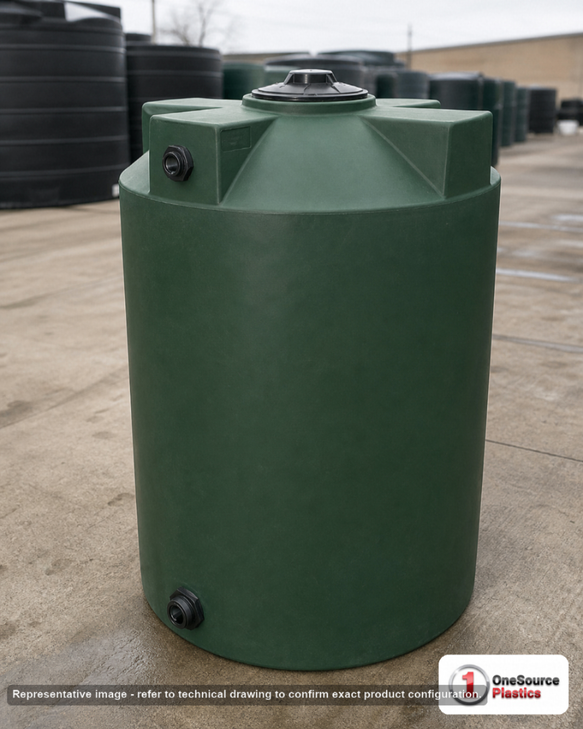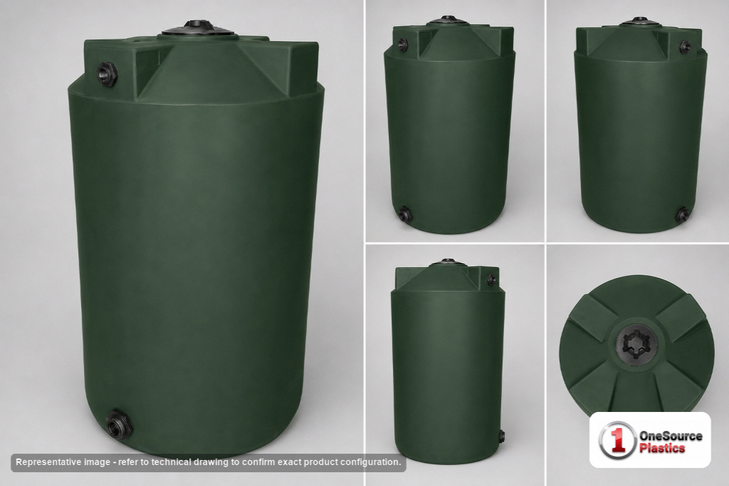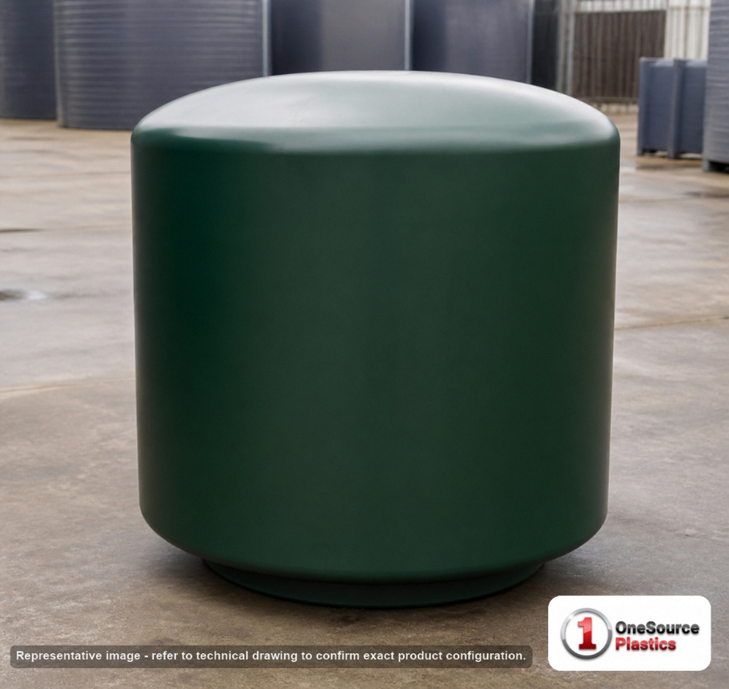
200 gallons of green water storage, 40 inches across and 42 inches tall
The Snyder SII-32495 is the smallest tank in this family: 200 gallons of water in a green polyethylene shell 40 inches across and 42 inches tall, listed at 33 pounds empty and a 50 pound ship weight, molded at Merced, California or Albertville, Alabama. The sheet rates the wall at a specific gravity of 1, which is water, so the 1,668 pounds of contents it lists is the same 1,668 pounds the tank weighs full of water at 8.34 pounds per gallon, with no margin claimed beyond it. It comes fitted: a 20 inch threaded vented manway on top, a 1-1/2 inch polypropylene female NPT bulkhead inlet and a 2 inch polypropylene female NPT bulkhead outlet. Freight is class 400 and it moves as ordinary LTL. The sheet publishes no temperature limit and no warranty term, so this page states neither; ask us and we will get Snyder's current terms in writing.
Need the certification on file? Add the 200 gallon tank to your cart above with freight quoted to your ZIP, or call 866-418-1777 and the paperwork ships with the tank.
Two colours in one 40 inch shell, and the 300 gallon step up
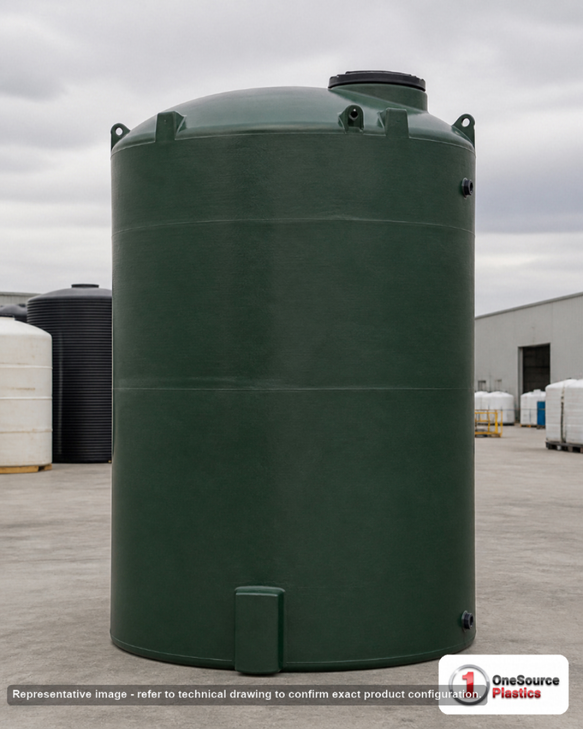
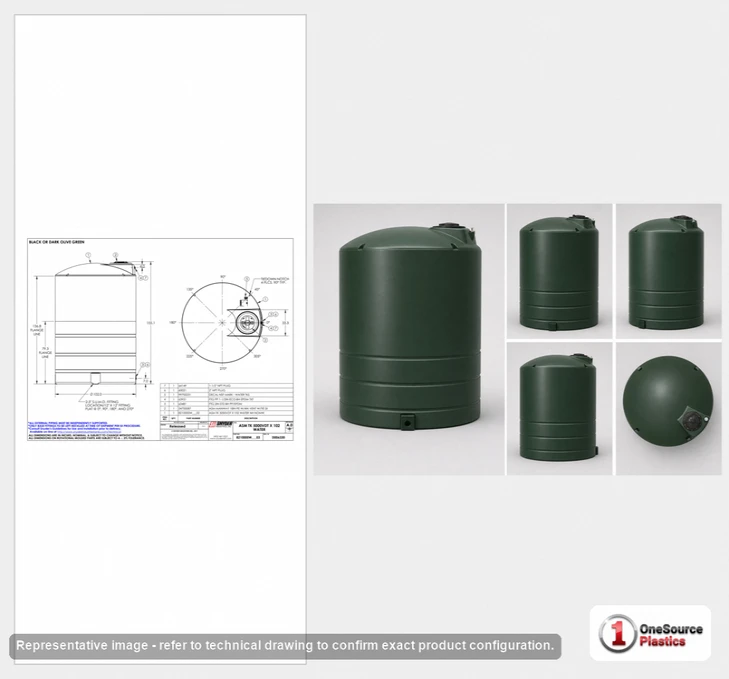
The family here is short and the decision is quick, which is exactly why it is worth stating plainly. Two moldings hold 200 gallons in this 40 by 40 by 42 inch shell, both listed at 33 pounds, and the only difference the sheet gives between them is the wall colour: this one is green and the other is mocha. Take the green one when the tank sits outdoors in a yard, a nursery row, a tree line or a fence corner and you would rather it disappeared into the planting than announced itself, and when you would rather daylight did not reach the water. Take the mocha one when the tank stands against a building, a deck or a gravel pad and brown reads quieter than green. There is no performance claim between them on this sheet and this page will not invent one. The other member of the family is a different tank entirely: the SII-32499 holds 300 gallons on a 36 inch base and stands 72 inches, six feet, at 57 pounds, which is a hundred more gallons for a footprint four inches narrower and a shell two and a half feet taller. That is the real choice on this sheet, and it comes down to whether the site has height or floor. This shell is the low one, and low is what makes it easy: 42 inches means a person looks into the manway standing on the ground, sets the tank on a bench, a trailer deck or a pallet rack without a lift, and puts the whole thing under a bench or inside a truck body. Full of water it is 1,668 pounds on a 40 inch circle, which is more than people expect from something this size, and a rotationally molded floor bears on the whole surface it touches and nothing else, so the base is flat, level and continuous rather than three timbers and a hope; where the ground is soft or the tank is permanent, the framework is in the concrete pad sizing guide. At 33 pounds empty it is light enough for one person and light enough for wind, so strap it before it is full and strap it again if it is ever mounted on a vehicle. Then test the volume against the duty in the tank sizing calculator, and take the reserve you never draw and the freeboard water needs as it warms from the tank sizing guide.
The 200 gallon pair and the tall 300
| Part | Gallons | Diameter x height | Empty weight |
|---|---|---|---|
| SII-32495 (this tank, green, low and wide) | 200 | 40 x 42 in | 33 lb |
| SII-32611 (mocha, same shell) | 200 | 40 x 42 in | 33 lb |
| SII-32499 (black, narrower and much taller) | 300 | 36 x 72 in | 57 lb |
Three tanks, two silhouettes, and one honest way to read the table. The two 200 gallon moldings are the same shell at the same 33 pounds in two colours, and colour is the whole of the difference the sheet publishes. The 300 gallon SII-32499 is where the family changes character: a 36 inch base and 72 inches of height at 57 pounds, which buys a hundred gallons and a lot more head for a footprint that fits between joists or beside a door, at the price of a manway six feet up and a much higher centre of gravity when it is empty. If the water has to push through a hose without a pump, take the tall one. If the tank has to fit under something, ride on something, or be filled and looked into by one person without a step, this is the shell. Nothing in this group needs a crane, a platform or a permit, which is the quiet advantage of buying small.
Pad already poured? Send its size to 866-418-1777 or in a quote request and we will match a row to it, freight to your ZIP included.
A 20 inch vented manway, a 1-1/2 inch inlet and a 2 inch outlet
- Vent first: the 20 inch threaded vented manway is the top of this tank, and on a shell this small the vent is easy to under-respect. A garden hose will not trouble it, but a transfer pump emptying 200 gallons in a couple of minutes moves air out of the shell fast, and a blocked or painted-over vent with a pump running is how a polyethylene tank gets pulled inward. Keep it clear, keep it screened against insects, and check it every time the lid is off.
- Fill: the 1-1/2 inch polypropylene female NPT bulkhead inlet is where a hose or a pressurised line lands, so a delivery is not falling into the open manway from above. On a hauled-water tank that also keeps the lid shut, which keeps dust, leaves and light out of the water.
- Outlet: a 2 inch polypropylene female NPT bulkhead fitting at the base, as the sheet lists it. Two inches will empty 200 gallons quickly by gravity, which is the point of it; give the thread one careful make-up with the right sealant, then put a union or a valve a short way downstream so every later change happens there and never on the tank fitting.
- Head and pump: 42 inches of shell is three and a half feet of standing water, which is modest head, so a pump goes below the outlet where the column keeps it flooded, or it is a self priming pump. A low level cut-out is worth fitting even here; a small tank runs dry in a hurry.
- Service limit and warranty: neither is published on this sheet, so this page asserts neither.
The rest is the discipline any tank wants and a small one usually gets denied. Nothing rigid runs from the base fitting to a pipe fixed in concrete or bolted to a wall, because the shell moves and the pipe does not; break the first joint with a flexible connector and carry the first valve on its own support. Where the site freezes, protect the valve and the exposed run and let the body ice from the top down. If this tank is ever mounted on a trailer or a truck deck, remember that 1,668 pounds of water moves when the vehicle does: strap it over the shoulder of the tank, not just at the base, and never travel it part full if you can travel it empty or full.
Hauled water, nursery feed and a 200 gallon buffer
Two hundred gallons is the size people buy when the tank is a buffer rather than a supply: hauled drinking-quality water taken off a truck at a cabin or a property with no well, a nursery or greenhouse mixing and feeding a drip line, a garden or orchard reserve filled from a hose overnight and drawn down by day, a wash-down or equipment rinse tank on a yard, a construction site water supply for dust control and hand washing, a livestock trough top-up on a small holding, and the flush or make-up tank on a system whose real storage is somewhere else. Where this tank is one stage in a train that collects, holds and re-uses water rather than a standalone vessel, the industrial water reuse tank topology article shows where a vessel this size belongs in the sequence. And if the reason for buying it is standing water against a fire, be honest about the gap between water in a tank and a designed reserve, which is a matter of sizing, draw rate, connection and freeze protection rather than gallons; the fire-water reservoir design guide makes that argument properly.
33 pounds empty, 50 pounds crated, class 400
This molding is listed at 33 pounds empty with a 50 pound ship weight, and the sheet gives both figures; we print what it says. It ships from Merced, California or Albertville, Alabama as ordinary LTL freight at class 400, crated at 40 inches by 40 inches by 42 inches, which is a pallet-sized shipment that a normal dock, a tail lift or two people can take off without a machine. Two plants means two lanes, and on a light shipment the lane is most of the cost, so the freight cost estimator prices it to your ZIP; the listed price is before freight. Look the shell over before you sign, because a light tank rides between heavier freight and the manway threads are what get knocked. Then accept it the way a bigger tank is accepted: set it on its final base, fill it with clean water, hold it, and read the base, the inlet bulkhead and the outlet fitting through the hold rather than filling it and walking away. The method and the hold-time arithmetic are in the hydrostatic test methodology guide, and on a 200 gallon tank the whole exercise costs an afternoon. Small tanks get installed casually, and that is the only reason they ever go wrong. Tape a copy of the spec sheet inside the control panel door; the next person to touch the tank will not have the box it came in.
Freight and documents
Ships from: Merced, CA; Albertville, AL. LTL freight is quoted to your ZIP with the freight cost estimator or by phone at 866-418-1777. The listed price is before freight.
See this tank
Interactive 3D model with live fill. This tank has an interactive 3D model built to its manufacturer dimensions. Rotate it, and set a fill level to see how much liquid it holds at any height. Open the 3D view on the product photo above. Download the 3D model (GLB).
Product video. Watch the 200 Gallon Plastic Vertical Water Storage Tank in Green video (65 seconds) with dimensions, fittings and shipping notes.
Ready to order?
Add it to your cart at the top of this page, get LTL freight to your ZIP, request a written quote, or call 866-418-1777. The listed price is before freight.