Tank Skid + Stand + Pad Engineering: Field Decision Framework for Foundation Type
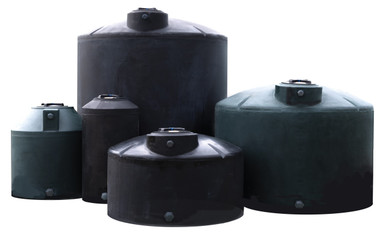
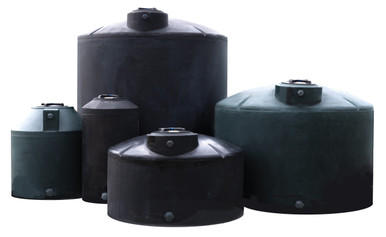
Every plastic tank installation rests on something. The "something" is the most under-engineered part of a typical tank purchase. Buyers spend weeks selecting capacity and material, then drop the tank on whatever flat surface is closest and call it done. Wrong foundation choice causes more tank failures than wrong resin selection. This guide walks the five real foundation options for plastic tanks — concrete pad, gravel pad, sand pad, polyethylene stand, steel skid / steel stand — and the field decision framework for choosing among them.
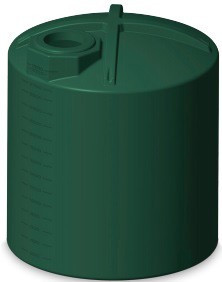
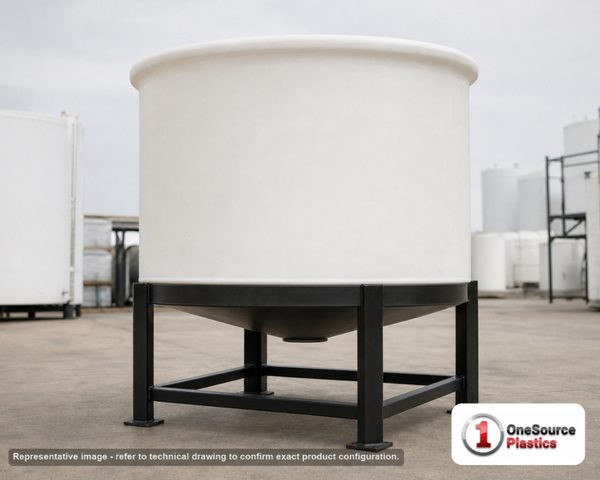
OneSource Plastics' commodity catalog includes both stand-alone tanks and tank-with-stand SKUs because the right answer depends on the tank geometry. A vertical flat-bottom tank can sit on any of the five foundations. A 30-degree cone-bottom tank cannot sit directly on the ground; it requires a stand or skid. A horizontal leg tank requires a level pad or saddle support. The geometry determines the available options before cost or convenience enters the conversation.
The Five Foundation Options
- Concrete pad: 4-6 inch reinforced slab on prepared subgrade. Highest-cost, longest-life, code-compliant for any tank.
- Gravel pad: compacted crushed stone (typically #57 or #67) over geotextile fabric. Mid-cost, drainage-friendly, suitable for most water-storage installations.
- Sand pad: compacted sand layer 4-6 inches deep. Lowest-cost, code-acceptable for many ASTM D1998 installations.
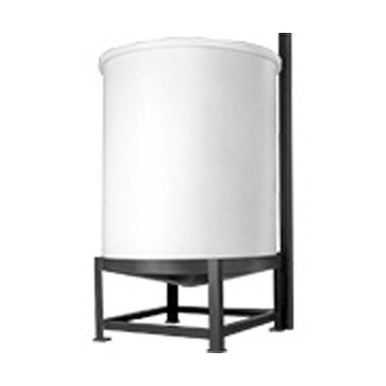
- Polyethylene stand: rotomolded HDPE stand engineered by tank manufacturer for specific tank model. Ships with cone-bottom tanks.
- Steel skid / steel stand: welded steel frame engineered for higher capacity, multi-tank arrays, or industrial mounting. Often used for portable / over-the-road and chemical-feed-station applications.
Foundation Option 1: Concrete Pad
A concrete pad is the gold-standard foundation for any plastic tank. Engineered properly, it lasts 50+ years.
Engineering basics
- Slab thickness: 4 inches minimum for tanks up to 1,500 gallons; 6 inches for tanks 1,500-5,000 gallons; 8 inches for larger. Per ACI 318 (American Concrete Institute Building Code Requirements for Structural Concrete).
- Reinforcement: #4 (1/2 inch) rebar at 12 inches on center each way, or 6x6 W2.9xW2.9 welded wire mesh.
- Concrete strength: 3,000 psi minimum (typical residential), 4,000 psi for commercial / heavy industrial.
- Subgrade preparation: 4-6 inches of compacted granular base over undisturbed soil, with vapor barrier if applicable.
- Surface tolerance: ASTM D1998 Section 7 specifies surface flatness within 1/4 inch over 10 feet for tanks above 1,000 gallons. Concrete easily meets this.
- Anchoring: embedded J-bolts at 4-8 locations around tank perimeter for tie-down strap attachment per ASCE 7-22 wind loads.
Cost
Concrete pads run $8-15 per square foot installed in most U.S. markets in 2026. For a 102-inch diameter tank (56.7 sq ft pad area + 6-inch perimeter clearance, total ~64-72 sq ft), pad cost: $510-1,080. For a 5,000-gallon tank with larger pad, $1,200-2,500.
When to use
Concrete is the right foundation for:
- Permanent installations (5+ year intended service life)
- High-wind zones requiring embedded J-bolt anchoring
- Code-required installations (NFPA 22 fire-water reserves, NFPA 30 AST, building-permit-driven projects)
- Sites where future heavy equipment access (forklift, crane) is anticipated
- Floodplain installations requiring elevation certificate compliance per ASCE 24
- Chemistry installations where leak containment matters; concrete with sealed joints provides secondary containment per 40 CFR 264.193 if sealed and bermed
Foundation Option 2: Gravel Pad
A gravel pad is the second-most-common foundation for plastic tanks and the most common for outdoor agricultural water installations.
Engineering basics
- Aggregate: #57 stone (1 inch nominal) or #67 stone (3/4 inch nominal) per ASTM D448. Crushed (angular), not rounded river gravel — angular interlocks for stability.
- Pad thickness: 6 inches minimum compacted depth, 8-12 inches for larger tanks.
- Pad area: tank diameter + 12 inches in all directions minimum.
- Subgrade: stripped of topsoil and organic matter, compacted native soil.
- Geotextile fabric: woven or non-woven separation fabric between subgrade and aggregate to prevent migration. Mirafi 140N or equivalent.
- Surface tolerance: ASTM D1998 1/4 inch over 10 feet — achievable but requires careful screeding.
- Anchoring: tank tie-down via gravel auger anchors or to concrete deadmen at perimeter.
Cost
Gravel pads run $3-7 per square foot installed. For a 102-inch tank: $190-500. Most affordable foundation that still provides drainage, frost-heave resistance, and load distribution.
When to use
Gravel is the right foundation for:
- Outdoor agricultural water tanks (no chemistry containment requirement)
- Rural / non-code-jurisdiction installations
- Sites with high water table where drainage matters more than absolute flatness
- Cold-climate installations where frost heave on a slab is a risk; well-drained gravel resists frost heave
- Temporary / 5-15 year service installations where concrete is overbuilt
We cover gravel-pad construction in detail in our foundation pad engineering pillar.
Foundation Option 3: Sand Pad
A sand pad is the lowest-cost foundation and is acceptable for many residential and agricultural water tank installations.
Engineering basics
- Sand: washed concrete sand or mason sand per ASTM C33. Fine enough to screed flat, coarse enough to drain.
- Pad thickness: 4-6 inches compacted depth.
- Containment: wood frame or geocell to prevent sand spread; sand pads naturally wash out at perimeter without containment.
- Drainage: sand drains well, but the underlying subgrade must drain too or the pad becomes a saturated sponge.
- Surface tolerance: ASTM D1998 1/4 inch over 10 feet — achievable with careful screeding.
- Anchoring: sand pads cannot host embedded anchors; tie-down requires concrete deadmen or auger anchors driven below the sand layer.
Cost
$2-4 per square foot installed. For a 102-inch tank: $130-280.
When to use
Sand is the right foundation for:
- Smaller residential water tanks (under 1,500 gallons)
- Tanks where ASTM D1998 is the only governing standard and budget is tight
- Temporary / construction-water installations
- Sites with already-loose granular soil; topping with washed sand is sometimes the cheapest path to compliance
Sand is the wrong foundation for:
- High-wind zones (no embedded anchoring possible)
- Tanks above 2,500 gallons (load distribution becomes inadequate)
- Cold-climate installations with deep frost (sand washes out around frozen edges)
- Code-driven installations (most jurisdictions require concrete or engineered gravel)
Foundation Option 4: Polyethylene Stand
Cone-bottom and dished-bottom tanks cannot sit on a flat foundation; they require a stand. The dominant industry approach for tanks under 5,000 gallons is a rotomolded HDPE stand engineered by the tank manufacturer.
Real catalog SKUs with poly stands
- Norwesco MPN 40359: 1,050 gallon 20-degree cone-bottom tank with poly stand, listed at $2,689.99.
- Norwesco MPN 40813: 1,600 gallon 30-degree cone-bottom tank with poly stand in white, $3,448.10.
- Norwesco MPN 60113: 175 gallon 30-degree cone-bottom tank with poly stand in white, $919.99.
- Norwesco MPN 62343: 300 gallon 30-degree cone-bottom tank with black poly stand, $1,157.88.
- Norwesco MPN 43730: 300 gallon 30-degree cone-bottom tank with poly stand in black, $1,270.07.
- Norwesco MPN 44951: 3,000 gallon cone-bottom tank and poly stand in black, $6,719.00.
- Norwesco MPN 62441: 310 gallon 30-degree plastic vertical cone-bottom tank with poly stand in white, $1,109.99.
- Snyder Industries MPN 8360037: 3,000 gallon cone-bottom tank with poly stand 40553, $6,646.15.
Engineering characteristics
- Cone match: the stand is engineered to the specific cone angle (20, 30, 45, 57 degrees). Not interchangeable between cone angles.
- Capacity match: stands are sized to the tank capacity. A stand for a 300-gallon tank is not rated for a 1,000-gallon tank.
- Foundation under stand: the poly stand still sits on something. Concrete pad is preferred; gravel acceptable for outdoor agricultural service. The stand's load is concentrated at 3-4 leg points, which is harder on a foundation than a flat-bottom tank distributing load over its full footprint.
- Discharge clearance: the stand provides ground clearance for cone discharge fitting and valve. Typical 12-24 inches of clear space below the cone outlet.
When to use
Poly stands are the right choice when:
- The tank geometry is cone-bottom or dished-bottom (no flat-floor option)
- Capacity is under 5,000 gallons (above this, steel skid usually wins on cost)
- Service is non-corrosive enough that steel-skid corrosion would be the governing failure mode
- Single-tank installation
We cover the cone-bottom + stand decision in our poly vs steel cone-bottom stand pillar and our cone-stand compatibility matrix pillar.
Foundation Option 5: Steel Skid / Steel Stand
For larger tanks, multi-tank arrays, portable installations, or chemical-feed-station applications, a welded steel skid or stand is the engineered answer.
Real catalog SKUs with steel skid / chemical-feed-station integration
- Snyder Industries MPN 5770104CFWS42: 440 gallon XLPE chemical feed station tank with stand, $6,197.00. Engineered steel platform with integrated containment, secondary containment ditching, and pump mount.
Engineering characteristics
- Material: A36 carbon steel structural framing per AISC 360 (Specification for Structural Steel Buildings). Galvanized, painted, or stainless options.
- Coating: hot-dip galvanizing per ASTM A123 (typical for outdoor); epoxy primer + polyurethane topcoat for indoor or chemistry-exposed.
- Connection to tank: the cone or dish flange bolts to the steel saddle. Gasket required to prevent point loads on the polyethylene.
- Connection to foundation: baseplate-and-anchor-bolt connection to a concrete pad. Gravel/sand foundations are inappropriate for steel skids because the load concentration at four feet exceeds gravel/sand bearing capacity.
- Wind / seismic engineering: per ASCE 7-22 Chapter 13 (seismic design of nonstructural components) and Chapter 26-30 (wind). Site-specific design required for tall steel skids in high-seismic zones (California, Oregon, Washington, Alaska, Puerto Rico) or high-wind zones (coastal Gulf, coastal Atlantic).
When to use
Steel skids/stands are the right choice when:
- Tank capacity is above 5,000 gallons (poly stands become uneconomic)
- Multi-tank manifold array (steel platform unifies multiple tanks)
- Chemical-feed-station integration (pump, level sensor, secondary containment all mount to the same skid)
- Portable / OTR installations (skid bolts to a trailer or container)
- Industrial process plants where tank moves between service locations
- Seismic design requires engineered tie-down to baseplate and anchor bolts
For multi-tank manifold engineering, see our multi-tank manifolding pillar.
Decision Framework: Which Foundation by Use Case
| Use Case | Recommended Foundation | Reason |
|---|---|---|
| Vertical flat-bottom water tank, residential, < 1,500 gal | Sand or gravel pad | ASTM D1998 compliant, lowest cost |
| Vertical flat-bottom water tank, agricultural, 2,500-5,000 gal | Gravel pad with auger anchors | Drainage + tie-down, mid-cost |
| Vertical flat-bottom chemical tank (any size) | Concrete pad with bermed containment | Spill containment per 40 CFR 264.193 |
| Cone-bottom tank, < 1,500 gal | Poly stand on concrete pad | Manufacturer-engineered match, cone discharge |
| Cone-bottom tank, 1,500-5,000 gal | Poly or steel stand on concrete pad | Steel for industrial; poly for ag / lower service |
| Cone-bottom or dish-bottom tank, > 5,000 gal | Steel skid on concrete pad | Engineered for capacity |
| Multi-tank chemical-feed station | Steel skid with integrated containment | Single platform unifies tanks, pumps, sensors |
| High-wind / coastal hurricane zone (any tank) | Concrete pad with embedded J-bolts | ASCE 7-22 tie-down required |
| High-seismic zone (any tank above 1,500 gal) | Concrete pad, engineered anchorage | ASCE 7-22 Chapter 13 seismic design |
| FEMA SFHA floodplain installation | Engineered concrete pad per ASCE 24 | Flood-resistant design required |
| Portable / over-the-road tank | Steel skid bolted to trailer | Mobility + structural support |
| Underground installation | Manufacturer-specified bedding sand | Encased per Norwesco/Snyder underground tank guides |
Frequent Foundation Mistakes
Mistake 1: Tank on bare ground
A tank on bare native soil violates ASTM D1998 Section 7. Settlement, frost heave, and point-load punctures cause premature failure. Even a sand pad is better than nothing.
Mistake 2: Sand pad with no containment
Sand pads must have a perimeter form (wood frame, geocell, or compacted edge) or they spread and the tank settles into a depression. Within 12-24 months an uncontained sand pad has lost 30-50% of its original thickness.
Mistake 3: Concrete pad with no rebar in cold climate
An unreinforced concrete pad in a frost zone (Wisconsin, Minnesota, North Dakota, Maine, upstate New York) cracks within 2-3 freeze-thaw cycles. The rebar is what holds the pad together when frost heaves the subgrade. ACI 318 + ACI 332 (Residential Code Requirements for Structural Concrete) are not optional.
Mistake 4: Cone-bottom tank on bare ground or wood blocks
A cone-bottom tank on stacked cinder blocks or pallet wood is not engineered support. The cone bottom needs a saddle that distributes load uniformly; point loading at the cone tip causes stress concentration and progressive crack initiation.
Mistake 5: Steel skid on gravel
Steel skid baseplates concentrate load at 4-6 contact points. A 5,000-gallon tank weighs ~42,000 pounds full; on a four-leg skid, each leg sees ~10,500 pounds. Gravel bearing capacity in residential / agricultural compaction is 1,500-3,000 psf; the leg baseplate must spread that 10,500 lb over enough area (3.5-7 sq ft per leg) to stay below allowable bearing pressure. This is rarely achieved without engineered baseplates.
Mistake 6: Mismatching cone angle to stand
A 30-degree cone tank does not bolt to a stand engineered for a 45-degree cone. Manufacturer cone stands are engineered as matched pairs. Always order tank + stand as a kit, or verify cone angle and tank diameter against the stand's spec sheet.
Foundation Permit Implications
Concrete pads typically require a building permit (1-3 weeks under most IBC adoptions). Gravel pads usually do not. Sand pads usually do not. Poly stands and steel skids do not require their own permits but are part of the tank installation permit.
For floodplain installations, ASCE 24 requires engineered foundations regardless of foundation type. For high-seismic zones, ASCE 7-22 Chapter 13 requires engineered anchorage. We cover the permit timing in our permitting lead time pillar.
Frost-Heave and Cold-Climate Considerations
In USDA hardiness zones 3-5 (most of the upper Midwest, northern New England, Alaska), frost depth ranges 36-72 inches. Foundation design must extend below frost depth or accept frost-heave movement.
- Concrete pads: must be founded on properly drained granular subbase below frost or on insulated shallow foundations per ASCE 32.
- Gravel pads: well-drained clean gravel resists frost heave naturally; properly designed gravel pads tolerate frost cycles.
- Sand pads: sand with high water content frost-heaves. Drainage is essential.
- Underground tanks: bury below frost depth always. Norwesco and Snyder underground tank install guides specify minimum cover.
We cover cold-climate field performance in our cold-climate pillar and heat-trace / insulation considerations in our heat trace pillar.
How OneSource Specifies
For inbound buyer questions on foundation selection:
- What is the tank geometry? Flat-bottom = pad. Cone-bottom = stand. Dish-bottom = skid.
- What capacity? <1,500 gal opens sand and gravel options; >5,000 gal usually drives concrete.
- What chemistry? Containment chemistry drives concrete with bermed perimeter.
- What climate / seismic / wind zone? Hurricane Coast, California seismic, high-frost zones drive engineered concrete.
- What service life? 5-year temporary = sand. 25-year permanent = concrete.
For cone-bottom installations we recommend ordering the tank-with-stand SKU as a matched pair. Our catalog lists 18+ Norwesco and Snyder cone-bottom-with-stand combinations spanning 175 to 3,000 gallon capacities. Every list price quoted is BigCommerce list — LTL freight is quoted separately per ZIP via the Freight Cost Estimator or by phone at 866-418-1777.
Internal Resources
- Foundation Pad Engineering Pillar
- Cone-Bottom Stand Selection (Poly vs Steel)
- Cone-Stand Compatibility Matrix
- Tank Permitting Lead Time by State
- Cold Climate Field Performance
- Multi-Tank Manifolding
- Hurricane Season Tie-Down
- Freight Cost Estimator
Source Citations
- ACI 318 — Building Code Requirements for Structural Concrete
- ACI 332 — Residential Code Requirements for Structural Concrete
- ASTM D1998 — Standard Specification for Polyethylene Upright Storage Tanks (Section 7 site recommendations)
- ASTM D448 — Standard Classification for Sizes of Aggregate for Road and Bridge Construction
- ASTM C33 — Standard Specification for Concrete Aggregates
- ASTM A123 — Standard Specification for Zinc (Hot-Dip Galvanized) Coatings on Iron and Steel Products
- ASCE 7-22 — Minimum Design Loads and Associated Criteria (Chapter 13 seismic, Chapters 26-30 wind)
- ASCE 24 — Flood Resistant Design and Construction
- ASCE 32 — Design and Construction of Frost Protected Shallow Foundations
- AISC 360 — Specification for Structural Steel Buildings
- 40 CFR 264.193 — RCRA Containment and Detection of Releases (secondary containment)
- NFPA 22 — Standard for Water Tanks for Private Fire Protection
- NFPA 30 — Flammable and Combustible Liquids Code
- IBC (International Building Code) Chapter 16 — Structural Design
- OneSource Plastics master catalog data, 2026-03-26 snapshot
Recommended Tanks for This Guide
Live pricing, updated automatically · estimate freight to your ZIP.