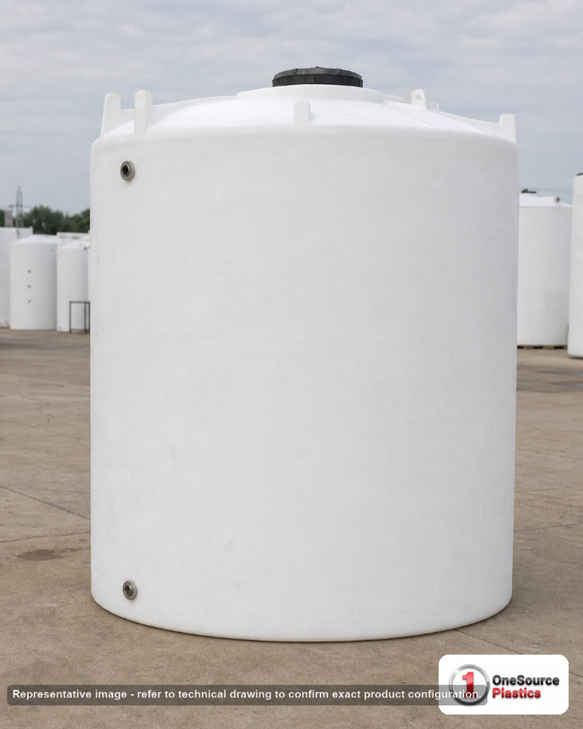
7,500 gallons of the heaviest wall in this shell, nineteen feet six inches tall on an eight and a half foot circle
The Snyder 7440000N42 is the heavy-duty wall in the 7440000 mold: 7,500 gallons inside a 102 inch circle standing 234 inches tall, 3,000 pounds empty, molded in natural white crosslinked linear polyethylene. Its sheet rates that wall for a specific gravity of 1.9, which it reads as 118,845 pounds of maximum contents against 62,550 pounds for plain water at 8.34 pounds per gallon. The listed opening is an 18 inch threaded, vented manway, the sheet lists 8 lifting lugs and 2 flange lines, the outlet field reads 23, the service limit is 140 F / 60 C, the warranty is 3 year, and freight is class 250 out of Lincoln, Nebraska.
Ready to price it? The listed price is before freight; quote freight to your ZIP in a few seconds, then add to cart above or call 866-418-1777.
The duty: a tanker of dense liquid where the floor plan is already spoken for
The buyer for this molding is a plant that takes a liquid heavier than water by the truckload and has run out of floor, not out of roof. A municipal water plant adding a dense chemical to a chemical room that is already full of vessels. A mine or a mineral processor holding a brine on an outdoor pad between the aisles it has to keep clear. A manufacturer replacing a wall of totes with one tank down a bay that is tall and narrow. In all three the argument is the same: 7,500 gallons of real bulk storage on a footprint just 102 inches across, with the wall rated at the 1.9 figure the sheet gives rather than at water weight. The delivery is what most people picture wrong. A tanker pulls to the pad, the driver lands a hose on a permanent connection at the manway platform, and most of that trailer goes into this one tank, which is the point of buying 7,500 gallons instead of chaining two smaller ones together. So the platform, the fill line and the vent are part of the order, not an afterthought: they get designed before the shipment arrives, because a driver holding a hose nineteen feet up in the dark is how sites get hurt. Under that duty the pad is the first real line item. A rotationally molded floor bears on its own floor and on nothing else, so 62,550 pounds with plain water in it, or 118,845 pounds if the liquid works the rating, is carried by a 102 inch circle alone, which is more load per square foot than any wide tank of this volume applies. Pour it to the concrete pad sizing framework, level, cured and in full contact under the whole floor, inside a berm sized to the tank wherever the liquid is regulated, and never on a slab poured for a squat vessel. Then the roof line, because 234 inches plus working room above the manway is a tall order in most buildings. Then the wind: 3,000 pounds of empty shell standing nineteen and a half feet on an eight and a half foot base is the highest center of gravity in the family, so bands to structure or anchors cast into the slab go on the day it lands, get checked after the first storm and get checked again at the end of the first summer. Whether 7,500 gallons actually covers the draw between deliveries is a question for the tank sizing calculator, and the reserve you hold back plus the freeboard a warm liquid needs come from the tank sizing guide.
Four walls out of the 7440000 mold
| Part | Gallons | Diameter x height | Empty weight |
|---|---|---|---|
| 7440000N42 (this tank, rated 1.9, class 250) | 7,500 | 102 x 234 in | 3,000 lb |
| 7440000N48 (same shell, heavy) | 7,500 | 102 x 234 in | 3,000 lb |
| 7440000N40 (same shell, lighter wall) | 7,500 | 102 x 234 in | 2,450 lb |
| 7440000N46 (same shell, lighter wall) | 7,500 | 102 x 234 in | 2,450 lb |
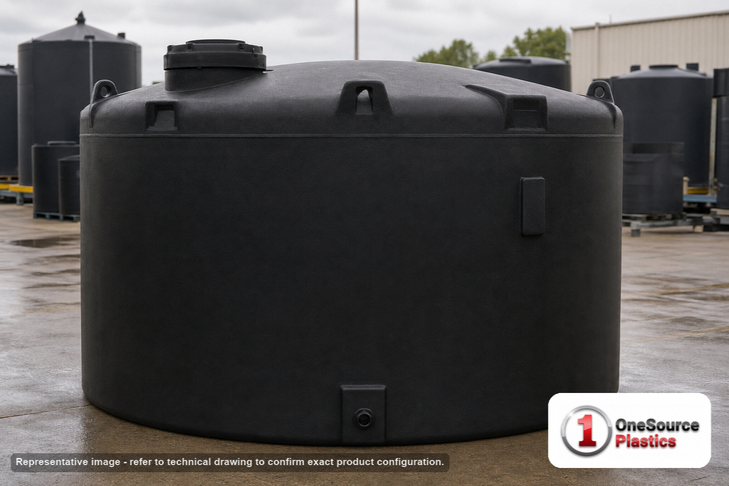
| 5300700N40 (low and wide) | 7,000 | 142 x 122 in | 1,400 lb |
| 5300700C26 (low and wide) | 7,650 | 142 x 122 in | 1,400 lb |
Everything in the top four rows is 7,500 gallons out of one mold at 102 by 234 inches, listed separately and each rated as its own sheet says. The reason to take this one rather than a lighter wall in the same shell is the 1.9 figure and the 3,000 pounds of polyethylene standing behind it: a rating you do not use is wall you paid for and freight you carried, and a rating you needed and did not buy is a tank you replace. The 7440000N40 and 7440000N46 are the lighter pair at 2,450 pounds empty, and on an ordinary feed or rinse solution they are the honest cheaper answer. Sideways out of the mold, the 5300700N40 and 5300700C26 put roughly the same bulk volume on a 142 inch circle only 122 inches tall, which is the buy when the building is low and the yard is wide, exactly the opposite site to the one this tank is for. Whether crosslinking is the right resin decision for your chemistry in the first place is worked through in the crosslinked against high density polyethylene comparison.
Want us to check the fit? Send the site dimensions to 866-418-1777 or through a written quote request and we will confirm the tank, the pad and the freight.
Pump first: nineteen feet of head on the suction line
- The pump, because on a tank this tall it is the whole install. Set the transfer pump below the base connection so gravity keeps it primed, and it runs flooded to the last few inches instead of cavitating on a column that is nearly nineteen and a half feet deep. Nowhere on this tank is there a reason to lift the suction, and every reason not to: a pump mounted level with the connection loses its prime the first time the level drops and the line drains back.
- Low-level protection, which is the second half of the same decision. A float or a probe stops the pump before it draws air, rather than the pump's own suction being what tells you the tank is empty. On a dense liquid at the 1.9 rating a dry run is not just a lost shift, it is a seal.
- Outlet, printed as published: the sheet lists the outlet as 23, and gives no bottom fitting diameter, material or thread anywhere on it. That is the field, it is not a pipe size, and we guess nothing. Name the liquid, the flow you need and the pump you already own at order and we confirm what this molding accepts before anything is drilled.
- Access: an 18 inch threaded, vented manway at the top of a 234 inch shell. That is a fixed platform with a rail and a gate, and a permanent fill connection landed at the manway.
- Fill and vent: a dip tube run to the floor so the incoming stream does not free-fall the height of the tank and foam the headspace, the vent piped outdoors on anything that fumes, and the vent sized to the delivery pump rather than to whichever port is nearest.
- Handling and hardware as listed: 8 lifting lugs, 2 flange lines. Service limit 140 F / 60 C, warranty 3 year, rating specific gravity 1.9 as the sheet gives it.
Whatever is plumbed at the base rides on its own support off the pad, with a flexible element between the tank and hard pipe, and nothing rigid bolts to the shell. Nineteen and a half feet of standing liquid at the 1.9 rating is the highest static pressure in this family, and a rigid run hands the wall every pump start, every temperature swing and the dead weight of the pipe on top of it. Above the liquid the tank has a second wear surface people forget: the vapor-wetted band ages before the submerged wall does, which the headspace wall thickness article sets out in detail, so the band above the line gets a light every time the cover comes off. Keep the manway threaded shut between deliveries, and put the name of the one liquid inside on the wall in letters a driver reads from the cab.
Dense liquids in a tall bay
Brines, concentrates and heavy process solutions are where this wall earns its money, in a building with height and no spare floor. Where a site rule or an insurer wants the liquid inside a second wall, the double wall freeboard sizing guide works out how much usable volume a contained vessel actually returns at this size, which is never the number on the label, and 110 percent containment is a design decision rather than a product feature. Plain water at 8.34 pounds per gallon sits far inside this rating, but a private fire reserve is a separate specification in a water-rated vessel, and the fire-water reservoir design guide explains why the two specifications do not swap.
Class 250 out of Lincoln, the lowest class in this shell
The sheet gives class 250 and 3,000 pounds shipping weight out of Lincoln, Nebraska, which is the lowest class on any tank in this shell even though it is the heaviest wall in it. The sheet gives both and we print what it says. A shipment 102 inches across and 234 inches long still prices on the deck space it occupies rather than on the scale, so put the delivery ZIP into the freight cost estimator before the requisition goes in; the listed price is before freight. A crane stands it up on the lugs with straps under the body, never a sling through the manway, and it sets down on a cured pad rather than on gravel it will have to be dragged off later. Then water before the working liquid: fill to the manway, hold it, walk the base and the pad edge twice looking for movement or a weep, drain and dry, on the discipline the hydrostatic test methodology article lays out. Check the band tension a week after that first fill, because a tank settles a little and the band that was tight is loose. A photo of the tank on its pad, full, on day one is worth keeping; it is the baseline every later inspection is compared against.
Freight and documents
Ships from: Lincoln, NE. LTL freight is quoted to your ZIP with the freight cost estimator or by phone at 866-418-1777. The listed price is before freight.
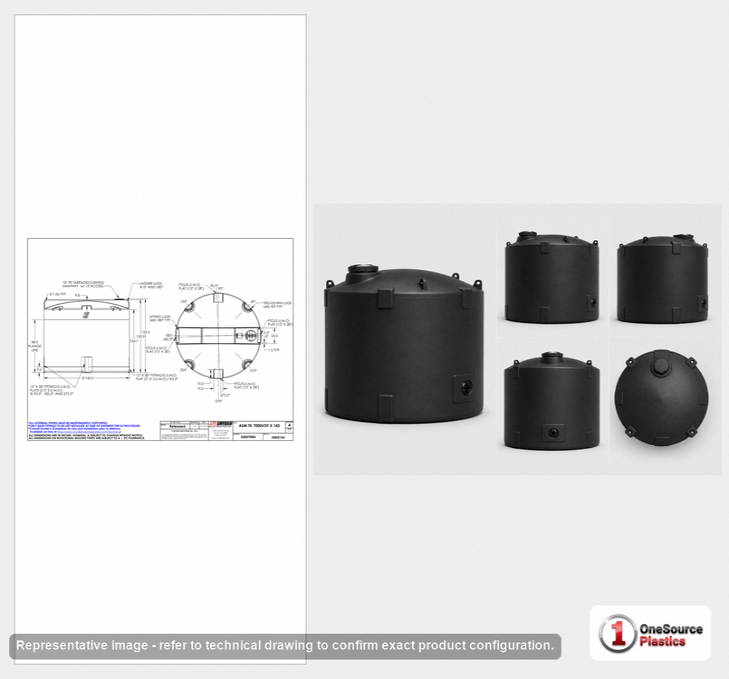
Technical drawing (PDF) for Snyder Industries 7440000N42.
See this tank
Interactive 3D model with live fill. This tank has an interactive 3D model built to its manufacturer dimensions. Rotate it, and set a fill level to see how much liquid it holds at any height. Open the 3D view on the product photo above. Download the 3D model (GLB).
Ready to order?
Add it to your cart at the top of this page, get LTL freight to your ZIP, request a written quote, or call 866-418-1777. The listed price is before freight.