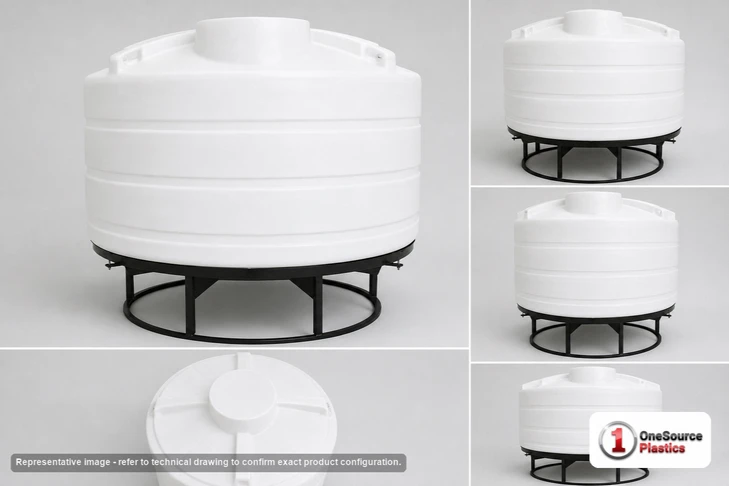
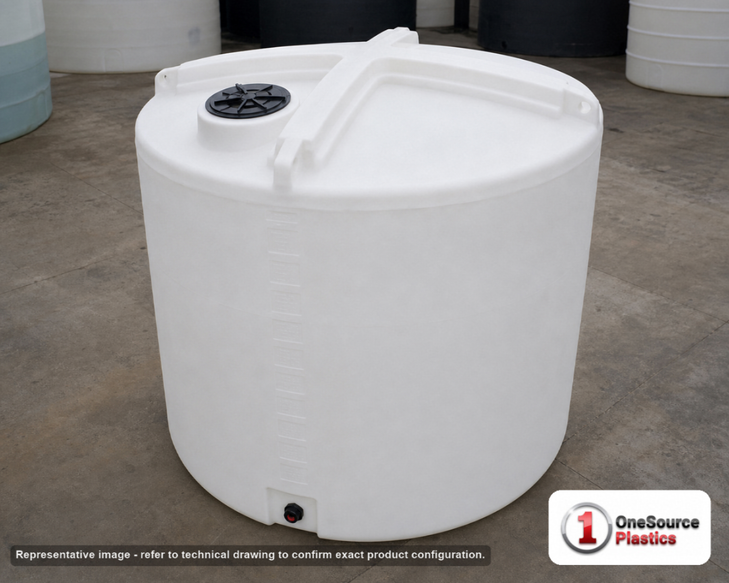
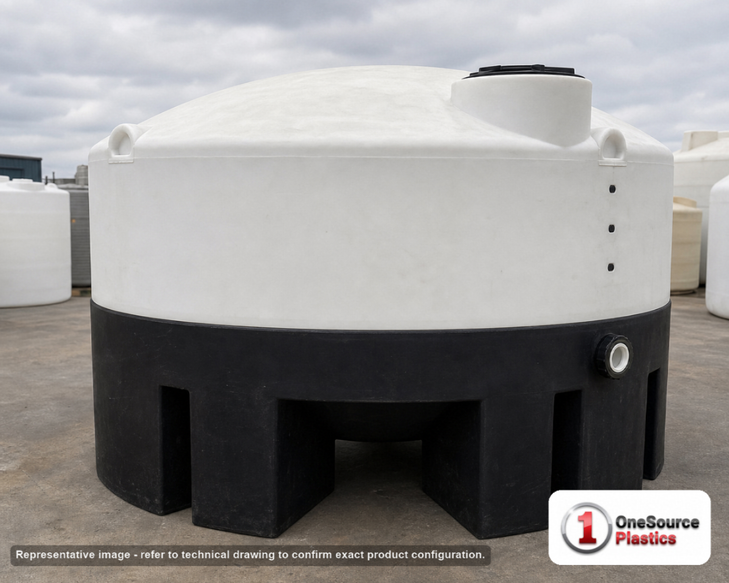
The Enduraplas 1350 Gallon Black Cone Bottom Tank is built for full-drain bulk chemical service, with a 1.9 specific gravity rating that makes it the heaviest-duty SG option in this cone bottom family.The sloped cone floor empties completely without manual recirculation, and the black polyethylene wall blocks UV light and limits the light-driven algae growth seen in translucent tanks on outdoor installs.This is a cone tank engineered to handle dense fluids that would overload a standard 1.9 SG cone tank.
Will it work for your application?
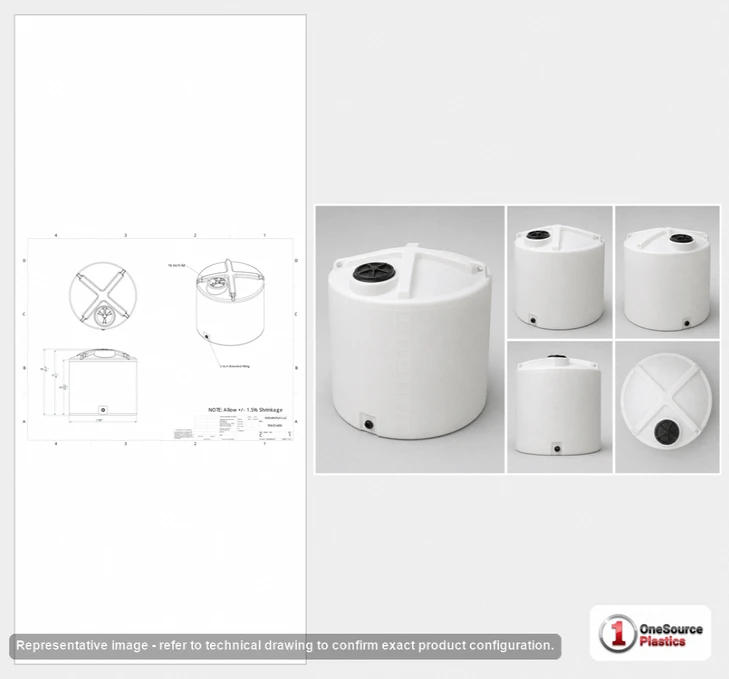
This Enduraplas cone bottom tank holds 1350 gallons and measures 85 inches across the base by 75 inches tall, with an 85.0 x 85.0 inch footprint to plan your stand and pad around.The 1.9 specific gravity rating is the number that matters most here: filled with plain water the contents weigh 11,259 lb, but the tank is rated to carry up to 21,392 lb of dense chemical contents.That headroom is why this tank handles concentrated acids and brines that a lower-rated vessel cannot, and at 1.9 SG there is no higher-rated step-up in this cone family to size into.A cone bottom tank always mounts in a matching steel or poly stand sized to the cone angle and full loaded weight; our cone bottom tank stand compatibility matrix walks through the Norwesco, Snyder, and Enduraplas stand options, and the Tank Sizing Calculator and Tank Sizing Guide help confirm 1350 gallons is right for your throughput.
Chemical compatibility
This tank is molded from high-density linear polyethylene (HDLPE) rated to 1.9 specific gravity.Because the resin shows as HDLPE with an open question, confirm HDLPE versus XLPE (cross-linked) with us before committing to chemical service - the two resins behave differently against aggressive oxidizers and solvents.That confirmation matters before the freight commitment too: this is a 21,392 lb-rated cone tank shipping LTL from a single plant, and a wrong-resin return on a 1350-gallon vessel is a freight disaster.The compatibility below comes from the OEM chemical-resistance chart and is concentration- and temperature-specific - verify your exact concentration and operating temperature against that chart before ordering.
At the 1.9 SG rating this tank is suited to the following, with the fitting and gasket materials each chemical requires:
- Acetic acid at 60% - PP/PVC fittings, EPDM gaskets
- Aluminum sulfate at 50% - PVC fittings, EPDM gaskets
- Calcium chloride at 40% - PVC fittings, EPDM gaskets
- DEF (diesel exhaust fluid) at 32.5% - 316SS fittings, EPDM gaskets
- Ethylene glycol at 100% - PVC fittings, EPDM gaskets
- Ferric chloride at 50% - PVC fittings, EPDM gaskets
- Ferric sulfate at 60% - PVC fittings, EPDM gaskets
- Ferrous sulfate at 20% - PVC fittings, EPDM gaskets
- Hydrochloric acid at 37% - PVC fittings, Viton gaskets
- Hydrofluoric acid at 48% - PP/PVC fittings, Viton gaskets
- Hydrofluosilicic acid at 26% - PP/PVC fittings, Viton gaskets
- Hydrogen peroxide at 50% - PVC fittings, Viton gaskets
- Magnesium chloride at 30% - PVC fittings, EPDM gaskets
- Peracetic acid at 30% - 316SS fittings, Aflas gaskets
- Phosphoric acid at 85% - PVC fittings, Viton gaskets
- Polyaluminum chloride - PVC fittings, EPDM gaskets
- Potassium carbonate at 50% - PVC fittings, EPDM gaskets
- Potassium hydroxide, saturated - PVC fittings, EPDM gaskets
- Propylene glycol - PP/316SS fittings, EPDM gaskets
- Sodium bisulfate - PVC/PP fittings, EPDM gaskets
- Sodium bisulfite - PVC/PP fittings, EPDM gaskets
- Sodium carbonate at 30% - PVC fittings, EPDM gaskets
- Sodium hypochlorite (bleach) at 16.5% maximum - PVC fittings, Viton gaskets
- Sodium thiosulfate at 40% - PVC fittings, EPDM gaskets
- Sulfuric acid at 98% - CPVC fittings, Viton gaskets
- Urea solution at 50% - PP/PVC fittings, EPDM gaskets
- Zinc orthophosphate - PP/316SS fittings, EPDM gaskets
- Ozonated water up to 10 PPM - PVC fittings, EPDM gaskets
Two material details catch buyers out.Sodium hypochlorite is listed with a hard 16.5% maximum concentration - that ceiling is the spec, because bleach off-gasses and stresses polyethylene as strength climbs, so do not run it stronger than the listed limit.And several chemicals here need metal, not PVC: DEF, peracetic acid, propylene glycol, and zinc orthophosphate all call for 316SS or PP/316SS fittings, so a buyer defaulting to PVC hardware will mis-spec them.The full Chemical Compatibility Database lists concentration and temperature limits for each.Only the chemicals above are confirmed for this 1.9 SG tank.
Avoid the costly mistakes
Two errors sink most chemical cone bottom installs.First, the gasket.Oxidizers - sulfuric acid, hydrochloric acid, hydrogen peroxide, sodium hypochlorite, and peracetic acid - demand Viton or Aflas, not the EPDM that works for the salt and glycol chemistries.Peracetic acid is the single chemical here that needs Aflas (with 316SS fittings), so do not assume the Viton that covers the other oxidizers will carry it - check the list above before you buy hardware.Second, mounting and labeling: a cone bottom tank carries its entire load through the stand and outlet, so the stand must be rated for the full 21,392 lb contents weight, and bulk chemical storage carries placarding obligations.Our guides on tank top fitting placement, level gauge selection for chemical service, and NFPA 704 and GHS label compliance cover the layout and signage decisions.
This tank ships LTL freight from the Enduraplas plant in Neche, ND, with freight quoted live to your ZIP - run your address through the Freight Cost Estimator for a delivered transit estimate, or call 866-418-1777 and our team will confirm resin, fittings, stand selection, and freight for your project.List price is shown above; LTL freight is quoted separately to your ZIP.
Freight and documents
Ships from: Neche, ND. LTL freight is quoted to your ZIP with the freight cost estimator or by phone at 866-418-1777. The listed price is before freight.
See this tank
Interactive 3D model with live fill. This tank has an interactive 3D model built to its manufacturer dimensions. Rotate it, and set a fill level to see how much liquid it holds at any height. Open the 3D view on the product photo above. Download the 3D model (GLB).
Ready to order?
Add it to your cart at the top of this page, get LTL freight to your ZIP, request a written quote, or call 866-418-1777. The listed price is before freight.