Tank Label and Signage Compliance for Bulk Polyethylene Storage: NFPA 704 Hazard Diamond Placement, GHS Pictograms, DOT Placard Hierarchy, OSHA HazCom Pipe Marking, and the Multi-Standard Reconciliation That Survives Fire and Workplace Inspectors
The tank label and signage on a bulk polyethylene storage installation has to satisfy four overlapping regulatory programs simultaneously: the NFPA 704 fire-and-emergency-response hazard rating, the OSHA Hazard Communication Standard with its GHS pictogram requirements, the DOT hazardous materials placarding for any tank used in transportation or accessed by transportation equipment, and the local fire-code requirements that frequently add detail to the federal baseline. The four programs were written by different agencies for different audiences with different design priorities, and they do not align cleanly. The site that gets labeling right satisfies all four inspectors; the site that gets labeling almost-right satisfies one and gets cited by the others.
This article walks the labeling and signage engineering for bulk polyethylene tanks installed by Norwesco, Snyder, Chem-Tainer, Enduraplas, and Bushman customers across chemical, water, agricultural, and process industries. The references are NFPA 704 Standard System for the Identification of the Hazards of Materials for Emergency Response (latest edition), 29 CFR 1910.1200 (the OSHA Hazard Communication Standard with its 2013 GHS-aligned amendments), 49 CFR 172 Subparts D and E and Part 173 (DOT placards and packagings), 29 CFR 1910.144 and ANSI Z535 (workplace pipe and equipment marking), and field experience reconciling the four programs across over 100 chemical-storage installations. The objective is the labeling specification that satisfies all four programs without contradicting any of them and that the site can install with stock signage from common industrial-supply sources.
1. The Four Regulatory Programs and Their Native Audiences
Each of the four programs serves a different audience and protects against a different failure mode. Understanding the audience explains why the programs disagree on details and helps the site engineer reconcile them.
- NFPA 704 hazard diamond. Audience: emergency responders arriving at a structure fire or chemical incident. The diamond communicates four hazards (health, flammability, instability, special hazards) with 0-4 numerical ratings on each, in a glance from a distance. The use case is the firefighter or hazmat responder making an entry decision and selecting protective equipment based on what is inside the building or tank. The standard is consensus-developed by NFPA and adopted by jurisdiction; it is not federally mandated but is universally referenced by local fire codes.
- OSHA HazCom / GHS. Audience: workers handling the chemical at the workplace. The GHS pictograms (the red-bordered diamonds with hazard symbols), signal words ("Danger" or "Warning"), and hazard statements communicate the chemistry to people interacting with the product daily. The requirement is federal and applies to any workplace that uses or stores hazardous chemicals.
- DOT 49 CFR 172 placards. Audience: emergency responders to transportation incidents and personnel handling chemicals during transportation. The DOT placards are the diamond-shaped color-coded signs on tanker trucks and rail cars; they apply to fixed-site tanks only when the tank is being loaded from or unloaded to transportation equipment. The requirement is federal for transportation but extends to fixed-site loadout pads in many state interpretations.
- Local fire code. Audience: local fire department responders and code enforcement. The requirements vary by jurisdiction but typically reference NFPA 704 for hazard rating, NFPA 30 for flammable liquid storage, IFC (International Fire Code) for storage configurations, and any local supplements. The local code is the variable layer that the site has to verify with the local AHJ (Authority Having Jurisdiction).
The programs overlap in coverage: a flammable liquid storage tank gets an NFPA 704 diamond for the fire department, a GHS pictogram for the workers, a DOT placard during loading or unloading, and any local code labels the AHJ requires. The programs do not contradict in spirit but they sometimes specify visually similar but differently-coded signage that can confuse the operator and the inspector. The reconciled labeling is the labeling that uses each program's signage in its proper location without trying to combine them into a single hybrid label.
2. NFPA 704 Hazard Diamond: Placement and Specification
The NFPA 704 hazard diamond is the four-color-coded diamond that emergency responders look for first. The standard specifies the geometry, the color code, the rating system, and the placement requirements.
- Geometry. Square sign rotated 45 degrees to form a diamond. Four quadrants: blue (left, health), red (top, flammability), yellow (right, instability/reactivity), white (bottom, special hazards including W for water-reactive, OX for oxidizer, SA for simple asphyxiant, and others).
- Rating. 0-4 numerical rating in each colored quadrant, where 0 indicates no significant hazard and 4 indicates extreme hazard. The rating for a specific chemical is determined from the SDS using the NFPA 704 chapter 5 criteria; the chemical manufacturer's SDS typically lists the NFPA 704 rating directly.
- Size. NFPA 704 specifies minimum diamond dimensions based on the viewing distance: 6-inch diamonds for 50-foot viewing distance, 10-inch diamonds for 75-foot, 15-inch diamonds for 100-foot. The diamond has to be visible from the location where the emergency responder will arrive at the property and look for it.
- Placement. NFPA 704 requires the diamond to be visible from the access point of approach for emergency responders. For a fixed bulk tank in an outdoor installation, this typically means one diamond on each accessible side of the tank installation, plus a master diamond at the property entry where the fire department arrives. The diamond is mounted at eye level (60-72 inches above grade for the responder approach height) on the tank itself, on a sign post adjacent to the tank, or on the building containing the tank.
- Multi-product situation. When multiple chemicals are stored in proximity, the diamonds are either grouped (one diamond per tank, all visible from the approach) or aggregated (a single diamond showing the worst-case rating across all chemicals, with the chemicals listed below the diamond). The aggregated diamond is acceptable for storage areas with multiple low-volume containers; the per-tank diamond is required for individual bulk tanks.
The NFPA 704 diamond does not communicate the chemical identity. It communicates the hazards. The chemical identity is in the GHS label and the SDS, and emergency responders confirming the diamond against the SDS retrieve the identity from there. The diamond's job is to give the first-glance hazard envelope so the responder can make immediate decisions without consulting the SDS.
3. GHS Pictograms and OSHA HazCom Labels
The OSHA HazCom Standard requires that hazardous chemicals in the workplace be labeled with the GHS-aligned pictograms, signal word, hazard statements, and precautionary statements. For chemical storage tanks, the label appears on the tank itself, near the tank's product-identification signage, and on any container that the chemical is transferred into.
- GHS pictograms. Red-bordered diamonds with black-on-white symbols. The nine standard pictograms cover health hazards (skull-and-crossbones for acute toxicity, exclamation point for irritants, health-hazard symbol for chronic effects), physical hazards (flame for flammables, exploding bomb for explosives, flame-over-circle for oxidizers, gas cylinder for compressed gases, corrosion symbol for corrosives), and environmental hazard (dead-fish-and-tree).
- Signal word. Either "Danger" or "Warning" depending on the severity of the most severe hazard. "Danger" applies to category 1 hazards across most categories; "Warning" applies to category 2 and 3 hazards.
- Hazard statements. Standardized phrases from the GHS hazard-statement library that describe the specific hazards (e.g., "Causes severe skin burns and eye damage" for category 1 corrosives).
- Precautionary statements. Standardized phrases from the GHS precautionary-statement library that describe handling precautions, response measures, storage requirements, and disposal requirements.
- Product identifier. The chemical name, supplier name, and any reference number that connects the label to the SDS for the specific product.
The GHS label is positioned where workers handling the chemical can read it: at the tank's manway, at the loadout connection, at any sample port, and at any transfer point. The label size is sufficient for legibility at the work distance (typically 0.5-1.5 meters); the label material is durable for the workplace environment (UV-stable, chemical-splash-resistant, mechanically durable for at least the recommended re-labeling interval).
The GHS label is not a replacement for the NFPA 704 diamond. The two serve different audiences (workers vs emergency responders), use different visual languages (pictograms vs colored quadrants with numbers), and convey different information (hazard type and precaution vs hazard severity rating). Sites that try to combine them into a single label produce a label that satisfies neither program. The reconciled approach uses both in their proper locations.
4. DOT 49 CFR 172 Placards: When They Apply to Fixed Tanks
The DOT placards are required on transportation equipment carrying hazardous materials in bulk quantities. The placards are diamond-shaped, color-coded by hazard class, and include a hazard-class number plus an identification number for the specific chemistry.
For fixed bulk tanks, DOT placards apply at two situations:
- During loading or unloading at the loadout pad. The tanker truck has to be placarded; the placards remain visible during the transfer. The loadout pad signage should not contradict the placards (e.g., a placard showing a flammable-liquid hazard class on the tanker should not be next to fixed-site signage showing a different chemistry).
- For fixed tanks intended for transportation to a different location. Some specialty installations use portable bulk tanks that are placarded for transportation when they are full and being moved between sites. These follow the DOT placard requirements during transport regardless of the fixed-site labeling at either origin or destination.
For fixed tanks at a single site, the DOT placards are not the primary labeling. NFPA 704 and GHS HazCom serve the fixed-site labeling role. The DOT placards are visible during transportation events and disappear after the tanker leaves the site.
The reconciliation point is the loadout pad signage. The pad needs labeling that identifies the destination tank chemistry (so the tanker driver confirms they are at the right facility), the safety information for the operator and the driver (GHS pictograms and any site-specific hazard signage), and the emergency contact information. The pad signage does not duplicate the truck's DOT placards; the placards are on the truck, the pad signage is on the pad, and they coexist without contradiction.
5. OSHA Pipe Marking: ANSI Z535 and 29 CFR 1910.144
The piping connecting the bulk tank to the use point or to the loadout pad has its own labeling requirements. ANSI Z535.1 specifies the pipe marker color code (yellow background with black lettering for hazardous chemicals, green with white for water and other safe materials, blue with white for compressed air, etc.) and the marker placement (at intervals along the pipe, at every change in direction, at every valve or fitting, and at every wall or floor penetration).
The pipe marker has to identify the chemical being conveyed and the direction of normal flow. The flow-direction arrow is part of the marker; an unmarked pipe or a pipe with an ambiguous flow-direction marker is a maintenance hazard for any technician who interacts with the system.
For a bulk tank installation, the pipe marking covers:
- The inlet line from the loadout pad to the tank, marked with the chemical name and flow direction toward the tank.
- The outlet line from the tank to the use point, marked with the chemical name and flow direction toward the use point.
- The vent line from the tank to atmosphere or to the vapor-control system, marked as "vent" or with the specific vapor-phase chemistry if relevant.
- Any recirculation, drain, or sample lines, marked appropriately.
- Any utility lines (steam, water, compressed air) running near the chemical lines, marked with their utility identification to prevent misconnection.
The pipe marker durability has to match the line's service environment: outdoor exposure, chemical splash, mechanical abuse during maintenance. Stick-on labels degrade quickly in outdoor service; engraved or molded markers last the service life of the pipe. The marker placement is typically every 25-50 feet along straight runs and at every direction change or component, so a typical bulk-tank installation has 6-12 markers around the pad and another 6-12 along the use-point distribution.
6. Local Fire Code Layering
The local fire code adds requirements that vary by jurisdiction but typically include:
- NFPA 30 compliance for flammable liquid storage. Tank distance from property lines, distance from buildings, distance from ignition sources, vent piping configuration, secondary containment design. NFPA 30 is referenced by most local codes and applies to flammable and combustible liquid storage at quantities above the code threshold.
- IFC (International Fire Code) compliance for hazardous materials storage. The IFC has chapters on indoor and outdoor storage of hazardous materials, with requirements for ventilation, separation, fire suppression, and labeling. Most US jurisdictions adopt the IFC by reference.
- Local supplements. Some jurisdictions add requirements beyond the federal and consensus-standard baseline: specific signage size or color, specific emergency contact information formats, specific notification requirements for new installations or modifications. These have to be verified with the local AHJ.
- SDS access requirements. Some local codes require a copy of the SDS to be physically accessible at the storage location, in a clearly-marked weatherproof container. The SDS access supplements the NFPA 704 diamond and the GHS label by providing the full chemistry information that responders need for detailed decision-making.
The local code review is part of the installation engineering. The site's fire-marshal pre-installation visit identifies the local requirements that will be inspected, and the labeling specification incorporates them before the installation goes in. The retrofit cost of adding signage after the inspection is much higher than the incremental cost of including the signage in the original installation.
7. Reconciling the Programs Without Contradiction
The four programs reconcile at the layout level: each program's signage in its proper location, none of them combined into hybrid labels that confuse one inspector while satisfying another.
- Property approach. Master NFPA 704 diamond at the gate or main approach showing the worst-case hazard rating across the property. Aggregated chemical list under the diamond if the property has multiple bulk-stored chemicals. This satisfies the fire-department-arriving-at-the-property use case.
- At each bulk tank. Per-tank NFPA 704 diamond showing the specific chemistry's hazards. Per-tank GHS HazCom label with pictograms, signal word, hazard statements, precautionary statements, and product identifier. Tank chemical identification with the chemical name in large letters readable from operator working distance.
- At the loadout pad. Site signage identifying the destination tank, GHS HazCom label for operator reference, emergency contact and response procedure summary, and the operator-station SDS access. The tanker truck brings its own DOT placards during transfers; the pad signage does not duplicate them.
- At each use point. Pipe marker showing the chemical and flow direction, GHS HazCom label at any valve or sample port, and any chemistry-specific PPE signage required for personnel working at the point.
- At the property exit. Emergency response summary signage in case of vehicular evacuation that has to communicate hazards to first responders arriving from outside.
The reconciled layout uses each program's required signage in its proper location, none of them in conflict. The inspector from each program sees what their program requires; the absence of hybrid labels means none of the inspectors flag mismatches between programs.
8. Tank Selection That Supports Compliant Labeling
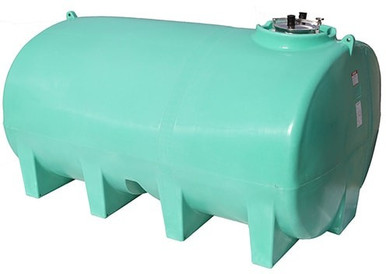
The tank physical configuration affects how easily the labeling installs and persists:
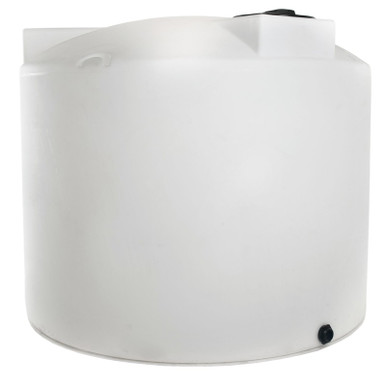
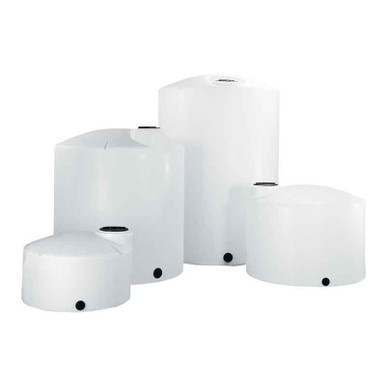
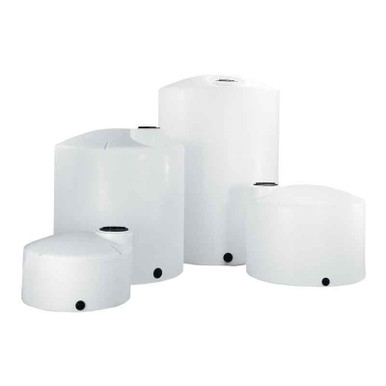
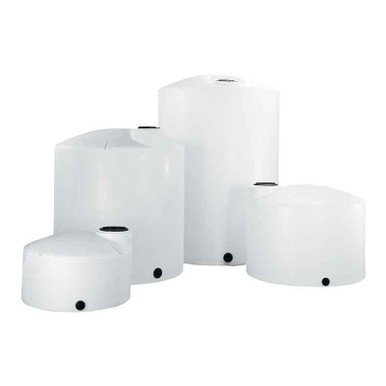
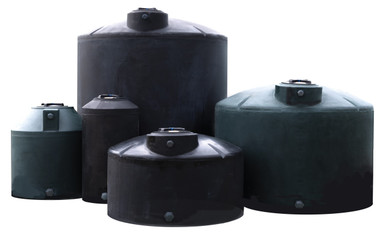
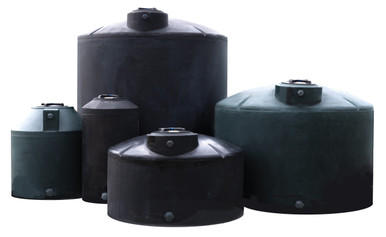
- Vertical tanks with cylindrical sidewalls present clean surfaces for tank-mounted signage. The labels can be installed at any rotation around the tank to face the prevailing approach direction. Reference N-40164 5000 gallon Norwesco vertical and N-43128 10,000 gallon Norwesco vertical for the bulk-storage envelope.
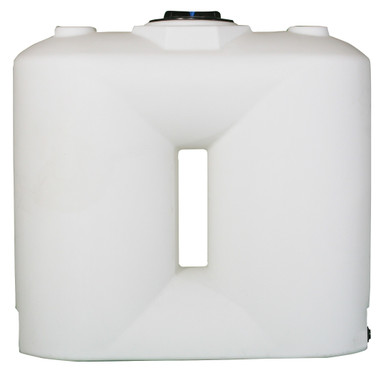
- Smaller capacity tanks where labeling on the tank itself is space-constrained. A 25 or 100 gallon tank may not have sufficient sidewall area for full NFPA 704 plus GHS plus product identification at legible size. The signage moves to a tank-adjacent post or to the wall behind the tank. Reference N-41867 25 gallon for the small-batch envelope and N-44800 100 gallon doorway tank for the small-capacity service envelope.
- Snyder Industries XLPE Captor double-wall tanks where the secondary-containment construction has signage implications. The double-wall construction may require additional or different signage for the interstitial-monitoring system. Reference SII-1006600N42 10,000 gallon XLPE Captor.
The label durability has to match the tank's outdoor exposure. UV-stable inks and substrates, chemical-splash-resistant materials, and mechanical durability for at least 5-10 years before re-labeling are the engineering targets. Pre-printed signage from industrial-supply sources is engineered for these conditions; field-printed paper labels in plastic sleeves are not. List pricing on the BC product page is for the standard tank without site-specific signage; the signage is a separate small-cost scope item that the customer or the installer specifies. LTL freight to your ZIP via the freight estimator or by phone at 866-418-1777.
9. Maintenance and Re-Labeling
Labels degrade. UV exposure fades pigments and embrittles plastic substrates. Chemical splash chemically attacks inks and adhesives. Mechanical abrasion from handling and weather slowly removes coverage. The compliant installation today becomes the non-compliant installation in 3-7 years if the labels are not maintained.
The label-maintenance program:
- Annual visual inspection. Walk every label at every tank, pipe, and signage location. Verify legibility at the inspection viewing distance. Flag any label with faded color, missing pictogram, illegible text, or compromised adhesion.
- Replacement on flag. Flagged labels are replaced within 30-90 days depending on severity. The replacement uses the same source material and verified-current rating as the original; chemistries with updated SDS hazard ratings get the updated rating on the new label.
- Re-labeling at chemistry changes. Any change in stored chemistry triggers a complete re-labeling of the affected tank, piping, and signage locations. The change-management procedure documents the chemistry change and the re-labeling completion before the new chemistry is introduced.
- Documentation. The labeling inspection results, replacement records, and re-labeling events go in the site's HazCom records. The records are reviewed during regulatory inspections and provide the audit trail for label currency.
The maintenance program is small-cost in absolute terms but high-impact in regulatory and safety terms. A site that maintains its labels passes the inspections; a site that has neglected labeling for 5 years has a multi-day project to bring everything current and faces inspection-driven enforcement in the meantime.
10. The Compliance Engineering Conclusion
Tank label and signage compliance is the engineering work of reconciling four overlapping regulatory programs that were written by different authors for different audiences. The NFPA 704 diamond serves emergency responders. The GHS HazCom label serves workers. The DOT placards serve transportation responders. The local fire code adds jurisdiction-specific layers. Each program has its required signage; the reconciled installation uses each program's signage in its proper location without trying to combine them into hybrid labels that confuse one inspector while satisfying another.
The labeling mistakes that produce inspection citations are not exotic. NFPA 704 diamonds at non-visible locations or in incorrect sizes for the viewing distance. GHS labels missing the signal word or precautionary statements. Pipe markers without flow-direction arrows. Signage that has degraded past legibility and was never replaced. Hybrid labels that combined elements from multiple programs into a single sign that satisfies none of them. None of these mistakes require novel engineering to prevent; all of them require the discipline to follow each program's specification consistently and to maintain the labels through their service life.
OneSource Plastics ships the polyethylene tanks across all 5 brands — Norwesco, Snyder, Chem-Tainer, Enduraplas, Bushman — with shell construction that supports site-installed labeling and with dimensional drawings that the installer uses to plan the signage layout. The site-specific signage is a separate scope from the tank itself; the customer or the installer specifies it based on the contained chemistry, the local fire code, and the OSHA HazCom requirements. List pricing by SKU on the product page; LTL freight to your ZIP and the signage installation scope are quoted separately. Reference the freight estimator or call 866-418-1777. For related operations engineering see secondary containment requirements and tank specification sheet reading.
Recommended Tanks for This Guide
Live pricing, updated automatically · estimate freight to your ZIP.