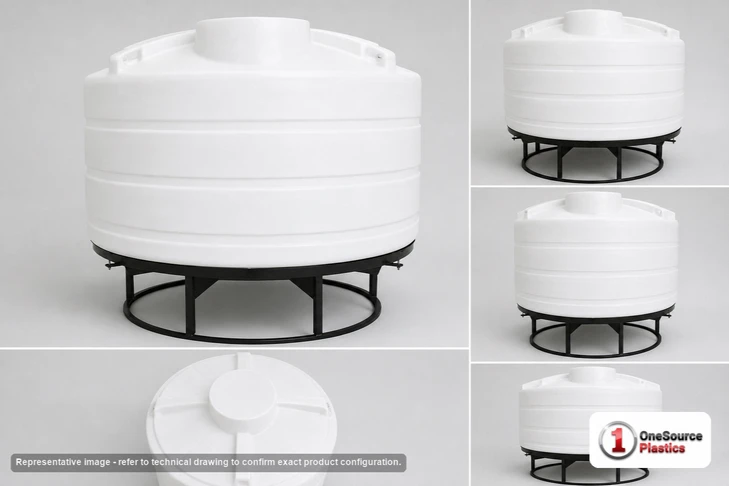
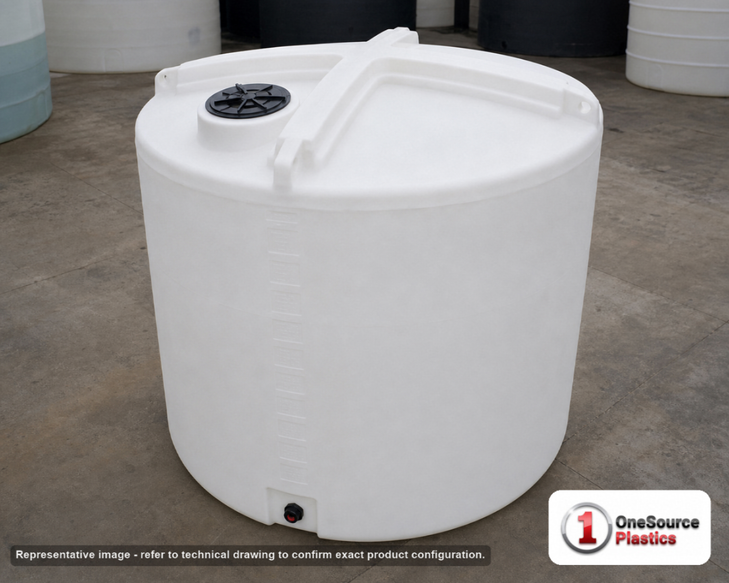
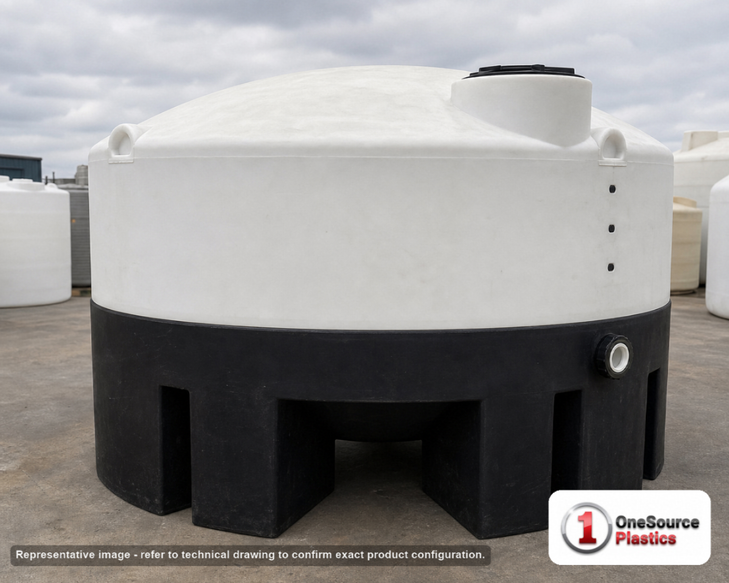
The Enduraplas 1350 Gallon Green Cone Bottom Tank is a polyethylene cone bottom tank built for full-drain bulk chemical service, and its 1.9 specific gravity rating is the top SG tier in this Enduraplas cone line. Molded in green at 1,350 gallons, it stands 75 inches tall on an 85 x 85 inch footprint, and the sloped cone discharges contents completely so you are not pumping off a flat floor or leaving residue behind. If you have been searching for a cone bottom tank or a cone tank from Enduraplas, this is the size that bridges large-batch chemistry and a manageable footprint.
Will it handle your contents?
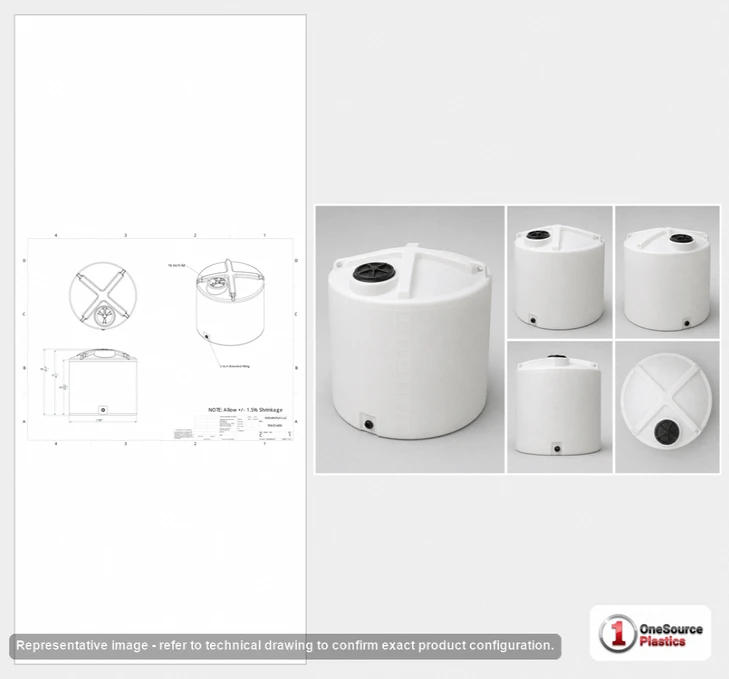
The 1.9 SG rating is the number that matters here: the tank wall is engineered for liquids up to 1.9 times the weight of water, which covers nearly every common water-treatment and industrial chemical. Filled with plain water this tank carries 11,259 pounds; at its maximum rated contents weight it carries 21,392 pounds. Because a cone bottom tank transfers its entire load to a steel or fiberglass support structure rather than the ground, that 21,392 lb figure is the number your stand and pad must be rated for - under-rating the stand is the failure mode. Confirm the size against your batch volume with the Tank Sizing Calculator and the Tank Sizing Guide, and match the stand using the Cone Bottom Tank Stand Compatibility Matrix before you order. See the technical drawing on this page for fitting locations and overall dimensions.
Chemical compatibility
This tank is molded from polyethylene and rated to 1.9 specific gravity - the heaviest tier in this cone line, so there is no higher-SG version to step into and you should not run service above 1.9 SG in this tank. The resin designation on file reads as HDLPE but is not fully confirmed: confirm HDLPE versus XLPE (cross-linked) with us at 866-418-1777 before you commit it to aggressive chemical service, since the two resins behave differently against oxidizers and solvents. At 1.9 SG this tank suits dense bulk chemistry such as DEF at 32.5% (316SS fittings, EPDM gaskets) and urea solution at 50% (PP/PVC fittings, EPDM gaskets) - note the distinct fitting metals between the two. Always size your stored chemical's specific gravity against the 1.9 rating, and select fittings and gaskets to match the chemical, not just the tank. The ranges below come from the OEM chemical-resistance chart and are concentration and temperature specific, so confirm your exact conditions before service:
- Acetic Acid (60%) - PP/PVC fittings, EPDM gaskets
- Aluminum Sulfate (50%) - PVC fittings, EPDM gaskets
- Calcium Chloride (40%) - PVC fittings, EPDM gaskets
- DEF (32.5%) - 316SS fittings, EPDM gaskets
- Ethylene Glycol (100%) - PVC fittings, EPDM gaskets
- Ferric Chloride (50%) - PVC fittings, EPDM gaskets
- Ferric Sulfate (60%) - PVC fittings, EPDM gaskets
- Ferrous Sulfate (20%) - PVC fittings, EPDM gaskets
- Hydrochloric Acid (37%) - PVC fittings, Viton gaskets
- Hydrofluoric Acid (48%) - PP/PVC fittings, Viton gaskets
- Hydrofluosilicic Acid (26%) - PP/PVC fittings, Viton gaskets
- Hydrogen Peroxide (50%) - PVC fittings, Viton gaskets
- Magnesium Chloride (30%) - PVC fittings, EPDM gaskets
- Peracetic Acid (30%) - 316SS fittings, Aflas gaskets
- Phosphoric Acid (85%) - PVC fittings, Viton gaskets
- Polyaluminum Chloride - PVC fittings, EPDM gaskets
- Potassium Carbonate (50%) - PVC fittings, EPDM gaskets
- Potassium Hydroxide (saturated) - PVC fittings, EPDM gaskets
- Propylene Glycol - PP/316SS fittings, EPDM gaskets
- Sodium Bisulfate - PVC/PP fittings, EPDM gaskets
- Sodium Bisulfite - PVC/PP fittings, EPDM gaskets
- Sodium Carbonate (30%) - PVC fittings, EPDM gaskets
- Sodium Hypochlorite (<16.5%) - PVC fittings, Viton gaskets
- Sodium Thiosulfate (40%) - PVC fittings, EPDM gaskets
- Sulfuric Acid (98%) - CPVC fittings, Viton gaskets
- Urea Solution (50%) - PP/PVC fittings, EPDM gaskets
- Zinc Orthophosphate - PP/316SS fittings, EPDM gaskets
- Ozonated Water (up to 10 PPM) - PVC fittings, EPDM gaskets
The gasket call-out is where most chemical-tank installs go wrong. EPDM covers most salts and bases, but the strong oxidizers and concentrated acids require Viton - sodium hypochlorite, hydrogen peroxide, sulfuric acid (98%), phosphoric acid (85%), hydrochloric acid (37%), and the fluoride acids (hydrofluoric, hydrofluosilicic) - and peracetic acid requires Aflas. Browse the full Chemical Compatibility Database to look up anything not listed above.
The mistake to avoid
The most expensive error on a cone bottom chemical tank is fitting and gasket mismatch. A correct 1.9 SG tank with the wrong gasket will still leak or fail at the bulkhead, so cross-check both the fitting material and the gasket against your chemical before ordering, and lay out your top penetrations deliberately. Our guide on tank top fitting placement strategy covers vent, fill, level and drain layout, and the level gauge selection guide walks through gauge choices for chemical service. If you store a hazardous chemical, follow our tank labeling and signage compliance guide for NFPA 704 and GHS placement.
This tank ships LTL freight from the Enduraplas plant in Neche, ND, with the rate quoted live to your ZIP. Get your number in seconds with the Freight Cost Estimator, or call 866-418-1777 and we will quote the freight, confirm the resin and SG for your chemical, and help you spec the right cone stand and fittings before you buy.
Freight and documents
Ships from: Neche, ND. LTL freight is quoted to your ZIP with the freight cost estimator or by phone at 866-418-1777. The listed price is before freight.
See this tank
Interactive 3D model with live fill. This tank has an interactive 3D model built to its manufacturer dimensions. Rotate it, and set a fill level to see how much liquid it holds at any height. Open the 3D view on the product photo above. Download the 3D model (GLB).
Ready to order?
Add it to your cart at the top of this page, get LTL freight to your ZIP, request a written quote, or call 866-418-1777. The listed price is before freight.