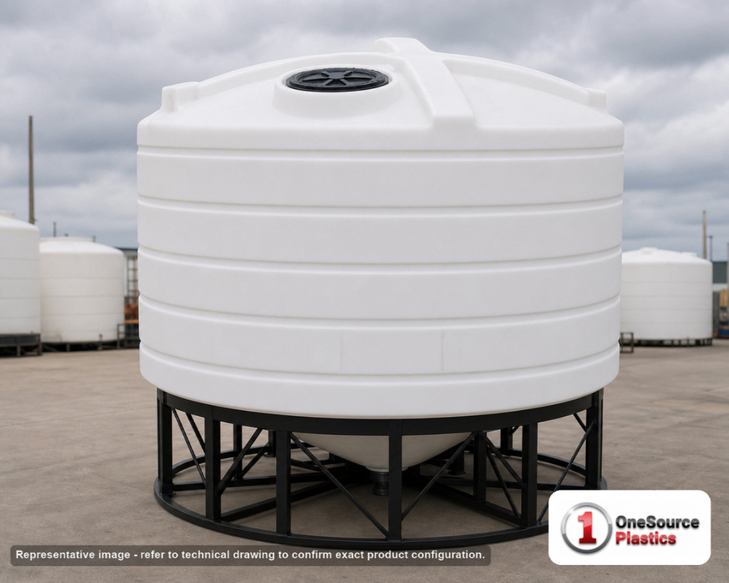
The Enduraplas 2520 Gallon White Cone Bottom Tank is built for full-drain chemical and process service where you need to empty every gallon and keep solids moving toward the outlet.Molded from polyethylene in natural white and rated to a 1.9 specific gravity, this 2520-gallon cone bottom holds heavy liquids that would overload a standard 1.0 to 1.9 SG tank.It stands 99 inches tall on a 110 x 110 inch footprint and is a leading choice when buyers search for a high-density cone bottom tank or a white cone tank for concentrated media.
Will it work for your application?
The 1.9 SG rating is the spec that decides this purchase.Stated as weight, the tank is rated to carry up to 39,932 lb of contents versus 21,017 lb when full of plain water - roughly 19,000 lb of density headroom, or about 1.9 times water.That margin is what lets you store concentrated acids and heavy brines that sink most polyethylene tanks.At 1.9 SG this is the highest-density rating available in polyethylene; for anything heavier you are into lined steel or FRP, not poly.Because this is a cone bottom design, it must sit in a matching steel or poly stand sized to the 110 x 110 inch footprint and the 99-inch height - it is not a flat-bottom tank and cannot stand on its own.Confirm your stand before delivery with our cone bottom tank stand compatibility matrix, and if you are still sizing the vessel, the Tank Sizing Calculator and Tank Sizing Guide confirm that 2,520 gallons is the right working volume.This listing covers the bare tank; fittings are not pre-installed, so you spec the bulkhead, outlet, and vent package to your chemical.
Chemical compatibility
This is a polyethylene tank rated to 1.9 SG.Our data does not confirm whether the resin is linear (HDLPE) or crosslinked (XLPE), and the two behave differently with certain reagents - verify the exact resin with Enduraplas for your chemical before putting this tank in chemical service.Always check the OEM chemical-resistance chart at your precise concentration and temperature; the ratings below are concentration-specific and assume ambient service.
Chemicals this tank and 1.9 SG rating support, with the fitting and gasket materials to spec, include: acetic acid (60%, PP/PVC fittings, EPDM gaskets), aluminum sulfate (50%, PVC, EPDM), calcium chloride (40%, PVC, EPDM), DEF (32.5%, 316SS, EPDM), ethylene glycol (100%, PVC, EPDM), ferric chloride (50%, PVC, EPDM), ferric sulfate (60%, PVC, EPDM), ferrous sulfate (20%, PVC, EPDM), hydrochloric acid (37%, PVC, Viton), hydrofluoric acid (48%, PP/PVC, Viton), hydrofluosilicic acid (26%, PP/PVC, Viton), hydrogen peroxide (50%, PVC, Viton), magnesium chloride (30%, PVC, EPDM), peracetic acid (30%, 316SS, Aflas), phosphoric acid (85%, PVC, Viton), polyaluminum chloride (PVC, EPDM), potassium carbonate (50%, PVC, EPDM), potassium hydroxide (saturated, PVC, EPDM), propylene glycol (PP/316SS, EPDM), sodium bisulfate (PVC/PP, EPDM), sodium bisulfite (PVC/PP, EPDM), sodium carbonate (30%, PVC, EPDM), sodium hypochlorite (under 16.5%, PVC, Viton), sodium thiosulfate (40%, PVC, EPDM), sulfuric acid (98%, CPVC, Viton), urea solution (50%, PP/PVC, EPDM), zinc orthophosphate (PP/316SS, EPDM), and ozonated water (up to 10 PPM, PVC, EPDM).Confirm your reagent in the full Chemical Compatibility Database before you commit.
The mistake to avoid
The costly error on a tank like this is matching fittings and gaskets to the tank instead of to the chemical.The polyethylene wall may hold a reagent fine, but the wrong gasket fails fast - putting EPDM where Viton or Aflas belongs is the most common cause of a leaking bulkhead fitting.Per the chart above, Viton is required for hydrochloric acid, hydrofluoric acid, hydrofluosilicic acid, hydrogen peroxide, phosphoric acid, sodium hypochlorite, and sulfuric acid; Aflas is required for peracetic acid; and DEF and peracetic acid both call for 316 stainless fittings, not PVC, so do not assume an all-PVC fitting package.Build the fitting and gasket spec off the chemical-resistance chart, not off whatever ships standard.For chemical service it also pays to plan level monitoring early; our guide on tank level gauge selection for chemical service covers radar versus ultrasonic versus hydrostatic versus magnetostrictive for corrosive media.You can confirm wall thickness, outlet location, and stand dimensions against the technical drawing on this page.
This cone bottom tank ships LTL freight from the Enduraplas plant in Neche, ND, quoted live to your ZIP.Get a real number in seconds with our Freight Cost Estimator, or call 866-418-1777 to talk through stand selection, fitting layout, and freight on this 2520-gallon cone bottom tank.
Freight and documents
Ships from: Neche, ND. LTL freight is quoted to your ZIP with the freight cost estimator or by phone at 866-418-1777. The listed price is before freight.
Technical drawing (PDF) for Enduraplas THC02520W.
See this tank
Interactive 3D model with live fill. This tank has an interactive 3D model built to its manufacturer dimensions. Rotate it, and set a fill level to see how much liquid it holds at any height. Open the 3D view on the product photo above. Download the 3D model (GLB).
Ready to order?
Add it to your cart at the top of this page, get LTL freight to your ZIP, request a written quote, or call 866-418-1777. The listed price is before freight.