


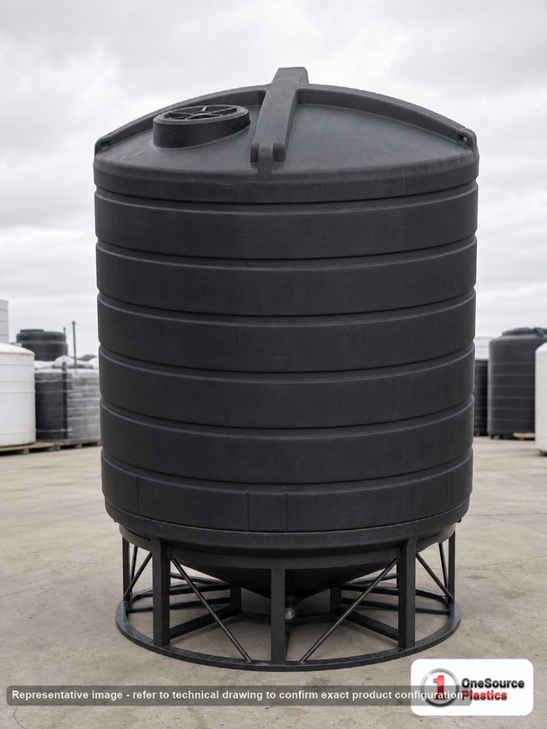
The Enduraplas 4000 Gallon Black Cone Bottom Tank is built for full-drain bulk chemical service, with a 1.9 specific-gravity rating that puts it among the heaviest-duty polyethylene cone tanks in the lineup. Measuring 135 in tall on a 110 x 110 in footprint (110 in across), this is a tall vessel that needs a matched stand and adequate overhead clearance for fill and venting. The cone-bottom geometry forces complete gravity drainage, so settled solids, slurries, and aggressive concentrates clear out instead of pooling on a flat floor. The black resin blocks light to limit algae and slows UV breakdown for outdoor installations.
Will it work for your application?
This is a 4000-gallon cone tank molded from polyethylene with a 1.9 SG rating, meaning it is built to hold dense liquids well beyond water weight. Filled with water alone the contents weigh about 33,360 lb; at the full 1.9 SG rating the contents can reach roughly 63,384 lb. Plan your foundation, stand, and anchoring around the heavier rated figure, not the water number, since cone tanks carry their entire load through a support structure rather than a flat pad. Use the Tank Sizing Calculator and Tank Sizing Guide to confirm the tank, stand, and chemical weight all line up before you order, and review the cone bottom tank stand compatibility matrix covering Norwesco, Snyder, and Enduraplas. Confirm exact fitting locations and overall geometry against the technical drawing on this page before finalizing your layout.
Chemical compatibility
This tank is molded from polyethylene rated to 1.9 specific gravity. The resin type is listed as HDLPE but is not fully confirmed, so confirm HDLPE versus XLPE with us before committing the tank to chemical service, because the resin choice changes how it tolerates certain concentrations over time. The fitting and gasket materials below come from the OEM chemical-resistance chart, which is concentration- and temperature-specific; verify your exact concentration and operating temperature against that chart for your chemical. Most listed chemicals run on PVC fittings with EPDM gaskets, but the highest-risk services are the exceptions: sulfuric acid (98%) needs CPVC fittings and Viton gaskets; sodium hypochlorite (<16.5%), hydrochloric acid (37%), hydrogen peroxide (50%), phosphoric acid (85%), hydrofluoric acid (48%), and hydrofluosilicic acid (26%) all call for Viton gaskets (the fluoride acids on PP/PVC fittings); peracetic acid (30%) needs 316SS fittings and an Aflas gasket; and DEF (32.5%) is specified for 316SS fittings with EPDM. Put an EPDM gasket on any of those and it can fail fast.
The remaining compatible chemicals run the standard PVC/EPDM combination unless noted: acetic acid (60%) on PP/PVC, aluminum sulfate (50%), calcium chloride (40%), ethylene glycol (100%), ferric chloride (50%), ferric sulfate (60%), ferrous sulfate (20%), magnesium chloride (30%), polyaluminum chloride, potassium carbonate (50%), potassium hydroxide (saturated), propylene glycol on PP/316SS, sodium bisulfate and sodium bisulfite on PVC/PP, sodium carbonate (30%), sodium thiosulfate (40%), urea solution (50%) on PP/PVC, zinc orthophosphate on PP/316SS, and ozonated water (up to 10 PPM). One cross-check worth flagging: DEF and bulk urea are not the same spec here. DEF (32.5%) is specified for 316SS fittings while a urea solution (50%) runs on PP/PVC, so confirm which one you are storing before you order valves and fittings. Verify every pairing against our Chemical Compatibility Database for your exact concentration and temperature.
The mistake to avoid
The most common and costly error on a high-SG cone tank like this is sizing the stand and fittings to the water weight instead of the chemical weight. A liquid near the 1.9 SG ceiling nearly doubles the load the support structure must carry, and an undersized stand or wrong-material fitting fails under that stress. Match the gasket and fitting material to your specific chemical and concentration above, lay out your top fittings deliberately to keep vent, fill, level, and drain from conflicting, and verify your operating temperature against the OEM chart. For planning your nozzle layout, see our guides on top fitting placement strategy and level gauge selection for chemical service, plus tank label and signage compliance for hazard placarding.
This tank ships LTL freight from the Enduraplas plant in Neche, ND, the nearest named shipping point, with freight quoted live to your ZIP. Get your number instantly with our Freight Cost Estimator, or call 866-418-1777 to confirm specs, resin type, and delivery before you order.
Freight and documents
Ships from: Neche, ND. LTL freight is quoted to your ZIP with the freight cost estimator or by phone at 866-418-1777. The listed price is before freight.
Technical drawing (PDF) for Enduraplas THC04000B.
See this tank
Interactive 3D model with live fill. This tank has an interactive 3D model built to its manufacturer dimensions. Rotate it, and set a fill level to see how much liquid it holds at any height. Open the 3D view on the product photo above. Download the 3D model (GLB).
Ready to order?
Add it to your cart at the top of this page, get LTL freight to your ZIP, request a written quote, or call 866-418-1777. The listed price is before freight.


