
Material Handling Tanks: Stackable IBC Totes & Transport Tanks
Material Handling Tanks — Stackable IBC Totes, Saddle Tanks, Transport Vessels
OneSource Plastics supplies the plastic tank inventory that distribution operators, manufacturing plants, fleet maintenance shops, and inter-facility transfer programs use to move bulk liquid in repeat cycles. Five OEM brands — Norwesco, Snyder Industries, Chem-Tainer, Enduraplas, and Bushman — cover the stackable IBC tote tanks (220 to 550 gallons, the workhorse of inter-facility liquid transfer), the applicator and saddle tanks for service-truck transport, the integrated-frame transport vessels for site-to-site relocation, and the lid-style cover tanks for batch handling on the production floor.
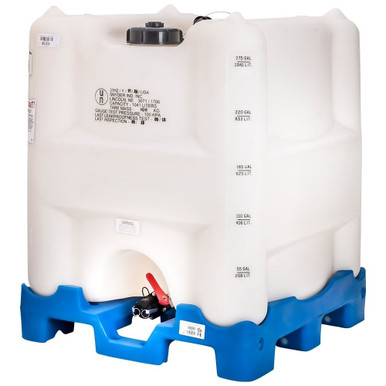
Featured: Snyder Industries 275 Gallon Plastic Stackable IBC Tote Tank Payloader System — the 275-gallon stackable IBC tote with payloader-style frame is the canonical inter-facility transfer vessel for distribution and chemical-handling operations.
1. Material handling tank applications — an overview
Material handling moves bulk liquid in repeat cycles between supplier, distribution warehouse, point of use, and recycling or disposal endpoint. The tank fleet covers four duty types in parallel. Stackable IBC tote tanks (the standardized 275- and 330-gallon footprint plus larger 550-gallon Megatainer configurations) cover the high-velocity inter-facility transfer cycle for chemicals, lubricants, food-grade ingredients, and water-based products; the stackable design allows two- or three-high storage in the warehouse footprint and standardizes the forklift and palletizer interface. Applicator and saddle tanks (50 to 300 gallons) ride in the bed of service trucks for spot-application work. Transport tanks with integrated steel frames (the Enduraplas frame line) handle site-to-site relocation by flatbed or rollback truck. Lid-style open-top batch tanks support batch handling on the production floor where the operator needs lid access for ingredient addition or sample draw.
Each duty has a distinct tank choice. IBC tote tanks ship UN31HA1/Y certified for non-hazardous and certain hazardous-material liquid transport under DOT 49 CFR 173 and 178 framework; the certification stamp on the cage and the bottle is the documentation the carrier and the regulator look for at any handoff. Saddle tanks ride in service-truck beds and need the integral leg or saddle geometry that stays vertical under partial fill. Integrated-frame transport tanks add the steel frame for crane-and-forklift relocation between sites. Open-top batch tanks support production-floor handling where the operator needs continuous access.
The pages below cover the spec discipline (UN31 IBC certification framework, ASTM D1998 wall-thickness engineering, OSHA materials-handling rules), the federal regulatory framework (DOT hazmat 49 CFR 173/178, OSHA 29 CFR 1910.176), and the chemistry compatibility intelligence that keeps a polyethylene tote inside the manufacturer warranty envelope when it cycles through repeat fill-and-empty service.
2. Why OneSource for material handling tanks
Five OEM brands, one catalog. Snyder Industries fills the stackable IBC tote range from 220 to 550 gallons; the Cagebuster, Excalibur, Megatainer, and Payloader configurations cover the full spread of cage geometries and forklift interfaces. Chem-Tainer covers smaller open-top batch tanks and lid-style cover tanks for production-floor handling. Norwesco fills the saddle and applicator tank range for service-truck transport. Enduraplas adds the integrated steel-frame transport tank line for site-to-site relocation. Bushman supplies the small vertical and slimline configurations for distributed inventory at multiple holding points. We carry every geometry and walk the operator through the trade-offs before quoting.
UN31 IBC certification framework. Stackable IBC tote tanks supplied for hazardous-material transport carry the UN31HA1/Y certification stamp under the DOT 49 CFR 178.703 marking framework. The certification covers the maximum specific gravity (the stamped value, typically 1.5 or 1.9), the working pressure, and the date of manufacture. IBC totes used in commerce are subject to the periodic-inspection requirements in 49 CFR 180.352: a leakproofness test every 2.5 years and a complete inspection every 5 years from the date of manufacture. Operators running a returnable-tote program should track the date stamp on each unit and rotate units approaching the inspection deadline through the requalification cycle.
ASTM D1998 wall thickness engineering. The standard for polyethylene upright storage tanks (ASTM D1998) defines the wall thickness as a function of the stored specific gravity, the tank diameter, and the design hoop stress. Tanks engineered to D1998 carry the published SG rating (1.0, 1.35, 1.5, 1.7, 1.9, 2.2 in the standard Snyder lineup); the operator must specify a tank rated equal to or above the specific gravity of the stored liquid. Specifying under-rated SG voids the warranty and accelerates wall fatigue under the cyclic load of repeat fill-and-empty service.
Pricing transparency. Every product page lists a current price before freight. LTL freight to the destination ZIP is quoted separately through the freight cost estimator or by phone at 866-418-1777. List prices on this site exclude freight; nothing on this catalog ships freight-included by default. Distribution accounts running multi-tote orders benefit from quote-desk freight consolidation across SKUs and recurring-replenishment scheduling.
3. Tank solutions for material handling operations
The product strip below pulls live inventory from our material-handling catalog — stackable IBC tote tanks in the 220- to 550-gallon range, applicator saddle tanks for service-truck transport, integrated-frame transport tanks for site-to-site relocation, and the open-top batch tanks for production-floor handling.
Need a specific size or fitting layout? Use our tank sizing calculator to translate inter-facility cycle volume into the right tote count, or open a custom-fabrication request for non-stock geometries such as integrated cooling-jacket totes, multi-compartment transport tanks, or custom forklift-interface frame mounts.
4. Chemical compatibility intelligence for material-handling chemistries
Material-handling totes and transport tanks cycle through a wide range of chemistries depending on the operator's program: lubricants, water-based cleaning chemistry, agricultural concentrate, DEF for fleet refill, food-grade ingredient transfer, and bulk water-treatment chemistry are all common. The pillars below cover six of the highest-volume material-handling chemistries.
- Diesel Exhaust Fluid (DEF, ISO 22241)
- Urea Solution (32 percent UAN)
- Sodium Hypochlorite (NaOCl)
- Calcium Chloride brine
- Glyphosate (commercial concentrate)
- Propylene Glycol
The full chemical compatibility database indexes 500+ chemistries; an operator transferring specialty chemistries through a returnable-tote program should cross-check every chemistry on the chemistry pillar before refilling a polyethylene tote, and should confirm the tote SG rating matches or exceeds the stored chemistry specific gravity.
5. Regulatory considerations for material handling tanks
Federal regulations governing material-handling tanks rest on the DOT Hazardous Materials framework, the OSHA general-industry rules for materials handling and storage, and the consensus standards for IBC certification and tank wall-thickness engineering. The fleet operator and the warehouse safety coordinator should treat each rule as a checklist item during program design.
49 CFR 173 — DOT Hazardous Materials Regulations. The hazmat regulations cover the classification, packaging, marking, labeling, placarding, and shipping-paper requirements for any hazardous material moved in commerce. IBC tote tanks transporting a listed hazardous material must use a UN-certified package matching the chemistry's packing group (Packing Group I, II, or III; lower numerals carry more restrictive packaging). The shipper certifies the proper packaging on the shipping paper; the carrier verifies the marking and the placarding before pickup. Operators running a returnable-tote program for hazardous-material transfer should integrate the shipping-paper preparation into the dispatch workflow.
49 CFR 178 — DOT specifications for packagings. The packaging-specifications subpart defines the construction, testing, and marking requirements for UN-certified packages including IBC totes. Subpart N covers the IBC-specific requirements: the design type test (drop test, stack test, leakproofness test, hydraulic-pressure test), the periodic retest cadence (leakproofness every 2.5 years, complete retest every 5 years per 49 CFR 180.352), and the marking requirements. The tote must carry the UN identification, the type code, the maximum specific gravity, the working pressure, the date of manufacture, and the manufacturer name on a permanent durable marking.
29 CFR 1910.176 — OSHA Materials Handling and Storage. The general-industry standard for materials handling covers the use of mechanical equipment, the secure storage of materials, the housekeeping of aisles and passageways, and the safe stacking and stability of stored materials. Stackable IBC totes must be stacked within the manufacturer's published stack rating (typically two or three units high empty plus one full at the top, depending on the cage design) and must rest on a level supporting surface with the specified clearances around the stack.
ISO 22241 — DEF (AdBlue) quality and handling specification. Diesel Exhaust Fluid (DEF) for use in selective-catalytic-reduction emission systems must meet ISO 22241 for purity, concentration (32.5 percent urea solution), and contamination control. DEF totes and transfer equipment must be dedicated to DEF service; cross-contamination from any other chemistry can disqualify the DEF and damage the SCR catalyst. Tanks rated for DEF service (the Snyder DEF totes and the dedicated Norwesco DEF storage line) ship with the ISO-22241 service designation; operators should not repurpose a tote that has carried any other chemistry into DEF service.
ASTM D1998 — polyethylene upright storage tank wall thickness. The standard for polyethylene upright tanks defines the wall thickness as a function of stored specific gravity, tank diameter, and design hoop stress. The tank operator must specify a tank rated equal to or above the specific gravity of the stored liquid. Specifying under-rated SG accelerates wall fatigue under the cyclic load of repeat fill-and-empty service typical of material-handling totes.
State and local hazmat overlays. Several states impose state-specific hazmat reporting and tracking rules beyond the federal baseline; California's hazardous waste tracking system and the New Jersey Department of Environmental Protection's bulk-storage rules are examples. State-specific rules are summarized on our state regulatory pages linked from the state regulations index.
6. Field handling and procurement for material handling operators
Sizing the IBC tote fleet. Inter-facility liquid transfer at the 275-gallon IBC standard typically prices the tote at less per gallon-shipped than 55-gallon drums and more per gallon-shipped than dedicated bulk transport tankers; the IBC sweet spot is the 250- to 5,000-gallon-per-month transfer cadence between two or three handoff points. A fleet running 2,000 gallons per month between supplier, distribution warehouse, and three field points typically sizes the tote pool at 8 to 12 totes (covers in-transit, in-warehouse, in-use, and in-cleaning rotation simultaneously). Stackable totes recover floor space (two-high storage drops the warehouse footprint per stored gallon by 40 percent versus single-stack storage) and the standardized 48-by-40-inch footprint integrates with standard pallet-handling equipment.
Cage geometry selection. The Snyder Cagebuster line carries a standard wire-cage geometry that matches the GENERIC IBC profile (compatible with the largest range of recovery and cleaning programs). The Excalibur line carries a heavier-gauge cage for repeat-cycle service and field abuse. The Megatainer 550-gallon configuration delivers double the capacity per tote in a footprint that still palletizes; the Payloader configuration adds a forklift-payloader frame for direct loader-bucket interface. The choice depends on the cycle abuse, the cleaning program, and the per-cycle volume.
Returnable versus one-way. Returnable IBC programs require a tote-return logistics flow, a cleaning-and-requalification supplier, and a tracking system to keep each tote on its inspection cadence. One-way IBC programs ship the chemistry to the customer and treat the tote as a consumable; the cost difference between returnable and one-way is typically 60 to 80 percent of the new-tote price spread over 4 to 8 cycles before the per-cycle break-even crosses. Operators running 1,000-gallon-per-month or higher transfer cadence to a single customer typically benefit from returnable; lower-cadence and multi-customer programs trend toward one-way.
Procurement cadence and pricing. Standard material-handling plastic tanks ship from manufacturer warehouses in two to four weeks for stock SKUs; the larger 550-gallon Megatainer configurations and the integrated-frame transport tanks run four to eight weeks. List prices on this site reflect the current OEM published pricing before LTL freight; freight to the destination ZIP is quoted separately through the freight estimator or by phone. Distribution-fleet accounts running recurring tote replenishment benefit from quote-desk freight consolidation and scheduled-delivery cadence.
Five-brand discipline. Norwesco, Snyder Industries, Chem-Tainer, Enduraplas, and Bushman cover the full domestic material-handling tank market. We do not pad the catalog with off-brand imports or no-name secondary suppliers. The five-brand discipline keeps the spec conversation grounded in published technical-bulletin data and keeps the warranty, the UN-certification documentation, and the replacement-parts pipeline intact.
7. Custom fabrication when stock will not fit
Specialty material-handling geometries route through our specialty & metal fabrication network. Typical custom builds: integrated cooling-jacket totes for temperature-sensitive food or chemical transfer, multi-compartment transport tanks that segregate two or three chemistries in a single trailer-bed footprint, custom forklift-interface frame mounts for non-standard handling equipment, and dedicated cleanout-port modifications for high-frequency cleaning programs. Lead times run six to twelve weeks depending on complexity; the quote desk runs the spec dialogue with the fabricator and stays involved through commissioning.
8. Next steps for the material handling operator
Quote the freight to the warehouse or distribution point. Every product page lists a price before freight. Get the LTL freight quote to your destination ZIP through the freight cost estimator, or call 866-418-1777 for a phone quote with the SKU plus destination ZIP plus dock-or-residential delivery indication.
Match the chemistry to the resin and the SG rating. Use the chemical-to-tank recommender to filter by chemistry plus capacity plus SG rating; the tool returns the ranked stock options with current pricing.
Open a custom request. If the spec falls outside the stock-tank envelope, the custom-fabrication request form routes the project to the right shop and the quote desk follows up the same business day. Include the chemistry, the cycle volume, the handoff cadence, and any handling-equipment constraints.