Tank Chemical Spill Cleanup: 7-Step Hot-Wash + Neutralize + Rinse Protocol
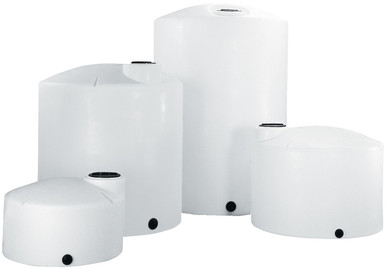
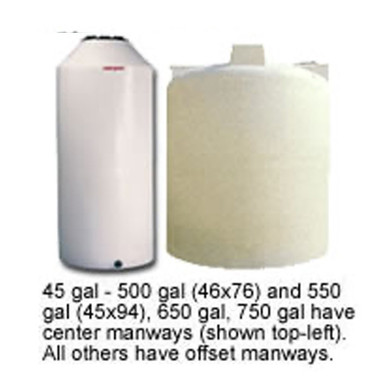
A 2,500-gallon polyethylene tank holding 50% sodium hydroxide cracks at the lower fitting boss at 2 AM on a Saturday. By 7 AM the responder arrives to find 800 gallons of caustic on the secondary containment floor, a dilute caustic puddle on the access road where the rain drained the spill area, and an operator who has been hosing the area down with potable water without reading the SDS. This is the wrong start. The next 12 hours determine whether the cleanup is documented, defensible, regulatory-compliant, and safe — or whether the responder creates a worse problem than the original release.
This guide walks the 7-step decontamination protocol that converts a spill from a hazardous-condition emergency into a managed, documented, regulatorily-defensible cleanup. The chemistry, dose math, and regulatory framework are real and verified: OSHA 29 CFR 1910.120 (HAZWOPER), EPA 40 CFR 264 Subpart F/G (RCRA TSDF post-closure), DOT 49 CFR 173 (hazmat packaging for waste transport), and SDS section 6 (accidental release measures) are the governing references throughout.
Step 0: Stop, Read the SDS, Do Not Improvise
Before the first drop of water, the responder reads SDS sections 4 (first aid), 6 (accidental release), 7 (handling and storage), 9 (physical and chemical properties), and 10 (stability and reactivity). The SDS is the legal authority for cleanup choices on this specific chemistry. Improvising — "I know how to clean up acid, this is acid, give me a hose" — is the failure mode that converts a single-tank release into a multi-tank reaction event.
For sodium hydroxide release, SDS section 6 typically reads: "Absorb with inert dry material (sand, vermiculite, dry earth). Do not use sawdust or other combustible absorbent (exothermic with hypochlorite contamination). Cautiously neutralize residual with dilute acid. Do not allow contact with aluminum, zinc, or galvanized surfaces." Every word matters. The "do not use sawdust" line specifically prevents one of the common amateur mistakes.
Step 1: Isolate and Eliminate Ignition / Reactivity Hazards
- Stop the source — close the upstream valve, plug the leaking fitting, transfer remaining contents to a recovery tank. The faster the source is stopped, the smaller the spill.
- Eliminate ignition sources for flammable releases — kill electrical, prohibit smoking, remove vehicles per NFPA 30 Section 7 for flammable and combustible liquid handling. The minimum ignition-control zone is determined by the flash point of the contents and the ventilation conditions of the spill area.
- Identify reactive incompatibilities — caustic versus acid stored in the same containment, oxidizer versus organic, acid versus cyanide salt. Per OSHA 29 CFR 1910.120(j) and EPA 40 CFR 264.17, incompatible wastes cannot be commingled. The spill response must keep them separated.
- Establish exclusion zone, contamination reduction zone, support zone — the three-zone HAZWOPER scheme per OSHA 29 CFR 1910.120(q)(3). Personnel cross zones only at controlled access points wearing appropriate PPE.
Step 2: Contain and Prevent Further Spread
- Secondary containment — if the tank is in a properly sized containment per the EPA Spill Prevention Control and Countermeasure rule (40 CFR 112) the spill is already contained. If containment was undersized or absent, deploy spill berms, absorbent socks, or pneumatic plugs at storm drains to prevent migration.
- Storm drain protection — spill kits with drain covers per EPA stormwater rules under 40 CFR 122. Any release that reaches navigable waters triggers Clean Water Act Section 311 reporting at 40 CFR 110.6 if a sheen is visible.
- Vapor management — for volatile or odorous releases, consider water-fog vapor suppression, foam blanket (NFPA 11), or active ventilation if the release area is enclosed.
Step 3: Recover Bulk Material
Bulk recovery before any water is added. The reason: water added to a high-concentration spill before bulk recovery dilutes the chemistry but increases the mass of waste that must be transported, treated, and disposed. A 100-gallon concentrated caustic spill that fills a 100-gallon recovery tank costs less to dispose of than a 1,000-gallon dilute caustic-water mixture that fills 10 recovery tanks. Bulk recovery options:
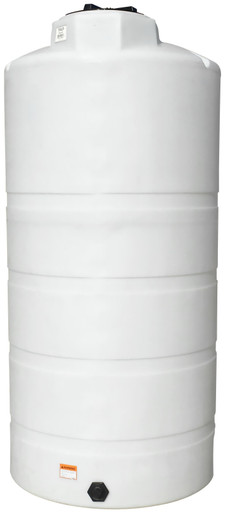
- Air-operated diaphragm pump (AODD) — chemistry-compatible diaphragms (Viton for solvents, EPDM for caustics, PTFE for general). Discharge to a recovery tank rated for the contents. Norwesco MPN 44217 (110-gallon full-drain inductor) is a typical small-volume recovery tank candidate; Norwesco MPN 43852 (1,000-gallon cone bottom) works for medium-volume recovery where gravity drain to a tanker is needed.
- Vacuum truck — for releases over 500 gallons, contracted vacuum trucks (3,000-6,000 gallon tank) are usually faster than pumping. The truck must be DOT-placarded for the contents; the carrier must have an EPA hazardous waste hauler ID per 40 CFR 263.
- Inert absorbent for residual — vermiculite, sand, clay, or chemistry-specific absorbent (per SDS section 6). Spread, allow contact time, sweep into appropriate hazardous-waste container per DOT 49 CFR 173.
Step 4: Hot-Wash with Detergent (Pre-Neutralization Detergent Rinse)
Once bulk material is recovered, hot-water plus detergent dissolves residual chemical adsorbed onto concrete, asphalt, and surface films. The hot wash is not the final cleanup — it is the preparation step that exposes the residual chemistry for proper neutralization.
- Water temperature — 140-160 F is the working range. Hotter accelerates dissolution but increases vapor generation; cooler reduces dissolution rate.
- Detergent — non-ionic surfactant compatible with the contents. Anionic surfactants can react with cationic contents. Test small area first.
- Application — low-pressure to avoid aerosolization. Pressure washers are the wrong tool for chemical spill cleanup; they generate breathable mist of the contaminant. Soft-flow application via fire hose, garden hose with fan nozzle, or detergent applicator wand.
- Recovery — collect every drop. Containment dam plus wet-vacuum recovery is standard. The hot-wash water is itself a regulated waste under EPA RCRA "derived from" rule at 40 CFR 261.3(c)(2)(i) if the original chemistry is listed.
Step 5: Neutralize
Neutralization converts the residual chemistry into a non-hazardous form before final rinse. The neutralization choice depends on the contents:
- Acid spills (HCl, H2SO4, HNO3, H3PO4, acetic) — neutralize with dilute soda ash (Na2CO3) or sodium bicarbonate (NaHCO3). Bicarbonate is preferred for amateur use because it self-buffers at pH 8.3 and cannot over-shoot to a caustic condition. Soda ash is faster but can overshoot.
- Caustic spills (NaOH, KOH, ammonia) — neutralize with dilute citric acid, dilute acetic acid, or dilute phosphoric acid. Mineral acids (HCl, H2SO4) react too aggressively for general use. The reaction NaOH + CH3COOH = NaCH3COO + H2O proceeds to acetate salt at pH 5-7, well within drainage tolerance.
- Oxidizers (bleach, hypochlorite, peroxide, nitrate) — reduce with sodium thiosulfate (Na2S2O3) for hypochlorite or with sodium bisulfite (NaHSO3) for general oxidizers. NEVER neutralize oxidizers with organic acids — exothermic decomposition.
- Heavy metals (chromate, mercury) — precipitate with sulfide reagent or hydroxide precipitation per EPA TCLP guidance at 40 CFR 261.24. Heavy-metal contamination requires laboratory analysis before disposal.
Dose calculation for acid neutralization with soda ash: stoichiometric ratio is 53 g Na2CO3 per 36.5 g HCl (1.45 g Na2CO3 per g HCl, by mass). For 1 gallon of 36% HCl (specific gravity 1.18), the acid mass is 4.46 lb HCl. Stoichiometric neutralization requires 6.46 lb Na2CO3. Apply 1.5x stoichiometric (10 lb Na2CO3) to ensure full neutralization with margin.
For caustic neutralization with citric acid: 192 g citric acid per 120 g NaOH (1.6 g citric per g NaOH, by mass). For 1 gallon of 50% NaOH (specific gravity 1.53), NaOH mass is 6.4 lb. Stoichiometric neutralization requires 10.2 lb citric acid. Apply 1.3x (13 lb) for margin.
Always neutralize from the dilute end toward the contents — never add concentrated neutralizer to concentrated contents (exothermic, splash hazard). Make a 5-10% neutralizer solution in water first, then add the solution slowly to the contaminated area.
Step 6: Rinse and Verify
- Final rinse — clean potable water at low pressure. Volume of rinse water is 3-5x the volume of contamination removed during steps 4-5.
- pH verification — after final rinse, surface pH should read 6-8 on calibrated pH paper or pH meter. ASTM D1293 governs pH measurement of water. Surface pH outside 6-8 indicates incomplete neutralization; repeat steps 5-6.
- Conductivity verification — for chemistries where pH is not informative (e.g., chloride, sulfate, nitrate salt residue), conductivity per ASTM D1125 detects residual ionic loading. Background conductivity on a clean concrete pad is <100 microsiemens/cm; post-cleanup conductivity should approach background.
- Wipe sample — for hazardous-substance cleanup with regulatory documentation, a wipe sample analyzed per appropriate EPA SW-846 method (e.g., 8270 for organics, 6010 for metals) is the legally defensible verification. Sample collection per ASTM D6661 for surface contamination.
Step 7: Documentation, Reporting, Disposal
- Reportable quantity (RQ) determination — under CERCLA 40 CFR 302.4, certain chemicals have a federal RQ that triggers National Response Center notification at 800-424-8802 if exceeded. State RQs may be lower; check state environmental agency. State regulations hub documents state-specific RQ thresholds.
- SARA Title III Section 304 — extremely hazardous substance releases above their RQ require notification to State Emergency Response Commission and Local Emergency Planning Committee.
- Waste manifest — hazardous waste collected during cleanup ships under EPA Form 8700-22 manifest per 40 CFR 262.20-23. The generator (site owner) signs the manifest; the transporter signs at pickup; the TSDF signs at receipt. Copies retained 3 years per 40 CFR 262.40.
- Spill report file — written report including time, contents, volume, response actions, samples taken, manifest numbers, and corrective action. Retained for the longer of 3 years (RCRA) or 5 years (CERCLA Section 113 statute of limitations).
- Replacement tank ordering — if the failed tank is being replaced, document the failure mode (UV degradation, stress crack, fitting failure, mechanical damage) for future selection. The replacement-tank specification should address the root cause, not just the symptom.
Replacement Tank Catalog
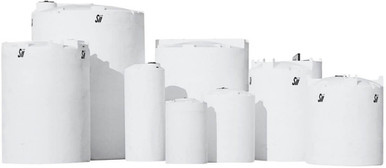
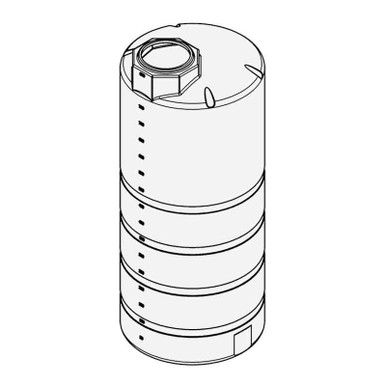
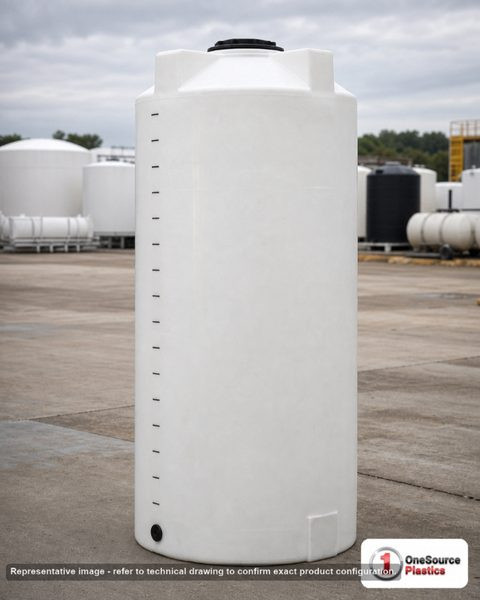
If the spill resulted from tank failure, OneSource catalog options for like-for-like replacement, sized correctly for the contents and specific gravity, include:
- Caustic / sodium hypochlorite / acid storage (SG 1.5-1.9) — Norwesco MPN 47564 (2,000-gallon SG 1.9), Norwesco MPN 42380 (3,000-gallon), Norwesco MPN 47620 (6,502-gallon).
- Cone-bottom for full-evacuation transfer / spill-recovery service — Norwesco MPN 44217 (110-gallon inductor), Norwesco MPN 43852 (1,000-gallon 45-deg), Norwesco MPN 40813 (1,600-gallon 30-deg with stand).
- Horizontal leg tank for distributed storage / containment plus contents — Norwesco MPN 40775 (2,035-gallon), Norwesco MPN 41294 (2,635-gallon).
List prices are quoted before LTL freight. Use the Freight Cost Estimator for delivered pricing to a specific ZIP. For chemistry-service replacement tank selection, the Chemical Tank Recommender selects the correct specific-gravity rating, color (UV stabilization), and certification class. The Chemical Compatibility Reference documents per-chemistry attack rates and resin selection.
Internal References
- State Regulations Hub — state-specific reportable quantities and spill reporting agencies
- Chemical Compatibility Reference — failure-mode prediction by chemistry
- Chemical Tank Recommender — replacement tank specification by contents
- Freight Cost Estimator — delivered pricing for replacement tank
- Tank Sizing Calculator — capacity validation for recovery / replacement
- Environmental Containment Fabrication — secondary containment and bulk recovery custom builds
- Specialty & Metal Fabrication Hub — custom recovery and treatment tank options
Source Citations
- OSHA 29 CFR 1910.120 — Hazardous Waste Operations and Emergency Response (HAZWOPER); paragraphs (j) incompatibility, (q)(3) zone scheme
- OSHA 29 CFR 1910.132-138 — Personal Protective Equipment selection
- OSHA 29 CFR 1910.1200 — Hazard Communication Standard (SDS authority)
- EPA 40 CFR 110.6 — Discharge of Oil; sheen reporting threshold
- EPA 40 CFR 112 — Spill Prevention, Control, and Countermeasure (SPCC) plan requirements
- EPA 40 CFR 122 — National Pollutant Discharge Elimination System (stormwater)
- EPA 40 CFR 261.3 — Definition of Hazardous Waste; "derived from" rule
- EPA 40 CFR 261.24 — Toxicity Characteristic Leaching Procedure (TCLP) thresholds
- EPA 40 CFR 262.20-23, 262.40 — Generator Manifest and Recordkeeping
- EPA 40 CFR 263 — Standards for Hazardous Waste Transporters
- EPA 40 CFR 264 Subpart F/G — TSDF post-closure (referenced for cleanup standards)
- EPA 40 CFR 302.4 — CERCLA Reportable Quantities
- EPA SARA Title III Section 304 — Emergency Release Notification
- DOT 49 CFR 173 — Shippers - General Requirements for Shipments and Packagings
- DOT 49 CFR 172.504 — Placarding Requirements
- NFPA 30 — Flammable and Combustible Liquids Code (Section 7 storage)
- NFPA 11 — Standard for Low-, Medium-, and High-Expansion Foam
- NFPA 472 / 1072 — Competence for Hazardous Materials/Weapons of Mass Destruction Incident Responders
- ASTM D1293 — Standard Test Method for pH of Water
- ASTM D1125 — Standard Test Method for Electrical Conductivity and Resistivity of Water
- ASTM D6661 — Standard Practice for Field Collection of Surface Wipe Samples
- EPA SW-846 — Test Methods for Evaluating Solid Waste, Physical/Chemical Methods
- OneSource Plastics master catalog data, dated 2026-03-26 snapshot (9,419 products across Norwesco, Snyder, Chem-Tainer, Enduraplas, Bushman)
Recommended Tanks for This Guide
Live pricing, updated automatically · estimate freight to your ZIP.