
Chemical Processing Plastic Tanks & Equipment
Chemical Processing Plastic Tanks & Equipment
OneSource Plastics supplies the bulk plastic and FRP tank inventory that chemical processors use to store acids, caustics, oxidizers, brines, and water-treatment chemistries at site capacities from 100 gallons to 20,000 gallons. We carry the five OEM brands that dominate North American chemical-storage applications — Norwesco, Snyder Industries, Chem-Tainer, Enduraplas, and Bushman — so a process engineer can specify by resin (HDPE, XLPE, FRP), specific gravity (1.5 or 1.9), and containment configuration (single-wall, double-wall, secondary dike) without leaving one catalog. Our 511-chemical compatibility database, 50-state regulatory pillar set, and on-staff custom-fabrication coordination round out the procurement workflow.
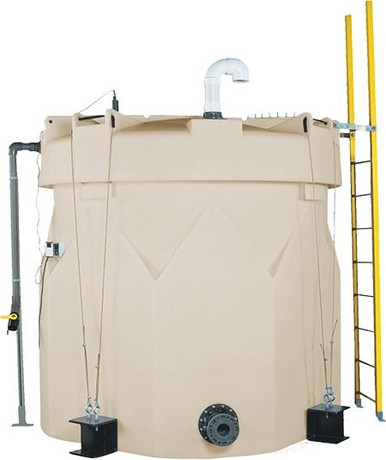
Featured: Snyder 10,000 Gallon XLPE Captor Double Wall Liquid Storage Tank — 1.9 SG — the workhorse XLPE double-wall configuration for sulfuric acid, sodium hypochlorite at low storage temperatures, and other 1.9-SG aggressive chemistries that require integral secondary containment.
1. Chemical processing applications — an overview
Chemical processing covers a broad span of operations: bulk acid and caustic storage at receiving terminals, day-tank and feed-tank service inside production buildings, dilution-and-makedown vessels for working-strength solutions, pH-control buffer tanks at wastewater pretreatment, polymer-emulsion initiator service, oxidizer storage for disinfection and bleaching, and secondary-containment dikes for outdoor bulk farms. Each application has a distinct duty cycle, temperature window, fill cadence, and regulatory exposure, and the right tank choice changes accordingly.
The pages below cover the spec discipline, the resin-versus-chemistry compatibility matrix, the federal and state regulatory framework, and the procurement reality of buying tanks in this segment. Whether the project is a 1,500-gallon sodium hydroxide day tank for a metal-finishing line or a 20,000-gallon ferric-chloride bulk tank at a municipal water plant, the same five-brand catalog and the same compatibility intelligence apply.
2. Why OneSource for chemical processing
Five OEM brands, one catalog. Norwesco, Snyder Industries, Chem-Tainer, Enduraplas, and Bushman cover the full domestic plastic-tank market for chemical service. We carry the chemical-rated lines from each — Snyder Captor double-wall, Norwesco vertical chemical, Chem-Tainer ProChem, Enduraplas chemical-storage cones, Bushman bulk verticals — rather than carrying half a catalog from one brand. The procurement engineer compares HDPE 1.5 SG versus XLPE 1.9 SG against the same chemistry on the same product page, instead of swapping between four supplier portals.
511 chemicals in our compatibility database. Every chemical pillar in our reference library is sourced from manufacturer technical bulletins (OxyChem, Olin, Univar, Hawkins, K.A. Steel, Brenntag) and cross-checked against the resin compatibility charts published by the tank OEMs. We do not fabricate ratings. Borderline cases defer to the manufacturer chart and are flagged in the compatibility matrix for that chemistry.
50-state regulatory depth. Every U.S. state has a dedicated regulatory pillar covering bulk chemical storage rules: secondary containment thresholds, registration triggers, spill-reporting cadence, and the relevant agency (state EPA, DEP, DEC, or environmental quality department). When the project sits in California, Texas, Florida, or any other state, the regulatory page for that jurisdiction is one click from this hub.
Custom fabrication when stock will not fit. Stock plastic tanks cover roughly 80% of chemical-processing duties. The remaining 20% — high-temperature service, exotic chemistries, atypical footprints, integrated jacketing — route to our specialty & metal fabrication network for FRP, polypropylene, dual-laminate, alloy, and lined-steel custom builds.
Pricing transparency. Every product page lists a current price before freight. LTL freight to the destination ZIP is quoted separately through the freight cost estimator or by phone at 866-418-1777. List prices on this site exclude freight; nothing on this catalog ships freight-included by default.
3. Tank solutions for chemical processing
The product strip below pulls live inventory from our chemical-storage catalog — double-wall Captor configurations, single-wall vertical chemical tanks across the 100-to-20,000-gallon range, and the specialty sodium-hypochlorite UV-stabilized variants for chlorinated-disinfection service. Cards refresh from the live BigCommerce catalog so the price, stock status, and image reflect the current state at page load.
Cannot find the right size, resin, or fitting layout? Use our chemical-to-tank recommender to filter by chemistry plus volume, or open a custom-fabrication request for non-stock geometries.
4. Chemical compatibility intelligence
Every chemistry stored in a polyethylene, FRP, or fluoropolymer tank has a compatibility envelope: temperature limit, concentration limit, and resin-specific behavior. The pillars below cover the eight chemistries that drive the largest share of chemical-processing tank purchases. Each pillar carries a full compatibility matrix (HDPE / XLPE / PP / PVDF / FRP vinyl ester / FRP isophthalic / 316L / 304 / carbon steel / titanium / EPDM / Viton / Buna-N), real-world use cases, OSHA / NFPA / DOT / EPA hazard communication, storage protocol, operator FAQs, and a field-operations addendum on dosing accuracy and supply chain.
- Sulfuric Acid (H2SO4)
- Sodium Hypochlorite (NaOCl)
- Hydrochloric Acid (HCl)
- Sodium Hydroxide (NaOH)
- Hydrogen Peroxide (H2O2)
- Ferric Chloride (FeCl3)
- Calcium Hypochlorite (Ca(OCl)2)
- Peracetic Acid (PAA)
The full chemical compatibility database indexes 500+ chemistries; the eight above represent the highest-volume chemical-processing inquiries we receive each month.
5. Regulatory considerations for chemical-processing tanks
Federal regulations governing bulk chemical storage in the United States rest on a small set of well-defined rules. The processor or specifier should treat each rule as a checklist item during tank selection rather than as background reading; the wrong tank in the wrong service can put a facility outside compliance from the day it is commissioned.
40 CFR 264.175 — RCRA secondary containment. Hazardous-waste container storage areas require secondary containment sized to hold 10% of the aggregate volume of containers or 100% of the volume of the largest container, whichever is greater. The dike must be impervious to the stored waste and free of cracks or gaps. Plastic double-wall tanks (Captor, Bushman bulk vertical with secondary, Chem-Tainer ProChem secondary) satisfy this rule when sited indoors or in covered areas; outdoor bulk tanks typically rest in a poured-concrete or steel-plate dike with a chemical-resistant liner.
40 CFR 112 — SPCC. The Spill Prevention, Control, and Countermeasure rule applies to facilities with aggregate above-ground oil storage of more than 1,320 gallons. Although SPCC is technically an oil rule, many state programs apply parallel containment requirements to chemical bulk storage. Required elements: a written SPCC plan, secondary containment for each container, integrity testing, and an annual visual inspection logged and signed.
29 CFR 1910.119 — PSM. The OSHA Process Safety Management standard applies to processes that handle highly hazardous chemicals above the threshold quantity listed in Appendix A. Tanks holding chlorine, hydrogen fluoride, oleum, and other PSM-listed substances above the threshold require a process hazard analysis, a written operating procedure, mechanical-integrity inspection, and management of change controls.
29 CFR 1910.120 — HAZWOPER. Anyone responding to a release of a hazardous substance from a chemical-processing tank must hold the appropriate level of HAZWOPER training (24-hour first responder operations level at minimum). The tank specifier should coordinate the response plan with the plant emergency-response team during commissioning.
NFPA 30 Flammable & Combustible Liquids Code. Bulk storage of Class IA, IB, IC, II, and III liquids is governed by NFPA 30. Polyethylene tanks are not approved for Class I flammable liquids; specifiers store flammable solvents in steel or FRP per NFPA 30 Chapter 21. Plastic tanks cover combustible (Class II / III) and non-flammable chemical service.
NFPA 400 Hazardous Materials Code. NFPA 400 consolidates the storage rules for oxidizers, organic peroxides, water-reactives, pyrophorics, and corrosives. Each hazard class has a maximum-allowable quantity per control area before sprinklers, hazard signage, and segregation distances apply. Bulk oxidizer storage above 4,000 lb (NFPA 430 Class 1) triggers a 0.30 gpm/ft2 sprinkler density over a 2,000 ft2 design area.
40 CFR 68 — EPA Risk Management Plan. Facilities holding regulated substances above the threshold quantity in Appendix A must register an RMP, perform a hazard assessment, and maintain a prevention program. Common chemical-processing chemistries that trigger RMP at typical bulk-storage volumes include anhydrous ammonia, chlorine, and hydrogen fluoride.
EPCRA Tier II reporting (40 CFR 370). Aggregate site quantities of any hazardous chemical above 10,000 lb (or 500 lb for extremely hazardous substances) trigger annual Tier II reporting to the State Emergency Response Commission, the Local Emergency Planning Committee, and the local fire department. Most chemical-processing facilities crossing the bulk-storage threshold file Tier II annually by March 1 for the prior calendar year.
State-level overlays sit on top of the federal rules; the relevant state regulatory pillar for the project location captures registration triggers, spill-reporting cadence, and any state-specific containment math. Those pillars are linked from our state regulations index.
6. Field handling and procurement
Resin selection by chemistry. HDPE (1.5 SG, linear polyethylene) handles the bulk of chemical service at ambient temperature: dilute acids (sulfuric below 70%, hydrochloric below 32%, nitric below 40%), most caustics, brines, and water-treatment polymers. XLPE (1.9 SG, cross-linked polyethylene) raises the engineering margin for aggressive chemistries (concentrated sulfuric, sodium hypochlorite, hydrogen peroxide) and adds resistance to environmental stress cracking. FRP vinyl ester (Derakane 411 / 441 series) takes the chemistries that polyolefins cannot hold — concentrated nitric, hot caustic above 150°F, oleum, certain aromatic solvents. Polypropylene (PP) overlaps HDPE with slightly better heat tolerance (up to 180°F continuous) and is the standard for fume-scrubber sumps. PVDF (Kynar) sits at the premium end for high-temperature dosing skids and fluorinated chemistries.
Single-wall versus double-wall. The decision driver is the chemistry hazard category and the local secondary-containment requirement. RCRA-regulated wastes, NFPA 400 corrosives above the maximum-allowable quantity per control area, and any tank sited in a sensitive environmental setting (well-head protection area, surface-water buffer, indoor production floor without a dike) call for an integral double-wall configuration such as the Snyder Captor line. Outdoor bulk farms with a properly sized concrete dike can run single-wall vertical tanks with no compliance issue, and the lower cost-per-gallon of single-wall storage often wins at the 6,000-to-20,000-gallon scale where dike construction costs amortize across multiple tanks.
Specific gravity selection. Tank wall thickness is engineered to a specific-gravity rating (1.0, 1.35, 1.5, 1.7, 1.9, 2.2 in the standard Snyder lineup; equivalents from Norwesco and Chem-Tainer). The rule is simple: the tank SG rating must equal or exceed the specific gravity of the stored chemistry. Sulfuric acid at 93% has SG 1.83 and requires a 1.9-rated tank; sodium hydroxide at 50% has SG 1.53 and requires 1.7 or 1.9; ferric chloride at 38% has SG 1.40 and runs in a 1.5-rated tank. Specifying under-rated SG voids the manufacturer warranty and accelerates wall fatigue.
Procurement cadence and pricing. Standard plastic chemical-storage tanks ship from manufacturer warehouses in two to six weeks depending on size, color, and fitting layout. Captor double-wall and other 8,000-gallon-plus configurations run six to twelve weeks. List prices on this site reflect the current OEM published pricing before LTL freight; freight to the destination ZIP is quoted separately through the freight estimator or by phone. Listed at $X is the convention used across this catalog — freight is never included in the list price by default. Volume discounts on multi-tank orders are coordinated through our quote desk.
Five-brand discipline. Norwesco, Snyder Industries, Chem-Tainer, Enduraplas, and Bushman cover the full chemical-processing tank market. We do not pad the catalog with off-brand imports or no-name secondary suppliers. The five-brand discipline keeps the spec conversation grounded in published technical-bulletin data rather than third-party reseller marketing copy.
7. Custom fabrication when stock does not fit
Specialty geometries, atypical chemistries, and high-temperature service route through our specialty & metal fabrication network. Typical custom builds: dual-laminate FRP (PVDF or polypropylene liner with FRP structural) for fluorinated chemistry above 150°F, jacketed polyethylene for temperature-controlled batch service, lined steel for high-temperature concentrated acid, integrated agitator-mount tanks for batch dissolvers, and bespoke footprints to fit retrofit projects inside an existing building shell. Lead times run six to sixteen weeks depending on complexity; the quote desk runs the spec dialogue with the fabricator and stays involved through commissioning.
8. Next steps
Quote the freight. Every product page lists a price before freight. Get the LTL freight quote to your ZIP through the freight cost estimator, or call 866-418-1777 for a phone quote with the SKU plus destination ZIP plus dock-or-residential delivery indication.
Match the chemistry to the resin. Use the chemical-to-tank recommender to filter by chemistry plus capacity plus configuration; the tool returns the ranked stock options with current pricing.
Open a custom request. If the spec falls outside the stock-tank envelope, the custom-fabrication request form routes the project to the right shop and the quote desk follows up the same business day. Include the chemistry, concentration, working temperature, capacity range, and any footprint constraints.